All support for Russia’s military action for the defeat of the Nazi government in Kiev, NATO/US/ European Union front man! By worker-controlled People’s Republics across Ukraine!
The left and the workers’ movement must fight for all nations to recognize the right to self-determination of people’s republics! For People’s Republics throughout Ukraine!
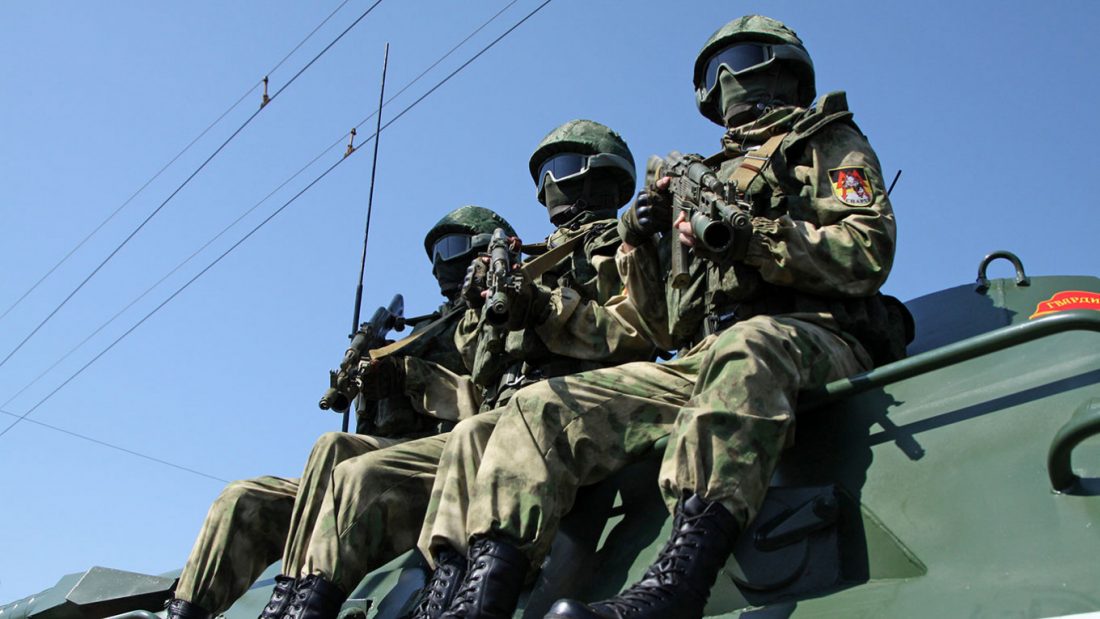
Putin has launched a war operation against the Kiev government. His aim is to demilitarize and denazify Ukraine. Zelensky ordered martial law in Ukraine. Ukrainian airspace was formally closed by the Kiev government, which, however, no longer controls it. The Russian army is carrying out a successful attack, impossible to defeat, with few civilian casualties. Russian Special Forces units advanced towards Kiev. Paratroopers descended on the capital. The Ukrainian navy was destroyed. Dozens of Ukrainian border guards fled to Russia. Several Ukrainian army units abandoned their positions.
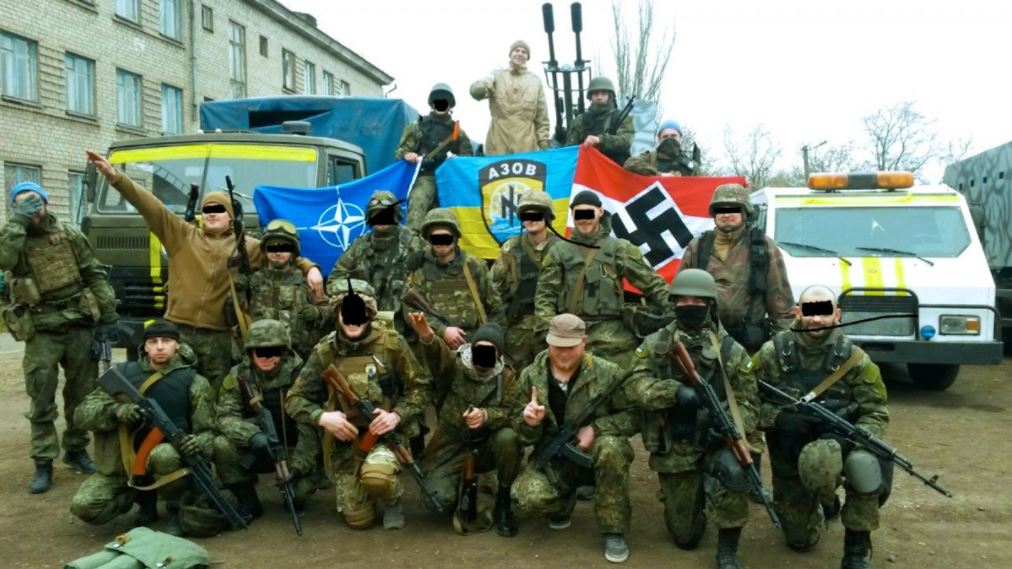
The military action was preceded by a selective hunt for Ukrainian Nazis. On February 23, the Russian Secret Service (FSB) averted an extremist attack on Crimea, prepared by “Right Sector” militants supervised from Kiev. Rumour has it that the head of the Nazi Azov battalion of the Ukrainian National Guard, known as the “White Leader”, Andriy Biletsky, has fled to Poland. Putin said he will bring justice to the Nazis who have barbarized the country in recent years and will find them wherever they are.
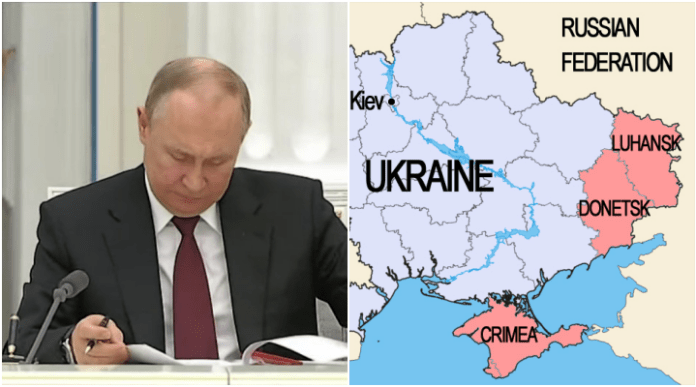
Putin was buffeted by the historic demand of the people’s republics of Donetsk and Lugansk to formally recognize their independence from the Kiev government, which he did on 22 February. Recognition of the republics by the Russian Federation was supported by the countries of the Collective Security Treaty Organization (CTO), Armenia, Belarus, Kazakhstan, Kyrgyzstan, Tajikistan, Venezuela, Cuba, Nicaragua, Syria and the Houthi government in Yemen. But important though this formal international recognition was, it could not stop there while Kiev’s bombing of the recognized republics continued. That would be a profound demoralization for Putin. Zelensky provoked the Russian military response. He has not been able to defend himself against Russia so far, and he has not had the military support he expected from his imperialist masters.
Imperialism
NATO Secretary General Jens Stoltenberg said “There are no NATO forces on the territory of Ukraine, nor are there any plans to send them there. We support Ukraine, but we provide firm security guarantees only to NATO allies. What we’re doing is defensive.” Stoltenberg noted that the deployment would include part of NATO’s 40,000-strong rapid reaction force, including a highly prepared unit of 7,000, mostly French, and an air wing under French command. NATO will meet on February 25th to activate a defence plan from its member countries.
The imperialist media that desperately create factoids to demonize the Russian special operation is the same one that for the last eight years supressed, or at least minimized, the Nazi atrocities against the oppressed peoples of Ukraine. All the imperialist war media outlets hid the attacks suffered by the Russian population throughout Ukraine. And now they censor information about the fact that in recent days, supported by the US and many imperialist countries, Kiev has increased attacks against the Donbass region, hitting schools and homes. The mainstream media hides the fact that these attacks were preceded by barbaric atrocities such as those committed against the Federation of Trade Unions of Odessa, the House of Trade Unions, on May 3, 2014, when 43 anti-Maidan people were tortured, executed by shooting, or burned alive while imprisoned in the Federation building that was set on fire by the “Right Sector”. Another 174 trade unionists and communists were injured. The leftist organizations, PCU and Borotba, suffered the most. Most of those who were burned at the Casa dos Unions were their members. None of these media outlets today want to remember the Mariupol massacre of May 9, 2014, when more than 100 people were shot by Nazi death squads, on the day of commemoration of the USSR’s victory over Hitler’s Nazism in 1945.
The pro-imperialist “neither-nor” world left
The majority of the world left, much of which constitute a petty bourgeois media layer, follow “critically” the orientation of the big bourgeois media, assuming there is a supposed ‘third camp’ in the war. They defend an ideal wall on which they climb so as not to directly assume the positions of imperialism, covering their shameful capitulation with a supposed policy against all capitalists. That left that imperialism likes says “neither Russia nor NATO, for Ukraine!”. This left calls itself Marxist, and justifies its pro-imperialist defeatism because Russia would be “imperialist” for “invading” Ukraine. But this position is opposed to that of Marxism. For Marxism, imperialism is the expansionist policy of finance capital, which demands economic domination over other nations. When Saddam Hussein invaded Kuwait in 1990 he did not turn Iraq into an imperialist country. Russia, despite its military and energy might inherited from the USSR and developed in recent years, is still a backward country, whose GDP is practically the size of Brazil after all the damage that the 2016 coup against Dilma Rousseff and then Bolsonaro did to the country. Putin may want to lead an imperialist power, but this status in the struggle between states does not depend on his will.
We also reject the imperialist version that it all started with “the Russian invasion of Ukraine”. War is a relationship. A dialectical relationship far beyond the relationship between Russia and Ukraine. First, it is a war provoked by the insatiable expansionism of finance capital towards Eastern Europe since the 1980s, an offensive that ended up playing two historically symbiotic nations one against the other, from the moment it sparked a Nazi insurrection in 2014. against the pro-Russian government. This also refers to the future of how imperialism will respond to Putin and how Putin will respond to imperialism’s response.
The appetites of imperialist finance capital have no limits. After the counter-revolutionary tragedy in the USSR and Eastern Europe, after 30 years of NATO expansion to the East, of cumulative economic sanctions to strangle Russia, in the last eight years they resorted to using neo-Nazis as front men in their expansionist march to the East. Of the 30 NATO members, 14 are former Eastern European workers states or directly former Balkanized USSR republics (Poland, Estonia, Lithuania, Romania, Slovenia, North Macedonia, Bulgaria, Montenegro, Albania, Hungary, Czech Republic, Slovakia , Latvia, …). With Ukraine joining NATO, no less than half of the countries in the Atlanticist alliance would be made up of countries captured from the enemy, from the old Warsaw pact.
For all these reasons, we believe that workers and oppressed minorities benefit from this anti-fascist and anti-imperialist action and therefore should support it. Just as they must reject all economic sanctions from imperialism to strangle Russia and even more we must reject any military reaction from NATO. And beyond that, the workers of the world must take advantage of Russian preventive-defensive military action against the expansion of NATO on its borders and we defend the full democratic right of the people’s republics of Lugansk, Donetsk, Kharkov and any other, of all national minorities for self-determination in relation to the Ukrainian central government, puppet of imperialism and xenophobic in relation to the other peoples of Ukraine, and the extension of this right to remain independent republics or unite with Russia, if they wish.
We advocate that the workers’ movement in each country fight for all countries to recognize the right to self-determination of people’s republics!
We advocate that this anti-Nazi, anti-imperialist and national liberation struggle becomes a socialist struggle for workers-controlled people’s republics throughout Ukraine!
The Liaison Committee of the Fourth International welcomes the recognition of the Independence of the Lugansk and Donetsk republics, within their original frontiers, by the Russian government of Vladimir Putin, following the vote in the Duma last week calling for such recognition. It appears that the Russian government is determined to defend these republics against attacks by the fascist-infested American neo-colonial regime in Kiev. Our tendency has been calling for such recognition since 2015: they should have been so recognised concurrently with Crimea, as the previous temporizing by Putin has emboldened the far-right coalition in Kiev to attack and partially roll back these republics, reducing their territories and subjecting much of the Russian-speaking population in the broader region of East Ukraine to terrorization by the fascist-dominated Ukrainian neocolony.
This is part of our defence of Russia, Belarus, and Kazakhstan against imperialism, and against the programme of ‘regime change’ that US imperialism is desperate to propagate against both Russia and China. The New Cold War, though it has major differences from the earlier conflict of imperialism against the USSR and the former Chinese workers state, also has important commonalities. After the collapse of the USSR in 1991 and the restoration of capitalism in China shortly afterwards, the United States expected a limitless future as the sole imperialist hegemon of a ‘unipolar’ capitalist world. But it has proved not so simple, as the capitalism restored in the great nations of both Russia and China has proven at odds with the imperialist system whose pressure destroyed the workers states. In a world dominated by imperialism, subject peoples are supposed to do as they are told, as indeed are subjected, defeated states that rule such peoples.
But Russia and China, in different ways, do not conform to the world that the imperialists want to dominate. Their still highly statified economies, marked and shaped by decades of economic planning, still give these states an unprecedented ability to act independently of the imperialists whose economic domination and pressure caused the collapse of the workers states. The contradictions of Chinese and Russian capitalism with imperialism are still residual achievements of each of the revolutions, despite their current bourgeois governments. A basic tenet of Trotsky’s program of Permanent Revolution was that genuine national independence could only be achieved by oppressed peoples overthrowing the bourgeoisie.
Despite the deformed character of those revolutions (degenerating post-1917, and 1949 from the start), both Russia and China benefited from this material fact of expropriating the bourgeoisie as a class. The proletarian dictatorships in these countries, with their various terrible deformations, solved pending bourgeois tasks, overcoming part of their semi-colonial characteristics, which did not happen in any large or populous semi-colony like India, Indonesia, Pakistan, Brazil, Mexico, Nigeria, Ethiopia or Egypt. None of these countries was able to carry out its pending bourgeois tasks or stop being semi-colonies. In turn, in Russia and China, countries concentrating an enormous mass of land, energy, technology and military power (Russia) and labour force (China), the restoration of capitalism did not and could not make a complete return to those backward and semi-colonial conditions of 1917 and 1949.
After a momentary low during the first period of the social counter-revolution in their status within the relationship between states, during the 1990s, the very contradictions of these countries’ economy with imperialism forced them to establish policies of resistance to imperialist parasitism that wanted to appropriate the larger share of the production of surplus value than the Chinese State and in Russia, the containment of the country’s military and energy capacity. Then Russia and China rebelled against assuming semi-colonial status. Paradoxically, the restored bourgeoisies of Russia and China are still benefiting from that and can thumb their noses at the United States, the world hegemon which is now in major decline. Despite the bourgeois nature of the regimes in both Russia and China, this contradiction in today’s capitalism has the potential to create revolutionary opportunities that can help the world proletariat to rearm itself for world socialism.
The defeat of US imperialism by Russia or China, or a combination of the two, would provide an opportunity for the working class to strike out independently for its own class interests. Just as in a slightly different way, the defeat of imperialism by a recalcitrant semi-colony would be a blow for the working class, the defeat of US imperialism by these rather stronger hybrid forms of capitalist regime would be an opportunity, not just to defeat imperialism, but potentially to roll back the counterrevolution that has robbed the proletariat of these countries of their own state power. The bourgeois regimes of these countries are in an insuperable contradiction, as part of the source of their ability to defend themselves against imperialism has its basis in the overthrown, but not transcended, social revolution. Therefore, Putin agonizes in a very visible way about the role of the Bolsheviks in creating the anomalous conditions in which his regime is forced to operate, whereas in China the hybrid state-capitalist regime dominated by a more numerous class of billionaires than in the USA (though nowhere near as wealthy) is forced to maintain the name of ‘Communist’ and pay lip service to ‘socialism’ as its objective.
The recognition of Lugansk and Donetsk has caused apoplexy among the imperialists whose antics over the last few weeks have been truly bizarre, repeatedly screaming that Putin was about to attack and occupy Ukraine, evacuating their nationals as if expecting carnage, ostantaneously moving their own diplomatic missions from Kiev, the capital, to Lvov on the far Western end of Ukraine, etc. They have been completely wrong-footed by Putin’s response and are getting more hysterical. In this hysterical yomp the German government, under pressure, has suspended the Nord Stream 2 pipeline agreement with Russia to supply Germany with natural gas. In this way, the economic sanctions, supposedly against Russia, will also fall on Germany, which will pay more for the energy that will be sold by the US. This is a capitulation to the US of a country that has been militarily occupied since 1945, a capitulation that give the appearance, at least, of a humiliating, vassal character of the German government, accentuated by the SPD’s very ‘Atlanticist’ social democracy. But this may not be sustainable, and when the dust settles seems unlikely to last.
Putin has not invaded and subjugated Ukraine and clearly has no interest in doing so, as he has not done in Georgia (2009), Kazakhstan (2022), or at the outside of Western fantasy, Syria (2016) despite this bizarre ‘invasion’ narrative that is even more threadbare than the lies used to justify the US/UK invasion of Iraq. If Russia does not allow the Donbass to be recolonized by the Kiev Nazis, it will be carrying out a progressive role as it did in Syria, preventing the country from being barbarized and recolonized as happened with Iraq and Libya. Biden, Johnson and co will be judged by history as not only liars, but stupid liars at that. The only objective of the current nationalist regime is to protect Russia, and to protect those that it regards as its own nationals, not to attempt to subjugate the (probably) rather brainwashed and nationalistic Ukrainian population, which would not be wise from the standpoint of the defence of Russia. And at this point the rational and effective defence of Russia coincides with the interest of the working class.
We, a group of comrades from Belarus, Kazakhstan, Ukraine, and Russia, appeal to you: we must prevent the war! No to the war that the Western imperialists are planning to unleash by playing off Russia and Ukraine against each other!
This fratricidal war is beneficial only to the tycoons of financial capital. In the contemporary world, capitalist predators understand that any war between nuclear powers is unpredictable in terms of consequences and presents a real threat of humankind’s destruction, using the piles of lethal weapons that have been accumulated over the years. Therefore, bloodsucking imperialists benefit from local conflicts in which an openly chauvinistic, terrorist dictatorship of financial capital itself, that is, fascism, can be used.
As the highest stage of capitalism, imperialism already once divided the whole world into zones of its influence. Note that countries don’t exist for financial capital, but regions of influence do. Capitalism in its development has approached a perilous state: it is now a decaying swamp that is poisoning the lives of the entire planet’s inhabitants. This rotting swamp is already taking people’s lives with its wars and devastation. Capital is incapable of resolving the sharp contradictions of the bourgeois society. Capital also means constant economic crises, and capitalism overcomes crises by starting military conflicts.
Who can halt the bloody agenda of financial capital? Only the working class and the progressive intelligentsia engaged in the proletarian struggle! The slogan “Proletarians of all countries, unite!” is more relevant today than ever. “Peace to the nations!” the Bolshevik revolutionaries once proclaimed.
So today, we appeal to all humankind: No to war, No to the imperialist plans of the USA and their vassals in Europe! Peace to Ukraine, Russia, Peace to all humankind!
We are against war, but in case of war we defend Donbass, Crimea and Russia against NATO and its allies.*
We urge everyone to repost or share this collective statement on your feed as a sign that you support it and/or consider yourself a signatory of this appeal to the world FOR PEACE.
If you would like to be added to the list of signatories please contact us via e-mail at in**@*******************nt.org
Signatories:
Iskra Group: Askar Aysin (Kazakhstan) Botagoz Datkhabaeva (Kazakhstan), Alexandr Naydenko (Russia) Anti imperialist front – Belarus MadaarSorkh – Iranian communist collective United International Anti-Imperialist Anti-Fascist Front Bulgarian Slavic movement Public organization “OPLOT Bulgaria” Laboratory of the Future (https://vk.com/flab20) Patriotic public association “Fatherland” (Belarus) Public Association “For Democracy, Social Progress and Justice” (Belarus) Consistent Democrats (Great Britain – LCFI) Liga Comunista (Brazil – LCFI) Tendencia Militante Bolchevique (Argentina – LCFI) Socialist Workers League (United States – LCFI)
* the sentence in bold was suggested as an addition by the LCFI groups. However, since several groups had already endosed the statement by that time, the organisers, while stating their agreement with it, considered it too complex to re-approach all the signatories with it for amendment, which is understanable. Therefore this is the proposal of the LCFI groups only.
(this is republished from the website of the Australian revolutionary organisation Class Concscious.)
Headlines recently went around the world describing how the Australian Government detained and then deported high profile anti-vaxxer and world number one tennis play Serbian Novak Djokovic. Djokovic had come to play in the Australian Open in Melbourne but refused to be vaccinated. Many around the world would have interpreted this as the continuation of strategies in Australia that had largely suppressed Covid19 resulting in a far lower death toll than Europe, the US and many other countries. However, looks can be deceiving. The deportation of Djokovic was in fact just a political manoeuvre to give cover to the abandonment of the policy of suppression and a switch to letting Covid19 rip through the working class.
Whilst its true that the Australian Government originally wanted to let Djokovic in to be a draw card in the Australian Tennis Open, which is a huge money spinner, once the public got wind that Djokovic was being given a bogus “exemption” public furore resulted. Not surprisingly after two years of health measures to restrict Covid19, the sight of an entitled multi-millionaire being allowed to thumb his nose at restrictions did not go down well.
Sensing a political opportunity, the far-right Federal Liberal Government moved into action and turned deporting Djokovic into an example of it taking strong “border protection” action to protect public health. “Djokovic’s visa has been cancelled. Rules are rules, especially when it comes to our borders. No one is above these rules,”, pontificated Prime Minister Morrison from his Twitter pulpit. The Liberal Party in Australia has branded itself the party of “border control” for over twenty years boasting of its murderous and cruel policy of turning back refugee boats at sea and imprisoning indefinitely any poor souls who made it by boat to Australia seeking asylum.
The sheer cynicism of this posturing was breathtaking. Whilst the press was tirelessly covered the deportation procedures against Djokovic, a massive Omicron wave was being deliberately unleashed on the Australian working class. Despite knowing that Omicron was so much more transmissible than Delta, all state and Federal Governments (except West Australia) removed nearly all public health measures to suppress Covid19. Quarantine at the international border and between states was removed. This was possibly the most important policy in addition to Test, Trace, Isolate and Quarantine (TTIQ) that had kept large parts of Australia virtually Covid19 free for almost two years were removed. Limits on nearly all retail, hospitality and public events were lifted.
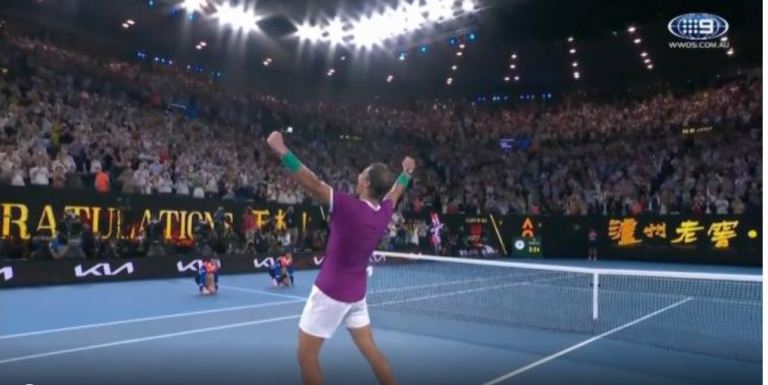
Some of thousands of tennis fans crammed into the arena during the mens’ final.
The sad irony was that the focus on the supposed threat to public health posed by one unvaccinated player at the Australian Open disguised the fact that the entire event was super spreader. Tens of thousands attended the event no doubt playing a role in spreading the virus. Unlike in March 2020 when on health advice the Melbourne Formula One Grand Prix was cancelled at the start of the pandemic, nothing was going to stop the tennis going ahead. The Labor Party in Australia is the social democratic party that rests upon the support of the trade union bureaucracies. The Labor Premier of Victoria, Dan Andrews, had dropped his earlier commitments to public health and adopted the Boris Johnson “let the bodies pile high” mentality. Letting Covid19 rip is truly a bipartisan project in the Australian capitalist class.
The result of letting Covid19 rip over the busy Christmas/New Years period were as tragic as there were predictable. Up to 1 in 12 Australian’s caught Covid within a few weeks. The supply chain was threatened as workers sickened or were in isolation. This problem was of course “solved “ by the weakening of isolation rules. Testing was quickly overwhelmed. This was “solved” by restricting who could get tested. Fifteen hundred people died in January 2022 alone which at that rate made Covid19 the largest single cause of death in the country. Hundreds died miserable deaths in Aged Care facilities. Like elsewhere it is the vulnerable who pay the highest price for letting Covid19 rip.
Like in Europe and the US, there was endless bourgeois propaganda that this was the new “normal” and Australian’s simply had to accept that suppressing Covid19 was impossible. Of course the fact that large sectors of the country had been free of Covid19 for most of the last two years had to be conveniently “forgotten”. It does without saying that the continuing success of China must be alternatively ignored or demonised as “Communist tyranny” at work.
The Covid19 pandemic is causing deep ructions in Australian politics. Public support for the Federal Liberal Government has collapsed just months out from an election. This is fuelling yet another round of conjecture that an Australian Prime Minister might be rolled before the election. There has not been an Australian Prime Minister that has served a full term of three years since 2007, reflecting the conflicts within the ruling class since the outbreak of the GFC.
Like elsewhere around the world, the Covid19 restrictions and the impact they have had an ordinary people has been used to whip up an extra-parliamentary anti-science, anti-public health far right or fascist movement. This has seen trade union offices attacked in Melbourne, “freedom” marches of tens of thousands and most recently a large gathering in Parliament.
The confused rallies have been funded and exploited by far-right billionaires like the coal magnate Clive Palmer. It is part of a project to not only defeat public health measures against Covid19 but to create a far right “anti-establishment” movement along the lines of MAGA in the US. Such a movement can help ensure far right parties, both fringe parties and the Liberal Party control of Parliament at the cost of their social democratic rivals. However, the ultimate target of this movement is the working class as both the drive to war and the class struggle more generally intensifies. As in other countries of course the movement has also been used by explicitly fascist forces to recruit from the disorientated petty-bourgeois and lumpen proletariat layers attending. Trump flags and Q Anon imagery has been common at the rallies.
No mass workers or socialist parties exist in Australia; therefore the Left has not been able to intervene significantly in the politics of the pandemic as yet. The Labor Party at a national level has faithfully towed the line of the Federal Government for two years. The state based leaders, despite some earlier resistance, have all fullen into line with the let it rip agenda. The Trade Unions bureaucrats have carried out a historic betrayal in not fighting for either safe workplaces or the suppression of the virus more broadly. The few squeaks now heard from the likes of Australian Council of Trades Union (ACTU) Secretary now being made are a last-ditch effort to try and herd popular discontent behind the reelection of the Labor Party and not into industrial struggles.
The small Trotskyist parties have also struggled politically. Some such as the Cliffite Solidarity party followed the dangerous trend of trying to “win over” the disaffected “freedom” protestors by trying to give a left gloss to anti-public health demands. The Australian section of the ICFI has published many useful articles on the pandemic in Australia but are of course ham strung by their own sectarianism and ultra-leftist “rank and file committee” strategy. Socialist Alternative another Cliffite/IST grouping which is perhaps the largest of the small Trotskyist group in Australia, did mount a “Health Before Profits” Campaign in support of the maintenance of public health measures. This was a campaign I participated in. However, the campaign has failed to become more than an online propaganda campaign. The campaign is also crippled politically as it has not taken a consistent and strong line working to expose the trade union bureaucrats’ betrayals.
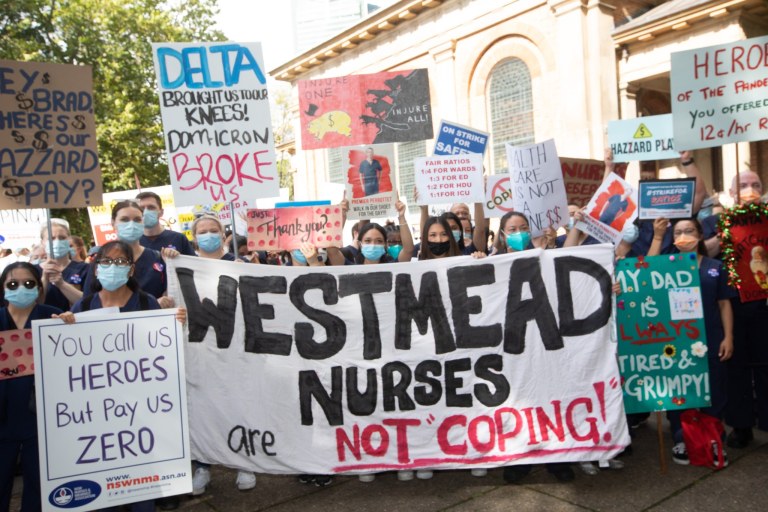
There are signs that the dam on working class resistance may be cracking. A very significant strike has broken out amongst New South Wales Nursers and Midwifes. They struck on February 15th for the first time in a decade, demanding higher pay and better staffing nurse to patient ratios. Health care workers in Australia have of course been pushed to the brink by the ongoing onslaught of Covid19 patients straining an already underfunded public health system. Most significantly perhaps the strike in NSW was carried out in defiance of a last-minute injunction from the Industrial Relations Commission to stop it. Australia has some of the most draconian anti-strike legislation in the world and any real struggle by workers with have to be done by breaking free of the shackles of the Industrial Relations Commission and the misnamed Fair Work Commission.
Nurses protesting in Sydney (From NSW Nurses and Midwives Facebook page)
The decision by the Australian ruling class to switch to a “let it rip” policy is a crossing of the Rubicon moment in the class struggle. Intersecting with other factors such as the ecological crisis which saw so much of Australia recently burn, the deepening economic crisis and of course the drive to war with China and Russia, it will continue to push the working class into struggle and the ruling class further towards authoritarianism.
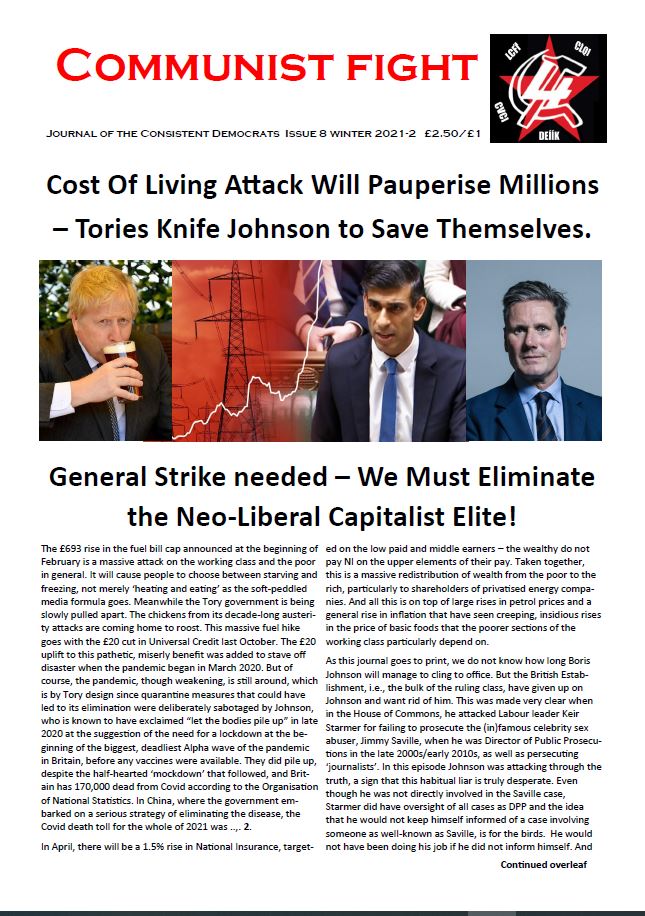
Communist Fight issue 8 is out now, in hard copy format. It features an extensive analysis centring on the huge ‘cost of living’ crisis which is the biggest attack on the working class since the early Thatcher years, and the need to fight it by the left getting organised politically and preparing to lead struggles. It analyses the decay of the right-wing populist Johnson government, and how the ruling class have turned against it as its brutal and corrupt nature has become clear to large sections of the population. It analyses why it was ever promoted by the ruling class in the first place, Johnson being an instrument of a kind of soft coup against Jeremy Corbyn’s reformist Labour. It notes that now Corbyn has been ousted from Labour, and Starmer has massively weakened the left within Labour, he has gained ruling class support as the replacement for Johnson. Which explains the almost unanimous attack on Johnson for raising Starmer’s complicity in the Jimmy Saville scandal and the persecution of Julian Assange when he was the Director of Public Prosecutions under both New Labour and Tory governments.
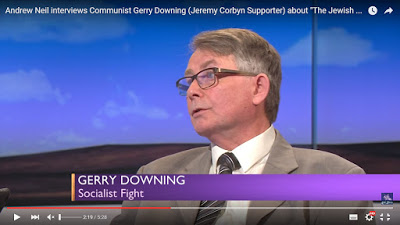
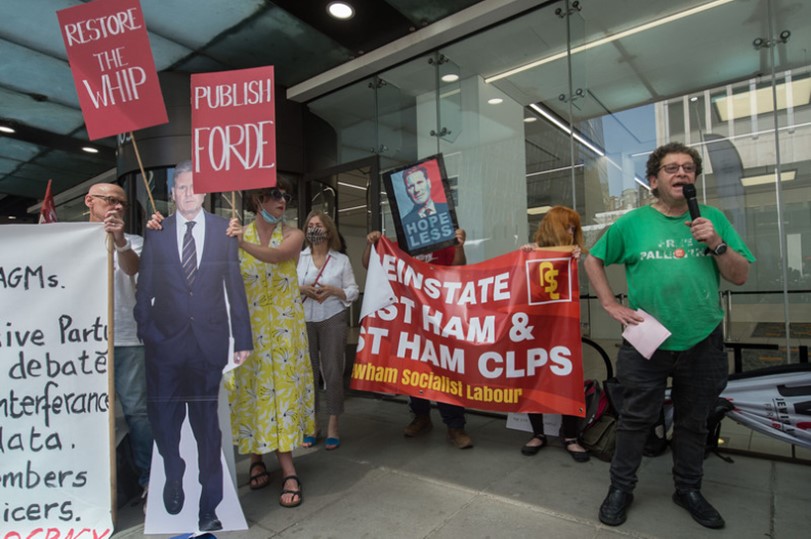
It also includes an analysis of the creation of the Socialist Labour Network (SLN) though the merger of Labour Against the Witchhunt (LAW) and the Labour in Exile Network (LIEN) which was completed in January. This includes and analysis of why LAW was not run as a genuine United Front of all leftists in the Labour Party against the witchhunt but engaged in its own mini-witchhunts against leftists like Socialist Fight and Peter Gregson – who founded Labour Against Zionist Islamophobic Racism (LAZIR) – that these leftists deemed ‘anti-Semitic’ – that is, more consistent in their attack on Zionist racism than the then-dominant forces in LAW. The article also analyses the strategy put forward by LIEN’s Roger Silverman of forming ‘shadow CLPs’, that is, local organisation of Labour activists and expellees outside the bureaucratic structures dominated by neoliberals, part of a ‘slow-motion split that is taking place in Labour. We also include a letter that was published in the Weekly Worker that nails the absurd justification for the CPGB’s petulant walk out of LAW when they lost the vote on unification with LIEN.
The issue contains an analysis by a sympathetic comrade, Anna Brogan of the refugee crisis, not only in Britain but also in Europe, and what is behind the refugees flows that racists and xenophobes are trying to exploit.
We publish also a statement agreed by the LCFI with other revolutionary-minded organisations and individuals, including Marxist groups in Australia, Greece and South Korea, on Kazakhstan, which analyses the recent upheaval that was prompted initially by workers protests against the removal of fuel price subsidies. We consider that the workers protests, which were peaceful, were used as a pretext by elements in the old Nazarbayev regime, which came to power closely aligned with the neoliberal Russian president Yeltsin at the time of the destruction of the USSR, to attack the government of the new president Tokayev, which is closely aligned with Putin. This statement produced some discussion in our own ranks, and we hope to publish more about this subject in due course.
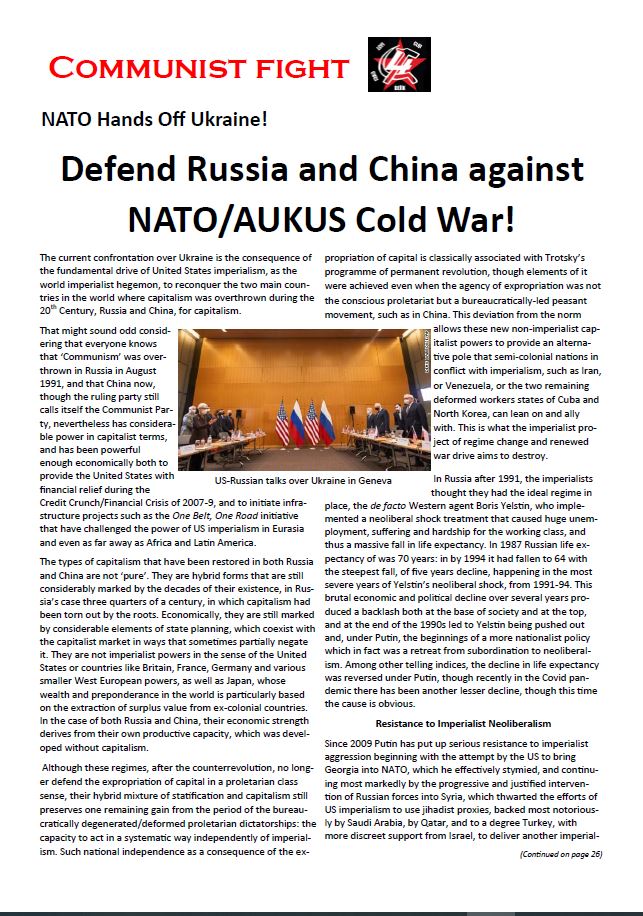
We also, relatedly, publish a more extensive analysis of the dialectic of the new Cold War that is underway between the US on the one side, and Russia and China, by our Latin American comrades. This is also enhanced by the back page LCFI statement on the war provocations by the US against Russia over Ukraine, obviously aimed at goading Russia into war by threatening it with NATO expansion into Ukraine. This statement contains a theoretical enhancement of our position on defending Russia and China, noting that despite the end of central planning and the bureaucratised proletarian dictatorships that existed in those states prior to the 1990s, the capacity of these states to act independently of imperialism is a residual gain from their long period as workers states, and is the real reason they are still targeted by imperialism for war drives.
We also have two articles on the Americas: firstly, an article by our comrades in the US about Honduras, and the victory of the leftist candidate Xiomara Castro in the recent election there, together with the steps that the US and its clients in Honduras have been up to in trying to undermine the victory of Castro, who is the wife of Manuel Zelaya. The second is about the potential for fascism in the US, and the fascist-like development of the US Republicans as they consolidate around Trump and further propagate the myth that Trump was in some way cheated out of the Presidency in 2020, when he lost the popular vote for the second time, by 7 million. The article notes that both major parties in the US are now cross-class blocs, with the Democrats keeping hold of the traditional pro-capitalist labour movement as well as the passive support currently of many black and anti-racist/civil rights activists, while Trump’s base in the rust belt working class is driven by resentment at the loss by workers of what was, and was felt to be, a privileged status. The article analyses the convulsive decline of labour aristocratic sentiment that has bred national-populist resentment in the US in support of Trump, and in Britain with Brexit, as parallel phenomena.
This 28-page edition contains substantial material on the international and domestic class struggle, and we urge socialists and those sympathetic to revolutionary politics to take out a subscription, which costs £17 per year for 4 issues. See our Communist Fight page for details.
General Strike needed – We Must Eliminate the Neo-Liberal Capitalist Elite!
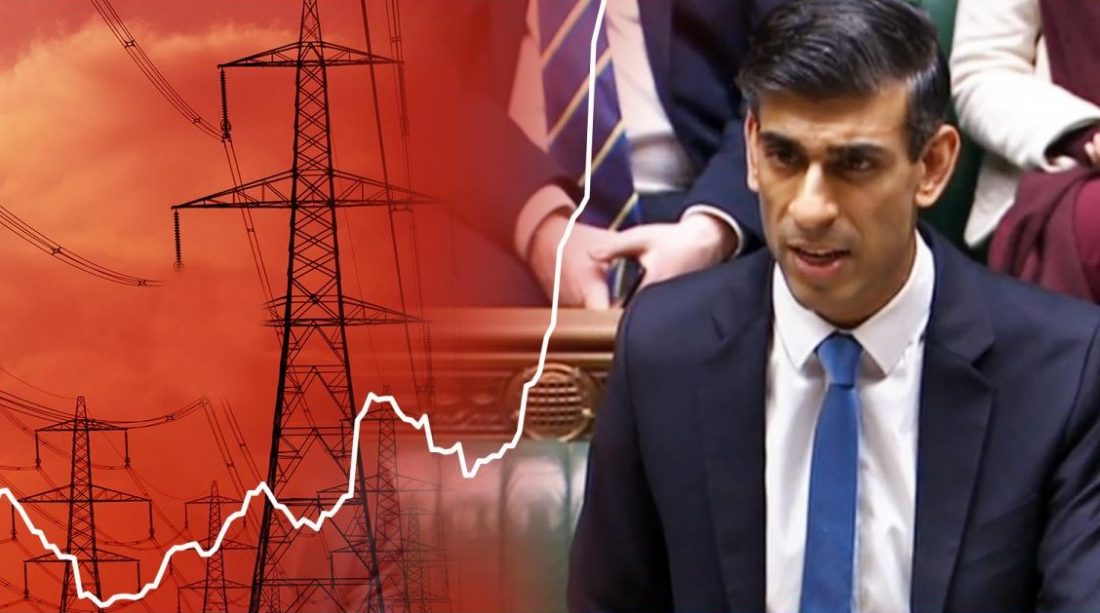
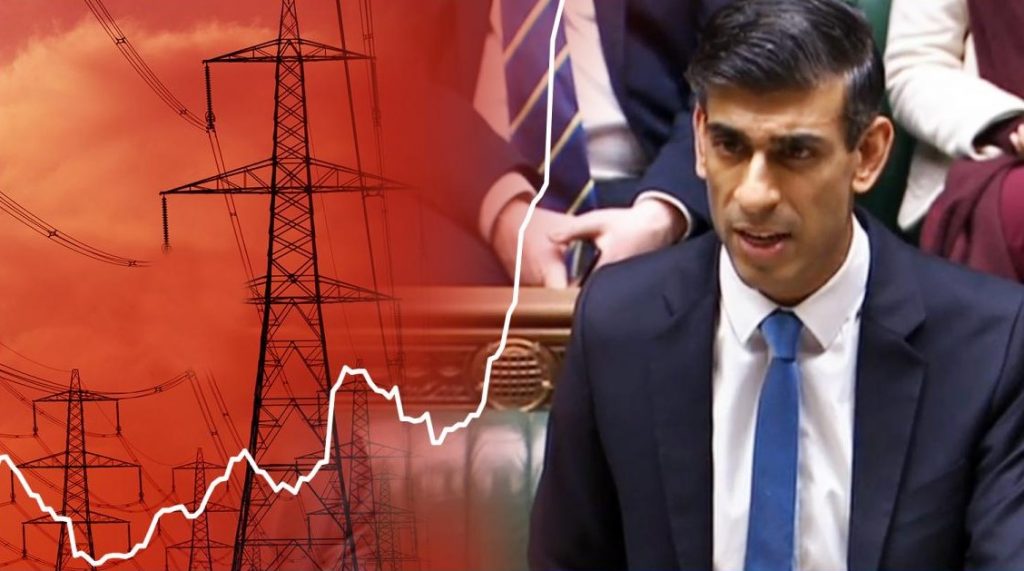
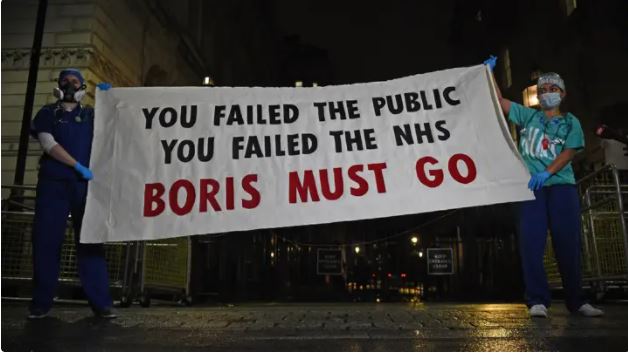
The £693 rise in the fuel bill cap announced at the beginning of February is a massive attack on the working class and the poor in general. It will cause people to choose between starving and freezing, not merely ‘heating and eating’ as the soft-peddled media formula goes. Meanwhile the Tory government is being slowly pulled apart. The chickens from its decade-long austerity attacks are coming home to roost. This massive fuel hike goes with the £20 cut in Universal Credit last October. The £20 uplift to this pathetic, miserly benefit was added to stave off disaster when the pandemic began in March 2020. But of course, the pandemic, though weakening, is still around, which is by Tory design since quarantine measures that could have led to its elimination were deliberately sabotaged by Johnson, who is known to have exclaimed “let the bodies pile up” in late 2020 at the suggestion of the need for a lockdown at the beginning of the biggest, deadliest Alpha wave of the pandemic in Britain, before any vaccines were available. They did pile up, despite the half-hearted ‘mockdown’ that followed, and Britain has 170,000 dead from Covid according to the Organisation of National Statistics. In China, where the government embarked on a serious strategy of eliminating the disease, the Covid death toll for the whole of 2021 was ..,. 2.
In April, there will be a 1.5% rise in National Insurance, targeted on the low paid and middle earners – the wealthy do not pay NI on the upper elements of their pay. Taken together, this is a massive redistribution of wealth from the poor to the rich, particularly to shareholders of privatised energy companies. And all this is on top of large rises in petrol prices and a general rise in inflation that have seen creeping, insidious rises in the price of basic foods that the poorer sections of the working class particularly depend on.
As this journal goes to print, we do not know how long Boris Johnson will manage to cling to office. But the British Establishment, i.e., the bulk of the ruling class, have given up on Johnson and want rid of him. This was made very clear when in the House of Commons, he attacked Labour leader Keir Starmer for failing to prosecute the (in)famous celebrity sex abuser, Jimmy Saville, when he was Director of Public Prosecutions in the late 2000s/early 2010s, as well as persecuting ‘journalists’. In this episode Johnson was attacking through the truth, a sign that this habitual liar is truly desperate. Even though he was not directly involved in the Saville case, Starmer did have oversight of all cases as DPP and the idea that he would not keep himself informed of a case involving someone as well-known as Saville, is for the birds. He would not have been doing his job if he did not inform himself. And the reference to ‘journalists’ clearly means Julian Assange: Starmer was centrally involved in pressuring Sweden not to drop the fake sex abuse case against Assange, laying the basis for extradition to the US on the real, political charges against him. What Johnson said about Starmer was true and yet the entire establishment accused him of lying, including his top aide Munira Mirza who knows what side her bread is buttered. Starmer is being groomed by the ruling class to lead a successor government to this, as it is obvious that when Johnson is finally forced out his Tory successor will have no mandate and will have to call an election quite soon.
Johnson’s government is the most calamitous in recent British history. And there have been some pretty calamitous governments in recent British history, from Blair who with Bush plunged the Middle East into bloody chaos through invading Iraq, and with the same US imperialists carried on blindly with deregulation of capitalism stoking up a capitalist boom based on fraudulent financial instruments that came close to destroying the capitalist financial system when the fraud was exposed in the 2007-9 Financial Crisis/Credit Crunch. The financial system was bailed out by taking money from the poor.
New Labour’s Gordon Brown made a start on this but was predictably crucified electorally in 2010, after his chancellor Alistair Darling let it be known that were New Labour to retain power in the 2010 General Election, it would enforce austerity that would be “more brutal than Thatcher”. This simply legitimised Tory attacks and unsurprisingly Brown was succeeded by a coalition of Tories and Liberal Democrats under Cameron and Clegg who massively lied to blame the financial crisis on the sick, the disabled and benefit claimants. This involved a cult-like denial of reality by part of the population who had seen the banks collapse and yet denied it was a capitalist crisis. Blaming the poor became an article of faith for Tories, LibDems and New Labour alike.
These benefit cuts and all-sided war against the poor were an exercise in premeditated mass murder, and caused the deaths of over 150,000 people, as intended by Cameron, Clegg, Duncan Smith, and the other vermin. Lives destroyed to extract a bit more profit to shore up the capitalist system that craves profit like a vampire craves blood. There was much more.
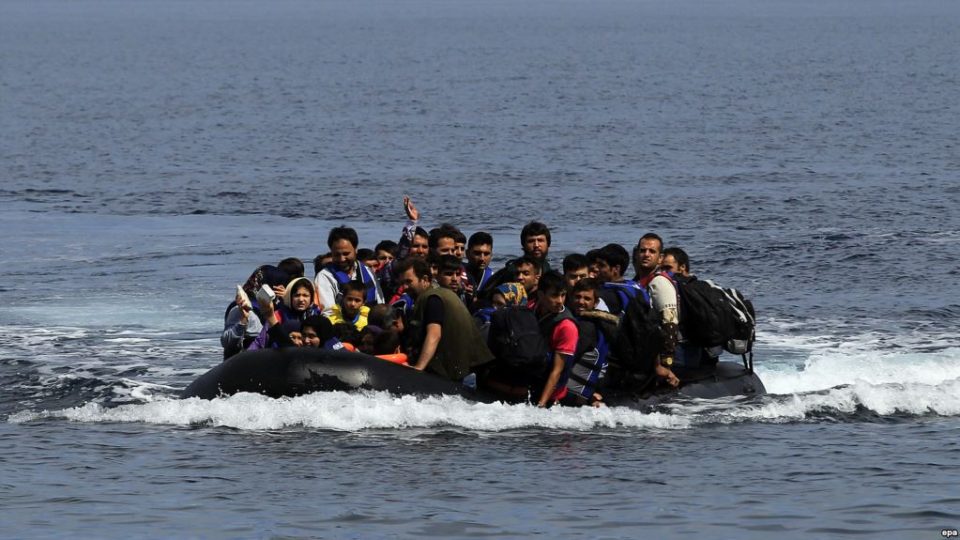
There was the hate campaign against migrants that escalated to Nazi-like racial persecution against African Caribbeans in the Windrush scandal. Again, often elderly African Caribbeans who had lived in Britain since the 1950s in some cases were deported away from families and social support, and health care, and to their deaths. As was intended by Theresa May and her successors, including the garbage in the current Tory regime from Patel to Johnson who are virtually openly seeking the deaths of refugees, and seeking to enlist the Navy in ‘pushbacks’ aimed at killing at least some of them and terrorising others. The anti-migrant hate campaign had its epitome in the Brexit referendum, where rage against the decline of living standards was channeled by the corrupt, billionaire media in a crusade against ‘foreigners’ as the cause of all our problems.
However, the brutal and surreal nature of this regime produced a popular backlash which was directed into Labour, and resulted in the victory of Corbyn, winning the Labour Party leadership in September 2015 after the collapse of the Lib Dem vote resulted in a Tory majority government the previous May, which proved short-lived. After Cameron was unseated by his failure in the Brexit referendum in 2016, and replaced by Theresa May, the Tory majority was taken away by a surge of working-class support for Corbyn’s reformist programme in the 2017 election, which came close to victory. A key ruling class priority project after Corbyn’s ascent, and particular after 2017, was ousting Corbyn and destroying the left in the Labour Party, which is being carried out with gusto by the ruling class agent Starmer.
Then there is the pandemic. The many years of austerity have also involved a huge attack on the NHS, its run-down and in many places semi-privatisation to slake the thirst for profit of a dying system through cuts in corporate taxes. This undermined and massively underfunded the NHS, and provided the background, but the huge death toll in Britain is deliberate killing by Johnson’s regime. The smoking gun was Johnson’s bizarre speech on 2 Feb 2020 in Greenwich just as the pandemic was beginning:
“…in that context, we were starting to hear some bizarre, autarchic rhetoric, when barriers are going up, and when there is a risk that new diseases like Coronavirus will trigger a panic and a desire for market segregation, that go beyond what is medically rational, to the point of doing real and unnecessary economic damage, then at that moment, humanity needs some government somewhere, that is willing at least to make the case, powerfully, for freedom of exchange.”
“Some country ready to take off its Clark Kent spectacles, and leap into the phone booth and emerge with its cloak flowing as the supercharged champion of the right of populations, of the Earth, to buy and sell freely among each other. Here in Greenwich in the first week of February 2020, I can tell you with all humility, that the UK is ready for that role.”
What is the significance of the grotesque spectacle of Boris Johnson, the partying that evidently went on repeatedly throughout the pandemic, and the Sue Grey report? These events went on behind closed doors in government buildings in which Tory politicians and some of the officials who served them, partied through the night. Ordinary people who broke the rules were often fined £10,000 or more. But Johnson’s cronies who made the rules, and then sabotaged the lockdowns so they did not deal with the problem, in secret, broke them with impunity.
They partied through lockdowns in which working-class and middle-class people alike sought to protect themselves against an insidious, often crippling and deadly disease that killed the infirm and those with disabilities and long-term conditions despite which, with modern medical care and a decent public health system, they could be expected to survive for often decades longer. Each of these events risked their lives through spreading the disease. As well the disease struck down sporadically and unpredictably a minority of the physically fit, even some who were fanatical about exercise and had no obvious major health issues, reduced to gasping for breath as the viral pneumonia that Covid at its worst is, blocked the flow of oxygen. Those to whom the oxygen flow could not be restored, again for reasons that were often accidental, suffered tragic deaths that left their loved ones bereft.
Covid-19 is a coronavirus, one of a family of viruses whose ‘corona’ or spike protein makes it a relative of other viruses that already occur in humans, and form part of the pathogens that cause the common cold. Yet this relative, with its own distinctive and novel features, crossed a species barrier and evolved rapidly into something atypical of coronaviruses that attacked the lower respiratory system. A very infectious viral pneumonia was the result, that spread around the world.
There is no doubt that it is a natural disaster, despite all kinds of esoteric conspiracy theories being propagated particularly by right-wing populists and fascists, who have an interest in promoting anti-scientific obscurantism to advance their programme of attacking all manner of social progress and gains for the oppressed.
In this period of capitalist decline and a desperate search for sources of profit to prop up the capitalist system itself, extremist neoliberal trends arise within the bourgeoisie that see such a pandemic as a blessing to the capitalist system. A disease that kills mainly those with health problems that cost money to treat can be seen as a money-saving device that, if enough such people die, could provide a boost to capitalism so that social expenses that would have been spent treating such conditions can cut business taxes, raising the rate of profit. Johnson’s ‘superhero of capitalism’ speech in Greenwich is a prime specimen of such inhuman neoliberal extremism, that belongs alongside the demented ravings of Trump and Bolsonaro, who are also mass killers of their own people, to benefit parasitic capitalist oligarchies.
Johnson and his cohorts evidently believe themselves to be superhuman. But this is a curious kind of megalomania because they are constrained to hide it, to cover it up. The parties took place in secret and were a closely guarded secret for most of the pandemic. In the United States, and in Brazil, where such populist neoliberal extremists came to power, they were brazen in their virulent contempt for the huge numbers at risk from Covid-19. Yet in Britain it was hidden, there were the lockdowns (or later mockdowns) and also Johnson spent a lot of effort promoting vaccination once vaccines became available. For a while in early 2021 Britain was the leading country in terms of vaccinating its population which Johnson saw as a way to recover popular support. This duality was fundamentally because of fear of the working class in Britain, which is still suffused with social-democratic, partial class-consciousness despite Blairism having been imposed on it, and which the ruling class knew would not tolerate an openly propagated programme of mass death in the Trump/Bolsonaro mould.
‘Partygate’ only came out into public view after in early November 2021 Johnson was politically wounded by the exposure of an unrelated piece of grotesque corruption: the attempt to change the rules by which parliamentary misconduct is punished to overrule findings by the Commons Standards Committee of breaking lobbying rules (which forbid paid lobbying of ministers and regulators), for payment of over £100,000 against Owen Paterson, a former minister (in David Cameron’s government) and Johnson cohort. Paterson was suspended from the House of Commons for 30 days by the Commissioner, but Johnson and Rees-Mogg spearheaded a campaign to overturn that and change the rules so that their cronies could pretty much be exonerated at whim.
Instrument of a ‘Soft’ Coup
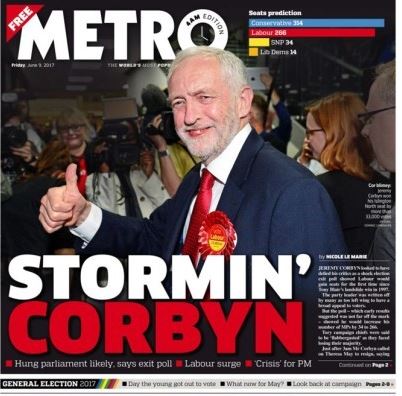
The spectacular backfiring of this blatant corruption broke Johnson’s “Teflon” shield that appeared to have given him the power to lie with impunity to the public shamelessly and repeatedly, for more than two years. This was in fact a degree of license granted to Johnson by the ruling class as the most effective weapon they had to defeat a real, if modest, challenge to the hegemony of their preferred politics – neoliberalism – from the Labour leadership of Jeremy Corbyn. And more importantly than Corbyn himself, the millions of voters who supported Corbyn as evidenced in the General Election of 2017, when Corbyn’s ‘surge’ among the voters deprived Theresa May of her majority and came close to making Labour the largest party by a number of metrics, despite an organised campaign of sabotage of Labour’s General Election campaign by the same right-wing members of the Parliamentary Labour Party that tried to oust Corbyn in the ‘Chicken Coup’ a year earlier.
Johnson was the man chosen by circumstance to carry out a ruling-class coup against the Corbyn Labour leadership. This was brought to fruition in the 2019 General Election, when Labour suffered a major election defeat and the Tories won by an apparent landslide. This was despite Johnson repeatedly running away from media scrutiny in the election campaign, and even hiding in a fridge on one notorious occasion. The accepted wisdom is that Johnson’s slogan “Get Brexit Done” and his claim to have an “oven-ready deal” appealed above all to the working class who were supposedly ‘outraged’ at the ‘undemocratic’ people in the Labour Party and others who wanted the public to have an informed vote on Brexit once what it would involve was widely understood, which was certainly not true in 2016.
Apparently, the population were so outraged at dissent at a vote that was won by the narrowest of margins, that the working class all queued up in their droves to vote for Johnson despite his well-known reputation as a pathological liar. This is garbage. The most class-conscious working-class conurbations voted remain. Liverpool, the most class-conscious working-class city in England, voted remain. Scotland voted remain. The huge working-class population in London, borough by borough, voted remain. Only mainly Tory areas on the fringes of London, and one very run-down more working-class borough, Barking and Dagenham, whose car industry was previously destroyed, voted leave. The North of Ireland, whose nationalist working class is still suffused with anti-imperialist sentiment, voted remain with some liberal unionists going along with this and outvoting the loyalists because they (no doubt) benefitted from cross-border trade. In England, of the major cities only Birmingham narrowly voted leave. Wales voted leave, but those areas with the least English population – the Welsh-speaking areas, voted remain. In the nationalist terms employed by Brexit, it was mainly English ‘invaders’ of Wales who voted for Brexit. This was an English nationalist project that mainly won out in the Tory shires and those working-class areas that had been the most deindustrialized, the most hammered by neoliberalism.
Which are the easiest to manipulate, as class organisation in such places is at its weakest and social and political demoralisation at its height. This appears to be what happened in an attenuated way in 2019 also. A great many of the Labour seats that went Tory in 2019 were by small margins, which is why so many of these Tory MPs are so nervous now that Johnson’s criminality has been exposed. What was also remarked upon at the time of the 2019 election was the large size of the postal vote, administered by a private company led by the Tory right-winger Peter Lilley, and the fact that on several occasions leading personalities in and associated with the Tory party, such as Dominic Raab and the notorious Tory BBC Political Editor, Laura Kuenssberg, boasted of knowing electoral results from the postal vote before it was even legal to count these votes.
This came on top of the clear statements from ruling class spokespeople, from Theresa May to Trump’s US Secretary of State, Mike Pompeo, to military officers and ideologues such as Richard Dannat, that a Corbyn victory could not be tolerated. The Labour right also played a major role, with Blair making clear he was opposed to a left-wing party winning an election, Mandelson boasting that every day he did something to undermine Jeremy Corbyn, and Starmer’s aggressive promotion of the Second Referendum on Brexit – which did antagonise some Brexit-voting working-class layers – was revealed to be a cynical ploy when he subsequently supported Johnson’s Brexit deal and repudiated any campaign to reverse Brexit.
Ruling class shock at ‘Corbyn Surge’ in 2017 General Election
All these forces, from parliamentary wings of neoliberalism working together against Corbyn across party lines, extra-parliamentary and openly anti-democratic, and the whiff of manipulation and fraud within the election itself, were manifestations of the ruling class project of crushing Corbynism, which may well have been the last hurrah of Labour as a working-class party. It was an attenuated form of right-wing coup, which Johnson’s most strident ministers, such as Patel, are straining at the leash to take further with their attacks on democratic rights to protest in the Policing and Crime Bill, the attempt to abolish the right of Asylum, to rig future elections through photo ID requirements that exclude the poor, and other provocations. Now the ruling class has seen the back of Corbyn and the threat of a revived movement for social-democratic reformism, Johnson has outlived his usefulness, and we get passages like this appearing in the media, from Dominic Cummings, who was formerly Johnson’s co-conspirator, now acting as his political assassin:
“People also underestimate the extent to which he [Johnson] lies to literally everybody literally all day – including to Carrie and about Carrie.
“‘Lies’ isn’t even a useful word with him – he lives inside a fog of invention and ‘believes’ whatever he has to in the moment. E.g He both knows he’s lying about the parties AND thinks he did nothing wrong. This doesn’t make ‘sense’ unless you’ve watched him carefully or similar sociopaths.”
Of course, this was true all along; the Tory media knew it, the liberal media who joined in the hate campaign against Corbyn (that they knew full well could only bring about the victory of Johnson in a General Election), the right-wing saboteurs in the Labour Party, and their leader, Starmer, who is equally devoid of conscience: all knew it. They all knew that Johnson was a lying sociopath that does not know the difference between truth and lies just as well as Cummings knew it.
Social Explosions and Class Political Leadership
The decay and disintegration of Johnson’s regime, and its gross instability, coupled with the brutal attacks on the working class and the poor, contain all the ingredients for a social explosion. The mainstream ‘opposition’ from Labour under Starmer is no opposition at all; Starmer has effectively been politically endorsed by Munira Mirza, numerous and prominent Tory MPs and much of the billionaire media, which is unmistakably signalled by their defence of Starmer on the rare occasion that Johnson attempted to use the truth, about Starmer’s class treachery about Saville and Assange, against him. This endorsement of Starmer is a huge contrast to the torrent of lies about so-called ‘anti-Semitism’ directed against Corbyn. This ruling class endorsement underlines why no labour movement organisation should support Starmer. No Vote to Zionist Neoliberal New Labour!
We need a social explosion, but not a leaderless and undirected one. We need major struggles to overturn the whole gamut of austerity and neoliberal attacks on working-class people. This crisis of the Johnson regime could be a huge opportunity for the left to establish a genuine working-class party in this country, which has never existed. Such a party must be a leadership in mass struggles, not a parliamentary machine. Parliamentary interventions must be subordinate to leading struggles for gains for the working class in battle.
The Labour Party was from its inception dominated by pro-capitalist bureaucratic forces whose class-consciousness was diluted by material relations with imperialism, which forced pro-imperialist politics on the working class. It was only a half-step towards working class politics, and eventually it retreated from even that. The working class was in retreat going back to the end of the 1970s, when neoliberalism took hold under Thatcher and Reagan. Thatcher herself said that Blairism was her ‘greatest achievement’ – the Labour Party under Blair embraced anti-union laws and privatisation. We have had more than 40 years of neoliberal attacks on the working class without a break. Socialist and working-class trends cannot co-exist in a single party with supporters of neoliberalism: that is the main lesson of the Corbyn leadership that must be learned. The entire concept of the ‘broad church’ embracing anti-socialist ‘Labour’ politicians must be rejected.
We need a unified party of the working class left, rejecting any unity with neoliberals, while building on the basis of full freedom of debate for all socialist and working-class trends. The emergence of neoliberal trends in reformist parties was a symptom of the fact that the falling rate of profit that is an inherent feature of capitalism had undermined the possibility of any serious and systematic social reform within the system. Reformists would either have to abandon social democracy to become neoliberals or go beyond reformism to look for revolutionary solutions. We need the political space for the labour movement to develop politically, drawing in militant trade unionists and fighters for the rights of the oppressed across the board, to debate and adopt such a programme that can really abolish capitalism. Some of the tactical questions of how to organise and the various left initiatives are to be found in our article on the Socialist Labour Network (see page 6).
Another important point is the need to support left candidates, such as that of Dave Nellist in the parliamentary by-election in Birmingham Erdington, who is standing for the Trade Union and Socialist Coalition (TUSC) with the support of other left-wing groups and activists, including people who were recently involved in the Labour left.
We need to find ways to organise jointly with socialists in other countries. Obviously, we are at a very early stage in this political struggle, but considerations of how to take it further must be a top priority for all socialists.
(Left) Racist vigilante Kyle Rittenhouse poses with Proud Boys. (Right) Campaigner for lynching victim Ahmaud Arbery
After nearly a year of Joe Biden’s presidency, politics in the United States appears to be heading towards another confrontation involving two different layers of the masses, mobilised behind two bourgeois-imperialist factions. Current incumbent President Joe Biden heads the modern-day ‘liberal’ party of US imperialism, the Democrats. Their opponents being the Republicans led by Trump, who lost the November 2020 Presidential Election by over 7 million votes. In a strange sense, both parties have become variations of cross-class blocs. The baleful influence of the two blocs is causing a political paralysis of the working class which is creating a danger of confrontation along racialised lines, and indeed threatening to bring to power a fascist-like regime in open negation of the traditionally illusory American capitalist ‘democracy’.
The Presidency of Donald Trump was the product of this polarization among the masses. But Trump was decisively defeated by his Democratic opponent in November. On 6 Jan 2021 he then attempted a feebly organised, but real, putsch in Washington though encouraging a mob of white nationalists and QAnon conspiracy nuts to invade and attack the Capitol building to stop the certification of Trump’s defeat. Aiming to keep Trump in power against the popular vote as clearly expressed. Trump continues to this day to rubbish the idea that there was anything fair and accurate about election, and is seeking though racist gerrymandering – i.e., election fraud and fixing – to disenfranchise particularly millions of black people in key states to try to ensure that the Democratic Party and their sometime allies can never be elected.
In part, what is driving this Republican campaign of gerrymandering is the realization by many white nationalist/supremacist bourgeois politicians that the day is rapidly approaching, with the demographic growth of various non-white populations, when ‘traditional’ white US Americans will no longer be a majority in the United States. The hardened white supremacist element that is legion within the ruling class and many of its petty bourgeois fellow-travelers across the country, fear that this eventuality will lead to a major shake-up of US politics whereby ‘their’ kind of right-wing bourgeois, white dominated type of government will fail to be elected at all. The entire Trump administration rampage and attempted witchhunt against supporters of BLM was driven by this racist programme, which is a logical consequence of the colour-caste system that underpins US capitalism, in this period of imperialist decline. Trump has at times been effective in mobilising his working-class base on quasi-racial lines.
This was illustrated by such events as the November 2021 acquittal of Kyle Rittenhouse, the teenage white vigilante shooter at Kenosha, Wisconsin, of killing two Black Lives Matter protesters and maiming another in August 2020, at the height of BLM protests during Trump’s reign of terror. This killer, who associated himself with Proud Boys fascistic-militia types and with Trump himself, was blatantly assisted by a fascistic judge who evidently was firmly in support of shooting BLM demonstrators, to the extent that the prosecution was banned from calling Rittenhouse’s victims ‘victims’ in the courtroom, whereas Rittenhouse’s defence was allowed to smear the victims in numerous ways as rioters, looters, you name it. The traditional system in such cases, where an all-white jury, carefully selected, would let off such racists with a nod and a wink, was slightly modified by the presence of one token black on the jury. Rittenhouse was openly lauded by Trump and other far right figures in the United States, both when Trump was president, and he made his armed rampage, and now, in the light of his acquittal despite having clearly deliberately killed and maimed demonstrators who had in fact merely tried to disarm him after he brazenly menaced a BLM demonstration. This was against the police shooting of a black man, Jacob Blake, which left the victim paralysed. Rittenhouse is still vulnerable, as most of the population know he is as guilty as OJ Simpson was in his notorious case, and Rittenhouse knows he faces the same kind of civil legal action as Simpson did. Which is why after his acquittal he bizarrely tried to claim to himself as supportive of BLM. The explicit threat from Trump’s followers is that future outbursts of anger from blacks and their allies at police or vigilante murder will be met with Rittenhouse-type vigilantism on a much bigger scale.
However, the conviction of three white vigilantes of the murder of Ahmaud Aubery, an unarmed black jogger who was running through what they considered ‘their’ community in Brunswick, Georgia, in February 2020, did not quite fit in with what the Trumpians wanted. His vigilante killers blatantly tried to abduct him and murdered him in a “modern-day lynching” as his family put it. This case also provoked Black Lives Matter protests within the state, as the cops and local state prosecutors sat on the case for several weeks, while smearing the victim as a ‘burglar’ even though film clearly showed that he weas an unarmed jogger and not involved in any illegal activity at all. The jury’s verdict in convicting these vigilantes of multiple counts of murder, abduction etc. did not quite fit in with the Trumpians agenda, even though attempts had been made to interfere with the jury in this case as in Kenosha. It appears that it is not just the Trumpians who can exert social pressure on the viciously racist US justice system in these conditions.
Democrats and Popular Fronts
Since the early 20th Century, the Democrats have acted as the party of the US American popular front. Though originally, the Democrats were the party of the slavocracy, and the Republicans the party of Abraham Lincoln and the Northern bourgeoisie who were eventually forced to abolish slavery to consolidate capitalism as an economic system in the US, a complex evolution of US bourgeois politics led to the two parties changing places on the US political spectrum, with the Republicans today in the process of becoming a far right, white supremacist party with the Democrats nominally opposed to that. The labour movement/trade unions have lined up behind the Democrats as supposed ‘friends of labour’, a designation that was contradicted by reality far more often than this bourgeois party ever delivered any reforms for the working class. Though they had to provide something to prevent the labour movement from seeking independent politics, such reforms as were instituted were always about preserving the stability of US capitalism from such independent labour politics.
This kind of popular front politics was epitomized by the New Deal of Franklin D Roosevelt during his prolonged presidency from 1933-45, with a series of liberal, Keynesian economic reforms aimed at providing relief for the unemployed, and concessions on trade union rights aimed at co-opting and influencing what was then a tremendously powerful, expanding and radicalizing trade union movement in the basic industries such as auto, mining, steel, transportation, which in that period were still indispensable for US capitalism. Since then, the Democrats also co-opted much of the civil rights movement of the 1950s and 1960s, as the more left-wing and radical critics of collaboration with bourgeois liberals were either destroyed by the state, as were some of the best militants of the Black Panther Party; or wasted themselves in destructive factional struggles often derived from aspects of Stalinist/Maoist politics, often also fanned by the FBI’s strategies of infiltration and division. The net result of this history is that much of what is left of the old civil rights movement was co-opted into the Democrats, who thus doubly became the party of the US Popular Front.
In the neoliberal period of capitalism more recently, the US ruling class, and other imperialist states in the US orbit, sought to restore profitability and decisively weaken the proletariat by large-scale export of industrial jobs to lower wage semi-colonial countries. This amounted to the liquidation of that strategic part of the proletariat that was often militant in defence of its living standards and perceived gains within the framework of the imperialist nation state, but was aware, at least subliminally, that its standard of life was in some way bound up with that of ‘their’ imperialist nation state. In previous recessions and even depressions within advanced capitalism, such as the Great Depression of the 1930s, where much of productive industry went into deep economic decline and mass unemployment became a terrible curse on the working class, there was never any question that an economic revival would reflate those industries, or ones very much like them, and the workforce would rise again on similar foundations to the old one.
This happened to the industrial workforce in the US after the Second World War and was key to the economic revival of US imperialism and its imperialist allies after the war, The re-growth of the proletariat after the Great Depression essentially took place during the war itself and was thus seen to be bound up with the militarization of the subsequent Cold War. The US labour movement was radicalized in the 1930s to a considerable degree, so that as part of the building of the industrial unions three major city-wide near-insurrectionary strikes took place in 1934 under the leadership of ostensible Communists (the San Francisco General Strike, led by the US Communist Party; the Toledo Auto-Lite Strike, led by the Workers Party/US of AJ Muste, and the Minneapolis Teamsters Strike, led by the Trotskyist Communist League of America) Yet this labour aristocratic element always existed in the makeup of the very powerful US proletariat.
The Workers and the Labour Aristocracy
Of course, the entire US (or British) proletariat, could not be called a labour aristocracy. However, the creation of a labour aristocracy was both a result of imperialist plunder and exploitation of dependent nations. Not to mention that labour aristocratic sentiment is bound up with the post-slavery racial caste system in the United States: racist contempt for black and later Hispanic immigrant workers has frequently had a major influence particularly on a particular layer of workers from the dominant ethnic group, who are paid qualitatively more than the bulk of the working class, sit on top of the working class, and in ‘normal’ times exert a great deal of political influence on those below them.
This explains how the same labour movement then drove out its communist militants in the late 1940s and 1950s witchhunts in the most brutal manner and became dominated by right-wing business unionists and barely liberal pseudo-lefts like the Reuthers, who basically marched in lockstep with McCarthyism and the purge of ‘Reds’ from the labour movement. This is how the labour movement in a major imperialist country like the United States became hegemonized by social chauvinism of an extreme kind, as we saw in the McCarthy period (and in a rather different and transformed form today).
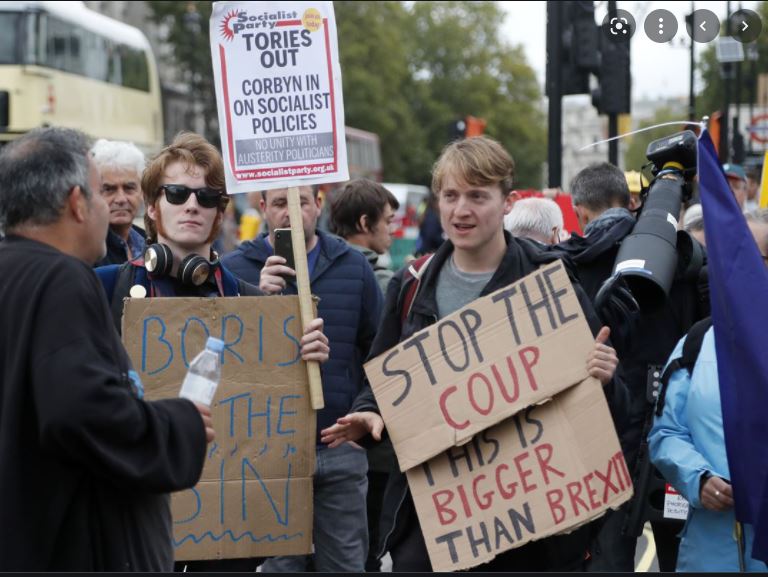
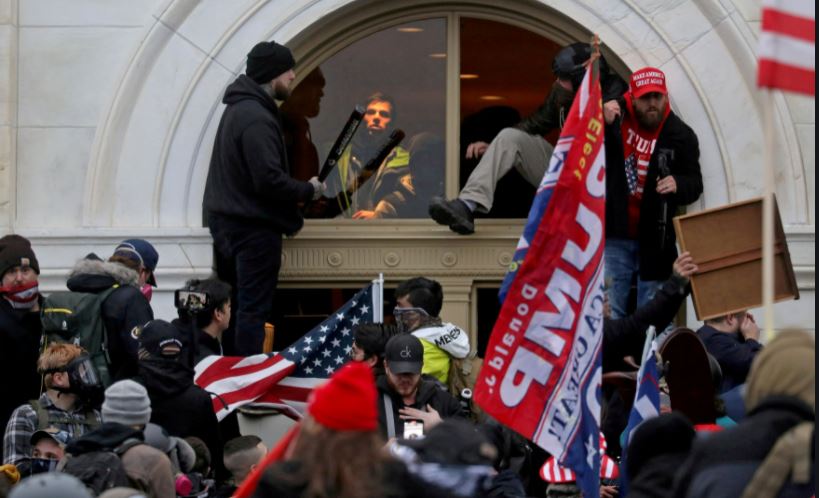
(Left) Johnson illegally prorogues British Parliament, August 2019. (Right) Trump’s mob storms Washington Capitol to stop Trump’s election defeat being certified, Jan 6 2021.
Of course, there was labour militancy at times in the mainstream of the US labour movement between those times and the period when Reagan took the axe to the working class with a vengeance, followed through by the elder Bush, with the finishing touches put on it by the ‘Reagan Democrats’ who elected Clinton/Biden as ‘New Democrats’ to undo key concessions from the Roosevelt era. The boom times under Clinton and then the younger Bush accelerated the restructuring of the proletariat away from the US, but the boom did not refloat the rustbelt where basic industries had been done away with. It passed them by and whole sections of the former industrial proletariat were robbed of their assumed birthright of a decent job and stable employment. The way this was often done was through ‘givebacks’ – the leadership of the US unions, realizing that jobs were threatened in an unprecedented way by the neoliberal project, made concession after concession to the bosses to try to induce them to keep the jobs of their members in the United States. And in so many cases, once the giveback deals were done, the jobs disappeared anyway. And this time the deprivation was permanent – these jobs had not ceased to exist temporarily in a homegrown depression but had been shifted permanently to elsewhere in the world. The result being that previously ‘proud’ working class localities in the rustbelt became hellholes of drug addiction and despair, and the only growth industry was the trade in opiates.
The initial response to the huge financial crisis that struck neoliberal capitalism in 2007, with its origin in the United States, was for the masses to put their faith in a supposed new Roosevelt, Barack Obama, the first black President in US history and a seemingly very liberal figure, who many felt would redress the balance against the anti-worker offensive that had dominated US politics over the previous thirty years or more. Obama’s huge landslide in 2008 was overwhelmingly social-democratic in its aspirations, reflecting the rhetoric of the candidate. But Obama, with his Kennedy-flavoured liberalism, would not have been able to reinstate the formerly strategic sectors of the proletariat that neoliberalism has outsourced, even if he wanted to, which he did not in any case. Under capitalism, such a reversal is well-nigh impossible. So, when disillusionment set in with Obama, the response was a sharp turn to nationalism in the rust belt, which made this formerly core sector of the proletariat prime fodder for a reactionary demagogue if one were to arise. As indeed happened with the rise of Donald Trump.
Trump’s movement, like Brexit, in terms of the working-class support base it has generated, is sloganised as ‘Make America Great Again’ (MAGA) which really translates as “give us back our stake in American imperialism, give us back our privileges over workers in the Global South, give us back our ‘national pride’“. Something similar is behind working class support for Brexit and the fall of the so-called “Red Wall” in the 2019 British General Election, based on the delusion that if the working class only supports the re-arming both ideological and military of US imperialism, British imperialism, etc. they will in turn regain the relative privilege that they previously had prior to neoliberalism’s fundamental attacks on the US American and British proletariat, symbolized by Reagan and Thatcher.
In both cases, there was plenty that was dodgy about the electoral process. Trump lost the 2016 popular vote by 3 million: a quirk of vote distribution in the electoral college got him in. There are legitimate grounds to suspect the tweaking of postal votes in the 2019 General Election in Britain. A massive rise in postal votes was reported by Lord Ashcroft, a top Tory pollster and pundit, Tory ministers and Tory-loyal media pundits let slip in the media that they knew the postal vote results before it was even legal to count the votes – the postal voting operation was done by a privatised outfit headed by Peter Lilley, a notorious right-wing Tory from the Major years. And somehow Boris Johnson managed to win a massive electoral victory while hiding in fridges from being asked awkward questions by the media, while his opponent Jeremy Corbyn addressed mass rallies around the country. Those demagogues who have latched onto working class despair at the permanent decline of the rust belts are none too scrupulous about corrupt and previously often illegal behaviour. This was shown in Johnson’s illegal proroguing of parliament in mid-2019, and in Trump’s attack on the Capitol on Jan 6.
Such is the delusional character of the programme derived from this, that sections of the working class came to regard as their saviours radical-right demagogues from the same main ruling class parties, the US Republicans and British Tories, that ground their faces into the dirt and brought about their humiliation and relegation to servitude in the first place. Since neither the US Republicans nor the British Tories have either the slightest intention, or even the capability, to reverse the fall of these layers from being the ‘favoured’ workers of ‘their’ respective imperialisms, the awakening from this delusion is likely to be abrupt and cause great anger against the ruling class when it happens.
Far-Right Cross-Class Blocs
However, in the meantime, we have this second cross-class block, of far-right, nationalist bourgeois figures personified by Trump, with a reactionary-minded, deluded section of the mainly, though not exclusively, white semi-lumpen (ex-)proletariat in tow, seeking to reclaim what it sees as privilege lost (or privilege in the process of being lost). This cross-class bloc bears a strong resemblance to 1930s style fascism, although there are specific differences in terms of origin and evolution. It does have a somewhat different composition to many of the fascist movements of the 1930s, with formerly core sections of the working-class providing Trump with his mass base. Like European fascism in the 1930s, it is wholly conceivable that this cross-class bloc could lead to the conquest of power by fascists in the United States around coming elections such as the 2024 presidential election. Trump himself is someone who flirts openly with fascism but hesitates to dot all the I’s and cross the T’s. The legacy of the ultra-reactionary Trump presidency can also be seen in the flagrant gerrymandering by the US Republicans in several ‘swing’ states: as the Republican Party consolidates behind Trump it bears more and more resemblance to an outright fascist party. This will be a major issue in 2022’s mid-term Congressional elections. This legacy is also present in the attack on Roe vs Wade – the constitutionally protected right of woman to abortion – which looks set to be done away with by the Supreme Court with Trump’s nominees in 2022, the hostility of many Republican ideologues and functionaries to basic public health precautions against the Covid-19 pandemic, and their continued open climate change denialism. All these things are not abstractions, but tools to mobilise a reactionary mass base with the aim of power.
All this must be fought and fended off by United Front tactics. One concrete example of trying to build such a thing is the initiatives we have endorsed in the US calling for a United Front against Fascism addressed at the labour movement, such as the call for action against fascism on the anniversary of the 6 Jan putsch, issued by a US-based body called the Committee for a Labor Party, implementing what is an obvious tactic for the United States in today’s situation just as it was when Trotsky advocated this policy for the US in the 1930s. This initiative was promoted by an Australian left-wing grouping, Class Conscious, who appear to have a correct perspective on this and some connections in the US to enable them to play a role in publicising and pushing for such initiatives, as they did with a previous initiative which we endorsed, an Open Letter to AFL-CIO head Richard Trumka, defending the Vermont AFL-CIO, which correctly put out calls for a general strike against an attempt at a coup to overturn the results of the November election, against a bureaucratic attack from the incredibly cretinous AFL-CIO leadership.
The Labour Aristocracy – A Pro-Imperialist Bulwark
However, the question then arises about the nature and material roots of labour aristocratic sentiment in the working class in imperialist countries, which has long been an obstacle to revolution. If as seems likely, Trumpism and Brexit represent a dramatic death twitch of such sentiments, it is worth briefly looking into the history of this phenomenon, and the role that it has played in making revolutionary struggles qualitatively more difficult in imperialist countries.
Marx noted about Britain that the English Trade Unions in the 19th Century reflected the privileged position of at least part of the British working class, in a period when for much of that century, Britain had a monopoly as the only major industrial capitalist power. Lenin quoted this analysis at length in his Imperialism: The Highest Stage of Capitalism (see https://www.marxists.org/archive/lenin/works/1916/imp-hsc/imperialism.pdf):
“It must be observed that in Great Britain the tendency of imperialism to split the workers, to strengthen opportunism among them and to cause temporary decay in the working-class movement, revealed itself much earlier than the end of the nineteenth and the beginning of the twentieth centuries; for two important distinguishing features of imperialism were already observed in Great Britain in the middle of the nineteenth century—vast colonial possessions and a monopolist position in the world market. Marx and Engels traced this connection between opportunism in the working-class movement and the imperialist features of British capitalism systematically, during the course of several decades. For example, on October 7, 1858, Engels wrote to Marx: ‘The English proletariat is actually becoming more and more bourgeois, so that this most bourgeois of all nations is apparently aiming ultimately at the possession of a bourgeois aristocracy and a bourgeois proletariat alongside the bourgeoisie. For a nation which exploits the whole world this is of course to a certain extent justifiable.’ Almost a quarter of a century later, in a letter dated August 11, 1881, Engels speaks of the ‘worst English trade unions which allow themselves to be led by men sold to, or at least paid by, the middle class’. In a letter to Kautsky, dated September 12, 1882, Engels wrote: ‘You ask me what the English workers think about colonial policy. Well, exactly the same as they think about politics in general. There is no workers’ party here, there are only Conservatives and Liberal-Radicals, and the workers gaily share the feast of England’s monopoly of the world market and the colonies.’ “
Lenin analysed the phenomenon of the labour aristocracy in more general terms, as representing something common to all the imperialist countries, particularly in the period when Britain’s industrial monopoly had been broken and various different imperialist powers faced off against each other. This phenomenon was the principal cause of the social chauvinism and social imperialism that allowed workers of all the imperialist powers to be led to slaughter each other in the carnage of the first imperialist world war, 1914-18 (this is from one of the prefaces to Imperialism):
“As this pamphlet shows, capitalism has now singled out a handful (less than one-tenth of the inhabitants of the globe; less than one-fifth at a most ‘generous’ and liberal calculation) of exceptionally rich and powerful states which plunder the whole world simply by ‘clipping coupons’. Capital exports yield an income of eight to ten thousand million francs per annum, at pre-war prices and according to pre-war bourgeois statistics. Now, of course, they yield much more. Obviously, out of such enormous superprofits (since they are obtained over and above the profits which capitalists squeeze out of the workers of their ‘own’ country) it is possible to bribe the labour leaders and the upper stratum of the labour aristocracy. And that is just what the capitalists of the ‘advanced’ countries are doing: they are bribing them in a thousand different ways, direct and indirect, overt and covert. This stratum of workers-turned-bourgeois, or the labour aristocracy, who are quite philistine in their mode of life, in the size of their earnings and in their entire outlook, is the principal prop of the Second International, and in our days, the principal social (not military) prop of the bourgeoisie. For they are the real agents of the bourgeoisie in the working-class movement, the labour lieutenants of the capitalist class, real vehicles of reformism and chauvinism. In the civil war between the proletariat and the bourgeoisie they inevitably, and in no small numbers. take the side of the bourgeoisie, the ‘Versaillese’ against the ‘Communards’. Unless the economic roots of this phenomenon are understood and its political and social significance is appreciated, not a step can be taken toward the solution of the practical problem of the communist movement and of the impending social revolution. Imperialism is the eve of the social revolution of the proletariat. This has been confirmed since 1917 on a world-wide scale.
Or in more generalised terms:
“The distinctive feature of the present situation is the prevalence of such economic and political conditions that are bound to increase the irreconcilability between opportunism and the general and vital interests of the working-class movement: imperialism has grown from an embryo into the predominant system; capitalist monopolies occupy first place in economics and politics; the division of the world has been completed; on the other hand, instead of the undivided monopoly of Great Britain, we see a few imperialist powers contending for the right to share in this monopoly, and this struggle is characteristic of the whole period of the early twentieth century. Opportunism cannot now be completely triumphant in the working-class movement of one country for decades as it was in Britain in the second half of the nineteenth century; but in a number of countries it has grown ripe, overripe, and rotten, and has become completely merged with bourgeois policy in the form of ‘social-chauvinism’”
However, concretely in the century or so since Lenin wrote this analysis, particularly in Britain and the United States, the domination of the labour aristocracy over the working class has never been consistently and coherently challenged. Decades of Stalinist betrayal have seen to that. And the impotence and thus far the failure of the Trotskyist movement has in turn failed to challenge the domination of the labour aristocracy over the proletariat and has thus allowed this chauvinist understanding and self-conception to persist and remain dominant in our class particularly in periods of defeat.
This persisted in Britain despite the formation of the Labour Party at the beginning of the 20th Century, which was a half-step towards class independence, but the resulting party was dominated by the labour aristocracy and completely dependent ideologically on British imperialism. This is the root of its crisis over neoliberalism, as the decision of the bourgeoisie to get rid of strategic layers of the working class that were dominated by a labour aristocracy, even when militantly defending the interests within the framework of trade unionism, cut off a whole supportive layer of the Labour Party bureaucracy. The upshot of this is that the Labour Party bureaucracy sought alternative social support from elements of increasingly financialised capital, and the semi-class element in Labour became more and more diluted. This lay at the root of both Labour’s near victory in the General Election of 2017, as the Corbyn leadership appealed to some basic class sentiment and achieved the biggest swing to Labour since 1945. And conversely, when Corbyn allowed Labour’s neoliberals to undermine him particularly using Brexit as a weapon, seeking to set the half-social democratic, half populist working class layers against the Labour leader, it led to a weaker election result in 2019, though it does seem likely that without the additional sinister influence of Tory-Trumpian electoral malpractice particularly in the ‘Red Wall’ the outcome would have been another hung parliament.
The question of ‘fascism’ has a curious dialectic. The decline in strategic proletarian layers in countries like the US and Britain has led to a culture of national victimhood among sections of the former industrial proletariat, that feeds the influence of far-right trends that target immigrants, refugees and other perceived ‘foreigners’. This sense of victimhood is characteristic of the far-right narrative that the oppressor nations, deprived of the opportunity to oppress, are the real ‘victims’. But the permanent end of large-scale industrial employment in formerly industrial districts is a real blow, a real oppression, inflicted by the bourgeoisie, against its former wage slaves, who are reduced in considerable measure to lumpenism in conformity with the adage that there is only one thing worse that being exploited as a worker under capitalism, and that is not being exploited under capitalism. Given the element of ‘anti-fascist’ mythology, derived from World War II, in both Britain and the US, you often hear some, even on the left, identify neoliberal ‘globalists’ who have robbed the British and American proletariat of their conditions of life, with ‘fascism’.
But this is not fascism, this is the normal workings of the capitalist system, translated into today’s conditions. It is a powerful argument for the system’s overthrow internationally. It is also an important shift which takes the necessity of international class struggle out of the realm of holiday speechifying and into the realm of vital necessity. It is simply necessary for elementary self-defence against today’s capitalism for workers to find ways to unite across national boundaries, and particularly for workers in advanced countries like Britain and the US to unite with workers in the Global South. The migration that goes hand in hand with this globalisation is an opportunity to forge such links and common struggles. The nationalist victimology of the former workers of labour-aristocratic consciousness, often expressed in virulent hostility to immigrants and ‘foreigners’, is complete counterposed to such unity and is therefore flatly counterposed to working class interests. It needs to be combatted, not conciliated, to help those sections of the working class transcend their labour aristocratic consciousness and take the position that is consistent with their own real material interest, as a class-conscious contingent of the internationalist world proletariat. For this to come about, a party is necessary that does not conciliate nationalism and populism, but which tells the truth to the masses about their real situation. That is what we are trying to build.
On 14th January the inaugural meeting of the Socialist Labour Network took place, in a virtual meeting online on Zoom, which allowed attendance from all over the country and indeed from as far afield as Australia. The SLN is the name that was chosen by the membership of the unifying group at the meeting in a democratic vote, in which many possibilities were put forward. The 140-or-so attendees also voted to elect a new steering committee, as expected.
The new organisation represents a merger of Labour Against the Witchhunt (LAW) with the Labour In Exile Network (LIEN). This was simply a logical progression, as the Starmer leadership had proscribed both organisations (along with the Resistance Movement founded by Chris Williamson) as their campaign against the left grew more and more frenzied last year. It is not even possible to campaign openly against the witchhunt in Labour due to its domination by far-right Zionist racists, led by Starmer: therefore, the perspective of running a network of expelled and driven-out Labour ex-members (and others) won out over the idea of pretending to be able to propagandise ‘against the witchhunt’ within Labour when the leadership no longer permits such advocacy. In this situation the only realistic way to punish Starmer and his cohorts is through external war against them, supplemented by internal guerilla actions when possible.
There are plenty of grounds for socialists and anti-racists to wage a public war against Starmer. He has conspicuously abandoned virtually every mendacious promise he made to get elected, lyingly claiming to be for ‘unity’ with the supporters of Corbyn, including promises to demand nationalization of privatised utility companies, promises to increase taxes on the wealthy, reversing cuts to corporation tax, to repeal anti-Union laws (not even all of Thatcher’s laws but just the most recent), all of which have been junked. They were mild social-democratic reformism in any case, but in a neoliberal Tory Party mark 2, they are no-nos.
Instead of this, Starmer has launched the biggest war against the party’s left in its entire history, targeting for expulsion not merely small groups of ‘Trotksyists’ and the like but the mainstream Labour left, all the way to Jeremy Corbyn himself, who has been effectively expelled from the PLP as a way to try to stop him from standing for parliament in the next election. Coupled with this, Starmer has elevated Jewish and white supremacists above oppressed ethnic minorities in his supposedly ‘anti-racist’ party, creating a hostile environment for blacks and Muslims, left-wing Jews and indeed anyone who is not prepared to grovel to the far-right racists and ‘former’ Israeli intelligence operatives and paid advocates such as Ashraf Kaplan, Luke Akehurst and Wes Streeting who now have a commanding role in Labour.
The ‘Labour’ leader has publicly stated his support for Zionism “without qualification” – that is, for the ideology of violent Jewish racists who expelled three quarters of the Palestinian Arab civilian population from their homeland in the 1948 war. This was accompanied by massacres such as Deir Yassin and Tantura, where Zionist troops have now admitted to murdering many Arab civilians and burying them in a mass grave on a beach, after decades of denial and smearing of those who said that a massacre took place at all. To Starmer and his handlers/minions, for members to raise such things is simply an opportunity for Starmer to throw them out with the increasingly bizarre and discredited accusation of ‘anti-Semitism’.
Labour Against the Witchhunt was a prominent and quite prestigious campaigning body that was founded at the end of 2017/beginning of 2018 in the context of accelerating purges of prominent left-wing Labour members, such as Ken Livingstone, Jackie Walker, Marc Wadsworth, Tony Greenstein, and many more, whom the Corbyn leadership refused to defend in a politically cowardly appeasement of Zionists, despite Corbyn’s previous long history of often outspoken advocacy of equality and democratic rights for Palestinians. Once he became leader, he became preoccupied with maintaining ‘unity’ with his enemies in the PLP, and so one left-wing victim after another was thrown under the bus by Corbyn, who simply refused to defend these people, even when he himself became a target of mendacious allegations, as when the affair of the Mear One mural, originally in 2012, was taken up by the Jewish Chronicle. This led to the calling of a Zionist demonstration against Corbyn that mobilised notoriously racist and bigoted figures like Norman Tebbit and David Trimble to demonstrate against the left while pretending in some way to be opposing racism. A sick joke.
Derelictions of LAW: Roots of the Current Situation
But even as it began to get underway, LAW showed fatal weakness. Another prominent leftist excluded from the Labour Party quite early on was Gerry Downing of Socialist Fight, which was our political predecessor. He was initially excluded at towards the end of 2015 by the early inquisition against alleged ‘entryists’ in the Labour Party because his Twitter profile had highlighted his position as a worker -Trotskyist who sought the overthrow of capitalism. In common with others, he was then reinstated as part of the Corbynites’ early counterthrust. But then his case was picked up by the Tories and he was denounced by David Cameron in the House of Commons for an article he had written that refused to condemn the anti-imperialist motives of the 9/11 hijackers. Cameron then picked up on this formulation and sought to scandalize the Labour Party as having an Al Qaeda apologist in their midst. In fact, the comrade’s article did not support terrorist actions at all but was a polemic in favour of trying to win militants away from such methods to Marxism, while showing empathy with the motives that impelled them to such errors in the first place. But at that denunciation by Cameron the LP apparatus panicked and re-excluded him within hours.
Shortly afterwards, Socialist Fight’s analysis of Zionism and the Jewish Question was picked up by the right-wing Tory blogger Guido Fawkes (Paul Staines) and caricatured in classic Zionist manner as an attack on Jewish people. Instead of what it is and was, a historical materialist analysis of the roots of disproportionate Zionist power in the old imperialist countries, characterizing the Zionist lobby/caste as representing an independent imperialist faction loyal to Israel based on racist, ethnocratic and racial supremacist politics. The factual basis of this is simply irrefutable: the numerical overrepresentation of Jews in the bourgeoisie is simply a linear consequence of the well -documented and theorized role of Jews over more than 1000 years of existence, as a commercial people-class in medieval society before capitalism. But with the rise of Zionism to dominance among Jewish politics, this has provided the material basis for a powerful faction within the West European and North American imperialist states whose main loyalty is to Israel as their ‘own’ transplanted imperialist state. This explanation of the power of the Israel lobby to force often virtually uncritical support for outrageous Israeli crimes against the Palestinians as policy of Western powers, and to attack the democratic rights of defenders of the Palestinians in the West, is not refutable by debate for the factual basis of it is clear and easy to prove beyond all doubt.
But for Zionists, to mention these facts is anathema, even worse than the capital crime in the IHRA fake definition of ‘anti-Semitism’ of saying that Israel is a ‘racist endeavour’. The hysterical smear is that merely to mention such facts is the same as echoing the Protocols of Zion. But in fact, the Protocols of Zion are a malicious caricature of Zionism concocted by genuine anti-Semites. They falsely portray the manipulative activities of early Zionists to try to secure for Jews the chance to join the colonial-oppressor fraternity, as some sort of all-encompassing plot involving all Jews in a plan for world domination. Whereas in fact Zionism at that point was the creed of a tiny minority of Jews, and its activities were limited to lobbying the great powers to allow them to steal a piece of land from a colonized people, preferably in Palestine but at one point part of what is now Kenya was mooted. This was conceived of as a place to build their own imperialist enclave in a parallel manner to the racist conquests of the likes of Cecil Rhodes in Southern Africa. Such an enclave is what Israel has been from its creation.
The response of the leadership of LAW, particularly the CPGB but also its then ally, Tony Greenstein, when this full-blooded Marxist critique of Zionism was lambasted by the bourgeoisie and its minions, was similar to that of Corbyn. They tried to throw our comrades under the bus and expel us from Labour Against the Witchhunt. But they had a hard time doing this and it has caused them problems ever since. The CPGB underline their third-camp politics every time they justify our January 2018 expulsion from LAW, but actually they lost the vote when the issue was first discussed at an LAW meeting in December 2017. They had to engage in a national mobilisation of all the capitulationist forces they could gather from the left to defeat us. Including elements such as supporters of the United Secretariat who are so soft on imperialist ‘humanitarian intervention’ that they applauded the imperialist ‘liberation’ of Libya and urged similar things in Syria. And in fact, the upshot was that the CPGB and its allies unconvincingly won the vote by approximately 2-1, against an obviously smaller and newer group, which is no moral victory at all. More an embarrassment.
The problem they have is that many members and ex-members of the Labour Party under Corbyn have extensive and bitter experience of the Zionist lobby and its poisonous influence and are not inclined to rubbish a materialist analysis such as ours that explains how it acquired the power to wreck such a left-wing development in the British labour movement as Corbynism. So, our views on Zionism get a hearing and a considerable echo among the more serious anti-Zionists among the ex-Corbynite diaspora, who are trying to create a new left formation in various ways in difficult conditions after some defeats, not to mention the pandemic. Comrade Greenstein, who is organically part of that ex-Labour militant layer, has had to adapt to that and in fact invited us to join electronic forums of Labour Against the Witchhunt in 2021 that he had had our predecessor group thrown out of more than three years earlier. His strong anti-Zionism, although flawed, always sat uneasily with the third-campism of the CPGB in any case, expressed in such things as the CPGB’s refusal to defend the elected Hamas-led Palestinian government against the Israeli-backed coup by the stooge Abbas in 2007, or its refusal to back Iraqi resistance to the US/British invasion in 2003, both motivated by crude Islamophobia. Such things sit uneasily with Tony’s politics, to say the least.
The CPGB, on the other hand, have expressed in their paper considerable hostility to the strong anti-Zionist sentiment that permeates the left-Corbynites (see letter, below), and logically this, and not any bullshit about ‘principles’ regarding supporting Labour (which contradicts what they did 20 years ago in the last – Blair – period of openly neoliberal Labour leadership), explains their cowardly and sectarian running away from engaging with the formation of the SLN, which logically will find itself allied with militants in the Resistance Movement and others seeking to create an alternative to Starmer’s Labour.
SLN and Shadow CLPs
Roger Silverman
The fused organisation does have a strategy and tactics of a sort. It involves splitting the labour movement from the neoliberals and refounding a labour party based on basic class independence. It leaves open the question of what happens to the official Labour Party and treats that as secondary to creating a real mass labour party. It is not a strategy for a revolutionary party, but it could be a step towards that. Its main theorist is Roger Silverman, a leading member of the ‘Shadow CLP’ in Newham, East London, which has gained the support of many left-wing activists from Labour when the Starmerites suspended the local Labour Parties because of the strength and defiance of the left. This local ‘Shadow’ Labour Party has maintained its activism and acts in complete defiance of the local Starmerite hacks and stooges. This is a correct strategy and tactics and poses defiance without running away from the battle with the enemy. He summarized his thinking in a recent Facebook post:
“The long-overdue historic split in the Labour Party is taking place at an unusually slow, uneven pace due to the paralysis of the official left, but it’s happening all over at a local grass-roots level. It’s not enough to take a snapshot and say: “what split?”; we have to see the process in perspective.
“An alien Tory clique now has the party by the throat. The official party membership, finances and voting figures are haemorrhaging. Only a couple of years ago, Labour was a mass party of half a million people, most of whom enthusiastically supported the socialist policies of Corbyn; most of those have dropped away from active involvement – but they have not disappeared.
“In my borough Newham there are now two quite separate Labour parties: the MPs, councillors and mayor on the one side, and the active campaigning membership on the other, now constituting itself as Newham Socialist Labour. And the same class split is taking place, albeit slowly and unevenly, in many areas all over the country. Inevitably, we’ll see similar groups springing up and establishing a network which will be the embryo of a mass socialist movement.
“A crucial factor in the mix is the explicit intention of the leadership to weaken or cut outright the trade union link; it is significant that several major unions have already drastically cut their financial contributions to the party.
“Autonomous socialist Labour groups are springing up; the unions are paring down their affiliation fees. The split is tortuous and protracted due to a lack of central leadership, but at a certain point there will inevitably be cracks at the top too. When the party regime engineers the deselection of some left MPs, that will spur them into bolder action. And if Jeremy Corbyn runs as an independent candidate at the next election, with thousands of enthusiastic canvassers he’ll win a landslide victory. That too would further encourage the development of a mass left breakaway.
“The situation is buzzing with opportunities.”
This is a reasonable and viable tactical option, that does not shrink from confronting the Starmerites in the electoral arena, and gives the mass of left activists in, around and formerly of Labour, a means to get organised politically. It logically dovetails with the activities of the Resistance Movement, and other fragments of the Labour left such as Breakthrough who are also seeking to organise politically, and who recently formed the Peoples Alliance of the Left (PAL) with Left Unity and TUSC as part of their own attempt to unify the ex-Corbynite left movement with other leftists to fight Starmer. All these initiatives deserve a sympathetic approach and critical though firm support, as they point in a direction that takes the labour movement forward. What they lack, as do all organisations that organise left-reformist socialists in struggle against the neoliberal right, is a coherent revolutionary socialist programme to counterpose to the reformism whose failure to deliver reforms is at the root of the neoliberal takeover of reformist Labour Parties in the first place.
Tony Greenstein at LIEN demonstration, July 2021
Obviously, the task of communists in this situation are twofold – to work alongside those seeking to implement this progressive and necessary perspective, and through patient argumentation and educational work, to win support for a revolutionary programme within this movement, to be the revolutionary ‘fish’ who can swim in the ‘sea’ represented by the movement and safeguard the historic interests of our class by seeking to advance both. Not to run away from this with pseudo-radical right-wing sectarian excuses as the CPGB have done, pulling their people out and misleading others to do so, and absurdly bad-mouthing those who fail to endorse their capitulation to Starmer as ‘liquidators’. As our letter published in WW pointedly makes clear, it is the CPGB who are acting as liquidationists in this situation.
Letter to Weekly Worker
‘Liquidationism’ and the Socialist Labour Network
The allegation against Tony Greenstein of ‘liquidiation’ of Labour Against the Witchhunt into the Labour In Exile Network (the unified group is now known as the Socialist Labour Network), is a fetish. LAW is not a revolutionary party. It is meaningful to talk of liquidating a programme or a revolutionary party, but ‘liquidating’ a single issue campaign is a nonsense. LAW was conceived originally as a united front of different forces to oppose the witchhhunt within the Labour Party under Corbyn.
Jack Conrad is making a fetish of LAW simply because it is a political status symbol. In fact they did not run LAW as a genuine United Front even within the Labour Party. They did not seek to unite all victims of the witchhunt, they expelled some who did not fit in with their third campist politics.
One manifestation of this was the exclusion of Socialist Fight, and also Peter Gregson for supposed ‘anti-Semitism’. Despite admitting that neither of these individuals/trends actually hated Jews, so their exclusion could only be justified with the self-contradictory characterization of these as ‘politically but not personally anti-Semitic’.
A foolish and self-contradictory formulation that denies human agency and in reality is an excuse for political cowardice. It really signified that LAW became, not a united front, but a ‘front’ for the CPGB and its third camp politics in the manner that Stand Up To Racism is a front for the SWP’s politics.
But now it has come apart because of its own contradictions, as the bulk of its hoped for constituency has been radicalized by experience far to the left of these third camp politics, and the Labour Party leadership is destroying the Left in the party in a manner going way beyond Blair, and destroying the party itself as an alternative for workers.
This has led to a change in Tony, and a breakdown in his relations with the CPGB. So I was excluded from LAW by the CPGB and Tony in 2018, but I was invited to join in LAW discussions online a few months ago by Tony. That is a change from 2018 and in Tony, which is to be welcomed.
Derek James’ recent article in Weekly Worker bemoaned this.
“Thus, whilst correctly identifying the politically motivated exaggeration of the nature and extent of anti-Semitism, some comrades enter into a sterile game of competitive oppression, in which racism directed towards black people or Muslims is contrasted unfavourably with the rather different contemporary experience of the Jewish population. Such denialism is ultimately rooted in the ‘beggar my neighbour’ politics of identity: it is not only politically wrong on all counts, but is also totally counterproductive, as it only gives further ammunition to the witch-hunters in the Labour bureaucracy and the media. It also adds further grist to the mill of those who provide the ‘intellectual’ cover for the big lie identifying the left with anti-Semitism, such as the ex-leftist turned conservative commentator, Brendan O’Neill, or the social-imperialists of the misnamed Alliance for Workers’ Liberty.”
The truth is that contradictory to Jack Conrad’s profession of opposition to ‘confessional sects’, he is building a confessional sect around Draperism and Kautskyism.
This rightist element is manifested in the denunciation of David Miller in WW. Reluctant defence of him and the allegation that he is a propagator of conspiracy theories.
Another manifestation of this is the idea of the Labour Party as a united front of a special kind. This is the old Chartist group’s position, the Labour Party as a soviet, in effect. A real liquidationist position. A soviet is a united front of a special kind.
LAW-LIEN is similar in some ways to the Socialist Alliance but on a higher level, not dominated by sects. More open to an intelligent revolutionary group that seeks to persuade and educate, not dominate. The CPGB was involved in the SA and other similar things like Left Unity, only not involved in RESPECT for third campist and Islamophobic reasons, but actually both RESPECT and LU have or had similarities with this.
This is where left activitists are at today, there is nothing unusual about this. You have to work alongside them to win influence for your programme. The CPGB fear them because subliminally they fear that this left-Corbynite milieu, because of their experience of Zionist witchhunts and its linked Islamophobia, will be spontaneously to the left of the CPGB’s third campism.
There is no coherent Marxist justification for the CPGB’s abstention from movements like LAW-LIEN other than this cowardly fear of the left-Corbynite layer. Not entirely different to the hostility that is seen to it from Andrew Coates and the AWL, but given a more superficially leftist phrasemongering.
This is ironically justified by a position of Labour Party fetishism that is similar to things the CPGB denounced in the early 2000s in the SA. The kind of thing that Socialist Appeal and Bob Pitt did in those days , support Blairities against the left. Will the CPGB support Starmer against, say Chris Williamson today if Labour is challenged? That seems like the logic of the argument.
Ian Donovan
Consistent Democrats/Liaison Committee for the Fourth International
Iraqi Kurdiish refugee Khazal Ahmed and her three children, (l to r) Hadia, Mubin and Hasti. drowned in Channel in November. British government tries to criminalise claiming asylum, forces refugees to risk their lives. Murder by xenophobic politicians.
The current refugee crisis in Europe cannot be separated from the political crisis and is a direct result of Western Imperialist machinations and interventions for Regime Change in the Middle East and elsewhere. The US, (a nation born and built on violence with its endless war policy) and its allies had specific plans for the Middle East. Their primary interest was of course (1) control and steal the oil reserves in the area. (2) Prior to 1991, during the Cold War -their aim was to contain the Soviet Union and wage hybrid war against it, then post 1991 in order to secure their own economic and political interests to create chaos (3) To Support and sustain Israel (an outpost of Western Imperialism.)
Evidence of the plans to destabilize certain countries can be found in the Memoir of former US General Wesley Clarke, who wrote in September 2007 that less than 2 weeks after the September11th 2001 attacks, he visited the Pentagon where a “Senior General” told him “We are going to attack Iraq. The decision has been made” Six weeks later Clarke went back to visit the same general to see if the plan on Iraq was still being considered. Clarke says the general told him “It’s worse than that..” holding up a memo on his desk…”here’s the paper from the office of the Secretary of Defense ( then Donald Rumsfeld) outlining the strategy. “We aregoing to take out seven countries in five years” And he named them, starting with Iraq and Syria and ending with Iran.
In interviews since 2007, Clarke has mentioned that the list included Lebanon, Libya, Somalia and Sudan.
Clarke quotes a conversation he had in May 1991 with Paul Wolfowitz (Deputy Secretary of Defense under Rumsfeld) “ We screwed up and left Saddam Hussain in power. The president, (then George H.W. Bush) believes he’ll be overthrown by his own people, but I rather doubt it. But we did learn one thing,with the end of the Cold War, we can now use our Military with impunity. The Soviets won’t come in to block us. And we’ve got five perhaps ten years to clean up these old surrogate regimes before the next superpower emerges to challenge us”
To confirm that America’s European Allies were also plotting mayhem in the region there is an interview with the former French Minister for Foreign Affairs, Roland Dumas on the French TV station LCP, in which he said, “I was in England 2 years before the Arab Spring violence in Syria… I met with top British Officials, who confessed to me that they were preparing ‘something’ in Syria. Britain was organising an invasion of ‘rebels’ into Syria. They even asked me, although I was no longer Minister for Foreign Affairs, if I would like to participate. Naturally I refused…The operation goes way back, it was prepared, preconceived and planned.. in the region it is important to know that this Syrian regime has a very anti-Israeli stance…. the former Israeli PM told me ” We’ll try to get on with our neighbours, but those who don’t agree with us will be destroyed” Tel Aviv’s role in the “revolution” had to be kept secret, ”to conceal the fact that the Jihadists didn’t realise that they were actually fighting for Israel”
The method is always the same. Imperialism backs “rebels’ wherever its interests are threatened by regimes which refuse to do Imperialism’s bidding.
The US doctrine of regime change has been a total disaster and leaves people in a worse situation than they were previously. e.g. Iraq, Libya, Afghanistan and Syria
Let us not forget British colonialism and repression in Iraq during the 1920s. In 2003 the US with the UK, Australian and Poland invaded Iraq on the lying pretext that Iraq had weapons of mass destruction. The Iraq war began on March 20th 2003
Much of the world was able to ignore the Refugee Crisis prior to 2015, as the refugees were hosted by much poorer countries nearby, but then the war refugees started coming to Europe….
The UN defines refugees as “Persons fleeing armed conflict and persecution. These are people for whom the denial of asylum has potentially deadly consequences” (UNHCR) Migrants on the other hand are people who chose to leave their home country. and under International Law, theycan be returned home.
The 1951 Refugee Commission says ” Refugees have certain rights under International Law. These include (1) the right not to be returned to their country of origin if their safety cannot be assured (2) the right not to be penalised for entering a country illegally if they request asylum. International Law requires that countries protect and house refugees regardless of their religious beliefs.” However the President of Hungary has said that they must keep Muslims out of Europe to “ keep Europe Christian”
Half of the people seeking asylum are from Syria, 12% from Afghanistan, which had most asylum seekers for 30 years prior to 2015, then Syria took first place. 8% are from Eritrea.
There is a lot of misinformation and disinformation being churned out and used ruthlessly against refugees. There is a widely held idea that Refugees/immigrants are disproportionately likely to commit crimes, but all the studies show that Refugees and first generation immigrants are likely to commit crimes at a much lower rate than members of the host community. There is also a lot of racism and anti-foreign-national politics on the rise in Europe. Fear is easy to sell, and recent elections have shown that Nationalist and Populist parties rely on misinformation to gain support. Most Europeans have real fears of direct competition from the refugees in the labour market and of these people being a burden on the welfare system, schools, hospitals and pensions.
The refugees have lost their homes, family members, friends, jobs and community. There are 65 million displaced people worldwide, 40 million of which have not crossed international borders. Most displaced people are hosted by much poorer countries nearby
The US and its allies created this crisis. Modern Syria is one of the most ancient inhabited regions on this planet. Syria was ruled by many empires including the Persians, Egyptians, Babylonians, Phoenicians and Greeks and Byzantines. In 637AD Muslim armies defeated the Byzantine Empire and took over Syria. A thousand years later Syria fell into the hands of the Ottoman Empire which ruled Syria for 400 years until 1946 when Syria became independent
Due to the ancient History and famous historical sights and the pleasant weather, Syria became a popular Tourist site, visited by 8.5 million people from around the world in 2010, earning 8 billion dollars in revenue.
In 2011 peaceful anti-regime protests turned into a civil war (see Roland Dumas’s comment above) where the government was fighting the “”Free Syrian Army” the situation became more complex as the war progressed with new forces joining the war. The US gave financial aid and weapons to “moderate” rebels to fight the regime. Cities, towns and villages were destroyed, causing millions of people to flee from their homes, this caused the largest refugee crisis since World War 2. This impacted the tourist industry, no foreign-national could visit so the tourist industry and the economy collapsed. The Government arrested protesters and the US ordered sanctions against Syria. Syria was accused of chemical attacks against their own people although the UN inspectors said they had seen no evidence of the Syrian army using chemical weapons, and said that further investigation was necessary
The US invested 20 years in Afghanistan because of its geostrategic position but even more because of opium. The Taliban destroyed the crops, so the US had to invade, now the CIA (Cocaine Import Agency) has moved cultivation to South and central America to continue the income stream for regime change and bribes to corrupt officials abroad.
People are willing to risk their lives to come to Europe because of the ongoing armed conflict in these countries.
2001 – 2021 ? Afghanistan
2010 – “ ? “ Somalia Civil war
2010 – 2012 Arab Spring
2011 – Present Iraq
2011 – Present Syria
2013 – Present South Sudan
Some refugees come to Europe via the Western Mediterranean Route, entering Europe through Spain, this is also the route used by drug smugglers to smuggle drugs into the European Union. Criminals smuggle refugees and drugs from Morocco to Spain. As a result crime is now a huge part of the refugee debate….
The disproportionate burden on the gateway EU countries (Spain, Greece, Italy, Hungary) created political fallout among various governments. Compassion fatigue set in and and terrorist attacks in 2016 in a Berlin market and sexual assault in Cologne in Germany gave rise to strong anti refugee sentiment across Europe.
Thousands of refugees have died trying to get to Europe and until legal opportunities are available, the smuggling and deaths will continue. A large number of refugees take the eastern Mediterranean route , people fleeing Syria, Iraq, Afghanistan, took this route and travelled to Turkey.
These refugees entry-point to Europe would be through Greece, Cyprus and Bulgaria. Refugees try to get to Hungary which is a member of Schengen.( twenty-six European countries which had abolished their internal borders for the free movement of people and goods)
They believe that their chances to apply for asylum and gain citizenship is higher in a country in the Schengen Area. The EU has now stopped the movement of undocumented migrants within the Union. Turkey has 3.6 million refugees from Syria, only 31,000 of whom have work permits, representing 1.5% of those of working age. Those without work permits are working in the black-market economy often, being exploited often below the minimum wage, and with poor working conditions. The EU paid Turkey 6 billion Euros to stem the tide of refugees into Europe in 2016.but has expanded sanctions on Belarus. The EU should pay Belarus. Less than half the population of Syria still live in their homes, 7. 6 million are internally displaced. Millions more are refugees, Iraq, Lebanon and Egypt each have a million refugees. Twenty five percent of Jordan’s population are refugees. Germany has received 6000 refugees via Poland in the last six months. The UN says 10,000 children have disappeared from the moment they entered the EU. Saudi Arabia, and the UAE have done nothing to help. Qatar, the richest Arab country in the world, has not taken a single refugee. The US spends hundreds of billions of dollars on its Military but is unwilling to spend on humanitarian causes such as this
Thousands of refugees are stranded on the Poland and Belarus border in freezing weather. Poland has deployed 12,000 troops at the border with Belarus. Polish police fire tear gas, stun grenades and water cannons at women and children at the border. People are dying in the freezing winter weather. The Poles have accused Belarus of facilitating the transport of refugees to their border, Belarus rejects these allegations. The EU supports Poland and has imposed additional sanctions on Belarus as at 15th November 2021. ( It is worth noting that the EU had imposed sanctions on Belarus due to concerns about their 2020 elections not being fair or free. There had been many violent demonstrations against the government and it responded with force, and many people were arrested.) There is a stand off at the Polish/Belarus border for some months now.
Polish forces mass to block refugees at Belarus border, December 2021
The solution to this crisis is obviously to end these US sponsored wars throughout the world and in the Middle East in particular. This is unlikely just now because Imperialism needs war to continue to exist. The US dollar is on life support and the only thing keeping it afloat is their Military. Industrial Complex. The Capitalist economic system is incapable of solving the problems of inequality, poverty, unemployment. More and more people are sinking into poverty. Greed is an incurable mental disease endemic in the ruling classes in all countries. Advanced commodity production means that there is no planning of the economy for the benefit of the majority. The economy lurches from crisis to crisis, while the rich are getting richer and the poor are getting poorer.
The US and the EU must provide financial help for those countries which are bearing the brunt of the crisis, countries such as Jordan, Lebanon, Iraq, Egypt.and Kenya These countries do not have enough resources to effect local integration They should also invest in the countries near to these war zones so people can stay close to home and be reunited with their families. And it ought to go without saying, that socialists and the labour movement must stand up for migrants and refugees in general, and oppose all restrictions and controls by imperialist states on all refugees and other migrants.
Only the end of the barbaric economic system of capitalism can guarantee a peaceful life for all on this planet, Indeed the very survival of the planet demands an end to this economic system.
The current confrontation over Ukraine is the consequence of the fundamental drive of United States imperialism, as the world imperialist hegemon, to reconquer the two main countries in the world where capitalism was overthrown during the 20th Century, Russia and China, for capitalism.
That might sound odd considering that everyone knows that ‘Communism’ was overthrown in Russia in August 1991, and that China now, though the ruling party still calls itself the Communist Party, nevertheless has considerable power in capitalist terms, and has been powerful enough economically both to provide the United States with financial relief during the Credit Crunch/Financial Crisis of 2007-9, and to initiate infrastructure projects such as the One Belt, One Road initiative that have challenged the power of US imperialism in Eurasia and even as far away as Africa and Latin America.
The types of capitalism that have been restored in both Russia and China are not ‘pure’. They are hybrid forms that are still considerably marked by the decades of their existence, in Russia’s case three quarters of a century, in which capitalism had been torn out by the roots. Economically, they are still marked by considerable elements of state planning, which coexist with the capitalist market in ways that sometimes partially negate it. They are not imperialist powers in the sense of the United States or countries like Britain, France, Germany and various smaller West European powers, as well as Japan, whose wealth and preponderance in the world is particularly based on the extraction of surplus value from ex-colonial countries. In the case of both Russia and China, their economic strength derives from their own productive capacity, which was developed without capitalism.
Although these regimes, after the counterrevolution, no longer defend the expropriation of capital in a proletarian class sense, their hybrid mixture of statification and capitalism still preserves one remaining gain from the period of the bureaucratically degenerated/deformed proletarian dictatorships: the capacity to act in a systematic way independently of imperialism. Such national independence as a consequence of the expropriation of capital is classically associated with Trotsky’s programme of permanent revolution, though elements of it were achieved even when the agency of expropriation was not the conscious proletariat but a bureaucratically-led peasant movement, such as in China. This deviation from the norm allows these new non-imperialist capitalist powers to provide an alternative pole that semi-colonial nations in conflict with imperialism, such as Iran, or Venezuela, or the two remaining deformed workers states of Cuba and North Korea, can lean on and ally with. This is what the imperialist project of regime change and renewed war drive aims to destroy.
In Russia after 1991, the imperialists thought they had the ideal regime in place, the de facto Western agent Boris Yelstin, who implemented a neoliberal shock treatment that caused huge unemployment, suffering and hardship for the working class, and thus a massive fall in life expectancy. In 1987 Russian life expectancy was 70 years: by 1994 it had fallen to 64 with the steepest fall, of five years decline, happening in the most severe years of Yelstin’s neoliberal shock, from 1991-94. This brutal economic and political decline over several years produced a backlash both at the base of society and at the top, and at the end of the 1990s led to Yelstin being pushed out and, under Putin, the beginnings of a more nationalist policy which in fact was a retreat from subordination to neoliberalism. Among other telling indices, the decline in life expectancy was reversed under Putin, though recently in the Covid pandemic there has been another lesser decline, though this time the cause is obvious.
Resistance to Imperialist Neoliberalism
Since 2009 Putin has put up serious resistance to imperialist aggression beginning with the attempt by the US to bring Georgia into NATO, which he effectively stymied, and continuing most markedly by the progressive and justified intervention of Russian forces into Syria, which thwarted the efforts of US imperialism to use jihadist proxies, backed most notoriously by Saudi Arabia, by Qatar, and to a degree Turkey, with more discreet support from Israel, to deliver another imperialist ‘colour revolution’ against Assad. The imperialist double-dealing over this has been considerable, since the US was both claiming loudly that it was at war with Islamic State and the various more amenable Al Qaeda affiliates active in Syria, while at the same time depending on such forces to destabilise Assad. But this resistance to imperialism has dovetailed very well with China’s own attempts to counter the increasingly strident imperialist campaign against it, the so-called ‘pivot to Asia’, and their bloc against imperialism is itself useful for the masses in much of the world targeted by the imperialists. NATO now has a counterpart in the Pacific, AUKUS, which draws on the residue of the British Empire to threaten China the way NATO has always threatened the USSR and today’s Russia.
So, the project in Ukraine is expand the frontiers of NATO, whose whole purpose is to threaten first the USSR and now Russia, to include Ukraine, which will inevitably mean the placement of deadly US weaponry right on Russia’s border to the West, a severe escalation in the US project of encircling both China and Russia/USSR. NATO, and now AUKUS, in their overall purpose, are successors to the pre-WWII Anti-Comintern Pact, which was formed in 1936 by Nazi Germany and Imperial Japan, later including fascist Italy, to oppose the Communist International in the name of combatting ‘Communism’. It should be realized that even at that time, the Communist International was no longer Communist except in name, it had already abandoned the goals of internationalism and revolution. Today, the remnants of the bureaucratic regimes in Russia and China have, in slightly different ways, abandoned maintaining even the measures of socialisation that Stalin and later Mao maintained. But that is still not enough for the imperialists and the latter-day Anti-Comintern Pacts, they want regime change and what amounts to colonial adminstrations in both Russia and China. And they have initiated a new Cold War to try to nail that down.
Russia justifiably complains that this has broken even the letter of treaties and undertakings given at the end of the previous Cold War, which was supposed to have ended in 1989-90 as part of German reunification, through the Organisation for Security and Co-Operation in Europe (OCSE). But US imperialism, and its European lackeys, including the dying Johnson regime in Britain, regard such things as purely instrumental. And this has been a bipartisan US policy for decades; apart from Biden’s current activities, recall that the Intermediate Nuclear Forces (INF) treaty signed by Ronald Reagan and Mikhail Gorbachev in 1987, was torn up by Trump in 2018.
Thus, the expansion of NATO into Eastern Europe, then the Baltic States and Ukraine, should be viewed as extensions of the attacks of the Anti-Comintern Pact on the workers states and Communist forces, in that period, centrally Hitler’s Operation Barbarossa attack on the USSR in 1941, and the war which Japanese imperialism waged against the Chinese Communists in the same period. Although inter-imperialist rivalries kept the US, Britain, and France out of that particular bloc at that time, nevertheless in class terms the current NATO expansion, and also the creation of AUKUS, are a continuation of Barbarossa, aimed at subjugating the main countries where capitalism was previously overthrown, and wiping out all trace of those revolutions even in an indirect sense. It is thus entirely appropriate that a prominent role in the Ukrainian US puppet regime is played by open Nazis, supporters of the WWII Ukrainian collaborator Stepan Bandera, including the Azov Battalion, whose symbols include the NATO flag and swastika.
Elements of Correct Analysis
A useful assessment of the course of Putin in pulling back from the servility to imperialism of the Yelstin regime is laid out in the Weekly Worker (27 Jan) in an article by Paul Demarty:
“After the eastern European satellite states gave up their ‘socialist’ regimes, Mikhail Gorbachev cut a deal with the west – Germany would be allowed to reunite, on the condition that Nato expansion would go no further east than Germany. Once the Soviet Union dissolved itself, the US considered that agreement null and void – after all, it had been with the USSR, which no longer existed. The rump Russian state was stung by the rapid accession of Poland and the Baltic states to the Nato alliance. The sense of humiliation attached to that phenomenon is not incidental to the rise of Putin and his resurgent nationalism. Russia began, again, to cleave apart from the US-led order, though this took time to fully work itself out.
“A crucial flashpoint came in 2008, when the possibility of Ukrainian and Georgian membership of Nato was first taken seriously by the US. Buoyed by this prospect, Georgian president Mikheil Saakashvili found a pretext to retake two border areas, South Ossetia and Abkhazia, which had, since the USSR’s break-up, been under the de facto control of pro-Russian separatists. The Russians took a dim view of that development and beat the hell out of the Georgians in a brief war. The result was effectively the status quo ante – except now Russia recognised South Ossetia and Abkhazia as independent states. Whether they cared to admit it or not, both Nato and the Georgians knew that, under such conditions, Nato membership was impossible for Georgia; so long as these formally-Georgian territories are under dispute, such a move would immediately invoke mutual defence obligations and demand a global war against Russia. Nobody had an appetite for that, though Saakashvili seems genuinely to have believed that the Americans would come to his rescue.
“The South Ossetian war served notice that the Russian state was prepared to go to war to prevent its encirclement by Nato, which was received with alarm among the pro-western elements in Ukrainian ruling circles, who coexisted uneasily with pro-Russian opponents. In the course of the Soviet era, the eastern part of Ukraine had been extensively industrialised and had an influx of Russian workers to meet demand. Post-Soviet deindustrialisation hit these areas hard. In parts of the west, meanwhile, Ukrainian national sentiment was triumphant, and resented the cautiousness of the country’s elite towards its eastern neighbours. Such was the background to the political crisis of 2014, when president Victor Yanukovych’s stymying of closer relations with the European Union inadvertently set off a colour revolution that placed, ultimately, an alliance of ‘moderate’ and far-right nationalists in charge.”
The point about Georgia is crucial. At least one ostensibly Trotskyist group, the New Zealand-centred International Bolshevik Tendency, concluded from Putin’s 2009 successful resistance to a NATO takeover of Georgia that Russia had become ‘imperialist’. Which is a strange conclusion from what is obviously a defensive move, as even comrade Demarty, spokesperson for an organisation that has often positively embraced the notion of the ‘third camp’ characterised thus:
“Russia’s actions in both these theatres are of the same type. They combine offensive tactics – annexing the Crimea, aggressively retaking South Ossetia and Abkhazia – with a defensive strategy. The latter part of the equation is the one that gets lost. Russia is, militarily at least, a capital-G, capital-P Great Power. It takes an interest in its near abroad, and this interest is characterised by resisting attempts to break these countries from its sphere of influence. It’s not completely clear that Russia could militarily conquer Ukraine from one end to the other (though you’d bet on them to do more damage than the Ukrainians), but it could certainly have conquered Georgia, and it didn’t. So far as Ukraine goes, Russia has shown no interest at all in any part of it other than the majority-Russian eastern provinces and the Crimea, which has a vitally important Russian naval base and was part of Ukraine only as a result of a Khrushchev-era lines-on-a-map exercise.”
This is hardly the conduct of a power engaged in imperialist rivalry to the US in seeking to conquer colonies and markets. It actually reflects the strategy of a non-imperialist capitalism in seeking to resist and safeguard itself from being subjugated in the manner of many if not most countries in the semi-colonial world. Unlike the imperialist countries, Russia’s wealth overwhelmingly comes from its own productive capacity, and not the systematic transfer of surplus value from semi-colonies. Indeed, its antagonism to NATO comes from its resistance to being forced into the position of a semi-colony; the objective of NATO and its AUKUS spinoff is precisely to subordinate Russia and China and thus finally complete the counterrevolution.
Paul Demarty’s article correctly criticises the Socialist Workers Party for making “false equivalences … when it characterises the whole issue as one of ‘sabre-rattling between US and Russian imperialism’” and observes that “The SWP seems to be reverting to its old ‘neither Washington nor Moscow’ line” but then endorses that line despite conceding that “The characterisation of both as ‘imperialist’ has at least the sense that both operate with a ruthless attitude to the questions contested between them; but it wholly obliterates the weakness of Russia’s position.” Thus despite the correct analysis in Demarty’s article, he then concludes merely that:
“The SWP at least concludes, correctly, that ‘in Britain socialists should build opposition to the US and British states beating the drums of war’. Indeed, that is our first and only duty, especially given our own state’s foul role in furthering the drive to a conflict that could – with a snake-eyes roll of the dice – wipe out human civilisation.”
Which winds up as a kind of pacifist position, which puts the kind of passive opposition – refusing to publicly take sides – that characterises much ‘far left’ anti-war activism, refusing to push the questions of principle as to why the working class should take sides on matters like this, why it should publicly stand up and defend Russia and China. Thus, for all its promising analysis, Demarty’s article is in the end disappointing, as it evades posing the need for a political fight against the spontaneous and wrong-headed third-campism that is only too common on the left regarding this question.
We will not so evade: we seek to elevate the question of principle to the fore, and to turn spontaneity into consciousness, to paraphrase Lenin, by publicly putting the programmatic case why the labour movement should take sides with Russia and China against US-led NATO/AUKUS imperialism.
Privacy & Cookies: This site uses cookies. By continuing to use this website, you agree to their use.
To find out more, including how to control cookies, see here: Cookie PolicyClose & Accept
Manage consent
Privacy Overview
This website uses cookies to improve your experience while you navigate through the website. Out of these, the cookies that are categorized as necessary are stored on your browser as they are essential for the working of basic functionalities of the website. We also use third-party cookies that help us analyze and understand how you use this website. These cookies will be stored in your browser only with your consent. You also have the option to opt-out of these cookies. But opting out of some of these cookies may affect your browsing experience.
Necessary cookies are absolutely essential for the website to function properly. These cookies ensure basic functionalities and security features of the website, anonymously.
Functional cookies help to perform certain functionalities like sharing the content of the website on social media platforms, collect feedbacks, and other third-party features.
Performance cookies are used to understand and analyze the key performance indexes of the website which helps in delivering a better user experience for the visitors.
Analytical cookies are used to understand how visitors interact with the website. These cookies help provide information on metrics the number of visitors, bounce rate, traffic source, etc.
Advertisement cookies are used to provide visitors with relevant ads and marketing campaigns. These cookies track visitors across websites and collect information to provide customized ads.