Consistent Democrats and the Anti-Fascist International

The Consistent Democrats are a Marxist trend in the Trotskyist tradition that are associated with the Liaison Committee for the Fourth International – we have close co-thinkers in South America – Brazil and Argentina – as well as looser associations with other like-minded groupings in the United States and Australia.

Our comrades in South America are obviously strongly affected by the imperialist offensive waged by the Trump administration in the Western Hemisphere: the attempt to starve Cuba and destroy the workers state there, the attack on Venezuela and the abduction of President Maduro and his wife, and the numerous other threats against countries such as Mexico, Nicaragua, Colombia, and more. As well as the pro-Zionist, far right government in Argentina that looks with favour on the 70s-80s military dictatorship.

The Anti-Fascist International is one strand of what we feel we should be involved in, given its formation as a campaign to fight against imperialist and fascist aggression in the Americas. It is obvious that the International does not concern itself solely with the Americas, as the recent discussion on slogans regarding Iran reveals. The slogan calling for an Iranian victory in the still-current war is a key dividing line against social-pacifism, although such matters are still subject to debate in the British Chapter.

Our strategic objective is international working-class revolution. Our model is the 1917 revolution and other (unfortunately defeated) revolutions that were part of the revolutionary wave that the followed the First World War, more than a century ago. We reject the capitulationism of many, if not most, of those who claim to be Trotskyists today, among whom a failure to take sides with workers states such as China and non-imperialist, former workers states such as Russia when they come under attack from imperialism, is all too common.

We are for defence of China as a deformed workers state against imperialism and any internal attempt to restore capitalism. We do not politically support the CPC bureaucracy, whose modus operandi resembles the programme of the Right Opposition in Russia in the 1920s, with considerable latitude for capitalism far beyond what was ever permitted in the USSR. We want to see the CPC bureaucracy replaced by a government of workers councils (soviets) like that in early Soviet Russia, and a programme of international socialist revolution.

Regarding Russia, we are not partisans of Russian nationalism, but the defence of the right to self-determination of Russian speakers in East Ukraine is a basic right, threatened by Nazi-like Ukrainian nationalism. Russia is threatened by NATO expansion, which is an existential imperialist threat.  We do not see Russia as imperialist at all – in fact we consider its mixed economy and the considerable suppression of the oligarchs by Putin as remnants of the previous workers state, and there to be a degree of interpenetration of different modes of production embodied in today’s Russia, which explains its technological lead over US imperialism in some spheres.

As a model, we do not see guerilla warfare of the Chinese and Cuban model as something to be advocated as the road to the world revolution. Although they managed to overthrow capitalism in those countries through historic social revolutions, they were always limited in their aspirations and did not seek a world revolution. The proletariat does not rule directly in those countries but is deprived of political power by bureaucratic regimes that are somewhat akin to Bonapartism in the bourgeois revolution – a retreat, though on the foundation of social revolutions. They are a by-product of the Russian Revolution and should be defended tooth and nail against imperialism and internal capitalist restoration, but they are unlike the Bolshevik leaders of the Russian revolution who based themselves on the class-conscious working class.

We see the Anti-Fascist International as an important united front of some of the most advanced organisations of the left, and a possible bridge to a future international revolutionary party. It complements our work in International Ukraine Anti-Fascist Solidarity (IUAFS), and our attempts to play a role in Your Party to encourage it to give birth to a real working- class party. We must collaborate in all these spheres with tendencies and individuals we have considerable differences with at times, which can be complex. But we encourage political debate and workers democracy as the way to resolve such differences. In such a way we consider the Anti-Fascist International can also grow and expand its influence.

(Submitted to the British Chapter of the Anti-Fascist International as an explanation and motivation of our involvement, 18-4-2026)

Marxism, elections, and “revolutionary abstentionism”

(From the Brazilian Section of the LCFI)

For Marxists, participation in bourgeois elections has always been a tactical issue. However, while for most of the left, electoralism is their raison d’être, for a minority influenced by leftist and anarchist ideas, casting a blank vote or boycotting elections is also an existential principle, a testament to being “revolutionary.”

Bourgeois elections have existed since at least the 19th century. Democracy, since the advent of the  Athenian Ecclesia  (popular assembly) with Solon, and the Roman Republic in 509 BC. Therefore, this dimension of politics, where the interests and representations of the dominant classes predominate, in Brazil and in the world, is not a new problem for Marxism, the science of the struggle for the emancipation of the proletariat.

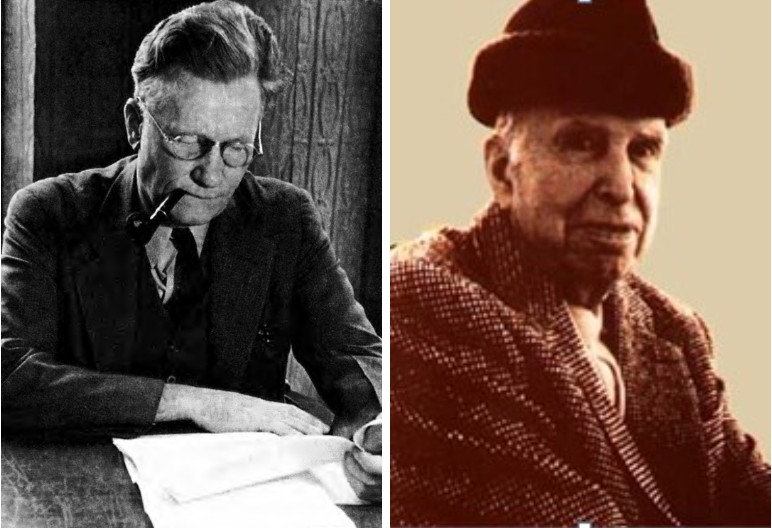
Karl Marx and Friedrich Engels

Marx and Engels witnessed several bourgeois elections. Unlike most anarchists (some consider the current situation and therefore oppose adopting abstentionist positions), Marxists do not advocate abstention or casting a blank vote in bourgeois elections. Karl Marx saw bourgeois elections as a limited instrument of the capitalist state, serving primarily for the bourgeoisie to manage its affairs and maintain power. However, he did not advocate abstention; he considered elections a secondary battleground for strengthening class consciousness, conducting revolutionary propaganda, and, when possible, winning seats in parliament to defend workers’ interests.

In 1864, Marx wrote a letter on behalf of the IWA (First International) congratulating Lincoln on his re-election. Despite considering him a representative of the bourgeoisie, Marx saw Lincoln as an honest leader capable of guiding the country to relative historical progress through industrialization in the northern US and the Union’s victory in the fight against the pro-slavery reaction of the South.

The participation of communist parties in bourgeois elections was seen as a way to bring the communist program to a wider audience and test the party’s strength. The classic Marxist position is not one of contempt, but of instrumental use of elections for revolutionary organization, without creating democratic illusions that the bourgeois state can be reformed to serve the workers.

In 1850, Marx and Engels, in their “Message from the Central Committee to the Communist League,” explained:

“The proletariat must ensure that everywhere, alongside the bourgeois democratic candidates, working-class candidates are proposed, as far as possible from among the members of the League, and that all possible means are used to elect them. Even where there is no hope of success, the workers must present their own candidates, to maintain their democracy, to maintain their autonomy, to gauge their strength, to bring their revolutionary position and the party’s views to the public.”

VI Lenin and the Bolsheviks

Although Lenin considered bourgeois elections a rotation of exploiters and oppressors in power, the Bolsheviks only advocated boycotting the national parliamentary elections (of the Duma) in 1905, during a period of revolutionary agitation in the Russian political landscape. At that time, workers possessed dual power structures, the soviets, workers’ and people’s councils; the Social Democratic Labour Party (Bolsheviks and Mensheviks) was illegal and could not field candidates; and the assembly of elected federal deputies was not deliberative, but merely consultative, thus being used by the Tsar to divert the popular momentum of the 1905 revolution. However, after that year, when the revolutionary political situation had already dissipated, the Bolsheviks participated in the Duma elections under the Tsarist dictatorship.

In opposition to the sectarians who admired the Bolshevik revolutionaries but veered towards leftist political positions in the Third International, Lenin wrote, in 1920, the booklet “Left-Wing Communism: An Infantile Disorder.” The main leader of the Bolshevik revolution rebutted the German “left-wing” communists, who advocated boycotting parliamentary elections, considering that communists should not participate in the bourgeois Parliament, a politically outdated and obsolete institution.

“As is natural, for the communists in Germany, parliamentarism has become ‘politically obsolete’; but the point is precisely not to assume that what is obsolete for us has become obsolete for the class, for the masses. Once again, we find that the ‘leftists’ do not know how to reason, they do not know how to conduct themselves as the party of the class, as the party of the masses. Your duty is not to descend to the level of the masses, to the level of the backward sectors of the class. This is not debatable. You have an obligation to tell them the bitter truth: to tell them that their bourgeois-democratic and parliamentary illusions are nothing more than that: illusions. At the same time, however, you must calmly observe the real state of consciousness and preparedness of the entire class (and not just its communist vanguard), of the entire working mass (and not just its advanced elements).”

In 1920, the Second Congress of the Third International was also held. At that time, revolutionaries considered it an obligation for communists to use the platform for public speaking, even though they placed no illusions in it.

“Communist deputies are obliged to use the parliamentary platform to unmask not only the bourgeoisie and its official lackeys, but also the social-patriots, the reformists, the centrist politicians and, in general, the adversaries of communism, and also to widely propagate the ideas of the Third International; communist deputies, even if only one or two, are obliged to challenge capitalism in all their actions and never forget that only those who reveal themselves not verbally, but through actions, as enemies of bourgeois society and its social-patriotic servants are worthy of the name of communist.”

Karl Liebknecht

Unlike the German “left communists,” a leader of the internationalist wing of social democracy carried out a new type of parliamentary activity. Karl Liebknecht was elected in 1912 to the seat of Potsdam-Spandau-Osthavelland by the  SPD , the German Social Democratic Party .  On December 2, 1914, “even though he was alone” (in the face of the nationalist betrayal of his SPD colleagues), he voted against a second war budget for the army in the German Parliament ( Reichstag) ,  arguing against the imperialist nature of the First World War and defending the principles of proletarian internationalism.

Liebknecht continued to expose the Krupp scandals , showing that arms companies were bribing officials in the War Ministry.  In 1916, he was the only member of parliament to speak out against the Armenian genocide and continued to denounce German war policies.  Due to his outspoken opposition, he was arrested for “high treason” in 1916 and lost his immunity.  Liebknecht was released in 1918, founded the Spartacist League, and was assassinated in 1919, along with Rosa Luxemburg. 

Antonio Gramsci

Gramsci helped found the Italian Communist Party (PCI) in 1921 in the city of Livorno, as a section of the Third Communist International. The PCI was born from a split in the Italian Socialist Party at its 17th Congress. At the PCI’s founding, the majority of the party belonged to an abstentionist faction, led by Amadeo Bordiga, but Gramsci was elected to the Central Committee of the new party. For the Italian communist, in Russia, “in the East,” the “war of maneuver” was victorious, referring to the Bolshevik revolution of 1917, but this concept could be extended to the Korean, Chinese, and Vietnamese revolutions. Gramsci emphasized that in the West, where civil society possessed a robust structure, the “war of position” should prevail so that communists could conquer civil society before seizing political power.

This does not mean that elections are the ultimate goal, but rather a terrain of political and ideological dispute within the context of the struggle for  cultural hegemony  over society. Cuba, due to the particularities of its class struggle, was the only exception in the West to carry out a social revolution, that is, the conquest of political power through “war of maneuver”.

The Italian thinker was elected deputy in 1924. On April 6th of that year, 15 communist deputies were elected in Italy, obtaining 304,719 votes, representing 4.6%. Gramsci was elected even though he was outside the country. He was in the USSR, representing the Italian Communist Party (PCI) in the Communist International (Comintern), and even so, he obtained 1,856 votes for the Veneto district. Taking advantage of parliamentary immunity, he returned to Italy the following month. In his work, Gramsci used parliament to criticize the bourgeois state and disseminate socialist ideas, even after the fascist seizure of power. On October 28, 1922, the March on Rome by the fascists, led by Benito Mussolini, took place.

Gramsci viewed parliament as a space for the workers’ party (the ” modern prince “) to educate the working class, win minds, and build collective will, focusing on “grand politics” and structural transformation, not merely on occupying positions, the opportunistic and careerist “petty politics.” ” The party is the best form of organization, and unions and councils are intermediate forms of organization, in which the most conscious members of the proletariat position themselves in the struggle against capital ” (L’Ordine Nuovo, 1921). Elections would be an important moment, but not the only one, in the class struggle to contest and influence civil society and build cultural hegemony. The political party, for Gramsci, is a “collective intellectual” that must promote intellectual and moral reform, overcoming the immediate interests of “petty politics.” 

Gramsci emphasizes the need for a strategic, long-term vision in the class struggle, through the “war of positions” for the contest of cultural and political hegemony. Therefore, bourgeois elections are not isolated, isolated events that occur every two years (in Brazil), but part of a permanent struggle that takes many forms—union, parliamentary, direct—for the conquest of power for the workers, where the parties and movements of the working class must organize civil society in favor of the immediate and historical interests of their class, they must train leading political cadres, territorial leadership, by workplace, in the construction of networks of mutual support for a long-term struggle.

Leon Trotsky

One of the main leaders of the Bolshevik revolution and a theorist of Marxism, he devoted considerable attention to the debate on the participation of communists in bourgeois elections. Just as Lenin saw a strain of sectarians growing among the international supporters of Bolshevism, Trotsky also identified the growth of a leftist lineage within the ranks of his Fourth International, a lineage that has become dominant among organizations that claim to be Trotskyist today. The analyses of the founder of the Red Army led him to a firm position against abstentionism and null votes, considering them tactics detrimental to building the revolutionary struggle.

Trotsky vehemently criticized the idea that revolutionaries should completely abstain from participating in elections. For him, this stance, known as abstentionism, was a mistake that demonstrated weakness and a misunderstanding of the dynamics of class struggle. In a 1931 text on Spain, Trotsky argues that if communists “turned their backs on the Cortes (a type of Spanish parliament in the early 1930s), opposing them with the slogan of the soviets and the dictatorship of the proletariat, they would only demonstrate that they cannot be taken seriously .” He advocated using elections and parliament as a platform for propaganda and agitation to dissipate the illusions of workers in their socialist leaders, “demanding things from the government. It is their leaders who are in it…”  without ever losing sight of the ultimate goal of the revolution. Electoral participation was, therefore, a tactical means of reaching the masses and exposing the contradictions of the capitalist system.

“If the communists, at this stage, were to turn their backs on the Cortes, opposing them with the slogan of the soviets and the dictatorship of the proletariat, they would only demonstrate that they cannot be taken seriously. There is probably not a single communist in the Cortes (this is the information transmitted by the Turkish telegrams). It is clear that the revolutionary wing is always stronger in action, in struggle, than in parliamentary representation. But even so, there is a certain relationship between the strength of the revolutionary party and its representation in parliament. The fragility of Spanish communism is perfectly evident. Under these conditions, to speak of the overthrow of bourgeois parliamentarism by the dictatorship of the proletariat would simply be to play the role of imbeciles and chatterboxes. The task is to strengthen the party in the parliamentary phase of the revolution, mobilizing the masses. Only in this way can parliamentarism be overcome. But precisely for this purpose it is indispensable to develop a fierce agitation under the most decisive and extreme democratic slogans.”

What should be the criteria for launching slogans? On the one hand, the general direction of revolutionary development, which determines our strategic line; on the other, the stage of mass consciousness. The communist who does not take this latter factor into account will complicate matters. Let us reflect a little on how the Spanish workers, en masse, view the current situation. Their leaders, the socialists, hold power. This increases the demands and tenacity of the workers. Every striker will conclude that the government should not only not be feared, but, on the contrary, should be expected to help. The communist must direct the workers’ thinking precisely in this direction: “Demand things from the government. It is your leaders who are in it.” The socialists, in response to the workers’ delegations, will claim that they do not yet have a majority. The answer is clear: with a truly democratic electoral right and the rupture of the coalition with the bourgeoisie, a majority is assured. But this is what the socialists do not want. The situation in which they find themselves contradicts the slogans of a full democracy. “If we simply oppose the Cortes, the dictatorship of the proletariat, or the soviets, we unite the workers with the socialists, for both will say: ‘The communists want to rule us.’ Already under the banner of democracy and the separation between socialists and bourgeois, we foment the split between workers and socialists and prepare the ground for the next stage of the revolution.” ( Leon Trotsky,  Spain :  Tactics Arising from  Electoral Results,  July 1, 1931 ).

For Trotsky, ” revolutionary abstentionism ” would be a misguided tactic. Although some contemporary Trotskyist groups advocate null votes, abstention, or boycotts of any and all bourgeois elections as a form of protest, Trotsky’s position was quite different. In a 1939 letter, he criticizes the proposal of “revolutionary abstention” in municipal elections, made by a militant named Vereeken, considering it ” extravagant nonsense ” and a tactic that confused intransigence on small issues with opportunism on large ones.

“It is with immense satisfaction that we, here in Coyoacán, read the declaration of the councilors of Flénu, members of the PSR  .  Bravo! In this moment of retreat, cowardice, and confusion, their two magnificent declarations bring true comfort to every true revolutionary.  Poor Vereeken, who never misses an opportunity to commit some extravagant gaffe (very “intransigent” on small issues, very opportunistic on large ones, like Spain and France), proposed “revolutionary” abstention in the municipal elections. Even without any other result of electoral participation besides their two declarations, Marxist politics would already be fully justified, if it ever needed further justification.” Leon Trotsky: Letter to the Socialist Party, February 12, 1939 ).

Revolutionary abstentionism, which finds some adherents among sectarian Trotskyists of yesterday and today, is a way of abdicating the responsibility of intervening in political reality, leaving the field open for the bourgeoisie. Instead of withdrawing, the revolutionary should actively participate to denounce the electoral farce and build an independent alternative.

Trotsky’s defense of electoral participation did not signify adherence to the system, but rather a strategy to use it as an instrument of struggle. He believed that participation in elections allowed for: Propaganda and agitation: The electoral platform offered a unique opportunity to disseminate socialist ideas and denounce the evils of capitalism to a wider audience; Organization of the working class: Electoral campaigns forced the organization and mobilization of militants, strengthening the party and its ties with the masses; Experience and rupture with social democracy: Participation in elections allowed for the exposure of the betrayal of social-democratic and Stalinist parties, which collaborated with the bourgeoisie and diverted the revolutionary struggle; Preparation for revolution: The electoral experience, although limited, served as a school of politics for the masses, helping to unmask the deceptive nature of bourgeois democracy and prepare the ground for the socialist revolution.

In short, we deny that Marx, Engels, Lenin, or Trotsky ever advocated revolutionary abstentionism, null votes, or anything similar. Marxists see abstentionism and null votes as tactics that ultimately weaken the revolutionary movement. They advocated participation in bourgeois elections, but always as a tactical tool subordinated to the strategic objective of the revolution. Preferably, this participation should be through their own parties and candidacies, followed by reformist candidacies supported by the vast majority of workers. Electoral participation should serve to build class consciousness, organize workers, and expose the corrupt nature of the system, never to legitimize it or seek reforms within its limits. For Trotsky, true social transformation would come from direct action and the revolutionary struggle of the masses, not from the ballot box, but the organized force capable of seizing power would need to go through various experiences capable of overcoming the majority illusions in reformist organizations.

The Communist League’s position in 2022 :

Below, we reproduce the electoral position adopted by the Communist League (the predecessor group to Emancipation of Labor) 4 years ago, when we were part of a progressive mass movement that prevented the re-election of the fascist Bolsonaro. Even though this puppet of big finance capital, imperialism, and a broad coup front carried out numerous stratagems to impose himself, managing, despite his government’s responsibility for the 700,000 deaths of the pandemic, as an example of his numerous crimes, to obtain 400,000 more votes in 2022 than in 2018, the organized force of the population gave the PT candidate 60 million votes, the highest vote count for a president in the entire history of Brazil.

Although we knew and even anticipated that Lula tended to frustrate the expectations of the masses who longed to sweep away Bolsonaro’s policies, his coup-mongering, and his legacy of fiscal reforms, privatizations, and counter-reforms, it was right to follow the political evolution of the proletariat’s consciousness while Lula’s victory interrupted the offensive against labor and social rights, the times of hunger and long lines for food, and the fascist escalation. Thus, we said at the time:

“We start from a basic truth: it is the organized masses of millions who will bring about the transformations that Brazil needs. That is why we stand with the millions who will vote for Lula, following his political evolution.”

Therefore, it is a sectarian error to defend the null vote as if it were something revolutionary. In the current situation, it is nothing more than a marginal participation in the electoral process, typical of groups without dialogue with the masses, marginal nuclei of academic intellectuals, and anarchist groups without social weight. Likewise, the candidacies of the PSTU, PCB, and UP are a sectarian error, as they cannot even form a united electoral front, remaining invisible to the working class.

However, voting for Lula does not mean capitulating to the reformist strategy of a broad front with the coup-plotting business sector and imperialism. These sectors will never accept measures such as agrarian reform, national sovereignty, renationalization, price and rent freezes, strengthening public health and education, repeal of spending caps, and nationalization of the financial system, for example. 

Communists participate in the electoral struggle as long as the masses lack sufficient awareness and organization to build their own power structures capable of overcoming the bourgeois state through socialist revolution. In the current situation, the Communist League supports candidates for state/federal deputy in São Paulo, Pernambuco, Paraná, and Ceará with the aim of strengthening the united front against the bourgeoisie and imperialism. It is a way of dialoguing with the most politically aware sectors of our class.” (Editorial of FT34: With Lula, against Bolsonaro! Beyond Lula, against the broad front with the coup-plotting business class!)

In short: the Marxist tradition of almost two centuries has nothing to do with sectarian abstentionism. The Bolsheviks only boycotted bourgeois elections once, and rightly so, during a revolutionary process in 1905. But it is pure leftist naiveté to believe that a boycott, in itself, defended permanently and independently of the political conjuncture, can generate some kind of revolutionary situation, a shift in political consciousness, or cause the masses to follow the boycotters. Furthermore, Marxists are obliged to participate in bourgeois elections precisely to contest the consciousness of the workers in this inhospitable terrain, because most of the time, the thinking of the dominant classes is the dominant thinking in the dominated class, and the working population places illusions in the democracy of the rich.

Thus, the tactical question of participation in bourgeois elections must obey conjunctural mediations. This is even more so when the threat grows on the regional horizon, not of socialist revolution, but of Trumpist coups, of fascist counter-revolution, since fascism is a bourgeois party with mass influence, capable of mobilizing them against other workers and the left. Hence the importance of electoral polarization for recruiting and organizing the left-wing sectors of the working class.

Currently, Flávio Bolsonaro’s candidacy is supported by a broad front of the national ruling classes and by a declining imperialism, which is retreating from its global domains in the face of the growing geopolitical influence of the China-Russia-Iran axis, but seeks to refocus on the American continent. This situation demands the tactic of a united anti-fascist and anti-imperialist front to mobilize the population for struggle in the streets, economically, and also in the electoral arena. Therefore, the first part of the electoral conference of the Emancipation of Labor Group unanimously decided to support the Workers’ Party’s candidacy for the presidency of Brazil in 2026. 

The Brazilian Chapter of the Anti-Fascist International and the Porto Alegre “Conference”

(From the Brazilian Section of the LCFI)

International anti-fascist and anti-imperialist forums and the need for permanent united front organizations.

The Brazilian Chapter of the Anti-Fascist International, organized in several Brazilian cities such as Brasília, São Paulo, Campinas, and Rio de Janeiro, is one of the many national chapters created by the World Meeting of the Anti-Fascist International , which brought together 1,100 delegates representing 76 countries in Caracas on November 28, 2024.

Caracas, Venezuela, 28 November 2024

The event in the Venezuelan capital was not the first of its kind; however, it was one of the largest and the only one that generated national chapters, regular, active, and permanent anti-fascist and anti-imperialist united fronts, expressions of organized international collective resistance to the current Nazi escalation of imperialism, Zionism, and their national satellites. These expressions of workers’ organizations and the world left have held important forums in the last four years.

The first such major international anti-imperialist and anti-fascist activity took place in Paris in 2022: the Anti-Imperialist Platform , also known as the World Anti-Imperialist Platform (WAI). From the outset, the Emancipation of Labor Group has supported this international movement. The Liaison Committee for the Fourth International (LCFI) and Marxist Speak Out—the latter formed from the unity of organizations across five continents that defended Russia against NATO in the 2022 Ukraine War—also endorsed the Paris Platform Declaration .

In 2023, the First International Anti-Fascist Forum was held in Minsk, Belarus, with the participation of 50 countries. The Minsk Forum was born precisely in response to the return of Nazism in Europe, when, following the Euromaidan coup d’état of 2014, openly Nazi parties returned to power for the first time on that continent since Hitler’s defeat in 1945.

In 2025, the Second International Anti-Fascist Forum took place in Moscow, Russia, bringing together 92 countries, almost double the participation of the First Forum, and was hosted by the Communist Party of the Russian Federation.

Summary of the “First Conference” in Porto Alegre

Despite the existence of these large and representative previous forums, between March 26 and 29, 2026, a new event was held in Porto Alegre, Brazil, which proclaimed itself the “First International Anti-Fascist Conference,” apparently to mark its discontinuity with previous political and organizational developments. The Porto Alegre Conference did not prioritize the construction of permanent united fronts among its participants. The main resolution was to vaguely indicate a desire to hold a future Conference, somewhat in the style of the world Social Forums, but smaller and with less institutional support. After the event, each person continues on their own, in their atomized, electoral campaigns, to combat an increasingly violent and audacious fascism against all workers and the oppressed, an instrument of imperialism for the recolonization of the American continent.

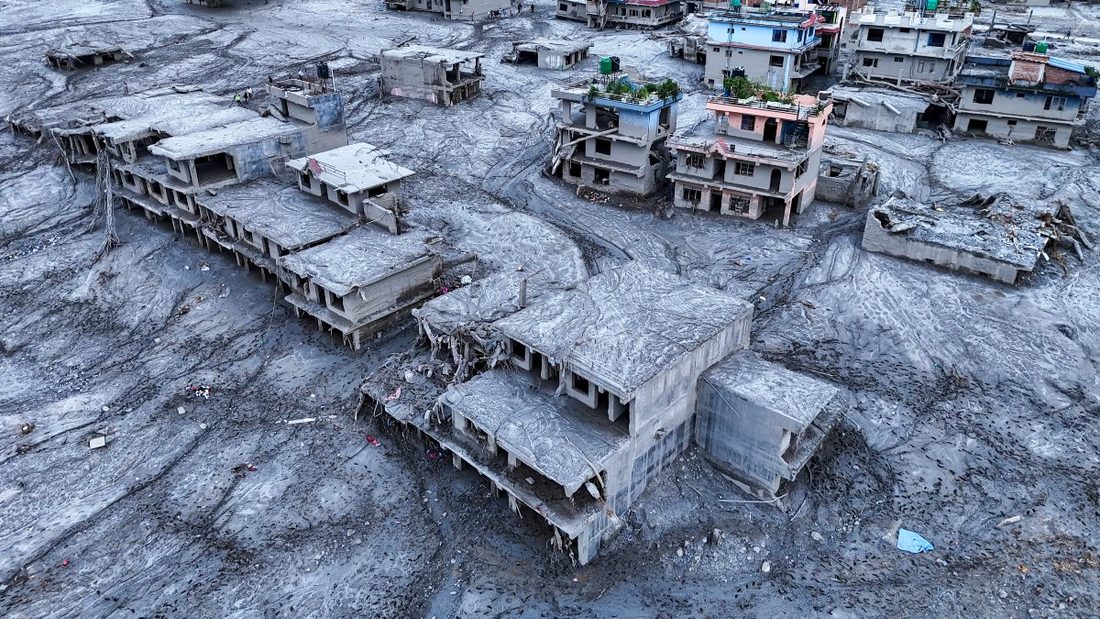
The “First Conference” was also the smallest of the forums in terms of the number of international delegations present. According to the organizers themselves, it brought together around 40 countries. Initially, this activity was scheduled to take place in May 2024. The initiative came from a spectrum of the left, dominated by a wing of the PSOL, the Socialist Left Movement (MES). However, the idea was rendered unfeasible that year due to the flooding that hit Rio Grande do Sul and Porto Alegre. This event allowed for some changes to the original idea, with the incorporation of the Communist Party of Brazil (PCdoB), the Workers’ Party (PT) in Rio Grande do Sul, and the Socialism and Liberty Party (PSOL). According to the organizers, more than four thousand people participated in the event, with 11 structuring panels and dozens of self-managed panels.

Despite the need to establish the fight against fascism and imperialism—which promoted genocide in Gaza, invaded Venezuela, intensified the blockade against Cuba, and attacked Iran—as the central focus of the debate, the Conference was hampered by the ambiguous character given to the anti-imperialist and anti-fascist struggle by the PSOL party and, to some extent, by the PT party.

The national PT (Workers’ Party) formally supported the activity from afar. Neither members of the party’s national leadership nor those of the federal government participated, as if we didn’t need, in Brazil in 2026, a major conference to organize the fight against fascism and coup-mongering, more turbocharged than ever by the right wing, the far right, the Centrão (center-right bloc), Faria Lima (a financial district in São Paulo), the mainstream media, drug trafficking, evangelical companies, the banking sector, and, above all, the White House itself.

The PT and PSOL parties avoided taking Russia’s side in the anti-imperialist war that this country has been waging since 2022 against NATO, which uses the Nazi government in Kiev as its puppet.

The Brazilian government opposed Venezuela’s entry into BRICS, which would have strengthened solidarity between both countries against the coup attempt threatening both left-wing governments. The PT and PSOL parties opposed defending Venezuela’s sovereignty against external pressure in the last presidential elections, yet another coup attempt by imperialism and its local fascist agents, who have been trying to overthrow Chavismo since 2002. Despite the profound solidarity of Chavismo and Maduro with the PT and Lula against the coup attempts in 2016 and 2018, the PT leadership and Lula’s government had a distinct, almost opposite, policy, not even demanding the release of Maduro and Cilia Flores, kidnapped by the Trump administration on January 3, 2026.

At the “First Conference” in Porto Alegre, PSOL even held a self-organized event under the name “The Ukrainian people and their working class facing the war of aggression by Putin’s Russia.” The words “people” and “working class” here are mere fanciful camouflages for the defense of NATO policy and its fascist puppet by MES and PSOL (this tendency within PSOL is known for supporting Lava Jato , a coup-plotting policy of imperialism, through lawfare). 

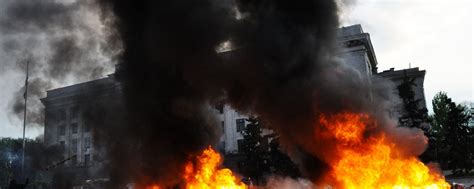
In real life, the Ukrainian people have been victims of an artificial fratricidal division, of neo-Nazi oppression by organizations such as the Azov Battalion and the Right Sector, for 12 years. Through the Democratic Party’s Obama-Biden administrations, the US and its allies financed, armed, and organized a fascist coup in Kiev in 2014. These organizations are part of the Vladimir Zelensky dictatorship – whose mandate expired on May 20, 2024, and the arch-corrupt clown of the West continues to wage war to perpetuate himself in power – and claim to be the political heirs of the Nazi collaborationist phalanxes. 14,000 people have been killed since 2014, mostly in the regions where the true industrial and mining working class of eastern Ukraine predominates, in Lugansk and Donetsk (Donbass), which are Russian-speaking. Terrible massacres were committed against the Ukrainian people and working class by NATO agents in the Kiev government, such as the massacre at the Trade Union House on May 2, 2014, resulting in the murder of approximately 42 trade unionists. Thus, behind deceptive, leftist, “popular,” and “working-class” rhetoric, these promoters of the Anti-Fascist Conference propagate the interests of the Kiev fascists, puppets of imperialism. We therefore have a type of anti-fascist who defends fascists.

In turn, the Russian side of the war is criminalized and demonized. However, in its alliance with the peoples of Donbass, the Russian government, supported by China, Iran, and North Korea, is engaged in a war of self-defence and national liberation against the imperialist attack and NATO’s expansionist march towards Eastern Europe. If we criticize the Russian government, it is for having waited too long to defend the Ukrainian people and the working class from the violent Nazi oppression in Kiev, which captures and kidnaps Ukrainian citizens from the west to force them to kill those from the east. In its global totality, this is a struggle between imperialism and the oppressed peoples of the world. Russia and China are not imperialist; they are oppressed by imperialism through sanctions, blockades, and permanent threats; they are the strategic enemy of Western big capital, as we have demonstrated, among other things, in the article ” Russia, China, and Socialism .”

The “Porto Alegre Charter“, the final document of the “First Conference,” reflected less a conjunction of distinct conceptions, which would be natural in a broad, united front forum, and more an ambiguous stitching together that neutralizes the political potential and fighting spirit of many of the delegations present. The central concern of the PSOL (Socialism and Liberty Party) was not the fight against US imperialism and its henchmen, which wants to recolonize the American continent, seize Greenland, attacked Venezuela, the Caribbean, strangle Cuba, attacked Iran—all this only in 2026, and has been doing this to the whole world for centuries—but the abstraction of “imperialisms”: “We fight against all imperialisms and support the struggle of peoples for their self-determination, by all necessary means.” In a rather unsubtle way, it reproduces the G-7 war propaganda that Russia (invaded by Napoleon in the 19th century, by Hitler in the 20th century, surrounded by NATO military bases in the 21st century) is not defending itself but advancing against the supposed self-determination of Ukraine and wants to invade Europe.

The conception of this faction of organizers wasted the anti-fascist and anti-imperialist forces of the “Conference” by demonizing peoples and nations that are our allies in the anti-imperialist struggle and are targets of the very same, by propagating that China is also imperialist, that Iran, Venezuela and Cuba are dictatorships,… trafficking ideological conceptions of the imperialist war propaganda itself into the “Conference” and the forums of the left that need to organize to fight and defeat the Trumpist offensive. An important criticism of the Porto Alegre Charter was made by the president of Cebrapaz, José Reinando Carvalho: “Anti-fascist unity demands strategic clarity and priority in the fight against US imperialism“.

Apparently, with the same intention of marking a break from previous international anti-fascist and anti-imperialist forums, the organizers of the “First Conference” never invited the Brazilian Chapter of the Anti-Fascist International to participate in organizing the Porto Alegre event; at most, we were invited to participate in a panel discussion.

However, without any self-proclamatory or sectarian character, members of the operational staff of the Brazilian Chapter of the Anti-Fascist International registered for and participated in the activity in the capital of Rio Grande do Sul. Comrade Pedro Batista, from the Chapter’s operational staff, participated in one of the structuring panels, a moment that can be accessed in this video: “Pedro Batista, from the Anti-Fascist International, at the Porto Alegre Seminar, 3/27/2026 “.

March 27th, the Chapter held an important self-organized roundtable entitled “The Construction of the Antifascist International,” with the participation of Ana Prestes and Ricardo Alemão (PCdoB); Ni, from the MNLM Movement for the struggle for housing; Carlos Pronzato (filmmaker); Acilino Ribeiro, from Unipop; Pedro Batista, from the IA-BR Operative; Sérgio Lösch, from LCB; Ricardo Harsbaert, from ACJM – RS; German Motta (TMB) and Nancy Gonzales (Union de Musicos/CTA), from the construction committee of the Argentine Chapter of the Antifascist International; and Érico Cardoso, from the Emancipation of Labor Group. At the end, the creation of the IA-BR RS Nucleus was initiated

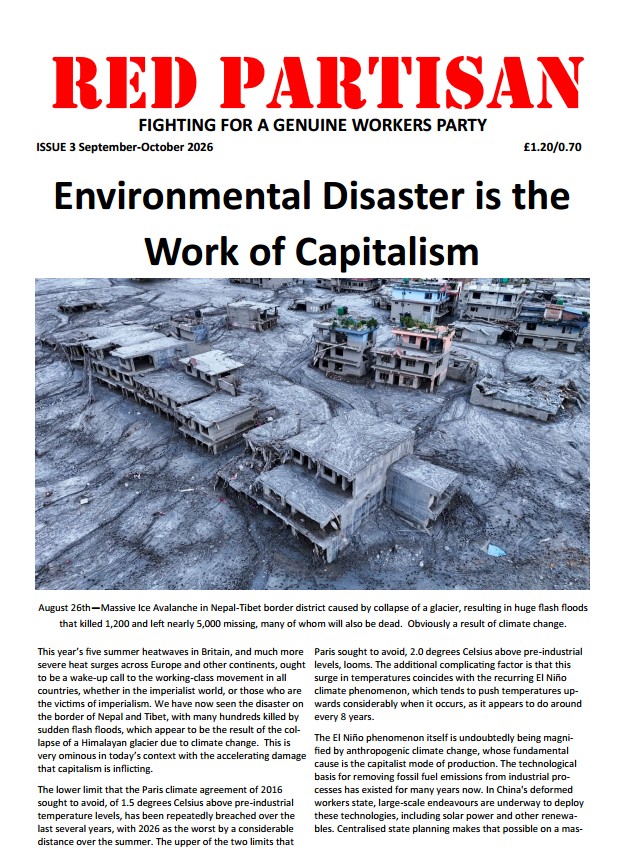
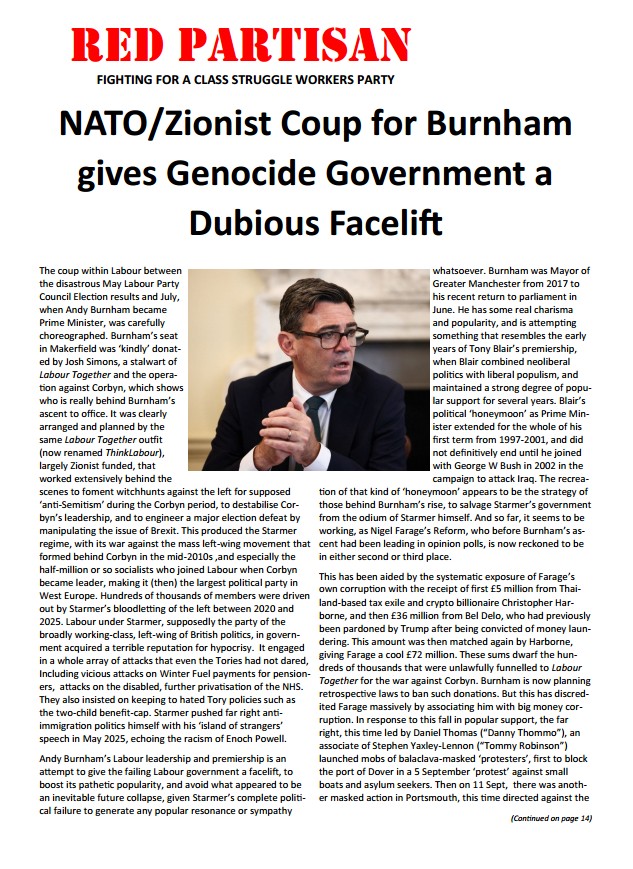
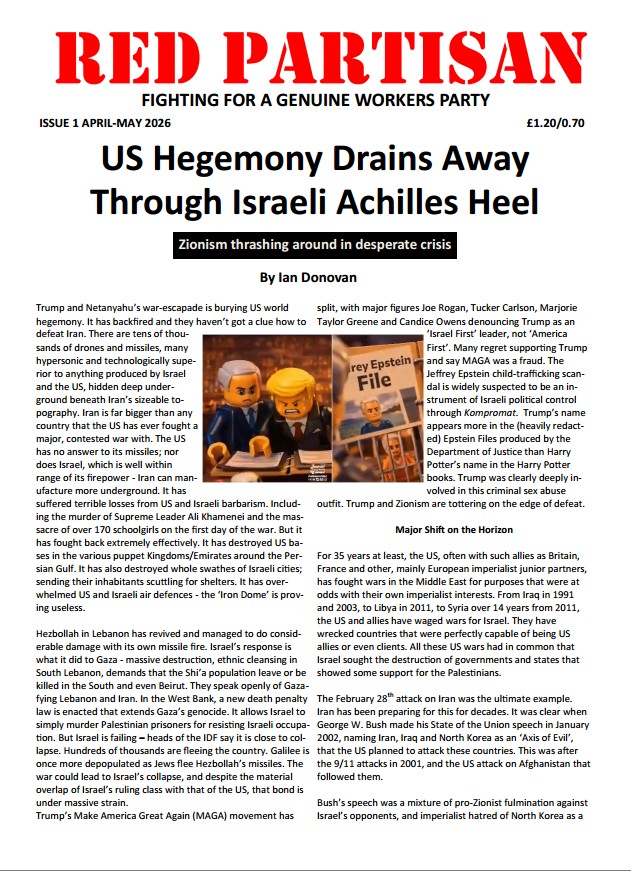
New Marxist Journal – Red Partisan – Issue 1 out now!

Red Partisan is a new Marxist journal published by Consistent Democrats and like-minded others involved in Your Party, the party initiated by Zarah Sultana last July, and less than whole-heartedly endorsed by Jeremy Corbyn. However, it struck an enormous chord in the working-class population, as shown by the 800,000 who signed up as YP supporters in August 2025.

The whole point of this new journal is to emphasise the need for a proper working-class party, not merely ‘business as usual’ leftist political activity, which has often been at a distance from any perspective of playing a role in the birth of a mass party of the working class. But now we are in a situation where such a change in politics is both urgent and possible. The catastrophic decline in both Labour and the Conservative party in this decade, and conversely the rise of the ‘respectable’ far right Reform – really the UK version of Trumpism, which in its second term has plunged the US close to fascism and the world close to World War, shows the urgent necessity of a serious engagement with the practical need  for a working class mass party.

The sabotage of YP by the Corbynites has itself further fuelled the volatility of politics in Britain today. Last year, the 800,000 that signed up for Your Party themselves indicated how volatile things are. Then we had the very public attack by Corbynites on the first membership portal by Zarah Sultana, and a series of virulent briefings against her in the reactionary media. The wave of popular enthusiasm for the new party, ridiculously named ‘Your Party’ by Corbyn rapidly wore off.  And at roughly the same time, the Green Party gained a left-talking new leader, who attacked Zionism and NATO, and no doubt consciously tailored his profile to appeal to those attracted to YP. The Greens gained more than 100,000 actual new members, while YP withered, having gained less than 60,000 members by the time of its founding conference in November.

In the first period of Starmer’s ‘Labour’ government, after July 2024, such was the popular odium of the government’s attacks on pensioners’ winter fuel payments, keeping the Tory 2-child benefit cap, and attacks on disability benefits, that the far right were able to take advantage of this and mount a racist, xenophobic offensive. Two summers running there have been waves of far-right attacks on refugees. In summer 2025 there was the ‘Raise the Colours’ far right tactic of plastering lampposts with Union and England flags, and painting roundabouts with similar insignia. Then the left was massively outnumbered and tactically defeat by Yaxley’s 150,000 strong march in Central London last September. And as a result of this, Farage’s Reform party for a year or so has been the leading party in opinion polls.

There has been a counter-offensive with the 500,000 Together Alliance London march in late March 2026, which even though its politics were laced with liberal and ‘peace and love’ type illusions, does represent a counterattack by anti-racists and socialists. Given the huge problems and disappointment with Your Party, the petit-bourgeois Greens have filled the vacuum on the left and are now neck-and-neck with Farage’s party in the polls, with some showing the Greens in the lead. This is obviously an improvement in some sense, but the Greens are not a working-class party, which is a huge problem and means that this turnaround is not at all secure or to be relied on. The only real antidote to fascism is a solidly working-class party, and it is to this that Red Partisan is oriented to playing a constructive but critical – when necessary, harshly so – role in creating.

In this vein, the new journal contains a page titled, “A Revolutionary Platform for Your Party”. An earlier attempt at such a platform was produced by the Spartacist League/Britain last year, as YP was at an earlier stage. They invited others on the left to submit amendments, and the Consistent Democrats responded by noting there were some serious flaws in the original. Notably, we identified a one-sided hostility to the liberal left, linked to a degree of softness on the populist right, adaptation to anti-migrant sentiment, and the lack of a point in their programme addressing the danger of fascism. They did not like our changes or want to discuss them at this point, but we consider the result to be a reasonable starting point for discussion on the programme we need, so it does serve well as the basis for the journal.

The first issue contains a major article on Trump’s and Israel’s brutal war on Iran, a detailed analysis as to why this war is clearly driven by Israeli interests, and how that can be in terms of a historical materialist analysis. It centres on the way this war is draining away US world hegemony and creating a new world situation. There is also a major article on Your Party, which deals with the fundamental dishonesty of Corbyn and those around him in taking control of the movement generated from Zarah Sultana’s call for a new left-wing party, and effectively sabotaging it. It does offer some solutions to this situation.

Along with these main pieces is published two statements on the US/Israeli attack on Iran – one from the Consistent Democrats issued on 28 Feb, the day of the attack, and one from the Liaison Committee for the Fourth International produced a few days into the war. Subsidiary to this we have a short article on “Jerusalem Fever” – addressing the Christian religious fanaticism that interlaces with Zionism which has been very apparent in this war with the apocalyptic statements of Hesgeth, and the absurd ‘laying of hands’ on the paedophile Trump in the Oval Office by crazed Christian-Zionists.

There is also a piece on the building of a new national Holocaust memorial in London, supposedly as a symbol of the ‘fight against hatred’, but with the purposes in mind of Zionists in and out of government which are anything but that. This is about covering up and distracting from today’s Zionist genocide in Gaza, which is now being extended to Lebanon and Iran. The purpose behind this monument has nothing to do with preventing genocide.

One final important item in this is a short piece from the Tendance Militante Bolchevique of Argentina, noting the 50th anniversary of the 1976 Videla coup in Argentina, a key landmark in the reactionary offensive against the left in South America in the 70s. The parallels with Trump’s offensive of today are obvious.

We hope that this new journal plays a role in crystallising a new working-class political movement our of today’s volatile circumstances.

The Imperialist offensive and the tasks of workers

Argentina: 50 years after the genocidal coup

50 years ago, on March 24, 1976, a coup took place in Argentina that gave rise to a nationwide genocidal dictatorship. The coup was preceded by various forms of bourgeois state terrorism, notoriously the AAA (triple A) death squads – the Argentine Anti-Communist Alliance.  The coup was part of a series of dictatorships established in the Southern Cone, at the continental level. Its purpose was to exterminate the vanguard of working class and popular fighters, to open the way to the neo-colonization of the country. The consequences of the coup:  deindustrialization, dismantling the industrial proletariat, remain to this day.

In the current context, U.S. imperialism strengthens the offensive on the Americas as its area of influence, as was the case in the coup d’état by fraud in Honduras in November 2025 or the direct intervention in Venezuela with the kidnapping of Maduro in 2026

The capitalist economic groups that benefited from the coup and its economic policy have never been condemned. This is what allows the social base of what was the genocidal dictatorship to be maintained and today that is manifested in the growing denialism on the part of the far-right government of Milei.

Today the Milei government not only denies the crimes of the dictatorship, but is deeply complicity in the genocide of Zionism in Gaza, defending Israel and the war of aggression of imperialism against Iran, siding with the imperialist offensive.

During this offensive to retake the political and military control of US imperialism over the continent the workers vanguard must prepare for new struggles. In a context where only the regroupment of the working class can be a guarantee of a popular victory.

A Holocaust Memorial in London To Blunt the Memory of all the Genocides?

On 27 Jan 2026, the UK government let it be known that it intends to build a National Holocaust Memorial and Learning Centre in Victoria Tower Gardens, London. If this Memorial – originally envisaged by David Cameron – gets created as planned in 2027, it will be adjacent to the Houses of Parliament. The project announces that its aims is “to honour the victims of the Holocaust” and “help combat antisemitism”.

According to the Community Security Trust (CST), antisemitism has continued to rise in the UK, “near record levels in 2025”. An investigation conducted by the Institute for Jewish Policy Research (JPR) also found that “35% of Jews in Britain felt unsafe in 2025 compared with 9% in 2023”.

Writing in the Jewish Chronicle, Chief Rabbi Mirvis says that situating the memorial “in the shadow of the seat of our country’s democracy” will be “an eternal reminder to our political leaders that the fight against hatred is a fundamental part of the responsibility we have conferred upon them”.

The announcement of such a project to build a Holocaust Memorial in London might seem apposite therefore, particularly in view of the 27th January 2026 marking the 81st anniversary of the liberation of the Auschwitz-Birkenau concentration camp in 1945.

To mark the date, a group of Holocaust survivors from various countries held a simple street ceremony and demonstration in London this 27th January 2026.

 Holocaust survivor Agnes Kory who was present, although not on the picture, said that: “It was the Russian army that liberated the Jews of the Budapest Ghetto in 1945. It was a Russian soldier that liberated my mother and myself. At Memorial Day events I say this as loud as I can, making sure that the people around me can hear it.”

Survivor Haim Bresheeth-Žabner – Israeli peace activist – said: “I am deeply shocked about the total denial of the events in Gaza by the wide variety of Holocaust memorial institutions. All such institutions are run mostly by Zionist Jews, and all share an unwillingness to mention a genocide in real time [..]”.

Survivor Chris Romberg said: “The Holocaust was not the only massacre committed by the Nazis and their collaborators: the genocides of the Roma and Sinti (Porajmos) and of the Slavs took place in parallel, as did the murders of disabled people, LGBTQ+ people, political opponents and many others. They too should not be excluded from our memory, nor from the call Never Again! It applies to everyone.”

The official announcement about the Memorial specified that it will ‘remember’ the non-Jews, Romas and others. But in The Canary, an article by Ed Sykes says that “Never Again is meaningless if it does not characterise Gaza: “The denial of the Gaza Holocaust is the position of our Western leaders, and is a sign of moral decline” he says. Adding that the location and focus of the Holocaust Memorial in London (when built) “must not be used to shield Israel from criticism, or as a political tool.”

In the US and UK, complex networks of Jewish organisations have formed over many decades. They contain hundreds of cross-communal representative bodies (advocacy groups, charities, federations, councils, security trusts, deputies, student bodies, assemblies, political entities).  Over time, and since 1967 in particular, these networks have imbued society with the symbol of the Holocaust, as the only one, the Jewish one, “to secure support for Israel as strategic asset of ‘our’ Western leaders in the Middle East”*

In June-July 2025 at the Human Rights Council, and speaking about Gaza, Francesca Albanese declared “Israel [..] responsible for one of the cruellest genocides in modern times”. At the UN Human Rights Office on 3 July 2025, she said that Israel’s genocide against Palestinians is being sustained by a system of exploitative occupation and profit. This is precisely what Donald Trump’s behaviour is confirming in Gaza.

The Memorial in London will mention the other non-Jewish victims – something often omitted. But it will not mention that the USSR was the primary liberator of the Nazi killing sites. As ‘the Holocaust Memorial’, it will further aggrandize Jewish victimhood, just as Israel and the billionaires of world war criminalise any reference to genocide in Gaza. As Norman Finkelstein says, the Holocaust is used by the Jewish establishment, to exploit the Memory for political and financial gain.

The US Holocaust Museum condemns the governor of Minnesota Tim Walz for “comparing the crisis in Minneapolis with the tragic life of Anne Frank”. Walz had said that the US children, like Anne, are having to hide away from the ICE agents whom he calls “the modern Gestapo”. To this, Trump’s envoy, Rabbi Yehuda Kaploun retorted angrily that “Ann Frank was in Amsterdam legally and was targeted because she was Jewish. Nothing to do with illegal immigration. Our brave law enforcement should not be tarred with [..] this antisemitic comparison”.

Rabbi Mirvis says that building the Holocaust Memorial “in the shadow of the seat of our country’s democracy” will act as “an eternal reminder to our political leaders”. This would be laudable if the ‘reminder’ were not being used, as in this case, as a political cloak to try and obscure the continuing slide of capitalism into genocide and Nazism. 

Marie Lynam, posadiststoday.com – 29.1.26

* https://www.thecanary.co/uk/analysis/2026/02/27/palestine-censorship/

Jerusalem Fever

by Kalliste Hill

Trump’s preachers pray for Second Coming

Jerusalem Fever is, or rather was, a recognised delusional psychopathy affecting some visitors to the city, who fixated on Jerusalem as the City of God, on the delusion of a divine authority that gives the sufferer psychotic episodes and ecstatic visions, self-identification with biblical figures and the conviction that their actions can contribute to delivering the 2nd Coming by bringing on “the End Times”. In short Messianic delusions of the return of Jesus in the case of Christians, and the Messiah in the case of Jews. It was first recognised in modern times in the 1930’s and there were efforts to recognise it in the 1990’s in the DSM (Diagnostic and Statistical Manual of Mental Disorders) which were “conveniently” quashed by 2000 for reasons that should be causing serious concern to those who are working for opponents of imperialism’s genocidal wars. 

Historical cases are well documented from the Middle Ages amongst the pilgrims and visitors to the Holy Land, and Jerusalem in particular. Religious fanaticism increased in the ruling class, culminating during the period of the Crusades (between 1095 and 1291) in a series of bloodbaths of horrendous proportions that killed millions abroad and impoverished the lower classes at home – estimates vary between 1 and 9 million people – killing Jews and Muslims, and other Christians of different denominations. . The Vatican aimed to gain world domination for Roman Catholicism over all the Abrahamic religions by atrocities and genocide. The necessity of funding these wars by simony and usury eventually resulted in the Vatican falling victim to its own corruption as it lost moral authority, in turn spawning the Reformation, and Counter-Reformation. Its imperialist ambitions evolve and metastasize to this day into countless cults that bear no similarity to its origins, but instead focus on the goal of Zionism.

What we have seen since 1948 is a denial in the West of Jerusalem fever as a genuine mental disorder where one group of people hold increasingly hysterical and untenable attitudes to their neighbours, justifying apartheid and denial of basic right to self-determination and endless wars, right down to concentration camps, sexual abuse and starvation, genocide in the name of “self-defence” and their manifest destiny as the “Chosen People”. We see such things among both Jewish and Christian Zionists today.

 Those who visited Israel and saw the true situation for themselves came home to bravely stand witness to the atrocious realities of Israeli occupation. This stance clashes with the “see no evil, hear no evil, think no evil” attitude by the “Israel has a right to exist” of the die-hard left, and the blind hatred of all things communist by the right. Thus, both political wings fell prey to the weaponisation of words and policies pursued by the Zionists. Christian Zionism started with the manipulation of gullible believers with signs, trials and tribulations, and prophecies of global natural, economic and environmental disasters in the 19th century and 20th century in the service of Imperialism just as Christianity had served the Roman Empire under Constantine. Imperialist wars continue to bring death and destruction despite, or rather because of the League of Nations and its successors UN and NATO.  

This is a phenomenon of imperialism in decay, of which Zionism is a crucial part, attacking the rights of the masses with a variety of inventive techniques. In a myriad of ways, from the Holocaust Industry and the Hollywood mafia, controlling the information narrative, the legacy media to the secretive control of social media increasingly through to AI. It goes together with the manipulation of financial levers and stock markets by banks, insurance companies, hedge funds and the like. The artificial enhancement of the wealth of individuals using nepotism and insider trading, thanks to the corruption of the billionaire Epstein class with its many functionaries, from Trump to the Clintons to Mandelson to Starmer provide the funding to undermine  concepts such as Human Rights, the Geneva Convention, and crimes against humanity are increasingly chimerical under capitalism. 

The insistence of successive Israeli leaders extend to Western leaders and influencers to visit Jerusalem personally, often regularly, appear to exploit this phenomenon to pursue foreign policies that do not serve their own country but instead dedicate themselves to the sole interests of Israel, notably a succession of UK Prime Ministers culminating in Starmer’s election in 2025, declaiming his unequivocal support for Israel. Similarly, Trump, and his entire cabinet in 2024, including Chritian Zionist spiritual leaders as well as the Secretary for War, openly exhort their troops to fight for Israel and “God’s Plan”. Both, along with other European leaders, are trampling their own constitutions and citizens democratic rights to legitimise unpopular activities to support this genocidal state at the expense of their own interests.

It has long been the case that, as Trotsky once said, democracy was the most “aristocratic” form of class rule, confined to the privileged imperialist oppressor nations. But as imperialism flounders today, that aristocratic form is increasingly tenuous. Only socialist revolution on an international scale can reconquer even these basic rights.

US Hegemony Drains Away Through Israeli Achilles Heel

Zionism thrashing around in desperate crisis

By Ian Donovan

Trump and Netanyahu’s war-escapade is burying US world hegemony. It has backfired and they haven’t got a clue how to defeat Iran. There are tens of thousands of drones and missiles, many hypersonic and technologically superior to anything produced by Israel and the US, hidden deep underground beneath Iran’s sizeable topography. Iran is far bigger than any country that the US has ever fought a major, contested war with. The US has no answer to its missiles; nor does Israel, which is well within range of its firepower – Iran can manufacture more underground. It has suffered terrible losses from US and Israeli barbarism. Including the murder of Supreme Leader Ali Khamenei and the massacre of over 170 schoolgirls on the first day of the war. But it has fought back extremely effectively. It has destroyed US bases in the various puppet Kingdoms/Emirates around the Persian Gulf. It has also destroyed whole swathes of Israeli cities; sending their inhabitants scuttling for shelters. It has overwhelmed US and Israeli air defences – the ‘Iron Dome’ is proving useless.

Hezbollah in Lebanon has revived and managed to do considerable damage with its own missile fire. Israel’s response is what it did to Gaza – massive destruction, ethnic cleansing in South Lebanon, demands that the Shi’a population leave or be killed in the South and even Beirut. They speak openly of Gaza-fying Lebanon and Iran. In the West Bank, a new death penalty law is enacted that extends Gaza’s genocide. It allows Israel to simply murder Palestinian prisoners for resisting Israeli occupation. But Israel is failing – heads of the IDF say it is close to collapse. Hundreds of thousands are fleeing the country. Galilee is once more depopulated as Jews flee Hezbollah’s missiles. The war could lead to Israel’s collapse, and despite the material overlap of Israel’s ruling class with that of the US, that bond is under massive strain.

Trump’s Make America Great Again (MAGA) movement has split, with major figures Joe Rogan, Tucker Carlson, Marjorie Taylor Greene and Candice Owens denouncing Trump as an ‘Israel First’ leader, not ‘America First’. Many regret supporting Trump and say MAGA was a fraud. The Jeffrey Epstein child-trafficking scandal is widely suspected to be an instrument of Israeli political control through Kompromat.  Trump’s name appears more in the (heavily redacted) Epstein Files produced by the Department of Justice than Harry Potter’s name in the Harry Potter books. Trump was clearly deeply involved in this criminal sex abuse outfit. Trump and Zionism are tottering on the edge of defeat.

Major Shift on the Horizon

For 35 years at least, the US, often with such allies as Britain, France and other, mainly European imperialist junior partners, has fought wars in the Middle East for purposes that were at odds with their own imperialist interests. From Iraq in 1991 and 2003, to Libya in 2011, to Syria over 14 years from 2011, the US and allies have waged wars for Israel. They have wrecked countries that were perfectly capable of being US allies or even clients. All these US wars had in common that Israel sought the destruction of governments and states that showed some support for the Palestinians.

The February 28th attack on Iran was the ultimate example. Iran has been preparing for this for decades. It was clear when George W. Bush made his State of the Union speech in January 2002, naming Iran, Iraq and North Korea as an ‘Axis of Evil’, that the US planned to attack these countries. This was after the 9/11 attacks in 2001, and the US attack on Afghanistan that followed them.

Bush’s speech was a mixture of pro-Zionist fulmination against Israel’s opponents, and imperialist hatred of North Korea as a by-product of the Russian workers revolution of 1917. Its seriousness was underlined when Bush invaded Iraq in 2003. In response North Korea withdrew from the Non-Proliferation Treaty and by 2006 tested a nuclear weapon. Iran drew a different conclusion. It began preparing conventional defences against an attack which was certain to come one day. Ayatollah Ali Khamenei in October 2003 publicised his earlier mid-1990s fatwa forbidding the development, stockpiling and use of nuclear weapons. Iran’s decades-long development of missile technology, including hypersonics, working with other fraternal countries such as Russia and China, hidden in impregnable tunnels and bunkers, stood it in good stead for today.

This war represents a defeat for US imperialism that will far exceed that in Vietnam in 1975. The outcome in Vietnam was the victory of a social revolution in which the US played a straightforward counterrevolutionary role – and lost. But none of the wars the US has been fighting in the Middle East have been against social revolutions attacking capitalism, even locally. They have all been aimed at helping another imperialist power, Israel, dominate the Middle East in the service of its programme, Greater Israel. Its objectives are the conquest of large parts of the semi-colonial Arab and Muslim states nearby.  Both the Israeli flag, with its two blue stripes (representing the rivers Nile and Euphrates), and the maps circulated by its adherents, show this aim. This was shown by the list of targets that Wesley Clark revealed in 2007: Iraq, Syria, Lebanon, Libya, Somalia, Sudan and finally Iran. Any nearby state not servile to Israel is a target, even if they would be quite prepared to be allies or clients of US imperialism, if Israel were taken out of the equation.

They proved this by helping the US/Israel against each other at times. Iraq by attacking the Iranian Islamic Republic in 1980 – that war lasted until 1988. Iran did deals with US imperialism in the Iran-Contra affair of 1986-7, aiding its counterrevolutionary war against the leftist Sandinista government in Nicaragua, in return for brokering the release of hostages held by Shia fighters enraged by US support for Israeli crimes in Lebanon. Syria served in the US-led military coalition that expelled Iraq from Kuwait 1991, after Iraqi had in 1990 been lured into invading Kuwait by US Ambassador April Glaspie. She gave Saddam Hussein the green light to attack Kuwait in a dispute about Kuwait’s rulers siphoning off Iraqi oil under the border. This led to war, against her assurances. Libya became a US semi-ally in its 2000s ‘war on terror’; a place where the US and Britain ‘rendered’ Jihadist terrorists who had exceeded their remit. The US wanted such jihadists, al Qaeda mainly, to concentrate on the US-funded war against Assad in Syria, but some who attacked Western targets were rendered to Libya. Gaddafi disposed of Libya’s nuclear programme, convinced he was on the way to becoming a US client. But in the 2011 ‘Arab Spring’ the US under Obama used UN cover to invade Libya, murder Gaddafi and pulverise the country.

All these wars waged by the US or US-backed forces, often with allies such as Britain, are a product of the unusual intra-imperialist relationship between Israel and mainly, but not exclusively, the United States.  To a lesser degree this phenomenon affects the imperialist countries of Western Europe. Israel is an imperialist power in its own right; an advanced capitalist, colonising power which seeks to seize territory, and enriches itself at the expense of (particularly nearby) semi-colonial countries through capital exports. Israel is unusual among imperialist powers, as it was transplanted – it is not indigenous to the Middle East region except in its own exilic mythology. A large section of its ruling class does not live in Israel, though they have the right to live there and partake of the benefits of that bourgeois-imperialist state by birth.

Material Basis of Zionist Influence

Jews have an unusual, top-heavy social structure. On a world scale, in 2025 there were 3038 billionaires in the world according to the Fortune 5001 whereas the number of Jewish billionaires in the world, according to Forbes Israel, in 2025 was 2762. This means that, taking 2025 (last year) as the time of analysis, over 9% of billionaires in the world are Jewish, 9.055% to be more precise. Yet the number of Jews in the world is 15.8 million, which is 0.2% of the world’s population. This is approximately 45 times overrepresentation. The overwhelming majority of those Jewish billionaires live in the United States (163), Israel (39) and other imperialist countries of Western Europe, Canada and Australia (35) and a smattering elsewhere, including Russia, where a relatively lower number live (21). They are overwhelmingly concentrated in the imperialist West.

The overwhelmingly dominant ideology among bourgeois Jews is Political Zionism, an exilic ideology centred on Israel as a supposed refuge. Israel’s racist citizenship law, which gives those born Jewish anywhere in the world the right to citizenship, has the effect of creating a partially internationalised imperialist bourgeoisie loyal to Israel, who are massively and disproportionately represented in the US and West European ruling classes. The 2025 Forbes list puts the number of US billionaires in that year as 9023. As stated earlier, the number of US Jewish billionaires in 2025 was 163. Which means that 18% of billionaires in the US are Jewish, as compared to the proportion of Jewish people in the US population, which is 2%.  But that is not all – because as you go up the rankings of billionaires by wealth, the disproportionate representation of Jews increases dramatically. Of the top 10 billionaires by wealth in the US, 6 of them are Jewish – Larry Ellison, Mark Zuckerburg, Larry Page, Sergey Brin, Steve Ballmer and Michael Dell. The other four – non-Jewish – are Elon Musk (the wealthiest), Jeff Bezos, Warren Buffet and Jensen Huang. This can be determined by comparison of Forbes Israel with mundane US sources on billionaire wealth that do not distinguish ethnicity.

For Marxists, who understand that power in capitalist society, exercised from above, stems from capitalist wealth, this is the basis of the disproportionate power of Israel and Zionism in the US. The law of return gives Jewish bourgeois a direct interest through citizenship – in bourgeois terms a form of ownership — any bourgeois state is the de facto collective property of its bourgeois citizens – in the Israeli bourgeois state. There is no mystery about where this power comes from. No ‘conspiracy theory’ is needed to explain this, only Marxism – historical materialism – applied to today’s circumstances. Zionism is the dominant ideology of bourgeois Jews, but there are a minority of bourgeois Jews who do not embrace it or are reluctant to do so. One of the best known is the liberal philanthropist-financier George Soros, who has for his heresy been subjected to abuse that echoes old anti-Semitic themes, by some Zionists. Including Yair Netanyahu, son of Israel’s genocidaire leader, and Victor Orban, the rapidly pro-Zionist, very right-wing Hungarian leader.

This does not make Soros a friend of the working-class movement – he is a fervent supporter of US imperialism prominent in promoting the proxy Ukraine war against Russia: against a state considered by the US bourgeoisie as still embodying elements of working-class gains that originated in the 1917 Bolshevik Revolution.

Ruling Class Divisions

The US ruling class is divided as to whether this imperialist crusade against Russia – and even more China which is still a deformed workers state – is more important than its relationship with the Jewish-Zionist caste within the US imperialist bourgeoisie, described above. Trump’s attacks against Cuba and even Venezuela (which is not a workers’ state but a leftist ally of several) show he is just as anti-communist as his critics, but when forced to choose he prefers to back Israel. There is an element of bourgeois political cultism about the relationship with Zionism, because the imperialist bourgeoisie have changed their attitude to their Jewish brethren 180 degrees since Hitler’s day. In that period, the latter were regarded with suspicion by association with the strong and progressive role that Jews played in the early workers movement and in struggles for bourgeois democracy against feudal reaction. Whereas today the Jewish-Zionist bourgeoisie is seen by the bourgeoisie as the most class-conscious element of that bourgeois class4. This echoes Zionist strategy. Though in the early period of imperialism Jews were an oppressed group, they were never a colonised population – their oppression had its roots in pre-capitalist circumstances. The Zionists realised that the outsized Jewish bourgeoisie meant that this bourgeoisie, as leaders of ‘their’ population, had the possibility of overcoming the Jews’ oppression and becoming a distinct layer within imperialism, a strategy that ultimately proved highly successful in the 20th Century and so far in the 21st.

That is the root of the division between Trump and other bourgeois figures in both US parties over Ukraine – Trump, as a direct agent of Israel, favours Ukraine‘s resources going to Israel instead. This war, far more than the Ukraine proxy war, is his war. Other factions of the US bourgeoisie prefer a more even-handed distribution between the two – and those who object to Trump’s policy invented the ‘Russiagate’ hoax falsely accusing Trump of being in the pay of Putin, because they were too cowardly to accuse Trump of being in the pay of Israel and Likud, which is provably true and now obvious. They feared being accused of ‘anti-Semitism’ if they denounced Trump’s real allegiances.

Zionists vilify anyone who makes these points as ‘anti-Semitic’. Quite a number of leftists who claim to be opposed to Zionism echo them and even join in the vilification, claiming that it is racist to even mention facts about this that are solidly based, and that a couple of hours of research using primary sources can easily unearth and prove. But Marxism is founded on fact; as John Adams once said, and Marxism echoes, “facts are stubborn things”. If some trend, even of those that claim to be Marxist, denounce other Marxist trends for not ignoring important material facts, that is a clear sign that their views are not really Marxist.

But there is an important issue to address: the reason Jews have this top-heavy social structure that makes this phenomenon possible is not because of some inbuilt ‘racial’ essence, but because of the Jews’ history in medieval times as a people-class that represented commercial or merchants’ capital – in an historical era before the emergence of the capitalist mode of production – the society built on generalised commodity production and the extraction of surplus value. This issue is explored in depth in Abram Leon’s crucial 1942 Marxist work The Jewish Question: A Marxist Interpretation5 and extended by us in a 2018 pamphlet Abram Leon and Zionism: Marxism and the Jewish Question.6 According to Leon’s understanding, the reason why Jews survived from antiquity whereas other such populations disappeared was because of that class-economic role. And when feudalism was supplanted by capitalism, Jews, by virtue of their previous class role, were assimilated into other classes in markedly different proportions to other populations and acquired that top-heavy structure.

World Historic Defeat

Since the foundation of Israel after WWII this issue has been a crucial factor in inter-imperialist relations, and it has been pretty much dominant since the collapse of the Soviet Union around 1990-91. But now, during a major military adventure driven by the imperialist bourgeoisie’s cult of Zionism, the US bourgeoisie is facing a world-historic defeat, which will also be a major defeat for Israel, and therefore the Jewish-Zionist bourgeois caste in North America and Europe. Both sides of this relationship are being plunged into crisis, and the wider imperialist bourgeoisie’s deference to the caste will inevitably be questioned. It was before this happened, but this will qualitatively exacerbate this issue. A key factor in Trump’s election both in 2016 and 2024 was the perception that he was an opponent of the ‘forever wars’ that US imperialism has engaged in since 1991, mainly, but not exclusively, on behalf of Israel. But for Trump, “America First” really meant “Israel First” as noted earlier. This is a major threat to Zionism’s hold over US and European politics – the threat to it from below, from the Palestine solidarity movements, has recently been quite brutally repressed.

In the US, where the most dramatic expression of the Palestine solidarity movement was the student movement that erupted during the Biden administration’s support for the genocide from 2023 to 2025, Trump has repressed them by aggressively deporting overseas students who protested the genocide. In some cases, the regime failed. But it also forced the sale of the popular Chinese social media video app TikTok to a consortium headed by arch-Zionist Larry Ellison, mentioned earlier. TikTok featured numerous videos of Israeli crimes and massacres in Gaza. This has now been silenced, but too late. There has been a massive shift in popular sentiment in the US away from support for Israel to sympathy for its Palestinian victims, and for the first time, support from AIPAC in elections to some candidates for political office is seen as a liability.

This has also happened in Europe – France and Germany have become notorious for anti-democratic abuses and frameups of those criticising Zionism’s crimes. In Britain, Starmer, who “supports Zionism without qualification”, showed off his complicity with his appointment of Peter Mandelson, the ideological godfather of Zionist New Labour, as British ambassador to the US, knowing full well that he was a long-time associate of Mossad’s sex trafficker, Epstein. His regime has suffered from the exposure of the Israeli-funded Labour Together operation that undermined Jeremy Corbyn’s leadership and fomented the Zionist witchhunt that played a crucial role in defeating Corbyn, putting the Tories in power in 2019 and Starmer into the Labour leadership.

With Starmer as prime minister, outrageous and corrupt attacks on the democratic rights of opponents of Israel’s genocide have come thick and fast. Such as the unlawful proscription of Palestine Action on phoney allegations of ‘terrorism’, the brutal punishment with two years of racist abuse in remand prison that provoked a hunger strike, of PA militants who were then acquitted by juries. Brutal raids on Palestine activists in their homes to charge them with supporting ‘terrorism’ though actually defending resistance to genocide. The mass arrests of those protesting the proscription of PA for carrying signs saying, “I oppose genocide, I support Palestine Action”, which have now been resumed while the government appeals even though a court has ruled the proscription unlawful. Now we have the conviction of two leaders of the Palestine Solidarity movement, Chris Nineham and Ben Jamal, of a phoney public order offence when the government banned a Palestine demonstration from the vicinity of the BBC in January 2025. They were convicted on the say-so of a magistrate, sitting without a jury, who has been revealed as a member of a ‘liberal’ Jewish organisation that clearly supports Israel. This indicates clearly why this Zionist government wants to do away completely for jury trials for so called ‘minor’ offences, in the interest of political persecution and abuse.

The Zionists and Trumpists are so desperate about the collapse of their authority and their loss of world power that they are even resorting to extensive false flag attacks around the world. From mysterious missile attacks on Cyprus and Deigo Garcia, to false flag ‘anti-Semitic’ attacks by a fake ‘Iran-backed terror group’ in Britain and the Netherlands evidently aimed at drawing in European powers to the Iran War. Starmer evidently would like to join in this war; but popular opposition currently makes this impossible. The prospect however, that a decisive loss of US world hegemony where the moment of qualitative change is a politically suicidal war engaged in by the US for Israel’s interest, will lead to a major rift between Zionism’s international dimension, and the older imperialist powers. That will open up a new political situation worldwide.

Notes:

1.  https://fortune.com/2025/04/02/world-record-number-of-billionaires-wealth-higher-than-most-gdp-despite-stock-market-bloodbath/

2.  https://forbes.co.il/e/rankings/2025-jewish-billionaires/

 3. https://www.iheart.com/content/2025-08-27-the-2025-forbes-billionaires-list-features-a-record-902-americans/

 4. For a full exploration of this question, see https://www.consistent-democrats.org/uncategorized/political-zionism-and-its-genocidal-hegemony-in-the-imperialist-world/

 5. https://www.amazon.com/Jewish-Question-Marxist-Interpretation/dp/160488116X, full text also available on line at https://www.marxists.org/subject/jewish/leon/

 6. https://www.consistent-democrats.org/wp-content/uploads/2020/03/socialistfightpamphletno1.pdf

Defeat Corbyn’s Sabotage of ‘Your Party’!

Aims for Return of Labour Whip– Not a Real Challenge to Labour!

Opening the Road to Petit-Bourgeois Greens

The world, and the working class, are now in very dangerous circumstances thanks in large measure to a combination of two linked major questions: One is the decline of US world hegemony vis-à-vis Russia and China, two major states that, in different ways, owe their present power in the world to factors related to the 1917 Russian Revolution. The other is Israel and the Jewish question as manifested in the Middle East. The existence of Israel as a rogue, transplanted imperialist power with a major, factional base of support among the ruling classes of the older imperialist countries, and a project of attempting to dominate West Asia and North-East Africa, the area of the world usually known as the Middle East, complicates the world situation and has brought it to the brink of a major world confrontation – as manifested by the Israeli/US attack on Iran.

Your Party, in a way, is a product of these contradictions, of the activities of the dominant pro-Zionist element of the imperialist bourgeoisie. British imperialism will not tolerate any even reformist opposition to support for Israel, its oppression of the peoples of the Middle East, and sees that as a make-or-break issue for any party as to whether it will be tolerated, or not. Likewise, regarding support for NATO and its wars, particularly the proxy war in Ukraine. That is the reason why Your Party, much delayed, came into existence in the first place. Even though Corbyn’s opposition to Zionism and NATO was tepid, and he capitulated on both questions when he led the Labour Party in the late 2010s, it still put him, and more importantly the movement behind him, beyond the pale of what the ruling class is prepared to tolerate.

The Blairite infatuation with neoliberalism is also important, but the bourgeoisie would be more prepared to tolerate a fully social imperialist party, at least for a while, at variance with the neoliberal ethos to an extent. They realised in the past that such a Labour Party was useful if the masses threaten to escape their control. However, so disturbed was the bourgeoisie by the rise of a mass movement behind Corbyn that expressed popular discontent with these international alignments in the mid 20-teens, that it has attempted to steer politics toward bringing the far right to power. That is what Starmer represents. Coming off fourteen years of Tory government that exhausted the Conservative party, the main traditional party of the British ruling class, in a manner that would normally take two or three terms to recover from, this time replaced by a ‘Labour’ regime more openly brutal and reactionary than its predecessor. That is a ticket for a single Labour term and then its replacement by Reform, a far-right party. Starmer is a transitional figure to that.

This is a risk for capital though, as it can also bring into an existence a left-wing nemesis of the Labour Party. The Corbynites, though they seemed radical in 2015 when they won the Labour leadership, proved very tame. After his ejection following the engineered defeat of 2019, Corbyn procrastinated for five years and only dared verbally to go along with the creation of a new party when pushed by a younger, more militant figure, Zarah Sultana, whose radicalisation has gone much further than Corbyn was capable.

As when he was leader of the Labour Party, during the launch of the new party Corbyn has proven inadequate and incapable of leading the opposition to neoliberal capitalism. The sabotage of Your Party through a bureaucratic charade, the blatant rigging of the Central Executive Committee election so that a bureaucratic clique, loyal to Corbyn personally, led by Karie Murphy, effectively exert supremacy over the elected CEC, is an attempt to bury the potential that the party offers as an alternative to Starmer’s Labour. Murphy is both a former UNITE official and the partner and close political collaborator of UNITE ex-General Secretary Len McCluskey, who used that union’s block vote to ram the IHRA definition of ‘anti-Semitism’ through the Labour NEC in 2018 – supposedly to disarm the issue. He then was surprised that the witchhunt against the left accelerated. But if you give an inch to the Zionists, they will take a mile. This is elementary.

Corbyn’s Duplicity

Since Zarah Sultana resigned from Labour at the beginning of July 2025 and announced that she was going to found a new party to oppose Labour from the left jointly with Jeremy Corbyn, Your Party has been unable to challenge Labour in any election. This is because Corbyn lied to Sultana and the public. He was not an enthusiastic partisan of the creation of a new working-class party – rather he feared one being created without him if he refused to participate. When 800,000 signed up as interested last August, Corbyn found that not encouraging and inspiring, but worrying, and his course ever since has been one of slow strangulation of the party in favour of the creation of a stilted stage army that can at most be a bargaining chip with Labour.

He has used every bureaucratic trick in the book against Zarah Sultana and the membership to ensure complete control of the project and zero challenge to the Labour Party in elections. When comrade Sultana correctly criticised the way Corbyn’s leadership of the Labour Party had capitulated to the Zionist witchhunters and purged socialists, this went way beyond what he was prepared to tolerate and indicated the potential the party had to correct his own bad politics. So Corbyn and his supporters, including the four non-socialist independent MPs elected alongside him (on the single issue of Gaza) in the 2024 General Election, persistently obstructed the formation of a party with a basic membership system.

To the point that in September, Zarah Sultana took action to launch Your Party’s membership portal herself. This was the starting point of a slander campaign, at first alleging that the portal was ‘unauthorised’ and fraudulent, and a whole series of briefings to the bourgeois media with spurious allegations of financial chicanery against comrade Sultana, for the titillation of their readers. It is correct to call these petit-bourgeois independent MPs allied with Corbyn non-socialist; some like Adnan Hussain are landlords who criticised policies that favour tenants having ‘too many’ rights to challenge landlords. The Independent MP for Birmingham Perry Barr, Ayoub Khan, at one point demanded that the army break the militant, year-long Birmingham waste collectors’ strike, which was provoked by draconian pay cuts. Then there is the vocal dissent from a policy of defending transgender rights, as voiced by Adnan Hussain, backed by Iqbal Mohammad, who both walked away from the process of creating Your Party when it became clear that the overwhelming sentiment of the membership was at odds with their ‘socially conservative’ position.

The episode of the membership portal was the first of a series of blows to the party that has effectively alienated hundreds of thousands of those who signed up as potential supporters in August. A temporary limited company, MOU Operations, set up by then supporters of Zarah Sultana: Andrew Feinstein, Beth Winter and Jamie Driscoll, was to be the custodian for donations, including membership subscriptions, for the new party in the lead up to its founding. But Corbyn and close collaborators declared war on Zarah Sultana the moment that was acted upon – it is now clear why. They wanted sole control of membership data and funds. The way they have used it clearly shows that they wanted that monopoly as an instrument of bureaucratic control of the membership, instead of there being a separation, with different forces involved in different facets of preparing the launch. Corbyn, Murphy and the non-socialist independents created a situation where his ‘Peace and Justice’ pressure group, and its limited company Peace and Justice Ltd, had a monopoly of finances and data. Though this has shifted since the party’s formation with a brief interlude of a Corbyn-controlled company called Your Party Limited, which is now being wound up, the overall point of all these manoeuvres has been to create a party regime where a monopoly of control is in the hands of the clique of apparatchiks centred on Murphy, who act exclusively for Corbyn.

The result of this has been as intended by Corbyn, Murphy and co all along. The refusal of access to their local membership data of the 100 or so proto-branches around the country was not, as the Corbynite hacks claim, some kind of legal necessity, but a political choice. The purpose of that being to cripple activism and thwart the efforts of the membership to give effect to what both Jeremy Corbyn and Zarah Sultana said they wanted – a member-led, democratic party. It is obvious that only Zarah Sultana was sincere in this objective, and Corbyn went along with it verbally all the better to sabotage it in practice.

Hustings for Central Executive Committee (CEC)  at All-London Delegated Assembly (ALDA) of Your Party, January 2026
 

Grassroots Left vs ‘the Many’ – Basic Class Politics vs Feeble Populism

Even the name Corbyn chose – ‘Your Party’ — is a joke. Classless and devoid of socialist or working-class politics, it is a mockery of the socialist aspirations of the 60,000 or so members who have signed up to join.  These aspirations were clearly expressed when 80.26% of those who voted at the November conference decided that the party “should explicitly signal that it is a socialist party” and when 77.85% voted that it “should explicitly signal that the working class is at the heart of the social alliance it seeks to build”. But the membership did not get a free vote on the name, ever. They were confronted with four anodyne names, none of which had anything to do with socialism or the working class. Not surprisingly, they stuck with the one originally imposed on them as opposed to changing to something equally bland that no-one had even heard of.

Those are the underlying reasons for what is happening now, and the division in YP. Corbyn did not really want Your Party to become a genuine challenge capable of ousting Labour as the main party of the working class, though much of his base did, and many still do. He wants a bargaining chip at best. The real difference between the slates in the CEC election – the Corbyn led The Many (TM), and the pro-ZS Grassroots Left (GL) – is that the programme of the Corbyn wing is a vague left populism. They chose the name, which is anodyne, and they have little explicit to say about policy. Whereas the GL is forthright in its socialist aspirations, opposing NATO and Zionism, defends oppressed groups who the ruling class wants as a scapegoat and a thin end of the wedge – i.e. trans rights — and its leading figure advocates ‘class war’ politics. Also, the GL advocates a ‘party of the whole left’, which means no witchhunts, and the opportunity for all trends to argue policy and gain influence according to their political strength (or lose it according to their weaknesses). Whereas TM has already started bureaucratically excluding Marxists of differing views.

So that was what the contest between slates was about, and why it was correct to be involved in the GL. The GL is very heterogenous, and it includes people who are often not a model of clarity or anti-imperialism, some with awful or naive views on things like Ukraine, Iran, etc, but correctly in conflict with the Corbyn group over the questions in dispute. We have no reason to be fearful of this as orthodox Marxists. Our record in the SLN can serve as an example, as we won that organisation to a correct position on Ukraine, for instance. There is real comradeship emerging in the GL; this is the progressive aspect – the antidote to sectarianism. But the results remain to be seen.

The results of the election for the CEC were:  13 seats for The Many slate, 7 for the Grassroots left, and 2 friendly independents elected including one from Scotland. There seems to have been a major rise in the Your Party electorate, from around 25,000 at the time of the founding conference in November – when only 11,000 actually voted, to today, when there are, out of just short of 60,000 members, 35,000 or so actually verified and able to vote through the website. Though again, the actual number who voted was much less, around 25,000 this time. There were also a very small number of postal votes – only a couple of dozen valid ones, according to sortitioned observers of the electoral process. So that aspect of it was negligible.

Bureaucratic Rigging of the CEC Election

More to the point was the monopoly of data in the hands of the Corbyn faction. The apparatus that had charge of the data and organised the election was completely in the hands of Murphy and co. These people controlled the electoral process, with very little oversight as to how they controlled the data. Many members repeatedly got emails promoting TM, despite never having signed up for such promotions. It is clear they got this from the membership list of which they had a monopoly. The TM slate and its bureaucratic supporters were no slouch. The number of verified members, able to vote, rose considerably between the conference and the CEC vote. It particularly grew considerably between the end of endorsements, and the actual vote – there was a big effort to get voters verified and work on them with many campaign emails by the TM people. This is clearly why the results of endorsements of candidates were so different from the results of the actual vote. The electorate had effectively doubled by these means.

Karie Murphy and Len McCluskey
 

Not that there is anything wrong with expanding the voting membership. But only one side had access to the data to do this. The difference this made was such that, whereas the Grassroots Left in London overwhelmingly won the endorsements, only one of their two people won a CEC seat. This was the product of the TM’s monopoly of the membership data. There were simply large parts of the membership that no one else other than TM were allowed to approach. Then there was the choice of Imperiali as the method of STV (Single Transferable Vote) used for the election. This one is unusual in that it strongly favours larger blocks and generally rejected by those seeking a genuinely proportionate election. There was a risk that with this, it could potentially favour the GL just as much as the TM. So, it had to be supplemented with the (ab)use of the TM’s data monopoly to make sure Imperiali worked the ‘right’ way (much of the work done in analysing this was done by Matt Cooper of the AWL, whose politics are unconscionable – and who did not endorse the GL – but was useful nevertheless).

Since the CEC election, TM has continued in the same mould.  At its first meeting it selected an apparatus led by Karie Murphy once again, along with Alex Nunns, Angus Satow and Artin Giles. The apparatus and all the actual positions on the CEC were filled by supporters of TM, there was no proportional sharing out of responsible political posts. Corbyn was selected by the TM majority on the CEC as ‘parliamentary leader’ of YP in apparent contradiction to the decision of the November YP founding conference that the party should be led by a collective leadership, not an individual leader. There is an attempt to stop the membership from even knowing who runs the apparatus and impose a ‘code of conduct’ on elected CEC members preventing them from reporting accurately and in full the actions of the CEC to the members who elected them. So much, again, for a ‘member-led party’. This ‘code’ also gives the power to the staff ‘secretariat’, the group around Karie Murphy, not even the CEC itself, to declare that the business of the elected CEC can be declared ‘confidential’. This is another attack on the membership’s right to know what the CEC is doing and an attack on those CEC members who were elected on the promise to provide comprehensive reports of the CEC’s discussions to members.

Proposals to extend the CEC’s meetings to a whole day per month, and to have shorter 2-hour online meetings weekly, were rejected. As a result, the vital question of branch organisation fell off the agenda at the first meeting. What was also discussed was elections, and potential endorsements for the various local temporary registered local socialist groups, or campaigns of independent candidates that members of Your Party have been involved in setting up while the clique around Corbyn were instead preoccupied with bureaucratic manoeuvres against their own members. It appears that candidates, whether in such groups or independents, will have to pay an admin fee to be vetted by the central TM clique for accord with ‘our values’. Given the fulminations from some of the TM people about how such policies as anti-Zionism, opposition to NATO, etc would make the party ‘unelectable’, this sounds very much like the kind of procedures Labour under Starmer and Blair used to exclude genuinely left-wing candidates. This is also the reason why the branches that formed up since July were excluded from having access to the data of those who signed up to be members of the party. This vetting is clearly designed to exclude candidates from the genuinely socialist left, particularly Marxists. It is worth noting that when it was suggested that local campaign groups etc. that the Corbynite-dominated CEC wanted to support should be checked to see that their politics were actually socialist, that was rejected as ‘purity testing’. Evidently non-socialist forces are not a problem – it’s the left who are to be excluded.

Corbynites Assist the Greens to Thwart YP

The victory of the Green Party in the Gorton and Denton by -election, beating both the far-right Reform and Labour, pushing Labour into third place, shows that politics abhors a vacuum.  It also showed the opportunity that potentially existed for a left-wing challenge to Labour if the Corbynites had wanted to mount one. But they were opposed to that. There was no shortage of suitable candidates to stand, and numerous activists would have been prepared to make a beeline for that locality had a candidate been put forward. Zarah Sultana tried to get Your Party to stand a candidate, but this was denounced by TM in the person of  Terry Deans, who (unsuccessfully) stood as a TM CEC candidate in the South-West region, for trying to “dictate a GL-biased candidate in an election the party was not ready to contend” (https://skidrowradio.substack.com/p/exposed-the-canary-lies-for). He then went on to denounce the Grassroots Left for “rubbish[ing] the idea of YP supporting the more established Green Party candidate (ibid).” It’s clear that the TM objected to class politics making its presence felt in the election and particularly of any overt socialist from the GL.  Once it was clear the idea of YP standing had been squashed, some comrades, including Zarah Sultana, did indeed comprehensibly decide that the Green Party candidate’s victory was preferable. But the TM sabotaged the actual attempt by GL supporters to get YP to stand.

The ferocious campaign of the clique around Corbyn to control those who signed up for the putative party is the real reason why many tens of thousands of putative Your Party activists have instead joined the petty-bourgeois radical Green Party.  If Your Party defaults on its promise, social and political discontent can find other, seemingly left-wing outlets. Obviously, given what happened this defeat for Labour and Reform is not unwelcome in the circumstances. Benefiting the Greens is preferable in an immediate sense to benefitting the far right. Though because of the Greens’ lack of a working-class political programme and social base, it will only prove a temporary obstacle to the far right at best. No trust can be placed in the Greens: we cannot give them any political endorsement, as they are a petty bourgeois radical party and this is an imperialist country. They are a satellite party of the imperialist bourgeoisie. We need to build a genuine working-class party that can win over the socialist-minded elements of the Greens, as well as undercutting the appeal of the far right to the sections of the working class that, having been abandoned by Labour, have been driven to Reform. There need to be partial tactics for so interacting with left-wing Greens that stop short of any liquidation of class politics into a political bloc with the Greens. This is likely a subject for future debate on the left.

A New Initiative is Needed

What is needed in Your Party is an organised opposition body that is prepared to operate as a mass membership organisation in its own right. That this is entirely feasible shows when you consider that the joint appeal for a new party in August 2025 netted 800,000 potential supporters. When the first membership portal was opened by Zarah Sultana in September, 20,000 signed up as members in a couple of hours.  Yet because of the counterattack against the left from the Corbynites, and the ensuing air of bureaucratic chaos given off by the project since, the party recruited less than 60,000 people. It is highly likely that if the original portal had not been denounced, 60,000 members would have joined in one day! This bureaucratic chicanery and its results are not set in stone, and politics is extremely fluid. The potential mass base that was revealed by the 800,000 signups is still a real possibility and the explosive growth of the Greens is a symptom of this.

The Your Party socialist left should not accept such bureaucratic chicanery and dirty tricks, whose real target is the militant and indeed revolutionary potential of the party project itself. But neither should they walk away. We must contest the legitimacy of the anti-party Corbyn wing. One way of doing so would be set up a membership association within the party, aimed at putting things right and creating a genuinely member-led democratic party. Such an association can even itself be registered with the Electoral Commission and collect its own funds and data. Membership associations can be used for reactionary purposes – one called Labour Together, which broke electoral law on a massive scale with illegal, undeclared fundraising from the Zionist lobby, was used to undermine and overthrow Jeremy Corbyn’s leadership. But in a fluid situation like this, where the mass appeal and growth of a new party have been undermined by bureaucratic sabotage, this could be used as a weapon of the socialist left against such sabotage and be operated in a manner that is completely democratic and above board. What the Corbynites would do about such an initiative is up to them – a witchhunt could backfire spectacularly!

There are various proposals on the agenda of some of the genuinely socialist forces within Your Party, that potentially point in this direction. We will participate in these discussions, and as much as possible, try to encourage them in the right direction, so the party project can be renewed and hopefully reach the potential it showed in August 2025.
 

Lenin: State and Revolution – Chapter 4: Supplementary Explanations by Engels

The following is the notes/text of a presentation delivered by a Consistent Democrats speaker on 22nd March on this chapter. The recording of the presentation and discussion is here.

This is a substantial chapter, divided into six subsections. These are:

  1. The Housing Question.
  2. Controversy with the Anarchists
  3. Letter to Bebel
  4. Criticism of the Draft Erfurt Programme
  5. The 1891 Preface to Marx’s The Civil War in France
  6. Engels on the Overcoming of Democracy

All these sections embody an underlying theme. They cover a lot of ground in drawing more generalised conclusions about the lessons of the Paris Commune and the importance of those lessons for distinguishing genuine socialism – Marxism – from parliamentary opportunism.

It starts off with citing Engles on the Housing Question – about reforms, and the requisition of property. This is by way of a preface to the more substantial sections to come.

Regarding housing, Lenin cites Engels that:

“…one thing is certain: there is already a sufficient quantity of houses in the big cities to remedy immediately all real ‘housing shortage’, provided they are used judiciously. This can naturally only occur through the expropriation of the present owners and by quartering in their houses homeless workers or workers overcrowded in their present homes. As soon as the proletariat has won political power, such a measure prompted by concern for the common good will be just as easy to carry out as are other expropriations and billetings by the present-day state.”

And continues to cite Engels:

“It must be pointed out that the ‘actual seizure’ of all the instruments of labour, the taking possession of industry as a whole by the working people, is the exact opposite of the Proudhonist ‘redemption’. In the latter case the individual worker becomes the owner of the dwelling, the peasant farm, the instruments of labour; in the former case, the ‘working people’ remain the collective owners of the houses, factories and instruments of labour, and will hardly permit their use, at least during a transitional period, by individuals or associations without compensation for the cost. In the same way, the abolition of property in land is not the abolition of ground rent but its transfer, if in a modified form, to society. 

To summarise, Lenin again cites Engels’ formulated position from that adopted by the Blanquists in France after the Commune:

“… Necessity of political action by the proletariat and of its dictatorship as the transition to the abolition of classes and, with them, of the state….”

This sets the scene for the controversy with the anarchists. This was published in an Italian socialist annual in 1873. It was not published in German until 1913.

Its essence was this:

“If the political struggle of the working class assumes revolutionary form… and if the workers set up their revolutionary dictatorship in place of the dictatorship of the bourgeoisie, they commit the terrible crime of violating principles, for in order to satisfy their wretched, vulgar everyday needs and to crush the resistance of the bourgeoisie, they give the state a revolutionary and transient form, instead of laying down their arms and abolishing the state.” (this appears to be extracted by Lenin)

This is the essence of the Marxist criticism of the anarchists … not for rejecting the state as a supposed norm of society, but for rejecting the special kind of transient state that the communists advocated, the means of crushing the bourgeoisie.

Engels ridiculed the ‘anti-authoritarians’, the Proudhonists and similar, who “repudiated all authority, all subordination, all power” and noted that this implied rejecting revolution itself, in practice:

“Have these gentlemen ever seen a revolution? A revolution is certainly the most authoritarian thing there is; it is an act whereby one part of the population imposes its will upon the other part by means of rifles, bayonets and cannon, all of which are highly authoritarian means. And the victorious party must maintain its rule by means of the terror which its arms inspire in the reactionaries. Would the Paris Commune have lasted more than a day if it had not used the authority of the armed people against the bourgeoisie? Cannot we, on the contrary, blame it for having made too little use of that authority? Therefore, one of two things: either that anti-authoritarians don’t know what they are talking about, in which case they are creating nothing but confusion. Or they do know, and in that case they are betraying the cause of the proletariat. In either case they serve only reaction.”

But this, as Lenin points out, that Social Democrats in his day had never argued against the anarchists as Marxists:

“Social-Democrats, claiming to be disciples of Engels, have argued on this subject against the anarchists millions of times since 1873, but they have not argued as Marxists could and should. The anarchist idea of abolition of the state is muddled and non-revolutionary–that is how Engels put it. It is precisely the revolution in its rise and development, with its specific tasks in relation to violence, authority, power, the state, that the anarchists refuse to see.

“The usual criticism of anarchism by present-day Social-Democrats has boiled down to the purest philistine banality: “We recognize the state, whereas the anarchists do not!” Naturally, such banality cannot but repel workers who are at all capable of thinking and revolutionary-minded. What Engels says is different. He stresses that all socialists recognize that the state will disappear as a result of the socialist revolution. He then deals specifically with the question of the revolution – the very question which, as a rule, the Social-Democrats evade out of opportunism, leaving it, so to speak, exclusively for the anarchists “to work out”. And when dealing with this question, Engels takes the bull by the horns; he asks: should not the Commune have made more use of the revolutionary power of the state, that is, of the proletariat armed and organized as the ruling class?

Then Lenin goes on to deal with Engels’s Letter to Bebel, in March 1875. Engels was criticising the Gotha programme, the earlier draft programme of German social democracy. Taking up the question of the state, Engels wrote:

“The free people’s state has been transferred into the free state. Taken in its grammatical sense, a free state is one where the state is free in relation to its citizens, hence a state with a despotic government. The whole talk about the state should be dropped, especially since the Commune, which was no longer a state in the proper sense of the word. The ‘people’s state’ has been thrown in our faces by the anarchists to the point of disgust, although already Marx’s book against Proudhon and later the Communist Manifesto say plainly that with the introduction of the socialist order of society the state dissolves of itself disappears. As the state is only a transitional institution which is used in the struggle, in the revolution, to hold down one’s adversaries by force, it is sheer nonsense to talk of a ‘free people’s state’; so long as the proletariat still needs the state, it does not need it in the interests of freedom but in order to hold down its adversaries, and as soon as it becomes possible to speak of freedom the state as such ceases to exist….”

Indeed, Engels said that the attacks of the anarchists on the social democrats were in part justified “insofar as the ‘people’s state’ was as much an absurdity and as much a departure from socialism as the ‘free people’s state’”

Bebel replied to Engels that he fully agreed with his opinion on the draft programme. And yet, in Bebel’s 1886 pamphlet Our Aims is to be found the following formulation:

“”The state must… be transformed from one based on class rule into a people’s state.”

So, it appears that for all Bebel’s agreement with Engels abstractly, that agreement was negated by the social pressure of the political environment that Bebel and the SPD operated within.

Which brings us on to the section of the Erfurt Programme, the more developed programme of German Social Democracy, adopted in 1891, 8 years after Marx’s death.

Engels criticised this document, for faults on the question of democracy and the state, at several levels. There was opportunism in the SPD, in fear of a reprise of the anti-socialist law (1878-1890).

This was expressed in the SPD’s failure to challenge the legal prohibitions on the demand for a republic, the acceptance of a ‘federal’ constitution in Germany, when what should have been demanded is a unitary republic.

What Engels only touched on was the question of the need to combine legal and illegal work, as the Bolsheviks later did in Russia, with ultimately great success.

He was critical of the SPD thus:

“They push general, abstract political questions into the foreground, thereby concealing the immediate concrete questions, which at the moment of the first great events, the first political crisis, automatically pose themselves. What can result from this except that at the decisive moment the party suddenly proves helpless and that uncertainty and discord on the most decisive issues reign in it because these issues have never been discussed? …

“This forgetting of the great, the principal considerations for the momentary interests of the day, this struggling and striving for the success of the moment regardless of later consequences, this sacrifice of the future of the movement for its present may be ‘honestly’ meant, but it is and remains opportunism, and ‘honest’ opportunism is perhaps the most dangerous of all….

“If one thing is certain it is that our party and the working class can only come to power in the form of the democratic republic. This is even the specific form for the dictatorship of the proletariat, as the Great French Revolution has already shown….”

This was not a statement that the advent of a ‘democratic republic’ would be synonymous with the dictatorship of the proletariat, but rather a countering of the opportunism of the SPD for not raising the question of the republic, in a ‘constitutional’ setup that was a ‘fig leaf for absolutism’, as Bebel was reputed to have said.

(For brevity, I am leaving out two questions here. One is Marx’s view, referred to by Engels, that a peaceful overcoming of capitalism might have been possible in late 19th Century Britain, because of the absence then of a bureaucratic state. I think Marx was mistaken here.

The other being the prolonged elaboration of aspects of the national question, of a federal republic as the correct demand in Britain, his support for the autonomy of US states, and similar in Australia, Canada etc. And how ruinous the Swiss canton system was. Lenin links this with his own correct rejection of the dismissive attitude to the national question of some Polish and Dutch Marxists. These are worth discussing, but not really in detail here.)

Which then brings us onto Lenin’s exploration of Engles 1891 Preface to Marx’s The Civil War in France. This summarised the lessons of the Paris Commune thus:

“In France, Engels observed, the workers emerged with arms from every revolution: ‘therefore the disarming of the workers was the first commandment for the bourgeois, who were at the helm of the state. Hence, after every revolution won by the workers, a new struggle, ending with the defeat of the workers.’”

Lenin continues, citing Engles about the state in this context:

“”… It was precisely the oppressing power of the former centralized government, army, political parties, bureaucracy, which Napoleon had created in 1798 and which every new government had since then taken over as a welcome instrument and used against its opponents–it was this power which was to fall everywhere, just as it had fallen in Paris.

“From the very outset the Commune had to recognize that the working class, once in power, could not go on managing with the old state machine; that in order not to lose again its only just-gained supremacy, this working class must, on the one hand, do away with all the old machinery of oppression previously used against it itself, and, on the other, safeguard itself against its own deputies and officials, by declaring them all, without exception, subject to recall at any time….”

As Lenin remarked:

“Engels emphasized once again that not only under a monarchy, but also under a democratic republic the state remains a state, i.e., it retains its fundamental distinguishing feature of transforming the officials, the ‘servants of society”, its organs, into the masters of society.”

“Engels here approached the interesting boundary line at which consistent democracy, on the one hand, is transformed into socialism and, on the other, demands socialism. For, in order to abolish the state, it is necessary to convert the functions of the civil service into the simple operations of control and accounting that are within the scope and ability of the vast majority of the population, and, subsequently, of every single individual. And if careerism is to be abolished completely, it must be made impossible for “honorable” though profitless posts in the Civil Service to be used as a springboard to highly lucrative posts in banks or joint-stock companies, as constantly happens in all the freest capitalist countries.”

And then he concluded this section by saying:

“Two more remarks. 1. Engels’ statement that in a democratic republic, “no less” than in a monarchy, the state remains a “machine for the oppression of one class by another” by no means signifies that the form of oppression makes no difference to the proletariat, as some anarchists “teach”. A wider, freer and more open form of the class struggle and of class oppression vastly assists the proletariat in its struggle for the abolition of classes in general.

2. Why will only a new generation be able to discard the entire lumber of the state? This question is bound up with that of overcoming democracy, with which we shall deal now.

There is some discussion here of the inadequacy of the name ‘social democrat’ by Engels, and relatedly the name of the Bolshevik Party in Russia. This is worth reading, but it is tangential again, so I will just mention it and encourage comrades to read.

“In the usual argument about the state, the mistake is constantly made against which Engels warned and which we have in passing indicated above, namely, it is constantly forgotten that the abolition of the state means also the abolition of democracy; that the withering away of the state means the withering away of democracy.”

And Lenin addresses those who might suspect this is being some kind of elitism:

“We set ourselves the ultimate aim of abolishing the state, i.e., all organized and systematic violence, all use of violence against people in general. We do not expect the advent of a system of society in which the principle of subordination of the minority to the majority will not be observed. In striving for socialism, however, we are convinced that it will develop into communism and, therefore, that the need for violence against people in general, for the subordination of one man to another, and of one section of the population to another, will vanish altogether since people will become accustomed to observing the elementary conditions of social life without violence and without subordination.”

“In order to emphasize this element of habit, Engels speaks of a new generation, ‘reared in new, free social conditions’, which will ‘be able to discard the entire lumber of the state’–of any state, including the democratic-republican state.

In order to explain this, it is necessary to analyse he economic basis of the withering away of the state. Which is dealt with in the next chapter.