Statement: Liaison Committee for the Fourth International
Fight Imperialism from the Donbass to West Asia!
Defend Russia – defeat NATO!
We are now in a pre-war period, according to NATO politicians in Britain, France and Germany. Russia is an enemy that our rulers say they expect to attack them by 2030. This nonsensical projection is why the Starmer regime claims to have already raised the percentage of GDP devoted to ‘defence’ to 2.5%, aiming at 3% by 2030, and 3.5% by 2035, in tandem with others in Europe. This means more neoliberal austerity attacks on workers, benefit claimants, pensioners, and more. The working class is being impoverished for a programme of militarism against Russia, with a lot of similarities to the Cold War period. The latest manifestation of this is Defence Secretary Healey resigning from the government in apparent protest at it not rearming fast enough for his liking.
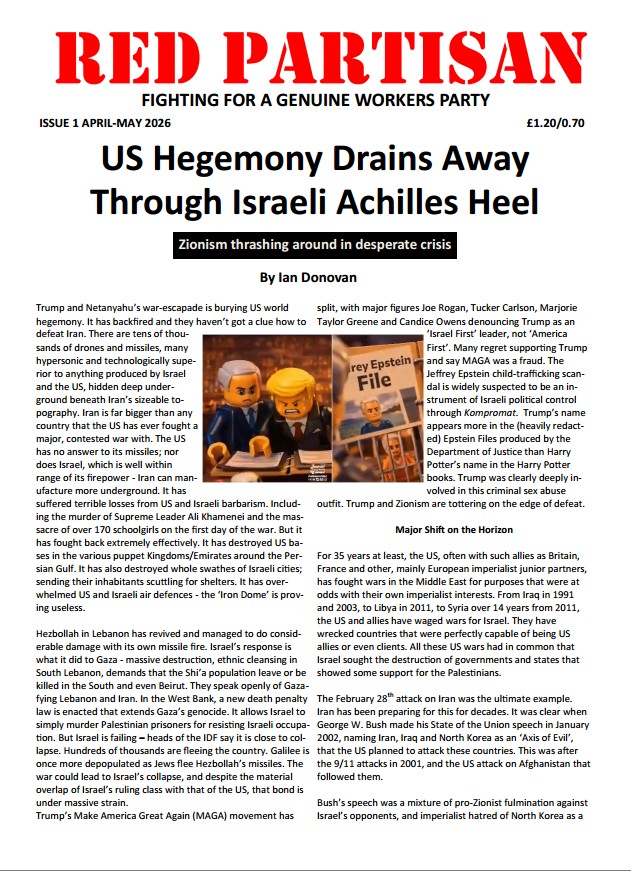
Trump’s US and Netanyahu’s Israel are fighting a different war against Iran, on which they launched an unprovoked attack on Feb 28th. The US/Israel conglomerate have lost badly, and are desperate to hide it and brazen it out. Trump is trying to hide this with bluffing statements, insulting to the intelligence, that he has really defeated Iran, Iran is on the verge of surrender, a deal is due any day, and so on. Netanyahu, on whose behalf Trump launched the war, refuses to allow Trump to make a real agreement with Iran, which would seem wise for the US given the economic damage being done by the closure of the Strait of Hormuz. The Zionist lobby in the US is strong enough to make this very difficult.
Israel has extended its genocide from Gaza to Lebanon, and in response Iran resumed firing its hypersonic missile arsenal at Israel. Israel and the US resumed their aggression against Iran, but they have no answer to Iran’s own missile superiority. Even the nuclear weapons option, which they have always had as a possible criminal means to raise the stakes, looks impossible. Due to credible but discreet threats of nuclear retaliation from others if Iran were nuked, and a real possibility that they may have provoked Iran into procuring some nukes by whatever means. Trump and Netanyahu may have provoked Iran into adopting a posture of nuclear ambiguity, similar to Israel, to counter Israel’s own arsenal. But that is not really the subject of this article – this had to be addressed to give a complete picture.
Flashpoints for NATO war
The European imperialists are not powerful enough to fight Russia, but that doesn’t mean that they wont somehow talk themselves into attacking at some point. There are some key flashpoints. Ukraine, where Russia has been fighting a war of attrition in four oblasts (provinces): Donetsk, Lugansk, Zaporozhe and Kherson, where the majority of the population has long spoken Russian. There are other such places, in a rough line from Odessa to Kharkov. Russia has been gradually winning since its Special Military Operation began in 2022, and has been fighting very painstakingly for two reasons. First NATO and the Ukrainian regime prepared several years in advance by fortifying many towns and villages in the Russian-speaking zone, making the local population virtual prisoners in many cases. Russia is not just fighting to take towns and villages, but heavily fortified prison-like outposts. The other is that this is a war to liberate the Russian-speaking population, not conquer them. These are often being abused and terrorised by the Maidan regime’s own occupiers/jailers. So, avoiding civilian casualties is the highest priority for Russia. That is why the Special Military Operation has dragged out so long.
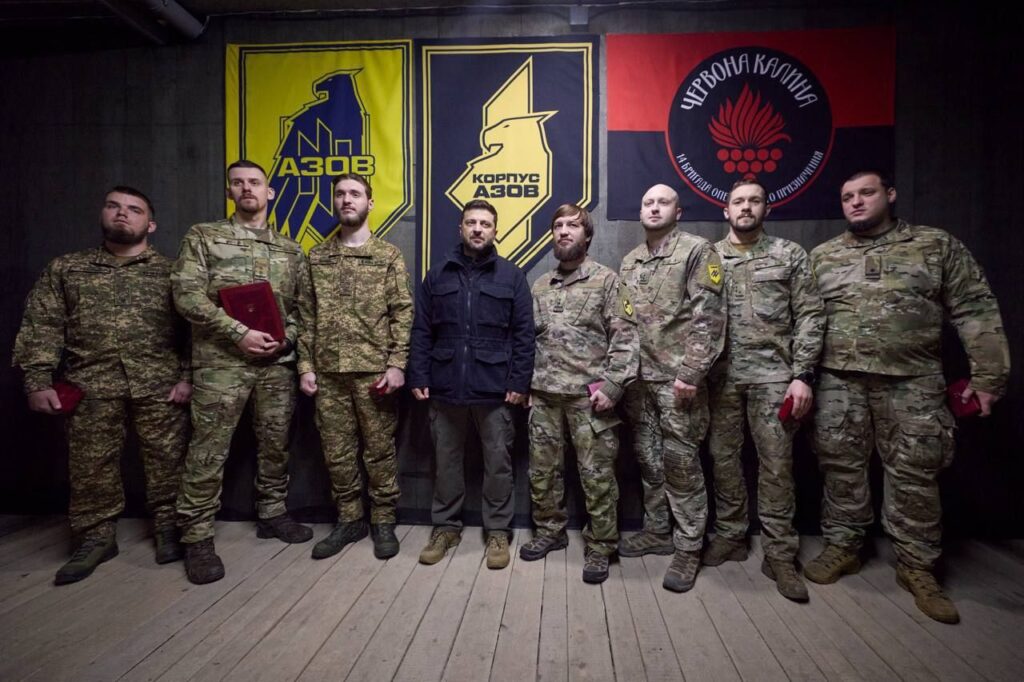
Russia does not seek to conquer the whole of Ukraine. It does not want to rule a hostile population. This conflict would not be happening if the current Ukrainian regime had not abolished the constitutional equality of languages that existed prior to Maidan. Rather it is fighting to liberate the Russian speaking part of the country and defeat the Nazi forces, leading to something better. It aims to denazify Ukraine and stop the NATO threat to Russia, but not to conquer Ukraine for Russia. A US-funded coup in 2014, the so-called Maidan uprising, brought to power anti-Russian Ukrainian nationalists who look to Nazi collaborators from the WWII period, such as the OUN (Organisation of Ukrainian Nationalists) led by Stepan Bandera and Roman Shukhevych, as their political inspiration. This has been hidden by censorship in the West since the Special Military Operation began in February 2022, but prior to that much of the Western media covered the endemic far right politics of Maidan Ukraine.
The kind of event that Maidan epitomised is known around the world, particularly in the Global South, as a ‘colour revolution’. A fake revolution funded by the US with its enormous financial power, that bribes large numbers of ‘extras’ to give a ‘mass’ façade to a foreign-funded coup. There have been so many of these around the world that ‘colour revolution’ has become almost a cliché.
Another potential flashpoint for war between NATO Europe and Russia is the Kaliningrad oblast, which is a small part of the territory of Russia that is situated between Poland and Lithuania on the Baltic coast, blocked off from Russia’s main territory and only accessible from the sea. In July 2025, one of Trump’s Generals, Chris Donahue, told the US Defense News that NATO forces could capture Kaliningrad and its surrounding oblast “in a timeframe that is unheard of” (quoted in the Kyiv Independent, July 17, 2025, https://kyivindependent.com/us-general-says-nato-could-seize-russias-kaliningrad-unheard-of-fast/)
Cold War Hysteria-Plus
European ruling class hysteria against Russia seems more acute than in the Cold War, when frequently Germany, sometimes France and even occasionally Britain demurred from some of the Cold War demands of Ronald Reagan, for example. Some of the massive left-wing pacifist movements that mobilised against the threat of nuclear war in the 1980s gained bourgeois support to varying degrees in Europe. But with the Trump administration, things appear different. Trump appears less engaged with the European imperialists’ obsession with fighting Russia in Ukraine, but that is misleading. He has the same class instincts as the rest of them, and like Biden, he has permitted, and at times encouraged, the firing of Western missiles into Russia from Ukraine using NATO guidance systems, personnel and the like. Early this year when negotiations about Ukraine were underway, he even assisted Zelensky to fire drones and missiles at the location they thought Putin was speaking from. The Russians were wise to this trick, which was used by the US/Israel to murder Iranian negotiators at the beginning of the 12-day war in June 2025. Putin was not where Trump and Zelensky, and their military cohorts, thought he was! So much for the absurd liberal myth about Trump being a Russian asset!
But Trump also has other priorities as a hireling of Israel. He provoked this war with Iran, which previous US administrations considered unwise, for his Zionist political benefactors. Ukraine is lower down Trump’s list of priorities than helping Israel destroy every state remotely within range willing to challenge its genocidal regional project: Greater Israel. That is the real tactical difference between Trump and the US bourgeois mainstream. The Democrats’ Russiagate accusation was a hoax as Trump, whatever manoeuvres he may undertake, has no loyalty to Russia or Putin. His loyalty is to Israel; if Ukraine gets in the way, taking away US resources from war projects on Israel’s behalf in the Middle East, Ukraine has to lump it. That contradiction has the potential to bury NATO, and certainly some West European NATO ideologues have been preparing for more aggressive confrontation with Russia, without US backing, as a result.
This is really where the irrational element of bourgeois consciousness reveals itself. Obviously, without the United States as lynchpin, European NATO powers would be massively weaker, and yet those who fear such abandonment are more inclined than ever to hysterical Russophobia and making plans for all out war with Russia, with the crystal ball forecast (or whatever) that Russia intends to attack Western Europe in the next few years. Why is not made clear.
“Russian Expansionism” – A Persistent Myth
This is a repeat, ratcheted up to the Nth degree, of NATO’s paranoia during the Cold War about the USSR invading Western Europe, which never had the slightest chance of happening. This paranoia grew from the existence of the “Iron Curtain”, as Churchill dubbed it in his Fulton, Missouri speech of 1946. He referred to the Soviet Red Army advancing as far as the Elbe in Central Germany, and consolidating a belt of carbon-copy workers states from East Germany to Bulgaria.
But that was never the product of any Soviet project of expansion. It was simply the consequence of the USSR fighting off the attack from Nazi Germany, which had already occupied that whole massive area and had to be driven out of there to defeat it. The USSR was not keen on a future repeat invasion, and made that impossible for two generations with the export to the ‘glacis’ (East European buffer zone) of its model of bureaucratic castes sitting on collectivised property relations as inherited from the October revolution. Soviet Russia’s backwardness and isolation after 1917 created the possibility for that degenerated form of proletarian dictatorship to come into existence. Trotsky, the Russian Revolution’s main surviving prominent revolutionary Marxist after the degeneration, regarded Stalinism as a short-term, unstable regime that would either have to give way to the working class retaking direct political power in a new, political, revolution, or else be overthrown by capitalist restoration. His evaluation was ultimately true, but took much longer to happen.
But in WWII the USSR proved more durable than Trotsky thought. It not only survived the war intact, defeating the Nazi invasion in an epic, heroic struggle, but also managed to create replicas of itself in several countries that its armies liberated from fascism. Even more unexpectedly, it managed to inspire petit-bourgeois peasant-guerrilla movements in a number of countries where wars against imperialist forces put capitalism itself under extreme stress. Such movements expropriated capital and created regimes that obviously imitated the Stalinist regime in Russia, with collectivised economies ruled by bureaucratic regimes that took shape from the command structures of the guerrilla armies that won these battles. This happened first in Yugoslavia, then China, then Vietnam/Indochina and finally Cuba in 1959-60. These took shape in the broader context of the USSR’s victory in WWII, and were a secondary product of that.
The Partial Retreat of Counterrevolution
By the end of the 1980s Stalinist rule was in a state of collapse, centrally in the USSR but also throughout Eastern Europe. These regimes collapsed in 1989 in Eastern Europe; in the USSR in August 1991 the regime finally collapsed when the liberal, increasingly pro-capitalist Stalinist leader Mikhail Gorbachev was ousted by a coup of “hardline” Stalinist bureaucrats opposed to both his pro-capitalist market “reforms” and his glasnost (openness). This met determined resistance from forces led by the former head of the Moscow Communist Party, Boris Yeltsin, and collapsed after three days. Yeltsin became the leader of the counterrevolution, seized power in Russia and instigated the end of the central USSR state by Christmas 1991, and the separation of the non-Russian union republics. His economic programme was a rapid neoliberal ‘shock treatment’, among the most ferocious ever attempted: privatisation, mass sackings of workers, and impoverishment of the masses on a massive scale, such that in the decade of the 1990s life expectancy fell by five years. This was the greatest fall in Russian life expectancy in peacetime since Stalin’s forcible collectivisation of agriculture at the beginning of the 1930s. It could only be explained by millions of workers suffering premature death from malnutrition, deprivation of healthcare, and in many cases suicidal despair. It was more severe than the economic shock that hit Weimar Germany after the Wall St crash of 1929, which brought Hitler to power.
But the response of the masses was not to support fascism, but to put enormous pressure on the apparatus left over from the USSR, which was a massive social layer that had been, and still was to a degree, a kind of labour bureaucracy. Even though its ‘communist’ ideology had been junked, links with the masses existed, and were able to give expression to that popular backlash. Yeltsin was ousted by the apparatus and Putin replaced him. And a process of partial rollback of the shock treatment began. Russia under this new political configuration rolled back much of the neoliberal shock, reversed much of the privatisation, and now has a kind of mixed economy. It has recovered a real measure of world power under Putin, whose popular authority is considerable because of this reversal.
In historical context, these events resemble the aftermath of the Battle of Waterloo in the early 19th Century. The defeat of Napoleon appeared to signal the final defeat of even the most degenerated expression of the French bourgeois revolution against feudalism. Yet the victorious reactionary powers found it impossible to restore the feudal regime. Because bourgeois society represents a higher mode of production. Likewise in Russia, the counterrevolution encountered major problems because the socialist elements in the USSR workers state, however stunted, represent elements historically superior to capitalism, and proved much more difficult to expunge than many thought. In Russia you thus have a new form of combined and uneven development.
Russia today is not a workers’ state. It is a non-imperialist bourgeois state with major post-capitalist deformations from its decades as the centre of the USSR workers’ state. But it is clear what the basis of imperialist hatred for Russia is – it is hatred of the survivals of the workers state, the elements of its social gains now embodied in Russia’s ersatz mixed economy. Western anti-communist hatred of the USSR has morphed into a demented racism against the Russian people themselves, Putin’s mass base. Just as Hitler believed that Jews were irremediably tainted with ‘Bolshevism’, and sought their elimination, the imperialist bourgeoisie of the West consider Russians, as a people, to be incorrigibly disobedient to the dictates of neoliberalism, and basically enemies. Hence the demented war threats against Russia, including killing civilians. Hence the firing of missiles into Russia from Ukraine under British, French and US Command and Control, and the threat to do the same from the Baltic states.
Hence the wanton risking of nuclear war in such escapades. And the need for the working class in Europe to mobilise against this demented war drive, and defend Russia against NATO imperialism.