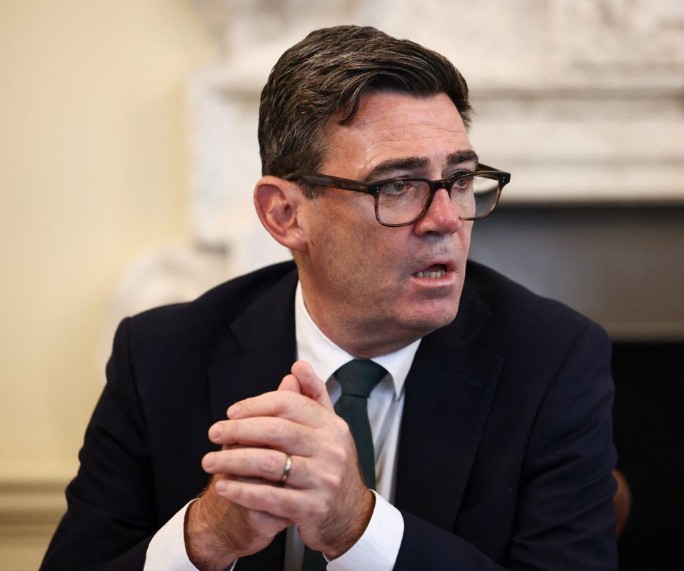
The coup within Labour between the disastrous May Labour Party Council Election results and July, when Andy Burnham became Prime Minister, was carefully choreographed. Burnham’s seat in Makerfield was ‘kindly’ donated by Josh Simons, a stalwart of Labour Together and the operation against Corbyn, which shows who is really behind Burnham’s ascent to office. It was clearly arranged and planned by the same Labour Together outfit (now renamed ThinkLabour), largely Zionist funded, that worked extensively behind the scenes to foment witchhunts against the left for supposed ‘anti-Semitism’ during the Corbyn period, to destabilise Corbyn’s leadership, and to engineer a major election defeat by manipulating the issue of Brexit. This produced the Starmer regime, with its war against the mass left-wing movement that formed behind Corbyn in the mid-2010s ,and especially the half-million or so socialists who joined Labour when Corbyn became leader, making it (then) the largest political party in West Europe. Hundreds of thousands of members were driven out by Starmer’s bloodletting of the left between 2020 and 2025. Labour under Starmer, supposedly the party of the broadly working-class, left-wing of British politics, in government acquired a terrible reputation for hypocrisy. It engaged in a whole array of attacks that even the Tories had not dared, Including vicious attacks on Winter Fuel payments for pensioners, attacks on the disabled, further privatisation of the NHS. They also insisted on keeping to hated Tory policies such as the two-child benefit-cap. Starmer pushed far right anti-immigration politics himself with his ‘island of strangers’ speech in May 2025, echoing the racism of Enoch Powell.
Andy Burnham’s Labour leadership and premiership is an attempt to give the failing Labour government a facelift, to boost its pathetic popularity, and avoid what appeared to be an inevitable future collapse, given Starmer’s complete political failure to generate any popular resonance or sympathy whatsoever. Burnham was Mayor of Greater Manchester from 2017 to his recent return to parliament in June. He has some real charisma and popularity, and is attempting something that resembles the early years of Tony Blair’s premiership, when Blair combined neoliberal politics with liberal populism, and maintained a strong degree of popular support for several years. Blair’s political ‘honeymoon’ as Prime Minister extended for the whole of his first term from 1997-2001, and did not definitively end until he joined with George W Bush in 2002 in the campaign to attack Iraq. The recreation of that kind of ‘honeymoon’ appears to be the strategy of those behind Burnham’s rise, to salvage Starmer’s government from the odium of Starmer himself. And so far, it seems to be working, as Nigel Farage’s Reform, who before Burnham’s ascent had been leading in opinion polls, is now reckoned to be in either second or third place.
This has been aided by the systematic exposure of Farage’s own corruption with the receipt of first £5 million from Thailand-based tax exile and crypto billionaire Christopher Harborne, and then £36 million from Bel Delo, who had previously been pardoned by Trump after being convicted of money laundering. This amount was then matched again by Harborne, giving Farage a cool £72 million. These sums dwarf the hundreds of thousands that were unlawfully funnelled to Labour Together for the war against Corbyn. Burnham is now planning retrospective laws to ban such donations. But this has discredited Farage massively by associating him with big money corruption. In response to this fall in popular support, the far right, this time led by Daniel Thomas (“Danny Thommo”), an associate of Stephen Yaxley-Lennon (“Tommy Robinson”) launched mobs of balaclava-masked ‘protesters’, first to block the port of Dover in a 5 September ‘protest’ against small boats and asylum seekers. Then on 11 Sept, there was another masked action in Portsmouth, this time directed against the RNLI lifeboat service, for rescuing asylum seekers in small boats, as well as against a Pakistan Cricket Team they accused of being asylum seekers. Burnham’s government is moving to ban such balaclava masks, popularly lampooned as ‘nonce masks’ in response. All this is a legacy of the Starmer regime’s appeasement of the far right.
The Starmer’s government’s odious authoritarianism made it acutely unpopular on the left wing of British politics, and it would never, no matter how much it grovelled and dressed up in far-right clothes, be able to satisfy the far right who were emboldened by it. Burnham is a rhetorical critic of neoliberalism who says that British politics has been on the ‘wrong track’ since Thatcher and claims to want to return to the 1970s before Thatcher’s neoliberal offensive. As Manchester Mayor he implemented municipal ‘control’ (not ownership) of bus services and he claims that this is a start of his return to the 1970s. He is a political chameleon – he was broadly speaking a Blairite/Brownite as a previous minister, but during the Corbyn period, he conspicuously refused to resign from Corbyn’s Shadow ministerial team when all the Blairite politicos did so as a unified tactic to try to bring down Corbyn in the 2016 ‘Chicken Coup’. He thus has a different reputation, which is captured in a popular joke about him: “A Blairite, a Brownite and a Corbynite walk into a bar, and the barman says: ‘What would you like to drink, Mr Burnham?’”.
Starmer: Labour’s Foulest Premier by a Country Mile
Starmer became certainly the most hated Labour Prime Minister in history within weeks of being elected with a massive majority in July 2024 – rightly seen as arrogant, ultra-reactionary and completely lacking any charisma and empathy by the population of left and right. His massive parliamentary majority was a freak, caused by the collapse of the Tory vote with a substantial chunk of their voters going to the hard-right Reform party of Nigel Farage. The Tories’ percentage of the popular vote fell from 43.6% in 2019 to 23.7% in 2024 – a huge collapse. But Labour’s only rose slightly, from 32.1% in 2019 (when they lost heavily) to only 33.7% in 2024. Starmer won a massive majority with fewer votes than Corbyn lost with previously. Corbyn lost with 10,269,051 in 2019; Starmer won with 9,708,716 in 2024 – more than half a million less. This was not a popular victory at all, but a quirk of the First Past the Post electoral system: in 2024 Reform got 14.3% of the vote, coming third. Which means that Starmer’s massive majority was built on sand – his popular base was minimal, and he was challenged from the get-go, within a matter of a few short weeks of being elected, by a broad far right movement centred on Reform. This went into overdrive with aggressive, threatening demonstrations outside hotels housing asylum seekers in the summer of 2024, repeated even more menacingly in 2005 with the nationwide fascist campaign of putting Union Flags on lampposts and painting roundabouts with the Cross of St George, aimed at threatening and intimidating ethnic minorities. Then followed by a half-million strong London ‘Unite the Kingdom’ fascist march in September 2025. This was countered and fought against by the left outside Labour. Starmer had no discernible political ‘honeymoon’ after he was elected, simply because his leadership was overtly reactionary and pusillanimous before big capital right from the very start.
The reactionary character of Starmer’s government is shown by its attitude to two crucial war questions: Gaza and Ukraine. Nine months before Starmer’s government was elected, in the days after the Al Aqsa Flood Hamas-led breakout on October 7th, 2023, Starmer made it quite clear that he supported the genocidal response of the Israeli government as laid down by defence minister Yoav Gallant’s statement that Israel were fighting ‘human animals’ who would be deprived of food, water and fuel therefore. When challenged by LBC’s Nick Ferrari in an infamous interview on 11th October 2023, about whether Israel had the right to withhold food and water from the Gaza population, Starmer clearly said that they “have that right”. Which put him clearly in the genocidaire camp. The draconian repression Starmer’s government has carried out against the movement against this genocide has far exceeded that of the Tories, from restrictions on marches and frameups of Palestine Solidarity activists and the fraudulent proscription of Palestine Action, attempts to abolish jury trials and interference with existing jury trials by pro-genocide Judges clearly acting on government instructions. Much more so than Sunak’s earlier government, Starmer’s was a repressive pro-genocide regime, and many of its measures the kind of thing that Suella Braverman, the proto-fascist chief Zionist in the previous Tory government , was forced from office for trying to enact. Braverman then defected to Reform.
On Ukraine, likewise Starmer had always been one of the most fervent Russophobes and militarists in the Labour Party political class going back to the early days of the Maidan regime, when he first became a Labour MP in 2015. The Stop the War Coalition, after the beginning of the Russian Special Military Operation in the Eastern half of Ukraine in February 2022, produced a statement whose essential thrust was “Britain needs to change its policy, and start working for peace, not confrontation”, calling for a “diplomatic settlement” on the basis of Minsk-2, while opposing eastward expansion of NATO. It was signed by then Independent MPs Jeremy Corbyn and Claudia Webbe, and a list of trade unionists and anti-war activists. 11 Labour MPs originally signed it. They were ordered by Starmer to withdraw their names, under penalty of the withdrawal of the whip. At that point, all did so, though some like Zarah Sultana were subsequently deprived of the whip for voting against Starmer’s cuts to pensioners’ winter fuel payments.
Burnham: Hypocrisy over Palestine, Virulent Russophobia
Burnham has paid lip service to some criticisms of Starmer’s regime on Gaza, saying they ‘got it wrong’. But he has conspicuously not used the word ‘genocide’. The new Foreign Secretary, Ed Miliband, has announced sanctions against goods produced in the occupied West Bank, which it is not difficult to discern, are calculated to be fairly token and to have very limited impact. But the Israeli regime has reacted virulently to them, with Netanyahu denouncing the Burnham government as the ‘Islamic Republic of Britain’, and far right Israeli defence minister Itamar Ben Gvir denouncing the British presence in the Falklands/Malvinas Islands and calling for ‘sanctions’ against Britain to force Britain to hand them over to Argentina, led by the Jewish convert, Zionist extremist and alleged relative of Netanyahu, Milei. Miliband’s sanctions are a very limited and cosmetic change. Burnham has kept in place the Home Secretary, Shabana Mahmood, who succeeded Yvette Cooper and if anything intensified the persecution of Palestine activists including the fraudulent proscription of Palestine Action, which is now being appealed to the Supreme Court, as well as repressive measures against legal migrants such as the attempt to abolish the status of indefinite leave to remain. Fresh persecutions of Palestine activists are still going ahead. Burnham’s government has continued in practice to back Trump/Israel’s war against Iran, by continuing to allow the use of British bases by US forces for supposedly ‘defensive’ operations – in an unprovoked war of aggression. However, the limited shift in policy over the West Bank has had an impact on the British labour movement, as for the first time in its history, on 16th September the TUC passed a motion endorsing the BDS (Boycott, Divestment and Sanctions) campaign against Israel. There is this some level of contradiction in the Burnham government’s stance over Palestine and Gaza, which appears to be a product of the mass pressure of the Palestine movement and the extreme discredit that the overt support for genocide brought upon Starmer. It appears extremely grudging, but it may open up possibilities for forcing more concessions.
Regarding Ukraine, however, Burnham has doubled down on Starmer’s whole policy, and his visit to Ukraine in late August, with the symbolic handing over of the blueprints of Storm Shadow to Zelensky signified that nothing has changed. See separate article. The only slight nuance of difference is that now Burnham claims that the rearmament demanded by Trump and the European bourgeoisies against the phantom threat of attack by Russia must not be paid for by the working class. Which is simply financially not feasible. What this all really means is that Burnham’s new government is a concession to left-wing popular opposition to Starmer’s regime, which was the most openly reactionary leadership and government in the whole history of the Labour Party. These concessions have had to be made to preserve Labour as a bourgeois workers party from destruction. But the concessions are very limited. Burnham keeps contradicting himself on such matters as possible water company nationalisation, to give one example. The political vacuum of working-class political leadership, which could have been filled by Your Party, still exists, and it is likely that the breathing space that Burnham’s rise has given to Labour as a party will not last a historically enormous amount of time.
Which also might, at least on the domestic terrain, give the left a slight breathing space to revive the project of a new working-class party, as the Corbyn-led Your Party is in deep trouble because of Corbyn’s own misleadership. It will have to be salvaged, and pretty soon, or else something else built to organise the working class politically for socialist politics in its place. But the threat of world war, with Russia or arising from US/Zionist defeats in the Middle East, and economic depression arising from the latter, will not give much space – we need working class political organisation as a matter of urgency.