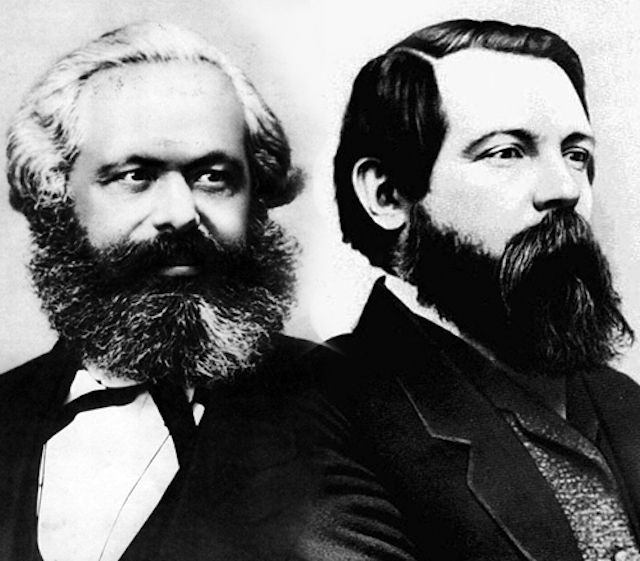
The following is the notes/text of a presentation delivered by a Consistent Democrats speaker on 30th August. The recording of the presentation and discussion is here.
This Manifesto is the key founding document of the Marxist movement of Scientific Socialism, in other words Communism, in the real sense of the term.
And this section, part 2, is the core, seminal section of the document. Part one is by way of an introduction and a sketch that really illustrates the application of the method of historical materialism to the whole of human history. Part 2 focuses on the struggle of Communists within the current social system of capitalism, and on the relationship of the communists to the working class.
It lays out the key points about the relationship of communist with the working class, when it says:
“In what relation do the Communists stand to the proletarians as a whole?
“The Communists do not form a separate party opposed to the other working-class parties.
“They have no interests separate and apart from those of the proletariat as a whole.
“They do not set up any sectarian principles of their own, by which to shape and mould the proletarian movement.
“The Communists are distinguished from the other working-class parties by this only: 1. In the national struggles of the proletarians of the different countries, they point out and bring to the front the common interests of the entire proletariat, independently of all nationality. 2. In the various stages of development which the struggle of the working class against the bourgeoisie has to pass through, they always and everywhere represent the interests of the movement as a whole.
“The Communists, therefore, are on the one hand, practically, the most advanced and resolute section of the working-class parties of every country, that section which pushes forward all others; on the other hand, theoretically, they have over the great mass of the proletariat the advantage of clearly understanding the line of march, the conditions, and the ultimate general results of the proletarian movement.”
That can be seen as an implicit criticism of some of today’s rigid, sectarian left-wing politics. The key question is not and never has been organisational separation from those movements whose leading views are questionable, but organise class-conscious workers in some way.
The key question for communists is our obligation is to “represent the interests of the movement as a whole” and to understand “the line of march, the conditions, and the ultimate general results of the proletarian movement.” As long as these are maintained, many different tactics are appropriate.
This is emphasised when the Manifesto says:
“The theoretical conclusions of the Communists are in no way based on ideas or principles that have been invented, or discovered, by this or that would-be universal reformer.
They merely express, in general terms, actual relations springing from an existing class struggle, from a historical movement going on under our very eyes…”
From that, the Manifesto goes on:
“The immediate aim of the Communists is the same as that of all other proletarian parties: formation of the proletariat into a class, overthrow of the bourgeois supremacy, conquest of political power by the proletariat.”
In one sense, this shows how the document is dated. Because it is no longer true that ‘ all other’ proletarian parties stand for “the conquest of the political power by the proletariat”. The Manifesto was written before imperialism developed, and bourgeois workers parties like Labour were created.
Moving on from that, the Manifesto goes on to talk about the specificity of the proletarian struggle:
“ The abolition of existing property relations is not at all a distinctive feature of communism.
“All property relations in the past have continually been subject to historical change consequent upon the change in historical conditions.
“The French Revolution, for example, abolished feudal property in favour of bourgeois property.
“The distinguishing feature of Communism is not the abolition of property generally, but the abolition of bourgeois property. But modern bourgeois private property is the final and most complete expression of the system of producing and appropriating products, that is based on class antagonisms, on the exploitation of the many by the few.
“In this sense, the theory of the Communists may be summed up in the single sentence: Abolition of private property.”
The Manifesto then replied to the bourgeois outcry against the abolition of private property.
“… does wage-labour create any property for the labourer? Not a bit. It creates capital, i.e., that kind of property which exploits wage-labour, and which cannot increase except upon condition of begetting a new supply of wage-labour for fresh exploitation. Property, in its present form, is based on the antagonism of capital and wage labour. …”
And they go on to examine this relationship:
“To be a capitalist, is to have not only a purely personal, but a social status in production. Capital is a collective product, and only by the united action of many members, nay, in the last resort, only by the united action of all members of society, can it be set in motion.
“Capital is therefore not only personal; it is a social power.
“When, therefore, capital is converted into common property, into the property of all members of society, personal property is not thereby transformed into social property. It is only the social character of the property that is changed. It loses its class character.”
The attempt by capitalist ideologues to claim that communists want to abolish the meagre property that workers possess, is refuted:
“We by no means intend to abolish this personal appropriation of the products of labour, an appropriation that is made for the maintenance and reproduction of human life, and that leaves no surplus wherewith to command the labour of others. All that we want to do away with is the miserable character of this appropriation, under which the labourer lives merely to increase capital, and is allowed to live only in so far as the interest of the ruling class requires it.
And likewise, they pull apart the claim that the abolition of bourgeois property represents the abolition of ‘freedom’:
“By freedom is meant, under the present bourgeois conditions of production, free trade, free selling and buying.”
[…]
“You are horrified at our intending to do away with private property. But in your existing society, private property is already done away with for nine-tenths of the population; its existence for the few is solely due to its non-existence in the hands of those nine-tenths….
“In one word, you reproach us with intending to do away with your property. Precisely so; that is just what we intend.”
They take on one-by-one the bourgeois objections:
“It has been objected that upon the abolition of private property, all work will cease, and universal laziness will overtake us.
“According to this, bourgeois society ought long ago to have gone to the dogs through sheer idleness; for those of its members who work, acquire nothing, and those who acquire anything do not work. “
Summing this up, the Manifesto lays out its indictment of capitalism and why it must disappear:
“The selfish misconception that induces you to transform into eternal laws of nature and of reason, the social forms springing from your present mode of production and form of property – historical relations that rise and disappear in the progress of production – this misconception you share with every ruling class that has preceded you. What you see clearly in the case of ancient property, what you admit in the case of feudal property, you are of course forbidden to admit in the case of your own bourgeois form of property.”
Likewise with the bourgeois outcry about the communists’ view on the family:
“On what foundation is the present family, the bourgeois family, based? On capital, on private gain. In its completely developed form, this family exists only among the bourgeoisie. But this state of things finds its complement in the practical absence of the family among the proletarians, and in public prostitution.
“The bourgeois family will vanish as a matter of course when its complement vanishes, and both will vanish with the vanishing of capital.
“Do you charge us with wanting to stop the exploitation of children by their parents? To this crime we plead guilty.”
[…]
“The bourgeois clap-trap about the family and education, about the hallowed co-relation of parents and child, becomes all the more disgusting, the more, by the action of Modern Industry, all the family ties among the proletarians are torn asunder, and their children transformed into simple articles of commerce and instruments of labour.”
And then there is the famous allegation that the communists would introduce a ‘community of women”:
“The bourgeois sees his wife as a mere instrument of production. He hears that the instruments of production are to be exploited in common, and, naturally, can come to no other conclusion than that the lot of being common to all will likewise fall to the women.
“He has not even a suspicion that the real point aimed at is to do away with the status of women as mere instruments of production.”
I suppose the following passage might once have been seen as contentious, but given what we know about the proclivities of today’s billionaire Epstein class, it seems quite mild:
“Our bourgeois, not content with having wives and daughters of their proletarians at their disposal, not to speak of common prostitutes, take the greatest pleasure in seducing each other’s wives.
“Bourgeois marriage is, in reality, a system of wives in common and thus, at the most, what the Communists might possibly be reproached with is that they desire to introduce, in substitution for a hypocritically concealed, an openly legalised community of women. For the rest, it is self-evident that the abolition of the present system of production must bring with it the abolition of the community of women springing from that system, i.e., of prostitution both public and private.”
Then there is the charge that communists want to abolish nations and nationality. The response to this is so pithy that we can cite it in full:
“The working men have no country. We cannot take from them what they have not got. Since the proletariat must first of all acquire political supremacy, must rise to be the leading class of the nation, must constitute itself the nation, it is so far, itself national, though not in the bourgeois sense of the word.
National differences and antagonism between peoples are daily more and more vanishing, owing to the development of the bourgeoisie, to freedom of commerce, to the world market, to uniformity in the mode of production and in the conditions of life corresponding thereto.
The supremacy of the proletariat will cause them to vanish still faster. United action, of the leading civilised countries at least, is one of the first conditions for the emancipation of the proletariat.
In proportion as the exploitation of one individual by another will also be put an end to, the exploitation of one nation by another will also be put an end to. In proportion as the antagonism between classes within the nation vanishes, the hostility of one nation to another will come to an end.
Actually, in the epoch of imperialism, capitalism developed a counter-tendency to this, setting the peoples of oppressor, imperialist countries against each other, and even more against those in countries who were the victims of imperialism. But Marx and Engels did not live long enough to fully address this.
We have to address it today, by formulating concrete Marxist policies on every national question to which imperialist capitalism gives rise. Though overall, what the Manifesto says is true, that capitalist development, in spite of this, is undermining the basis for nations and nationalism.
Imperialism itself is an expression of the fact that the productive forces created by capitalism have outgrown the nation-state itself, which is obsolete.
The manifesto rightly dismisses the objections to Communism from “from a religious, a philosophical and, generally, from an ideological standpoint” as “not deserving of serious examination”. It asks:
“What else does the history of ideas prove, than that intellectual production changes its character in proportion as material production is changed? The ruling ideas of each age have ever been the ideas of its ruling class.”
And concludes from that:
“When people speak of the ideas that revolutionise society, they do but express that fact that within the old society the elements of a new one have been created, and that the dissolution of the old ideas keeps even pace with the dissolution of the old conditions of existence.”
It notes that the proletarian revolution is different from previous revolutions, as:
“… one fact is common to all past ages, viz., the exploitation of one part of society by the other. No wonder, then, that the social consciousness of past ages, despite all the multiplicity and variety it displays, moves within certain common forms, or general ideas, which cannot completely vanish except with the total disappearance of class antagonisms.
“The Communist revolution is the most radical rupture with traditional property relations; no wonder that its development involved the most radical rupture with traditional ideas.
And having dismissed those anachronisms, it goes onto practical matters:
“ We have seen above, that the first step in the revolution by the working class is to raise the proletariat to the position of ruling class, to win the battle of democracy.
The proletariat will use its political supremacy to wrest, by degrees, all capital from the bourgeoisie, to centralise all instruments of production in the hands of the State, i.e., of the proletariat organised as the ruling class; and to increase the total of productive forces as rapidly as possible.”
The list of demands at the end, are fine, but of their time, and have been superseded by other, much more detailed programmes. I will not read them out. Marx and Engels themselves say “These measures will, of course, be different in different countries” and they note that they are applicable to “advanced countries” in particular. 10 demands which are the basis of other more detailed elaborations.
But what is also striking is the resemblance between the conclusion of this part of the Manifesto, and later, more detailed elaborations, such as Marx’s Critique of the Gotha Programme. Which we touched on in studying Lenin’s State and Revolution earlier:
“When, in the course of development, class distinctions have disappeared, and all production has been concentrated in the hands of a vast association of the whole nation, the public power will lose its political character. Political power, properly so called, is merely the organised power of one class for oppressing another. If the proletariat during its contest with the bourgeoisie is compelled, by the force of circumstances, to organise itself as a class, if, by means of a revolution, it makes itself the ruling class, and, as such, sweeps away by force the old conditions of production, then it will, along with these conditions, have swept away the conditions for the existence of class antagonisms and of classes generally, and will thereby have abolished its own supremacy as a class.”
This is indeed, the withering away of the state, as dealt with more concretely by Marx after the Paris Commune, as cited by Lenin. Which accompanies the higher stage of communist society, as Marx again later elaborated, where:
“In place of the old bourgeois society, with its classes and class antagonisms, we shall have an association, in which the free development of each is the condition for the free development of all.”