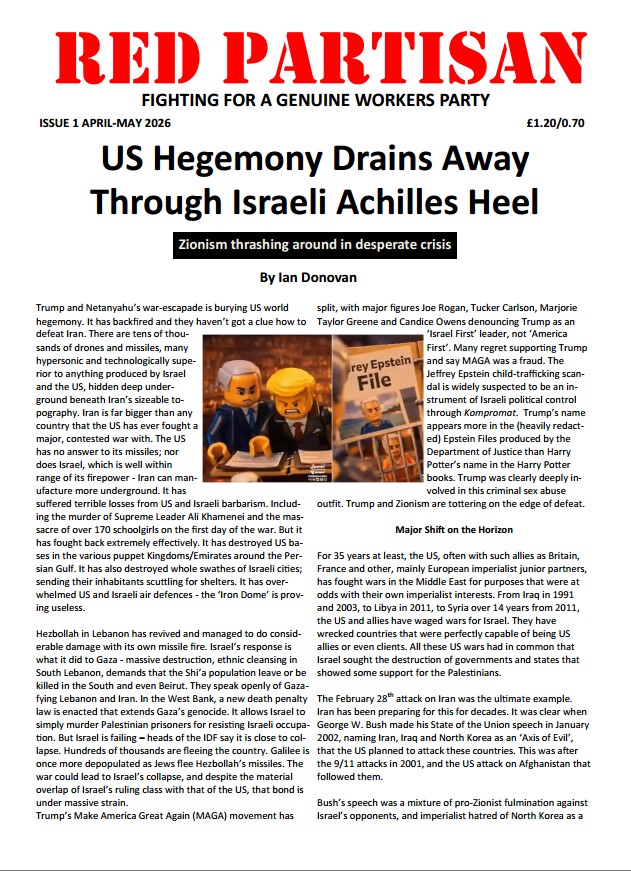
A spectre haunts Europe: the working class returns to the scene.
By Gregorio Carboni Maestri*

For half a century, European capitalism relied on the extraction of relative surplus value. After the exhaustion of Fordism, the monetarist turn of 1979 and the neoliberal offensive organized capitalist accumulation by dispossession: delocalisation, financialisation, the end of stable employment, and a slow proletarianisation of the middle classes. The worker was still allowed to earn on the price of goods, until, from 2008 onwards, productivity stopped growing and profit began to be sustained by the appropriation of rents, especially of workers and wage earners, by wage compression. On February 24, 2022, with the war in Ukraine, this process took a leap: wages were deindexed, “austerity” returned, and absolute surplus value became conscious politics, extracted directly from the worker’s body and life time. Peace, presented since the 19th century as a harmony of free trade, has shown itself again for what it was: an armed truce, and war has entered the very architecture of the European Union. Against this background, since October 2023, Palestine has been the catalyst for all latent struggles: university camps have set up a generation of young and not so young and opened a cycle that, passing through the tractors of the peasants of 2024 and the Serbian uprising, has not yet ended.
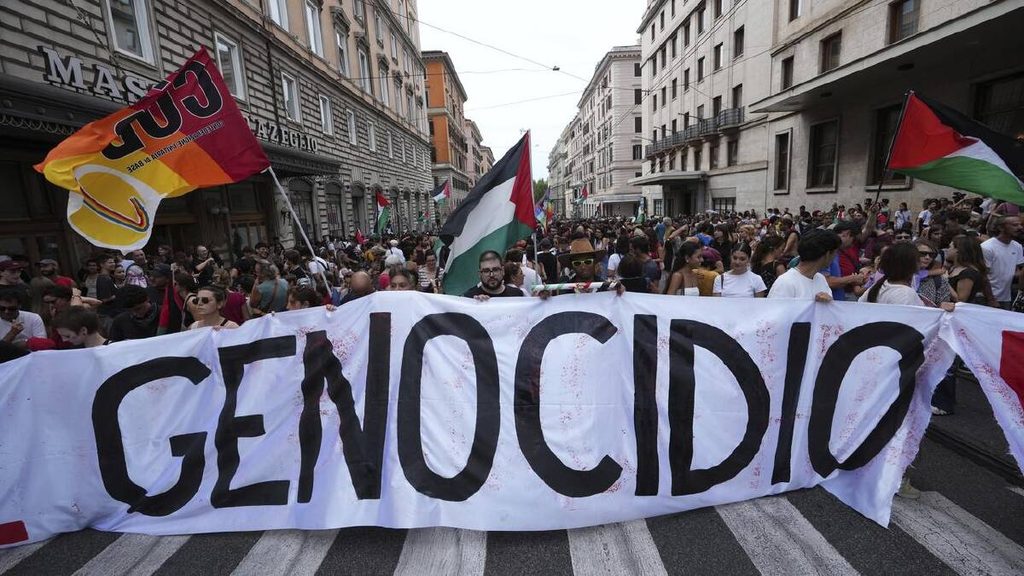
In these two years, the new generation that has awakened to the struggle has learned three things. That the European Union was a material accomplice in the genocide, due to its association agreements with Israel, arms trade and diplomatic silence. That the European states, led by Germany, France and the United Kingdom, proscribed solidarity with Palestine on the accusation of anti-Semitism, that is, that the rule of law was limited by criticism of Zionism. In these countries, the movement was harshly repressed by the state, with protest camps banned, students expelled from universities and the proscription of the slogan “From the river to the sea”, a strategic move by the Atlanticist bloc to prevent the convergence of those protesting against the genocide in Gaza that had already taken place in Italy and that was beginning in other countries.
The state began to demand that the institutions that were supposed to support the solidarity struggle should, on the contrary, repress it, as did prestigious universities, union confederations, right-wing, centre-left or ecologist parties. Those who saw their camp evicted, their university comrades expelled, and their slogans criminalised understood that legality is defined by the correlation of forces. This lesson would migrate to secondary schools, ports, and squares. Germany lived in parallel an invisible conflict: opposition fronts that did not converge, a sectoral unionism that won wage increases without formulating a class policy, a political camp captured by the AfD — a right-wing, nationalist, anti-war, anti-globalist party — precarious young people in the service sector and voiceless academic scholarship holders. But the repression produced the opposite of what it sought, and the generation of former lovers of the German Greens discovered in them the imperialist character of the state itself.
Austerity and rearmament
2025 was the year of ruling class projects. The governments of the European Union designed in parallel the two moves that would later be fought in the streets: the cut in social spending and rearmament. On January 31, in Belgium, five parties (the N-VA, the MR, Les Engagés, the CD&V and the Flemish socialists of Vooruit) signed the government agreement that the press called the Arizona Coalition, due to the colours of the associated parties and those of the flag of the US state of Arizona. The government was led by Bart De Wever, a Flemish separatist nationalist of the extreme right. Its program was the most coherent in Western Europe, from the point of view of the ruling classes. With a public deficit of over 5%, it prepared an adjustment of about 10 billion euros. The pension bill, approved on May 28, 2026, introduced a penalty of 5% for each year of early retirement before the age of 67, starting in 2027; required 156 days worked to count one year for early retirements; dismantled the retirement of civil servants; raised the right to end-of-career employment, that is, working fewer hours, from 25 to 35 years of contribution; suppressed pre-retirements, disregarding arduous work, as if it were the same to spend thirty years in an office or lifting bricks on a construction site; determined during the entire legislature, no increase for the lowest pensions; and predicted 2.4 billion euros of savings in four years. The automatic indexation of wages, a historic achievement of the Belgian working class, would not function, from 2026 to 2028, for salaries above 4,000 euros gross: it started at the top, but it was known that, by the same principle, the same would be done with the lowest wages. In addition, an increase in Value Added Tax, later shelved, and the annual bank of hours worked was announced. The unions limited themselves to filing an appeal with the Constitutional Court, which would rule in mid-2028, when the ‘reform’ would already have been applied. While cutting pensions, the country increased its military spending by 59%.
In March, the European Commission presented the Rearm Europe plan, renamed Readiness 2030 when the first name seemed too blatant: 800 billion euros for defence over five years. In June, in The Hague, NATO set a target of 5% of GDP for 2035, 3.5% in defence and up to 1.5% in “enhanced security”. The “Escape from the Stability Pact” clause, which allows member states to temporarily flout the draconian budget limits dictated by the European Union, was triggered for arms spending. When it comes to weapons, money appears. When it comes to pensions, it disappears! Maintaining these budgets required cutting social spending, limiting health and postponing all non-military public investment. Friedrich Merz, the least popular chancellor in Germany’s recent history, announced that he wanted “the strongest army in Europe.” At the end of the year, the European Union’s military spending was close to 400 billion. It was a rearmament undertaken when the United States could not cede more autonomy to Europe, which must continue to be a semi-vassal protectorate, increasingly dependent on a declining empire. And 78% of European defence purchases are and should be made mainly in the United States. The European Union and the Atlantic Alliance, Washington’s strategic annex, would be a semi-periphery dependent on tourism and foreign capital, with the “war economy” as the only viable and quick alternative to reassure European capital.
On September 10, 2025, the subjugated population of the moribund Franco-German axis began to raise their heads and go to fight, launching the slogan that would travel the continent considered to be the exclusive property of the ruling classes: “Let’s block everything”. That is, to physically stop France and Germany, in opposition to austerity policies. And the initially student mobilizations took to the streets, as a memory and legacy of the Yellow Vests, of the demonstrations of workers and popular sectors of 2018. They were faced with two divergent paths: a general strike or the encapsulation of the movement in the 2027 elections. The day against the budget of Bayrou, the French prime minister, was repeated on September 18, 2025.
Italy: the centrality of the working class
In Italy, on September 22, 2025, the rank-and-file unions called for a national strike with a port and rail stoppage, and in Genoa, access to the port was blocked. On October 3, after the approach of the Freedom Flotilla that tried to break the siege of Gaza, the CGIL, the Italian General Confederation of Labor, the seventh largest union in the world by number of members, and the USB, the Marxist Grassroots Trade Union Union, jointly called for a general strike for Palestine. Since 1968, it was the first time that a large mass federation paralyzed a European country for an anti-imperialist issue. The separation between the “social” and the “political”, which the CGIL, conservative and socio-liberal, had scrupulously respected since 1945, reserving the “social” and leaving the “political” to the parties, broke down that day. There were condensed the new political-ideological contents of the future “spring in autumn”.
The international silence of the press and the left on the scale of the Italian struggle was proportional to the fear that the ruling classes were beginning to feel in the face of what was happening in a country where Giorgia Meloni, in the recent neo- or post-fascist past, as you like, at the head of the government, unlike her colleagues in the “cordon sanitaire” of the European Union, could not even prohibit pro-Palestinian demonstrations or symbols, as Germany or France did. The street was as free in the country “governed by the post-fascist” as in the Spain of the PSOE, and RAI, the powerful Italian public television, a political battleground, did not admit the linear globalist propaganda of German public television. It has been proven that a strong, organized and legitimate mass movement does not allow itself to be blocked even under extreme right-wing governments. In Italy, the normal accusations, in the rest of Europe, of liberal politicians or claiming to be left-wing against the pro-Palestinian movement, would be accused of… fascism.
German paradox
The strongest paradox was produced in Germany, where thousands of left-wing citizens demonstrated every Saturday against the danger of the Alternative for Germany (AfD), presented as a true pro-fascist Black Wolf, by the entire ruling class. This while the country lives under the harsh systematic repression and censorship of any pacifist movement against the massacre in Gaza or for an end to the conflict in Ukraine, by the governing parties, Greens, CDU, SPD, which are part of the “cordon sanitaire” of the European Union.
In France, Emmanuel Macron’s party has occupied the Elysée since May 2017, thanks to two electoral victories allowed by the votes of the left, on the right, in the second round, against the “extreme right”, seduced by the narrative of the “politics of the least evil”. This when Macronism continued to serve, without any moderation, the interests of big capital, and repressed the popular movements that guaranteed it the election. In this context, the French National Assembly debated legislative proposals to equate anti-Zionism with anti-Semitism, and thus punish it. On October 10, 2025, after Macron reorganized the Executive and reinvested Sébastien Lecornu as prime minister of a minority government, the institutional instability of a country where, since 2017, the longevity of ministerial portfolios has been drastically reduced to less than a year became visible again.
The next day, October 11, a ceasefire came into force in Gaza that soon proved to be fictitious, as Israeli forces claimed more than 1,460 additional lives after the agreement. This brought the total death toll to more than 74,200 people since the resumption of the conflict in 2023, while Israel kept about 60% of Gaza’s territory under military control. Faced with the de facto continuity of the military actions by the Israelis, the cycle of social and political mobilization continued. At the end of the year, the Bundestag, the German parliament, approved the law on military service: from July 2027, medical and military fitness exams would be mandatory for those born after 2008. Rearming meant, after all, recruiting. Therefore, the Bundeswehr, the German armed forces, called up the meager thousand young people who agreed to enlist. On December 11, the war economy provoked, in Portugal, the first joint general strike of the CGTP and the UGT, since 2013, called against the government’s “labour package”. At the end of the year, the cauldron was prepared. It was enough to set it on fire.
2026: war has arrived by the gas bill
The detonator was called Hormuz, a strait of warm waters that would reduce Europe to cold. As four years earlier, war would enter every home in Europe by the gas bill. But first, in February 2026, two European governments began to feel the temper of the new political era. On the 2nd, in Germany, the powerful United Service Union (Ver.di) called a national warning day, paralyzing public transport, followed by successive strikes by the train drivers of the German Union of Locomotive Drivers (GDL), the last stable worker sector of the German export model. On the 20th, in France, Europe’s second power, Prime Minister Lecornu approved the 2026 budget law without submitting it to a vote in Parliament, following the pattern desired by globalism for the European Union – budgets without parliament.
On February 28, the United States and Israel illegally attacked Iran, without declaring war. Liquefied natural gas traffic through the strait was interrupted. That same day, in Portugal, thousands of people demonstrated against the labour package; no one yet knew that the war in the East would also influence that dispute. On March 2, an isolated, overburdened Macron without a majority announced an increase in the French nuclear arsenal that his country did not know how to pay for. Brent — crude oil with a reference price in the negotiations — rose to 80 or 82 dollars a barrel that month; in October, it would reach 110 before falling ten dollars.
Since the start of the war, the price of gas has risen by 140%. European natural gas deposits fell by an average of 74%, the lowest level since 2011, and in September storage was at 67%, compared to the usual 80% for that season. The war between the US and Israel added some 106 billion euros to the continent’s energy bill. Inflation reached 3.8%. Diesel fuel would have risen by 45% or more. In Germany, fuel prices rose by 49% and heating oil by 92% – a family that was heating itself with it started paying almost twice as much as a year earlier. Austria, Spain, Italy and Croatia reduced fuel taxes in September and October, without further results. Expensive energy made chemicals, steel and fertilizers, industry, work and food more expensive. The war thus entered every home, with the electricity bill, with the price of bread, with the amount paid for car fuel. For the European working and popular classes, the war against Iran would result in a costlier and colder winter.
It’s Capitalism, Stupid!
The first warning of what diesel fuel could do came from Ireland. Between April 7 and 14, convoys of tractors and trucks blocked the roads protesting the price of fuel — the government approved a package of 505 million euros and a secretary of state resigned. In May, in the other extreme periphery of Europe, Albania, the “flamingo revolution” was born. It began as a protest against a luxury tourist complex linked to investors associated with Jared Kushner and Ivanka Trump, near Zvërnec, in an environmentally protected area of the Albanian coast. In a few months, the opposition movement became, with the student protests in Serbia, the most radical political revolt in the Balkans in recent years.
To understand the Albanian opposition, it is necessary to know the regime of Edi Rama, the spoiled boy of the West, in power since 2013: a coastline handed over to Turkish and European capital; a subsoil gifted to energy multinationals, services dependent on Italian capital; a capital designed by the great globalist architects; a puppet state behind a democratic façade; a promise of European membership always postponed and a youth, without a future, leaving the country. Albania, with 2.9 million inhabitants in 2008, had 2.7 million in 2024. In June, another election with accusations of fraud expanded the popular protest and crossed it with the institutional opposition. It was a horizontal revolt, without formal direction, coordinated by WhatsApp, Telegram and Snapchat, with a base that expanded from the students and, for this very reason, without a strategic horizon: spontaneity without organization, indignation without program, iconography without theory. The Atlanticist analysts asked the poorly formulated question: “Who is behind the movement?” Behind the enormous popular disgust there was only… capitalism, stupid!
The struggle expands and they are confused
On May 22, German students demonstrated in Berlin against war, rearmament and austerity. They were not necessarily the same people who had seen the Berlin regime violently ban their camps and their pro-Palestinian slogans. In many cases, they voted for the AfD and the Sahra Wagenknecht Alliance — an anti-globalist, anti-militarist, anti-savage immigration left-wing political group that splintered from the Left Party (Die Linke). The opposition fronts were expanding and confusing throughout Europe. On June 3, the CGTP again paralyzed Portugal.
On the 4th and 5th, the Parliament of the Wallonia-Brussels Federation, a region of federalized Belgium, approved, after fourteen hours of debate, the decree-program for education: two more school terms to be completed by secondary teachers, an increase in enrollment and cuts in school budgets. The icing on the cake was a 3,100% increase in the price of the public transport pass for young people.
On 19 June, the Portuguese Assembly of the Republic rejected the labour bill under discussion in its entirety, in the first major victory of the opposition wave. On 3 July, the European Commission proposed five “projects of common interest” in terms of armaments. The European Union’s military spending grew that year by about 80 billion more, reaching 2.5% of gross domestic product. On the 8th, Belgian teachers gathered in front of the Parliament in Brussels with a slogan that summed up the summer and pointed to the Minister of Education, Valérie Glatigny: “Glatigny démission [Glatigny resign]”.
September 2026: German ballot boxes and school spark
If, in recent years, popular movements struggled not to lose what they had and did not identify with the programs of the institutional parties, it was enough to say “it’s capitalism, stupid” and no one would know very well what came next. In September, something different began to be seen: following the impulse of the street, European political formations collected proposals belonging to the forbidden territory of pamphlets and political rallies. If energy was expensive due to war and speculation, it was necessary to demand military neutrality and exit from NATO. If housing was expensive, it should pass to public control. And the large companies that were making huge profits at the expense of the crisis had to be nationalized under the control of their workers and users. And words like “nationalize” or “abandon the Atlantic pact”, which, until then, had not reached the public debate or if they did, were unsuccessful, now began to yield overwhelming electoral victories.
In September, Germany was the most eloquent example of this electoral tsunami, both for the populist, nationalist, anti-globalist right and for the left. On September 6, the first unprecedented Teutonic shift of the electoral boards occurred in the regional election in Saxony-Anhalt, with the AfD collecting 43.8% of the vote, thirty-nine seats out of eighty-three, while the CDU — the great party of capital and the globalist right — retreated. On September 20, the second earthquake of this spring occurred in the autumn with the German electoral map breaking up in just one day. In Mecklenburg-Western Pomerania, in the former East Germany, the AfD won 38.2% compared to 35.5% for the SPD, the historic German social democracy, then in the governing coalition, generally the first force in other regions of the deindustrialized east. In both Saxony-Anhalt and Mecklenburg, the program that led to the victory of the nationalist, populist, anti-globalist right called for an end to the war economy, the suspension of all military aid to Kiev, the repair of Nord Stream to resume refuelling with Russian gas, the lifting of all sanctions on Moscow and the veto of Ukraine’s entry into NATO and the European Union.
The European media and globalist parties ignored these demands and focused their attention on reactionary proposals, such as replacing social assistance with workfare, closing the borders to asylum seekers, abolishing the public radio and television tax and dismantling the Green Deal. They tried not to talk about the coming war with the Russian Federation that they propose, with a date set for 2030, preferring to scare the population with the “return of fascism”. In the German capital, on the same election days, the post-communists of Die Linke – The Left – reaped the best result in their history since the fall of the wall: 25.7% and forty-five seats, with a participation of 74.2% of the electorate, while the SPD touched its historic low and the AfD stood at 16.3%. They advocated expropriating and nationalizing 220,000 properties in the hands of real estate multinationals, establishing a universal transport pass at nine euros and suppressing school evaluations for children up to the ninth grade. And once again, the media and globalist parties began to denounce the alleged “anti-Semitism” of the former communists, who denounce the Zionist genocide, and tried to horrify the population with that party’s proposal to “nationalize”, pronounced due to the “return of the reds”.
Soaking the beards
Prevention is better than cure. The Italian Euro-Atlanticist ruling class prepared to make it difficult for future minority alternatives born of this explosive social context to enter the political system, approving in the Senate an electoral law amendment, which would drastically raise the requirements for new political formations without parliamentary representation to be able to run in elections. The number of signatures required per electoral district increased from 1,500 to 9,000 physical signatures, maintaining the exemptions from collecting signatures only for those forces that already had parliamentarians. The measure provoked a broad debate and was described by analysts as a “lock clause”. The text began its processing in the Chamber of Deputies, where it faced the predictable requests for revision on the “use of the digital signature” by the social democratic left, which specialized in demanding only the “relief of the slaves’ chains”, and objections of unconstitutionality on the part of the almost non-existent class opposition in parliament.
On September 24, in Germany, some 45,000 students from more than eighty cities staged their fourth school strike against military service. They had understood the arithmetic: the money for the tanks was what was lacking in their rickety schools, and the soldiers of these tanks, who would return from the war without legs, would be them. Two days later, on the 26th of the same month, the DGB, the confederation of German trade unions, and IG Metall, historically linked to co-management, were forced by the rank and file to mobilize throughout the month against Chancellor Merz’s program of cuts and the biggest plans to close Volkswagen, Mercedes, Audi and BMW since 1945. On the streets, students joined the workers’ demonstrations. The protest against conscription was united with the criticism of rearmament and austerity. It was the first worker-student rapprochement of the autumn, and the Atlanticist press preferred not to call the movement that broke through the mirage of German capitalist stability “spring.”
On that same September 26, in Madrid, the first tent was erected in the Puerta del Sol. In a few days there were hundreds. The camp was heir to the “indignados movement” against unemployment, low wages, high rents and so on, from May 15, 2011, also known as the 15-M movement. The camp in Puerta del Sol was born from the gap between rents that had risen by 29% while wages were advancing by 7.4%. A movement that was embodied by Maricarmen Abascal, an 87-year-old evicted from her Madrid home because of an increase in rent that she could not pay. The old lady died a few days after returning to her home, in the midst of the movement. In France, secondary schools were once again occupied. The high school movement, convened by the Union of Secondary Students, with the support of the Student Union, mobilized against a 2027 budget that abolished 4,500 civil service positions, and against the chronic lack of teachers, crowded classrooms, the precariousness of the teaching staff, the ‘reforms’ of the baccalaureate and elitist modifications to the rules of university enrolment (Parcoursup reform). In Belgium, French-speaking students looking across the border, ended up crossing it on October 1.
Spring in Autumn
In October 2026, in Belgium, the mobilizations of secondary schools brought spring air to the middle of autumn. On the 1st, without a centralized convocation, thousands of high school students blocked a dozen schools in Liège. In a few days, the movement travelled throughout Wallonia, the French-speaking region of Belgium, and reached Brussels, taking the form of blockades and assemblies arriving from France, where, on that day, the high school movement totalled more than 900 initiatives. Soon, the school issue was associated, in Spain, with the issue of housing. On the 2nd, the Spanish congress rejected the government’s decrees in favour of the democratization of housing, delegitimizing itself as a space for mediation. On the 3rd, demonstrations were held in fifty cities, with half a million demonstrators in Madrid alone. The Tenants’ Union shouted loudly what was already known – housing was the mechanism by which land rent appropriates wages. The forces of repression responded harshly and a ‘deterrent’ grenadetore off the hand of a young man in Lens. On the 9th, the FGTB, Belgium’s large French-speaking workers’ union, held the first major Union Day in Brussels at the multi-class station, which paralyzed transport on the same day that in Taranto, in southern Italy, Europe’s largest steelmaker, announced the closure of its blast furnaces. And on the 10th, as the urban middle class marched for the climate on the eve of COP31, Israeli drones continued to kill in Gaza, on the eve of the anniversary of a farcical ceasefire.
On Sunday the 11th, at ten o’clock in the evening, when the cities were already asleep, another railway strike began in Belgium. And meanwhile, in Lisbon and Porto, whose rents had risen by 124% since 2015, tens of thousands of people marched for the right to housing and against the law that facilitated evictions, camping in the heart of those cities, in a vigil under the windows of the houses they could not inhabit, until the police evicted them. So critical and of all was the hour, that even the one who felt, among all, as the most powerful, had to suffer it. Trump: frightened by the catastrophic polls that would be carried out and by the palpable dissatisfaction of the US working class with the MAGA base, which felt betrayed by the promise of peace and falling prices, seeking to make fuel cheaper before the midterm elections on November 3, announced an agreement to buy diesel fuel from Moscow, lifting sanctions on Russian hydrocarbons and throwing neoconservatives and globalists into panic. Which was of no use to him. And he declared to journalists, as if dropping a stone into a well to measure by the echo how deep his abyss was, that a change of leadership in Ukraine was needed. Meanwhile, London, the European Union and the neoconservatives, and with them the US Democratic Party, boycotted Putin’s outstretched hand: they made it known that they were preparing to send troops to Ukraine, while the head of the British armed forces warned the British “citizens” of the sacrifices they would have to face for the “security of the Fatherland”, a word that, spoken from above, always cries out for the blood to be shed by those below.
In the south of Italy, a crucial moment of the movement began. Truck drivers and farmers blocked the tolls on the Apulian and Campania motorways against diesel fuel that was 35% more expensive. In a few days, transport came to a standstill in Sicily and Calabria. And they were joined by fishermen, bakers and ambulance drivers. With the lack of fuel, the supermarkets in the Italian meridian began to empty out. And solidarity with the movement came from all sides. The European press barely reported what had happened and a good part of the postmodern left looked at it with suspicion, because it came from provincial sectors suspected of voting for Meloni. On the 12th, the metallurgical unions stopped twenty-four hours at the gigantic Siderúrgica de Italia, in Taranto, in the extreme south of Italy. By occupying state road 106, they left three regions without fuel. To extinguish the blast furnaces of the Ionian Sea, with European steel paying for the most expensive energy in the world, was to open the market to global steel, to demand public subsidies in the name of the “green transition” and the reduction of pollution. On the same day, the Public Services Trade Union Confederation (CGSP) stopped Belgian public services. In Italy, with the extension of the strike, workers occupied the city hall of Genoa and in Paris, the demonstration of the 5th brought together hundreds of thousands of demonstrators, taking to the streets the proposal for a general strike, while in Tirana, the capital of Albania, students tried to break into the Ministry of Education. On the 14th, the CGIL stopped Tuscany and the European Commission admitted that the winter would be “very, very difficult”. And the fire came: on the 15th and 16th, with hundreds of secondary schools occupied in Italy, the uprising, which spread throughout Albania, promoted a “No Meloni Day” of disturbances, with hundreds of arrests, mostly of minors. In Taranto, the trade union confederations agreed to a tactical truce, criticized by the rank and file. In Tirana, Edi Rama, prime minister of Albania since September 2013, attributed the protests to “foreign hands”.
The big day
Saturday, October 17, was the great day of the movement. In France, the march against the high cost of living brought together some 675,000 people. There was looting and arson in several cities: more than 2,000 arrested, hundreds of police injured, thousands of businesses damaged. In Limoges, the Gothic and eclectic municipal palace of 1883 burned down, which deeply divided opinions, including those who supported the mobilisations. The government took the opportunity to decree localized curfews for minors and to deploy police and military personnel to guard urban property. In Brussels, the demonstration ended in clashes in front of the Stock Exchange, with about two hundred arrested between Brussels and Liège, among them twenty-five minors, with barricades at the Midi station and disturbances in the Marolles. Bernard Quintin, Belgium’s Minister of the Interior, called the events “pure and simple” violence, in a country where, since 2012, there have been 120 deaths due to police interventions or in the custody of the so-called forces of order.
That same Saturday, in Taybeh, Palestine, masked Israeli settlers attacked and destroyed the car of a convoy of French and Polish diplomats, including the Belgian consul general in Jerusalem. This was not reported by the mainstream press, since it had its eyes fixed on the broken windows of Starbucks and McDonald’s. On the contrary, there was much talk, in a euphoric and warmongering tone, of the attack by 1,015 drones from Ukraine and NATO territories against the Leningrad region. A map published by the Ukrainian media revealed the direct involvement of Estonia, Latvia and Finland in the attack. Drones attacked oil terminals to block the plan to sell diesel fuel to the US, and VK’s data centre, the Russian Facebook, leaving twenty thousand people without electricity and forcing the closure of Pulkovo airport. Among the targets were also the Ruchyí warehouse, the Kolpin warehouses and Ozon’s logistics. Trump, exasperated, publicly ordered Ukraine to stop attacks on diesel fuel infrastructure and unilaterally declared a ceasefire on energy infrastructure, disobeyed by Volodymyr Zelensky who denounced the interruption of information provided by the US and the cut of Elon Musk’s Starlink service.
In Rome, the CGIL brought about a hundred thousand demonstrators to the streets. On the weekend of October 18 and 19, Milan witnessed scenes of unexpected violence in the Italian context, with minors and young people involved in a kind of unarmed urban guerrilla war in Piazza Duomo with the police forces “overflowing”. Lia Quartapelle, a militant of the Democratic Party, formerly the Italian Communist Party, converted to social-democratic liberalism, was the first to speak of “foreign powers” amplifying demonstrations called by social networks. President Mattarella, also of the PD, spoke of “violence exploited in an unexpected way by unprecedented subjects…”, demanding a deeper analysis of the events. Guido Crosetto, Minister of Defense, in response to his colleague Matteo Salvini, of the League, a right-wing and populist movement, said that it was useless to call in more soldiers if they could not act as police. It was “a hybrid war that someone is waging against our nations with unconventional instruments called TikTok, social networks, YouTube. The West must react.” Zelensky, the Ukrainian president with an indefinite term, doubled down: “Russia has been waging a hybrid war against Europe for a long time, also against Italy, France, the United Kingdom and Germany, through television, the media, the internet and networks. Citizens must not allow themselves to be manipulated by Russian campaigns.” Stefania Craxi, from Berlusconi’s party, now deceased, spoke of orchestrated disinformation. And Salvini, with known xenophobia, disavowed the neoconservative faction of his government allies, saying that they should point elsewhere: “I read strange things, the Russians…”; “I am worried about the Islamic invasion, not hybrid war.” And while so many were naming an invisible enemy, in Cosenza, Calabria, in southern Italy, the “Bread Revolt” began, the oldest of the names of hunger: 870 bakers closed their establishments against the increase in the price of raw materials and the pressure of large distributors. Thirty-one baker artisans camped on state 106 with the truck drivers, denouncing that flour had risen by one euro for every ten kilos and gas by 0.70 per litre.
“Putin’s hand”
Throughout Europe, rulers and the mainstream media attributed the protests to the “Russian hand” and focused the news and criticism on the youth and lumpen riots of the peripheries, the broken windows and the looting of luxury brand stores. They tried to fuel hatred against the demonstrators and silence the inter-class demands supported by the majority of the population crushed by the crisis. In Tirana, on the fifth day of revolt, the Supreme Court burned; Rama ruled out resigning, but on the 19th, thousands of demonstrators demanded his departure and 141 university professors condemned police violence. In Italy, the Ministry of the Interior announced that the intelligence services and the anti-terrorist police would investigate the announced strikes.
On the 20th, in Milan, Matteo Salvini received all the transport unions and the government put on the table 480 million euros against the increase in fuel prices and promised a “phase 2”, of aid, for the 27th. Fedralog, an association of companies in the freight transport, logistics and distribution sector, declared itself “not satisfied” after the meeting. In Sicily, the strike was lifted, maintaining the state of unrest, while Puglia, Calabria and Campania maintained the suspensions of services, blockades and demonstrations, especially active in the small towns of Foggia, Poggio Imperiale and San Severo. In front of Puglia, on the other side of the Adriatic, in Tirana, demonstrators placed empty chairs in front of the prime minister’s headquarters, offering a seat for a dialogue that was not coming, and photographs of bare hands leaning on police shields, the gesture of those who show that they do not carry weapons, went around the world. The official balance already spoke of 500 arrested and 310 injured, 191 of them policemen, while Rama accused the demonstrators of “crossing the red line” and threatening the country’s accession to the European Union. He proposed, me or chaos. In Paris, while Prime Minister Lecornu received the unions, Laurent Nuñez, Minister of the Interior, asked the mayors to ban the demonstrations on Saturday 24 that did not guarantee order, a measure immediately applied by the mayors of Rouen, Le Havre, Toulon and Perpignan, while the central government deployed military personnel from the “Sentinelle” operation, that is, military personnel spread across France, since 2015, to prevent terrorist attacks. In Brussels, anonymous calls were circulated for the date of the demonstration, while in Portugal, in the middle of the week, a protest for housing ended with 55 arrests.
In Italy, the failure of the agreement with the transporters interrupted the supply of fresh food, from milk to fruit and vegetables, and more than a hundred thousand demonstrators joined the day of strikes and protests that began to register the distance between the bureaucracy of the trade union confederations and the base of the movement, focused on October 30. Meanwhile, Brent crude touched 110 dollars. On the 22nd, the important university campus of Solbosch, in Belgium, was occupied again, with the protest of the transporters still active, while from Budapest to Riga, the capital of Latvia, the governments looked uneasily at the calendar. On Saturday, October 24, in France, the day of mobilization took place despite the government ban in several cities and with the army on the street. Macron asked for what the presidents ask when they no longer know what to ask of the so-called forces of order: “firmness”. In Rome, the “Italy Out of War” demonstration challenged the Russophobic alarmist narratives of the government and traveled through the central Via Cavour. The slogan that was heard the most was the demand for the interruption of all complicity in the Palestinian genocide and in the aggression against Russia and Iran. That public resources be invested in schools, health, services and territory, and not in ruins and destruction. The demonstrators commonly carried, as in the marches of the left, the flags of Cuba, Lebanon, Palestine and Iran. They also carried with them the Italian standard, in the official version, or in the variant of the communist Garibaldi Brigades of the war of resistance against Nazi-fascism, in general, a red star on the white background of the Italian tricolor, proposed as the flag of the future peninsular socialist society. With it, it was recalled that the countries of Europe must also resist imperialist interference. In order not to be totally overtaken by the movement that took to the streets, University Action, an extreme right-wing student organization, part of the fascistic Roman student associations where Meloni was politically trained, called for its own demonstration. It complained about the price of textbooks, university bureaucracy, fraud in income indicators (ISEE) and scholarships, and demanded more sports and more civic education. In Brussels, an anonymous summons scheduled the meeting for the demonstration in the city center and announced how it would act during the protest, its way of confirming its presence at the event.
The Students’ List
In the former Yugoslavia, the elections in Serbia gave a historic victory to the “Students’ List”. Vucic, the outgoing president, after fourteen years in power, commented on his defeat, once again spoke of a “colour revolution” supported by the European Union. The reality was different. The list, formed from the bottom up and despite the pressures of the ruling apparatus, had little in common with the pro-Western liberal agenda. Among its members were patriots and friends of the Slavic world, for whom fraternity weighed more than subsidies from Amnesty or European funds. The program of the list proposed “preserving the traditional association with the Russian Federation, maintaining the refusal to impose sanctions” and the “refusal of the agreements with Pristina signed by Vucic in Brussels”, concerning the recognition of the Kosovar authorities. Accession to the European Union was defined as “non-priority”.
On the 27th, two signs made it clear to what extent the ruling classes were beginning to feel the pressure of the masses. The first: the Italian government was forced to open a negotiating table on steel at the seat of government, in front of Marcus Aurelius’ column in Rome, while Salvini opened a discussion with the transporters. The second, more than 2,000 kilometers from Rome, was then practically unthinkable: Alexander Stubb, president of Finland, a country where unemployment is around 12%, and Jonas Gahr Støre, prime minister of Norway, called Vladimir Putin from Helsinki to talk about negotiations, asking him to meet with Zelensky and put an end to the special military operation. The call, made at the initiative of the Nordics, lasted ninety minutes: more time than the European governments had dedicated in three years to talking to Moscow. A few days later, on the 29th, the European Union’s energy ministers discussed common measures to reduce consumption, fearing that the Hormuz crisis would last for months. At nine in the evening, the Italian railways and motorways stopped: the historic strike the next day began.
On October 30, the rank-and-file unions (USB, CUB, USI-CIT and the Cobas) paralyzed Italy for twenty-four hours, hitting the public sector, industry, services, trains, planes, taxis and motorways. The strike was against the famine, the war and military spending, which, in terms of the Italian contribution alone, was estimated at around 20 billion since 2021. The sources differed on whether the stoppage affected the entire transport sector. What left no room for doubt was the position of the Guarantee Commission. This public body for monitoring compliance with the legislation on strikes had declared that the call violated the rules due to the proximity of All Souls’ Day, celebrated on November 2 in Italy, and the proximity of two strikes in the same sector. Like a police officer who applies the fine even before the car starts, the state was preparing to outlaw the strike before it began.
Everyone standing still
On the same day, in addition, more than forty ports, from the Cantabrian to the Mediterranean, closed in protest against the transport of weapons to conflict zones, rearmament, the war economy, the militarization of port infrastructures and genocide in Palestine. The mobilization was part of a worldwide strike of dockers in twenty-two countries, coordinated by the Ports in Action network and followed in Marseille, Le Havre, Dunkirk, Bordeaux, Patras, Thessaloniki, Genoa, Trieste, Livorno, Gioia Tauro, Ancona, Civitavecchia, Carrara, Bari, Barcelona, Valencia, Bilbao, Hamburg, Tangier, Casablanca, Istanbul, Mersin, Bombay, Chennai, Oakland, San Francisco, Dublin, Cork and in more than a hundred ports. In Athens, Giorgos Gogos, president of the Piraeus dockers’ union, denounced the transformation of ports into logistics platforms at the service of war, under a clear slogan: “Ports must serve peoples, not wars. We do not carry death.” In Ravenna, in Emilia-Romagna, the procession left at nine o’clock from Piazza del Popolo towards the port on the Adriatic Sea. Farmers’ tractors and trucks headed for Rome. It was the first time that internationalist solidarity ceased to be just a declaration and became a force for economic interruption, intervening directly in the circulation of capital and military transport. It is one thing to sign a manifesto, but quite another not to unload the ship.
The Italian strike, historic for its national participation and connection with the world day of port stoppage, was a qualitative leap. It created an objective basis that allowed the alliance between the industrial proletariat, peasants, students and small owners, as well as the development of a comprehensive political consciousness about war, anti-imperialism, the economic crisis and the criminal character of the capitalist system. The mobilization united inhabitants of the cities and the interior, old and young, reaching the most diverse sectors of society and articulating the complexity of their demands in a way that is incomparable to other recent moments. The demonstrations were multitudinous, with millions of citizens in the streets of the metropolises, large, medium and small cities, and even the villages.
Thus ended the month of October, and what some journalists baptized, amid bewilderment and alarm, the “European Spring” was in reality the late ripening of a cycle. Spring arrived in the autumn because the contradiction took years to find its mass expression: to move from moral solidarity with Palestine to material solidarity, from the university camp to the general strike. No one wrote this autumn’s calendar: it was written by force of things, and so when it was written, no committee, no chancellery, and no editorial staff could modify it. While the indexation of salaries or spending on education was denied, billions were destined for rearmament and the military alliance with Israel and the United States against Iran and Palestine. And, of course, for a corrupt and undemocratic Ukrainian government.
Billions to Death
As of February 2022, according to the European Commission’s documentation updated in mid-October, the European Union had directly disbursed around €117 billion in support for Ukraine: €43.9 billion in assistance under the Ukraine Facility, €43.3 billion for urgent needs on the ground, €19.8 billion under the Ukraine Support Loan (including €15.8 billion in military aid), €2.8 billion in loans and guarantees from the EIB, the EBRD and other financial institutions guaranteed by the EU, €1.2 billion in bilateral cooperation, €4.5 billion in other forms of support and only 1.19% of the total, or €1.4 billion, in humanitarian aid. For people, rounding up. In the Donbass alone, where Italian military and Wehrmacht troops had already passed through in 1941, there have been 13,500 civilian casualties and 25,000 wounded since 2014; In border regions, since 2022, there have been two thousand deaths and five thousand injured, including 480 children killed and 2,153 injured.
These contradictions undermined the budgetary legitimacy of governments. Which is a more elaborate way of saying that people no longer believe in their numbers. The war also provided a militant infrastructure: the camps, committees, and legal defence networks built over three years were also used in struggles for housing, education, and strikes, just as chairs from a funeral are kept to be used again on a birthday. The continuity of the actions of young militants between the 2024 encampments and the 2026 demonstrations was the organizing piece of this cycle. This process introduced the category of imperialism into everyday life: the degradation of public services came to be interpreted as a consequence of the Atlanticist state of war, an explanation that, in a nutshell, related the war to the lack of doctors, the interruption of trains, and the increase in the cost of housing. And it had, finally, two geopolitical effects. It deepened the Atlantic fracture, because the inability of the European Union to formulate an autonomous position delegitimized it in the eyes of its youth, who have a short memory for speeches and a long memory for bills. And it brought the multipolar world to the foreground: the mobilized generation discovered that South Africa, Brazil, Turkey, Iran and China had held more advanced positions on Palestine than the European Union and, with this discovery, their political consciousness was no longer centred on Europe.
But if none of the above can be understood without the war, the war explains the moment and not the whole movement. To understand why a student from Wrocław, a truck driver from Abruzzo, a tenant from Stuttgart, a dockworker from Algeciras and a student from Rotterdam did in the same month what they had not done in years, other elements of explanation are needed, in addition to energy bills, housing, school and recruitment: the wars (West-vs-Palestine, West-vs-Russia, West-vs-Iran) contributed to unleashing all these mobilizations at the same time. Wars and Russophobia are already a structural part of the ideological architecture of the EU. At the end of October, when it became known that Trump and Russia were discussing reactivating gas supplies after the war, including through Nord Stream and with US investors included, Brussels replied that the pipeline would not come into operation even in the event of peace. Commission spokeswoman Paula Pinho said that the Union was opposed to the attempt to reactivate it. There was even a law in front of it that prohibited importing gas from Russia regardless of what happened. Anna-Kaisa Itkonen, the European Union’s representative for energy, explained it with the calm of someone who lives on another planet: the renunciation of Russian gas was sanctioned within the framework of the REPowerEU plan and did not depend on sanctions or agreements. Long-term contracts for LNG and gas pipelines would expire in 2027. Itkonen did not say what Europeans would eat when bread, which had accumulated an average increase of 25% in the Union since 2022, continued to rise. Nor did he propose croissants. Marie Antoinette, at least, had a proposal. And bread, precisely, was talked about in Cosenza, Calabria, where bakery associations were regrettably announcing the entry into force of the new minimum price: from 3 to 3.80 euros per kilo, 26.7% more.
The Lame Duck
This spring in the fall, and the historic defeat of the Republicans in the November 3 midterm elections in the US, the worst since Watergate, inflicted with the support of a MAGA working class betrayed by Trump’s promises, will increase the pressure on an already retreating president to obtain concrete results in the trilateral negotiations with Russia and Ukraine scheduled in Abu Dhabi sometime in November. And they will confirm the isolation and historical irrelevance of the Europeans, who will not be able to participate under any circumstances. Or, as the Russian president’s advisor, Yuri Ushakov, sarcastically explained: “they can participate if they buy tickets, but no one thinks of inviting them to the negotiating table.” This, after former German Chancellor Angela Merkel, one of the main responsible for this geopolitical disaster, had declared that “Europe must participate in the negotiating process.” Participate, they will participate: from an audience. Meanwhile, with the return of the Democrats, the EU, the globalists and the anti-patriarchal warmongers, reinvigorated, are getting ready for the “wilful” manoeuvres planned for November in Poland to simulate a displacement on Ukrainian territory.
After the results of the midterm elections, financial markets suffered a sudden and accelerated fall, motivated by the fear of possible regulations or bans on advanced artificial intelligence promoted by members of Congress. In the early hours of the day, there were massive sales that caused double-digit falls in important companies such as Tesla, Nvidia, AMD or Micron, while volatility soared and investors called, seized by panic, their stockbrokers on Wall Street. As the day progressed, the volume of the fall erased the high recorded after the elections and wiped out billions of dollars in market capitalisation in a few minutes, while political instability deepened after management layoffs were confirmed. In the midst of the debacle, positions in the financial sector and the data industry ended up being divided between those who defended the continued growth of the technology sector, a very important element in recent campaigns, and analysts who maintained that this fall marked the beginning of the definitive collapse of the artificial intelligence bubble.
On November 5, the CGT interprofessional general strike brought together more than one and a half million demonstrators in France, according to union estimates; Raphaël Glucksmann, the candidate of the Socialist Party, was booed and expelled from the procession. In Marseille, 350 musicians and thousands of demonstrators sang the Internationale, “Bella ciao” and other struggle songs, a tradition increasingly rooted in European demonstrations. For the 11th, the strike of CCOO and UGT is called in Spain, which will be the first general strike in fourteen years, an organized stoppage of production born from the 2026 Sol camp, that is, a leap in quality that will measure the maturity of the cycle. For the week of the 23rd, Belgium, a new strike with the FGTB, if the government changes the indexation. In Italy, where all the fronts (steel, trucks, countryside, secondary schools, national strike) have converged, the union fracture is accelerating: the confederal leadership of the CGIL, pressured by the rank and file, called for the strike they demanded, but a month later, for November 20, and with the horizon tamed, while the rank-and-file unions reorganize around an early strike. With this call, Italy will reach the figure of almost 200 general strikes, sectoral or not, since 2008, 55 of them in the last three years alone: almost one per month over eighteen years, which is a rhythm of the liturgical calendar. The organic crisis is not limited to the state: it also crosses the forms of organization of the class and empties them of their historical function.
The Battle of France
And in the background, the French presidential elections of 2027, with the oligarchies of Paris and an exhausted political staff: Macron without a candidate for 2027. The Republicans in terminal crisis. Marine Le Pen’s National Rally, divided between her popular base and her Atlanticist leadership. A left (La France Insoumise, the PCF, the PS, the Greens) divided between the street, the magical social-democratic fantasies and bureaucratic corruption. And the probable entry into the race of the savior of the elites’ farming, Christine Lagarde, who resigned as president of the ECB while this article was being written. In Spain, in 2027, the general elections. Meloni, unable to save what her rhetoric promised to defend, with Vannacci’s National Future, growing to her right, thanks to her opposition to the war against Russia. De Wever on the defensive. Rama cornered. Merz with a fractured coalition and with a populist, nationalist, anti-globalist right that grows at its expense, by the same opposition to the war. And in Belgrade, the “students” with a parliamentary majority – how they will behave in practice remains to be seen, given the extremely heterogeneous nature of the bloc. Legitimacy is increasingly shifting from Parliament to the streets. Between the time of the squares, which is measured in acts and strikes, and the time of the ballot box, which is measured in years, the bourgeoisie is no longer able to reconcile the rhythm of popular mobilizations with the functioning of its institutions, one of the ways in which its crisis is expressed. In it an organic crisis materializes more and more clearly, that is, according to Gramsci, the moment when the ruling classes cease to organize the consent of the subalterns and have to replace it with naked coercion. A crisis that is no longer only economic or only of government, but of the very form of the State. When it is not convinced, it is forbidden. And in the gap that the regime leaves, the populist, nationalist, anti-globalist right tries to install itself, capturing in Germany the protest against the war that the left leaves free, and the extreme right, blaming immigration everywhere for all the problems, without ever explaining why capital has brought millions of workers to Europe or what a reserve army is, and without saying that the problem is not these exploited workers, but senile capitalism that displaces them. It is barbarism, stupid!
This spring in the autumn bore little resemblance to previous phases of European social unrest: it left the framework of citizens’ rights to pose as a class reorganization, uniting, after many decades, the metropolitan struggle with the provinces and with an anti-imperialist consciousness. In favour of the confederation, the simultaneity in a few weeks and the first victories, with confederations that, dragged by their bases, again called for general strikes that a few years earlier seemed impossible. On the other hand, there was a lack of a common, simple and immediate program that would place at its centre, as an absolute existential urgency for the future of the European working class, the immediate exit of Europe from the war. Each movement fought against its government, with its demands, hoping for circumscribed results, with the risk that the struggle would be exhausted in the dream of returning to a previous “better” situation and, in the end, to an “improved capitalism”.
There was also a lack of coordination between the struggles: the dates of the mobilizations and strikes were dispersed, and each dispersed date was a huge missed opportunity to expand the transnational reach of these moments and to organize unique or common days on a European scale. And there remained the problem of the violence of some groups of young people, as in Paris and Milan, born of the anger and social degradation of the ghetto neighbourhoods of the periphery, but also the lack of party structure: there were not, as in the mass parties of the sixties, militants who did bring order to the movement, although some began to organize. It is the phenomenon, with its contradictions, of the maranza, as stigmatized young people from the periphery are called today in Italy, which the left does not have the capacity to confront due to self-censorship. In these contradictions, the right observes, with interest, the discontent of a part of the population, including the periphery, workers and the people. And the repression sought what it always seeks: to tire, to frighten, to divide. The map of differences showed where each limit was. Today, the million-dollar question is that of 1905: how to transform spontaneity into organization without destroying it.
Unity and difference
Unity did not annul difference, and difference did not prevent unity. Synchronization was spontaneous, without central coordination; the International that coordinated the great cycles of the past no longer exists as an organization. But the material unity of capital that produced the material unity of contestation remains. In this sense, the spring has shown that the International, before being an organization, is a condition: the internationalisation of capital. The demands that the street formulated (expropriate the empty houses and socialize the patrimony of the funds; end rearmament and build a military industry of its own, autonomous, collectivized and detached from the United States; embargo arms to Israel) start from immediate needs and lead, by their own logic, to the question of who is in charge of the economy: what Trotsky called the Transitional Program. And above all, there is a lack of a party. An organization of the workers capable of uniting the struggles, giving them a program and proposing a political solution. Without this, each wave ends in demoralization or co-optation.
It was, in short, the first mass political condensation of the 21st century in Europe in which the five keys turned at the same time in the same lock, with a non-accidental coincidence. It was the necessary form that the organic crisis of the neoliberal and Europeanist bloc took to mature. The class struggle has its own seasons, and for this reason, it flourished in October. In this transit, the conflict between capital and labour left the classical industrial centre to install itself in circulation and reproduction, and not by a tactical choice, but by the very structure of a tertiary and financialised capitalism, which forces us to reformulate the workers’ and productive centrality, without abandoning it, since it will be the only one capable of giving, as the Italian case demonstrates, the leap in quality in the struggle. Dispossession proved to be the main engine of this phase, and housing, its purest form. The rent that devours wages was the central mechanism for the transfer of surplus value to the financial and rentier fraction. On this material basis grew the subjective basis of radicalism: for the first time since 1968, a European generation did not expect anything from the ascension promised by the diploma, did not defend a lost order or ask for a return to a normality that it knew had brought it to the current situation. And in front of it, an absence of political leadership and a legitimacy conquered by the street, with the general strike, the encampment, the horizontal revolt and the occupation of ministries as responses to a parliamentary regime that no longer processed the demands from below.
In Italy, the most advanced symptom of the crisis of the historical forms of workers’ organization was also seen, the fracture between the rank and file and the confederation, and the reconfiguration of the trade union field, not its simple radicalization, remained as a strategic task. Because the unity of the movement was European and its political organization is not yet. This was the beginning of a movement, not its end. What the coming months decide, from the strikes in November to the ballot boxes of 2027, through the revolts and the maturation of the movements, will determine whether the cycle is encapsulated in bourgeois management or advances towards a pre-revolutionary crisis. The European bourgeoisie has not yet won this battle. Neither has the working class. The correlation of forces will remain open, and its resolution will depend on the ability of the mobilized generation to pose and resolve the question of organization. If the November days, if the ports, the secondary schools, the teachers and the unions meet, the winter could be very different from what the governments expect. Dialectics, the old mole of the revolution reminded us, does not stop, even when it digs under the earth. For years, we were told that the working class no longer existed, that there were only individuals, consumers, isolated citizens and communities. This autumn it appeared again as a class, in the streets, in schools, in ports, on the sea. What has not yet returned is its party, the explicitness of its consciousness and its dream. Its project. That will be the task.
* Gregório Carboni Maestri, 49, Italian, Belgian and Brazilian, is an architect and university professor. He lives and works in Belgium and Italy. He has worked in Portugal and maintains close relations with Germany. Gr********************@***il.com