The following is the notes/text of a presentation delivered by a Consistent Democrats speaker on 16th August. The recording of the presentation and discussion is here.
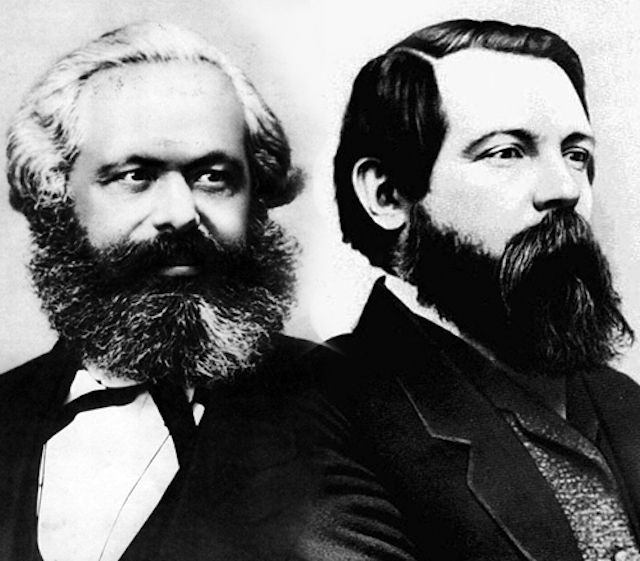
This obviously is a pioneering pamphlet, perhaps the founding document of the Marxist movement, that lays down some very simple concepts about history and the evolution of human society up to the mid-19th Century when it was published. It lays down not just the beginning of a communist, working-class programme for that historical moment, but also briefly, but coherently, lays out the materialist conception of history that Marx, and according to Engels, him alone, had distilled from his extensive study of human history up to that point.
It was the outcome of extensive, but secretive, discussions between communists, mainly those who lived in European countries such as France, Germany (then disunited, fragmented into many small states), Italy (likewise) and Poland, to name but a few. Feudal, or quasi-feudal reaction reigned there in 1847 when it was written. The various small groups of communists who had come together in the Communist League, did so very cautiously, and operated in secret, fearing retribution. The main organisation that originally made up the Communist League was the League of the Just, formed in Paris in 1834 by exiled German radicals. In 1847 it merged with the Communist Correspondence Committee, which was really Marx and Engels, to form the Communist League. They met up in London at a congress sometime in 1847, and Marx and Engels agreed to draft a proper manifesto, to explain the basic ideas of Communism, which was then the subject of hysterical press stories, but very few were familiar with Communist ideas.
In some ways even this part 1 of this manifesto is divided into two parts. The first part explains the materialist conception of history, how, after the dissolution of the early village societies, that predated private property as an institution, society began to differentiate into classes. It explains how society evolved through a series of succeeding modes of production, each based on particular ruling classes, oppressing and exploiting other classes, each such class being derived from particularly modes of social production. There were societies built on slavery, through feudalism, with several different forms of oppression, between lord and self, through the guilds, etc. Preceding the emergence of bourgeois society.
Each successive dominant mode of production became so because it played a progressive role in increasing the overall productivity of human society, the overall aggregate of social wealth Sometimes such modes of production lasted thousands of years. We still do not know as much as we perhaps ought to about pre-feudal slave modes of production. We do know that feudalism lasted over 1000 years, in Europe at least, from the fall of the Roman Empire to the Dutch Revolt against Spain from 1555 to 1601. Which was the first of a number of bourgeois revolutions, including the English Revolution in the 1640s, and later the French Revolution at the end of the 18th Century.
We don’t really know enough about what Marx later called the Asiatic mode of production. Pre-capitalist societies in Asia. What we do know is that societies built on irrigation of land by a central authority appeared to work differently, and that was common in large civilisations like India. These appear to be much more centralised kind of pre-capitalist systems, that did not involve parcellised sovereignty of local lords, which had a great deal of autonomy, though still under a king. The most centralised did not seem to easily generate an incipient bourgeois class internally. They appeared to last a very long time. It does appear that feudalism developed in the more temperate zone – in Eurasia at least. Feudalism developed in Europe, and also Japan – the Shogunates.
The key point of these is that in general, any of these modes of production may be brutal, but if they tended overall to raise the productivity of human labour, and were incapable of being exceeded by something else contemporary at a given time, they would have a degree of dynamism, and thrive regardless of moral considerations. In that sense, they played a progressive role. That was true of various societies where production was carried out by slaves. It is not always the case, for instance, that slaves were always lowly and oppressed. You could get societies where some layers of the population were formally unfree and enslaved, and yet played a major political role in running those societies. Even ruling them. Such were the Mamluks in Egypt around 900 years ago. Something similar happened in India.
This was very different from the slavery that was part of the primitive accumulation of capital, that was a key part of the early stage of capitalist society in the West, characterised by the Triangular trade to the Americas. That was probably the most barbaric form of slavery in history, because though it used forced labour, it was to produce commodities for an expanding capitalist market, particularly cotton in the nascent US, of course. Many millions died. It was a great atrocity of early capitalism.
Yet what can you say about early capitalism? It did also give rise to democratic movements – to the English civil war, to the French revolution, to the many other revolutions of the 19th century. It created the industrial and technical basis for the emergence of a modern working-class movement. Which as Marx and Engels noted in the Manifesto simplified the class antagonisms and created a class which, by taking power, can put an end to all forms of exploitation and oppression. Capitalism commodifies all things, based on the quantity of human labour to produce items for sale in the capitalist market. And the aspect that makes it fully capitalist, is that labour power is also a commodity for sale in the market. Its value is also the amount of human labour needed to produce it. In that sense, slave labour is not capitalist. The worker belongs to the boss. Whereas with capitalist wage labour, the worker’s labour power belongs to him or her, and he hires it out to the capitalist. In formal terms that is. He or she still has to work to survive. So, a non-capitalist, or partly non-capitalist, form of labour, was used to accumulate enough capital to industrialise the West. That was a historic crime, and why those countries in the Americas that were centres of capitalist slavery, are demanding reparations for this crime from the West, whose whole wealth was initially based on this slavery of mainly black African people.
The second section of part 1, is where Marx and Engels talk about the revolutionary role first of the bourgeoisie, and then the rise of the working-class movement to the point that it plays a revolutionary role.
“We see, therefore, how the modern bourgeoisie is itself the product of a long course of development, of a series of revolutions in the modes of production and of exchange.”
And it goes on (these are extracts, not necessarily strictly consecutive).
“The bourgeoisie, historically, has played a most revolutionary part.”
“The bourgeoisie, wherever it has got the upper hand, has put an end to all feudal, patriarchal, idyllic relations. It has pitilessly torn asunder the motley feudal ties that bound man to his “natural superiors”, and has left remaining no other nexus between man and man than naked self-interest, than callous “cash payment”.
“The bourgeoisie cannot exist without constantly revolutionising the instruments of production, and thereby the relations of production, and with them the whole relations of society.”
“The need of a constantly expanding market for its products chases the bourgeoisie over the entire surface of the globe. It must nestle everywhere, settle everywhere, establish connexions everywhere.”
“The bourgeoisie has through its exploitation of the world market given a cosmopolitan character to production and consumption in every country. To the great chagrin of Reactionists, it has drawn from under the feet of industry the national ground on which it stood.”
“The bourgeoisie keeps more and more doing away with the scattered state of the population, of the means of production, and of property. It has agglomerated population, centralised the means of production, and has concentrated property in a few hands. “
“The bourgeoisie, during its rule of scarce one hundred years, has created more massive and more colossal productive forces than have all preceding generations together.”
And Marx and Engels address how this came to be.
“We see then: the means of production and of exchange, on whose foundation the bourgeoisie built itself up, were generated in feudal society. At a certain stage in the development of these means of production and of exchange, the conditions under which feudal society produced and exchanged, the feudal organisation of agriculture and manufacturing industry, in one word, the feudal relations of property became no longer compatible with the already developed productive forces; they became so many fetters. They had to be burst asunder; they were burst asunder.”
And then, in turn, we see the same thing beginning to happen to bourgeois society:
“A similar movement is going on before our own eyes. Modern bourgeois society, with its relations of production, of exchange and of property, a society that has conjured up such gigantic means of production and of exchange, is like the sorcerer who is no longer able to control the powers of the nether world whom he has called up by his spells.”
Ever more serious economic crises:
“Society suddenly finds itself put back into a state of momentary barbarism; it appears as if a famine, a universal war of devastation, had cut off the supply of every means of subsistence; industry and commerce seem to be destroyed; and why? Because there is too much civilisation, too much means of subsistence, too much industry, too much commerce. The productive forces at the disposal of society no longer tend to further the development of the conditions of bourgeois property; on the contrary, they have become too powerful for these conditions, by which they are fettered, and so soon as they overcome these fetters, they bring disorder into the whole of bourgeois society, endanger the existence of bourgeois property.”
We see the rise of the working-class movement:
“The weapons with which the bourgeoisie felled feudalism to the ground are now turned against the bourgeoisie itself.
But not only has the bourgeoisie forged the weapons that bring death to itself; it has also called into existence the men who are to wield those weapons — the modern working class — the proletarians.”
We see then an extended account of the beginnings, the rise, the consolidation and expansion of the working class as a class with the development and expansion of modern industry. The growth of the workers movement goes through fits and starts, progress and setbacks:
“Now and then the workers are victorious, but only for a time. The real fruit of their battles lies, not in the immediate result, but in the ever expanding union of the workers. This union is helped on by the improved means of communication that are created by modern industry, and that place the workers of different localities in contact with one another. It was just this contact that was needed to centralise the numerous local struggles, all of the same character, into one national struggle between classes. But every class struggle is a political struggle. And that union, to attain which the burghers of the Middle Ages, with their miserable highways, required centuries, the modern proletarian, thanks to railways, achieve in a few years.
“This organisation of the proletarians into a class, and, consequently into a political party, is continually being upset again by the competition between the workers themselves. But it ever rises up again, stronger, firmer, mightier. It compels legislative recognition of particular interests of the workers, by taking advantage of the divisions among the bourgeoisie itself. Thus, the ten-hours’ bill in England was carried.”
The workers movement even attracts into its ranks elements from the camp of the bourgeoisie itself:
“Just as, therefore, at an earlier period, a section of the nobility went over to the bourgeoisie, so now a portion of the bourgeoisie goes over to the proletariat, and in particular, a portion of the bourgeois ideologists, who have raised themselves to the level of comprehending theoretically the historical movement as a whole.”
And what is that “historical movement as a whole?”:
“Of all the classes that stand face to face with the bourgeoisie today, the proletariat alone is a really revolutionary class. The other classes decay and finally disappear in the face of modern Industry; the proletariat is its special and essential product.”
The proletariat represents the future of humanity:
“All previous historical movements were movements of minorities, or in the interest of minorities. The proletarian movement is the self-conscious, independent movement of the immense majority, in the interest of the immense majority.”
“Though not in substance, yet in form, the struggle of the proletariat with the bourgeoisie is at first a national struggle. The proletariat of each country must, of course, first of all settle matters with its own bourgeoisie.”
And thus, we come to Marx & Engels’ final conclusion:
“The essential conditions for the existence and for the sway of the bourgeois class is the formation and augmentation of capital; the condition for capital is wage-labour. Wage-labour rests exclusively on competition between the labourers. The advance of industry, whose involuntary promoter is the bourgeoisie, replaces the isolation of the labourers, due to competition, by the revolutionary combination, due to association. The development of Modern Industry, therefore, cuts from under its feet the very foundation on which the bourgeoisie produces and appropriates products. What the bourgeoisie therefore produces, above all, are its own grave-diggers. Its fall and the victory of the proletariat are equally inevitable.”
Though actually, it has proved to be more complex than that. Marx goes though some of those considerations in the next part, so I won’t jump the gun by addressing them here.