This discussion forum took place on Zoom on 5th July. The presentation and discussion is available as a podcast here. The presentation notes are below:
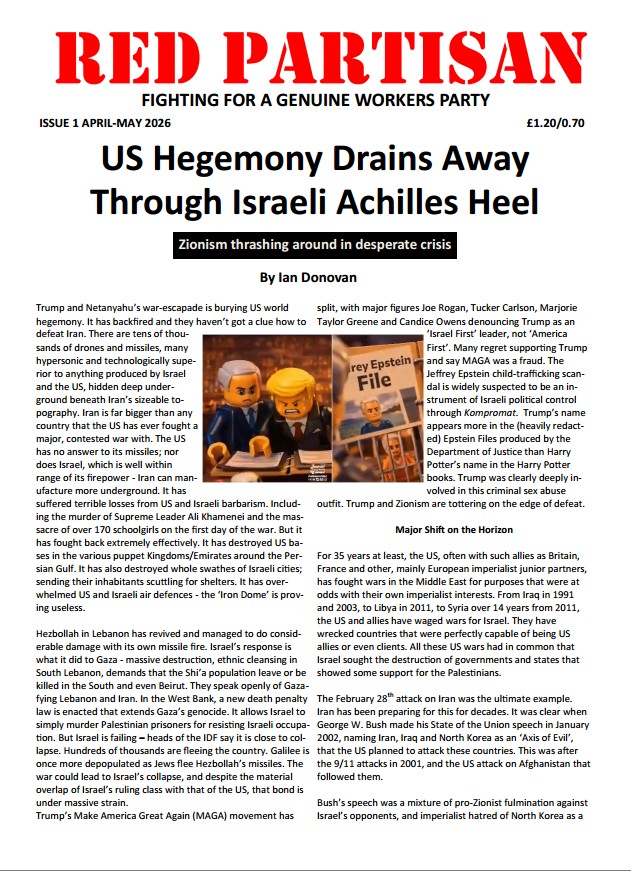
This is a crucial question for understanding the wars of today, though ironically this paradigm of imperialist war, which has been pretty much dominant since the collapse of the USSR, may have reached a significant watershed. It is clear now that the US and Israel have been defeated in their joint conflict with Iran. But they had different reasons for engaging in that conflict in the first place.
Israel has a very straightforward regional project in the West Asia/North East Africa region, traditionally known, partly in colonial terms, as the Middle East. It is an entirely artificial, transplanted, but at the same time advanced capitalist, imperialist entity. Its ruling class is very aware that its whole territory was taken by force from a Palestinian population that has a more coherent national consciousness than Zionism because it is truly indigenous and organic. Palestinians also have huge sympathy from fellow Arabs and often other particularly, but not exclusively, Muslim peoples in the region.
Islam has become increasingly important because previous Western-influenced forms of bourgeois Arab nationalism that had roots the region in previous decades, have declined particularly in the last half century or so, as Zionist expansionism has repeatedly humiliated them, and exposed their inadequacy and often servility. Islam has achieved great authority among the masses in this region in part because it is seen as ‘pure’ – despite the fact that servile and venal comprador and in some cases Royal dictatorships mar the region, still no imperialist country has an Islamic culture. It is therefore seen as untainted, uncontaminated and admirable by many oppressed peoples, from Palestine, Lebanon, and Yemen to Iran. Particularly the Shia variant, which as a result of the Iranian revolution in 1979, has gained a revolutionary fervour that resonates deeply. Most Palestinian Muslims – a minority are orthodox Christian – are Sunni, not Shia, but the Sunni Muslim radical movement (mainly Hamas) that has the ear of the Palestinian masses is considerably influenced by that same revolutionary fervour.
As revolutionary Marxists we consider such beliefs to be profoundly illusory, but we also understand their deep roots in the oppression of the masses of the region, a reaction to imperialist oppression and in particular Zionist conquest and brigandage. We note what Karl Marx said about religion in his essay A Contribution to the Critique of Hegel’s Philosophy of Right, from 1844, one of his earliest works:
“This state and this society produce religion, which is an inverted consciousness of the world, because they are an inverted world. Religion is the general theory of this world, its encyclopaedic compendium, its logic in popular form, its spiritual point d’honneur, its enthusiasm, its moral sanction, its solemn complement, and its universal basis of consolation and justification. It is the fantastic realization of the human essence since the human essence has not acquired any true reality. The struggle against religion is, therefore, indirectly the struggle against that world whose spiritual aroma is religion.
Religious suffering is, at one and the same time, the expression of real suffering and a protest against real suffering. Religion is the sigh of the oppressed creature, the heart of a heartless world, and the soul of soulless conditions. It is the opium of the people.
The abolition of religion as the illusory happiness of the people is the demand for their real happiness. To call on them to give up their illusions about their condition is to call on them to give up a condition that requires illusions. The criticism of religion is, therefore, in embryo, the criticism of that vale of tears of which religion is the halo.”
Evoking this dialectical understanding of religion is not any way a dismissal of its followers, particularly in a situation of the most severe oppression imaginable in Greater West Asia.
Zionism is an artificial construct built on land taken by force from the Palestinian Arabs. Its claim to any organic role in the region is mythological. As Shlomo Sand pointed out in The Invention of the Jewish People, it is the Palestinians who are the descendants of Ancient Hebrews, who converted to Islam and Christianity in large numbers during the first millennium CE, in the main. The Ashkenazi Jews, the core of the Zionist movement are the descendants of converts to Judaism from the Eastern fringe of Europe, also during the first millennium CE. They certainly were subjected to persecution in the late period of feudalism in both West and East Europe in late medieval and early capitalist times, and as a terrible knock-on in the early period of imperialist capitalism.
But the Zionist project was always a myth, and right from the start it had a genocidal logic. It necessarily required the dispossession of the indigenous inhabitants of Palestine, which implies their destruction. It is an unusual phenomenon, whose origins go back to the very beginnings of the modern phenomenon of imperialism. Lenin called this Imperialism: The Highest Stage of Capitalism, in a famous pamphlet. For him, capitalism had ceased to be a progressive social system, and definitively became reactionary. He considered it the eve of the socialist revolution. He agreed with Rosa Luxemburg, if socialism failed to happen, it would lead to barbarism. A choice we still face today. Competition had been transformed into monopoly in the advanced countries, to a considerable extent capital had fused with the state, and rival imperialist powers, centrally those in Western Europe – Britain, France, Germany, Italy, Holland and Belgium but also the United States, emerged, aiming to divide the world between them. This process really got going in the last two decades of the 19th Century, and accelerated to the point that in 1898 an armed standoff between Britain and France took place at Fashoda, in Sudan, that was the first instance of the kind of inter-imperialist conflict that erupted in 1914. Lenin dated 1900 as the dawn of the imperialist epoch, but in my view, he erred slightly as it was the 1880s “scramble for Africa” where a qualitative change happened.
The Jewish question is an anomaly in this. There was a significant, mainly Ashkenazi Jewish bourgeoisie, that existed in the advanced countries in the period we are talking about, which had much of its origins in the role of Jews as traders and middlemen, later usurers, in pre-capitalist Europe. Though in France and even more Holland, to complicate matters, many Jews had a different origin, Sephardic, from Muslim Spain in the inquisition period when capitalist development was well underway. When feudalism went into decline, the largely Ashkenazi Jews, who had a special social role, as a pre-capitalist trading class (“People Class” – as Abram Leon described them), were rendered obsolete by the rise of native capitalism, and were seen as insidious rivals by the early native bourgeois layers. They were thus persecuted in late feudal society.
Yet Jews were emancipated by the French revolution and similar events, and for the first time achieved equal status in a capitalist society. Yet the very unevenness of the bourgeois revolution produced enormous contradictions. There was a social and partly temporal gap of centuries between the emancipation of the Jews in Western Europe, and the final crisis of feudalism in East Europe, centrally Russia. And an enormous Jewish population were caught up in the decline of feudalism in the East in the late 19th Century, and there was a big impetus to flee from persecution westwards. This threatened to disturb the emancipated position of the Jewish bourgeoisie in the Western countries, at the same time as xenophobic and in time, racist fear of the Jewish masses from the East, was radicalising many Jews to look for solutions.
As is well known, many non-bourgeois Jews looked to progressive, socialist solutions, and saw the workers movement as the road out of poverty and persecution. But there was also a layer of nationalists, part of the bourgeoisie, and many petty-bourgeois nationalist radicals particularly from the East. They cohered in the late 19th Century with the rise of Zionism. Theodore Herzl, who came to be its chief ideologue, saw the British colonialism of Cecil Rhodes in Africa as a model of how a state for the Jews could be created. This was not a strategy of emancipation in unison with the rest of progressive humanity, but envisaged the creation of a Jewish state at the expense of the indigenous peoples of Palestine – the only realistic suggestion as to the location of such a state – others were considered. That was the dawn of the idea of Zionism as a realistic programme. It was to be built on the imperialist model and would involve the Jews, as a formerly oppressed population, taking their place among the dominant peoples in the creation of such a state. This could only be conceived of because of the social structure of the Jewish population, which as a result of its earlier role as a trading people-class, had a disproportionately large layer of businesspeople, and comparatively few workers.
Yet this was only achieved as a by-product of the most savage persecution of the Jews – the extermination of millions by the Nazis in the mid-20th Century. That genocide allowed another genocidal programme to be implemented after WWII. It was the contradictions caused by the massively uneven disintegration of feudalism in the East, setting in motion millions of Jewish refugees, that created the conditions where imperialist capitalism, in exterminating millions of that oppressed population, could nevertheless create the conditions where an imperialist, ethnocratic Jewish state could come into existence in the latter half of the 20th Century, which has now become a menace comparable to the Third Reich. Today, many who previously would have admired Hitler, admire Israel. As I’m sure we are all aware. The only explanation for this is that the root cause of the seemingly intractable oppression of the Jews was not, as Abram Leon mistakenly believed, the capitalist system itself, but the unevenness of the disintegration of feudalism between East and West, and the extreme anomalies that created.
But coming off this, we have to deal with Israel as an imperialist power today. That Jewish bourgeoisie, that was added to by radicalised petty bourgeois nationalists, created a transplanted Jewish imperialist state that in terms of strict size, ought to be minor, comparable to Denmark. But Israel is much more powerful than Denmark. Because that national-imperialist project gained a large bourgeois following in the diaspora. Not immediately – much of the Jewish bourgeoisie was originally sceptical or even hostile to it. But over time, with the impact of events (including two World War, then Hitler and genocide), the bourgeois and petit-bourgeois nationalist Zionists won over the bulk of the Jewish bourgeoisie, and many of the surviving masses, to the project of Israel as ‘national refuge’ for the Jews. This does not mean everyone has to live there. But they do regard it as their state.
The Israeli Law of Return says that every born Jew around the world is entitled to Israeli citizenship. This consolidated that quasi-national ethos and sentiment. So, the diaspora-Jewish bourgeoisie were eventually overwhelmingly won to Zionism. That gave them a material connection to the Israeli bourgeois state. As with other bourgeois states, both imperialist and non-imperialist, where a kind of ‘ownership’ of the state rests with the bourgeoisie who are citizens of that state. Combined with the exilic ideology of Zionism itself, this has the effect – and it was clearly designed that way – of creating a partly internationalised Jewish-Zionist bourgeoisie, based mainly, but not only, in the imperialist West. And as noted, that bourgeoisie was, and is, disproportionately massive in comparison with the size of the Jewish population generally. That means that Israel punches very much above its weight, far above Denmark, because its ruling class overlaps with the imperialist bourgeoisie of major Western countries, particularly the US.
Another important factor in bolstering this influence was the switch from Keynesian economics to Neoliberalism in the 1970s, in a major crisis. This was popularised and driven by Jewish-Zionist bourgeois ideologues like Friedman, Sherman, Joseph, Kissinger. That has created a deference among the imperialist bourgeoisie to this Jewish-Zionist bourgeois layer or caste, seen as their most class-conscious section. A kind of political cult.
Israel is an artificial, transplanted, illegitimate, imperialist formation in the Middle East. It has had to fight wars to defend that illegitimacy for the whole of its existence. It has had a project of seeking to pre-emptively defeat any Arab or Muslim country in the region that in any way was capable of becoming a champion of the Palestinians. In the earlier period, it managed to do this on its own, albeit with help from other imperialist powers. We saw this briefly in 1956, then decisively in 1967 against Egypt and Syria, and again in 1973. But after that it had problems. It got bogged down repeatedly in losing conflicts in Lebanon, from 1978 and 1982 and later. It faced Palestinian intifadas at home. But it also faced enemies that became too strong for it to defeat itself: Iraq, Russian-backed Syria, Libya and Iran.
All of these governments showed clearly that, left to themselves, and without having to deal with Israel, they would happily be US/Western clients. Saddam’s Iraq was a Western client in the Iran-Iraq war. Libya attempted to join the Western camp during the 2000s. Syria fought in the US backed coalition against Saddam’s Iraq in 1991. And even Iran was not purely anti-imperialist, as the murky 1987 Iran-Contra affair shows. The US interest in the region rationally, is mainly for oil and other raw materials. Most of these apparently willing clients are oil-rich and keen to trade, unlike Israel. Yet they were all attacked, both by force of arms and by proxy, by the US and its Western allies, since 1991. It is clear that this was done on Israel’s behalf.
In 1991 Iraq was misled into an unwise invasion of Kuwait, who were stealing Iraqi oil, by a mendacious US ambassador, April Glaspie. This was done because Iraq had acquired an effective ‘supergun’ weapon that threatened Israeli power. In 2007 Wesley Clark, in (perhaps mock) horror, revealed Bush’s ‘shopping list’, which included Iraq, Somalia, Sudan, Syria, Libya, Lebanon and finally Iran. These were all Israel’s enemies, not particularly the West’s. This chain of wars for Israel happened since. I will spare the details. There is no need for them. They are too recent and well known.
And now we have Iran. The US has been defeated, in a manner that Foreign Policy, the in-house journal of the US geopolitical establishment, says is worse than the defeat in Vietnam. That is embodied in the Memoradum of Understanding (MOU) that the US signed. Yet the Vietnam defeat was against a real social revolution, and took more than two decades. There was no social revolution involved in Iran’s war effort. Iran’s Shia regime is not leading a social revolution, whatever utopian religious ideas some of its adherents may harbour. And yet that war was lost in four months. For straightforward military/economic reasons. The US was warned it was unwise before they started it.
The US is still vacillating despite its defeat with Vance warning Israel that the US is its only remaining ally, and it is universally hated. Meanwhile Rubio is arranging the doomed Israeli/US stooge deal in Lebanon. The MOU the US signed with Iran says that Israel must stop its butchery in Lebanon immediately. But Netanyahu would be ejected from power if he did. Israel is committing atrocities in Lebanon, but still losing.
This is the latest episode in a saga. Iraq was ultimately a long-drawn-out defeat. Libya and Syria are chaotic and of little value to the US as clients. Only Israel benefits from the chaos. And Iran has been a completely unnecessary strategic defeat for the US. They didn’t have to attack. They did it for Israel, as Rubio admitted, as does Vance – and Trump blusters. The US is in decline, that is clear. But without fighting this war for Israel – and losing it – such a major, strategic defeat would still be several years away.
It is possible that this may drive a major wedge between Israel and the US. But that would be a huge convulsion in the ruling class, because the ruling classes overlap. In that context, you get section 224 of the National Defence Authorisation Act, which integrates US and Israeli military intelligence. This appears to be designed to counteract threats to the overlap of the ruling classes, i.e., to reinforce Israeli influence over the US at the level of bourgeois state power.
We are now entering a new historical period after the biggest US defeat in its history, that threatens its world hegemony. This will cause huge changes in the world. Our job as Marxists is to struggle to understand this new reality, as a guide to action. Without understanding the past, we will not be able to do this.