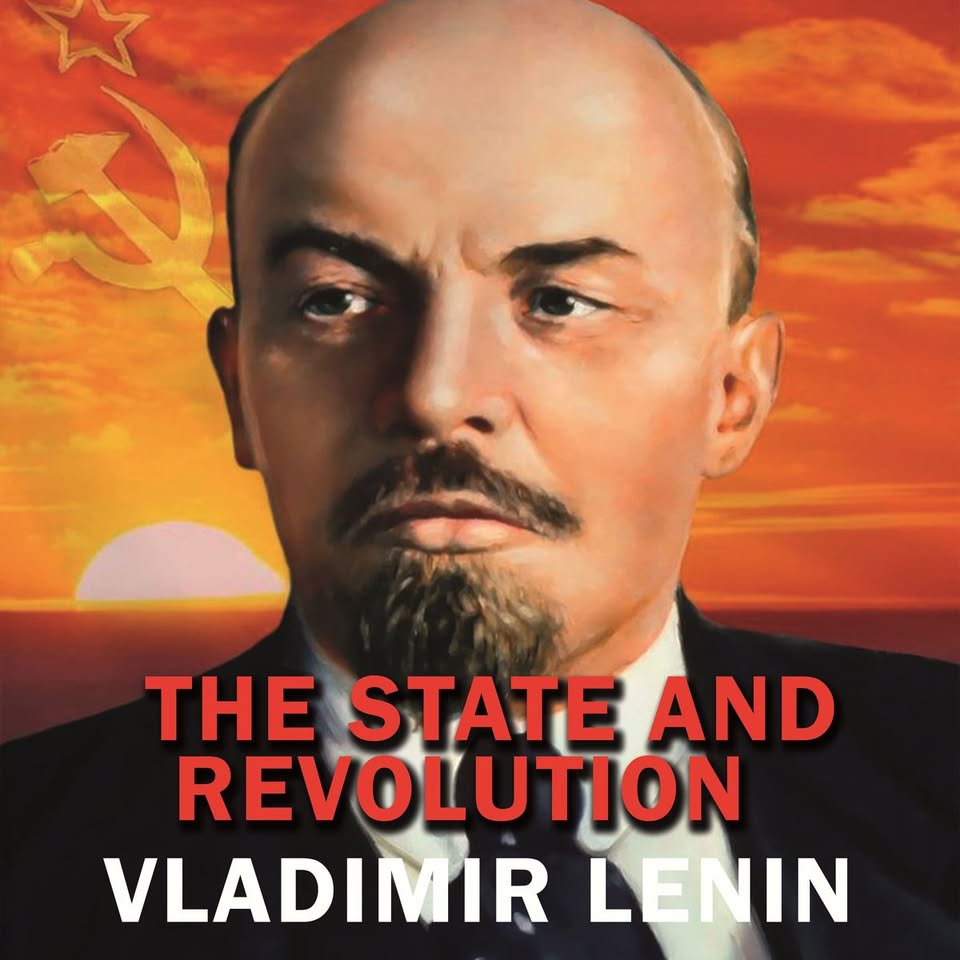
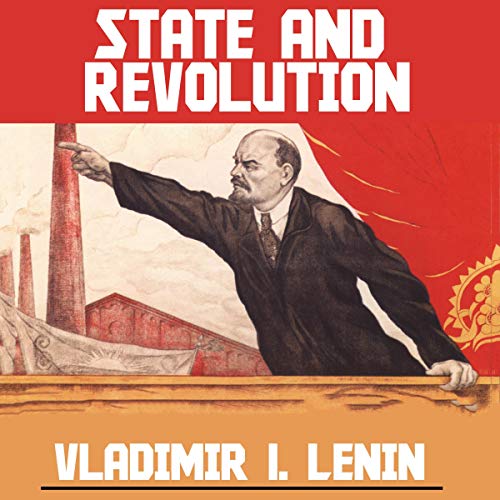
The following is the notes/text of a presentation delivered by a Consistent Democrats speaker on 22nd March on this chapter. The recording of the presentation and discussion ishere.
This is a substantial chapter, divided into six subsections. These are:
The Housing Question.
Controversy with the Anarchists
Letter to Bebel
Criticism of the Draft Erfurt Programme
The 1891 Preface to Marx’s The Civil War in France
Engels on the Overcoming of Democracy
All these sections embody an underlying theme. They cover a lot of ground in drawing more generalised conclusions about the lessons of the Paris Commune and the importance of those lessons for distinguishing genuine socialism – Marxism – from parliamentary opportunism.
It starts off with citing Engles on the Housing Question – about reforms, and the requisition of property. This is by way of a preface to the more substantial sections to come.
Regarding housing, Lenin cites Engels that:
“…one thing is certain: there is already a sufficient quantity of houses in the big cities to remedy immediately all real ‘housing shortage’, provided they are used judiciously. This can naturally only occur through the expropriation of the present owners and by quartering in their houses homeless workers or workers overcrowded in their present homes. As soon as the proletariat has won political power, such a measure prompted by concern for the common good will be just as easy to carry out as are other expropriations and billetings by the present-day state.”
And continues to cite Engels:
“It must be pointed out that the ‘actual seizure’ of all the instruments of labour, the taking possession of industry as a whole by the working people, is the exact opposite of the Proudhonist ‘redemption’. In the latter case the individual worker becomes the owner of the dwelling, the peasant farm, the instruments of labour; in the former case, the ‘working people’ remain the collective owners of the houses, factories and instruments of labour, and will hardly permit their use, at least during a transitional period, by individuals or associations without compensation for the cost. In the same way, the abolition of property in land is not the abolition of ground rent but its transfer, if in a modified form, to society.
To summarise, Lenin again cites Engels’ formulated position from that adopted by the Blanquists in France after the Commune:
“… Necessity of political action by the proletariat and of its dictatorship as the transition to the abolition of classes and, with them, of the state….”
This sets the scene for the controversy with the anarchists. This was published in an Italian socialist annual in 1873. It was not published in German until 1913.
Its essence was this:
“If the political struggle of the working class assumes revolutionary form… and if the workers set up their revolutionary dictatorship in place of the dictatorship of the bourgeoisie, they commit the terrible crime of violating principles, for in order to satisfy their wretched, vulgar everyday needs and to crush the resistance of the bourgeoisie, they give the state a revolutionary and transient form, instead of laying down their arms and abolishing the state.” (this appears to be extracted by Lenin)
This is the essence of the Marxist criticism of the anarchists … not for rejecting the state as a supposed norm of society, but for rejecting the special kind of transient state that the communists advocated, the means of crushing the bourgeoisie.
Engels ridiculed the ‘anti-authoritarians’, the Proudhonists and similar, who “repudiated all authority, all subordination, all power” and noted that this implied rejecting revolution itself, in practice:
“Have these gentlemen ever seen a revolution? A revolution is certainly the most authoritarian thing there is; it is an act whereby one part of the population imposes its will upon the other part by means of rifles, bayonets and cannon, all of which are highly authoritarian means. And the victorious party must maintain its rule by means of the terror which its arms inspire in the reactionaries. Would the Paris Commune have lasted more than a day if it had not used the authority of the armed people against the bourgeoisie? Cannot we, on the contrary, blame it for having made too little use of that authority? Therefore, one of two things: either that anti-authoritarians don’t know what they are talking about, in which case they are creating nothing but confusion. Or they do know, and in that case they are betraying the cause of the proletariat. In either case they serve only reaction.”
But this, as Lenin points out, that Social Democrats in his day had never argued against the anarchists as Marxists:
“Social-Democrats, claiming to be disciples of Engels, have argued on this subject against the anarchists millions of times since 1873, but they have not argued as Marxists could and should. The anarchist idea of abolition of the state is muddled and non-revolutionary–that is how Engels put it. It is precisely the revolution in its rise and development, with its specific tasks in relation to violence, authority, power, the state, that the anarchists refuse to see.
“The usual criticism of anarchism by present-day Social-Democrats has boiled down to the purest philistine banality: “We recognize the state, whereas the anarchists do not!” Naturally, such banality cannot but repel workers who are at all capable of thinking and revolutionary-minded. What Engels says is different. He stresses that all socialists recognize that the state will disappear as a result of the socialist revolution. He then deals specifically with the question of the revolution – the very question which, as a rule, the Social-Democrats evade out of opportunism, leaving it, so to speak, exclusively for the anarchists “to work out”. And when dealing with this question, Engels takes the bull by the horns; he asks: should not the Commune have made more use of the revolutionary power of the state, that is, of the proletariat armed and organized as the ruling class?
Then Lenin goes on to deal with Engels’s Letter to Bebel, in March 1875. Engels was criticising the Gotha programme, the earlier draft programme of German social democracy. Taking up the question of the state, Engels wrote:
“The free people’s state has been transferred into the free state. Taken in its grammatical sense, a free state is one where the state is free in relation to its citizens, hence a state with a despotic government. The whole talk about the state should be dropped, especially since the Commune, which was no longer a state in the proper sense of the word. The ‘people’s state’ has been thrown in our faces by the anarchists to the point of disgust, although already Marx’s book against Proudhon and later the Communist Manifesto say plainly that with the introduction of the socialist order of society the state dissolves of itself disappears. As the state is only a transitional institution which is used in the struggle, in the revolution, to hold down one’s adversaries by force, it is sheer nonsense to talk of a ‘free people’s state’; so long as the proletariat still needs the state, it does not need it in the interests of freedom but in order to hold down its adversaries, and as soon as it becomes possible to speak of freedom the state as such ceases to exist….”
Indeed, Engels said that the attacks of the anarchists on the social democrats were in part justified “insofar as the ‘people’s state’ was as much an absurdity and as much a departure from socialism as the ‘free people’s state’”
Bebel replied to Engels that he fully agreed with his opinion on the draft programme. And yet, in Bebel’s 1886 pamphlet Our Aims is to be found the following formulation:
“”The state must… be transformed from one based on class rule into a people’s state.”
So, it appears that for all Bebel’s agreement with Engels abstractly, that agreement was negated by the social pressure of the political environment that Bebel and the SPD operated within.
Which brings us on to the section of the Erfurt Programme, the more developed programme of German Social Democracy, adopted in 1891, 8 years after Marx’s death.
Engels criticised this document, for faults on the question of democracy and the state, at several levels. There was opportunism in the SPD, in fear of a reprise of the anti-socialist law (1878-1890).
This was expressed in the SPD’s failure to challenge the legal prohibitions on the demand for a republic, the acceptance of a ‘federal’ constitution in Germany, when what should have been demanded is a unitary republic.
What Engels only touched on was the question of the need to combine legal and illegal work, as the Bolsheviks later did in Russia, with ultimately great success.
He was critical of the SPD thus:
“They push general, abstract political questions into the foreground, thereby concealing the immediate concrete questions, which at the moment of the first great events, the first political crisis, automatically pose themselves. What can result from this except that at the decisive moment the party suddenly proves helpless and that uncertainty and discord on the most decisive issues reign in it because these issues have never been discussed? …
“This forgetting of the great, the principal considerations for the momentary interests of the day, this struggling and striving for the success of the moment regardless of later consequences, this sacrifice of the future of the movement for its present may be ‘honestly’ meant, but it is and remains opportunism, and ‘honest’ opportunism is perhaps the most dangerous of all….
“If one thing is certain it is that our party and the working class can only come to power in the form of the democratic republic. This is even the specific form for the dictatorship of the proletariat, as the Great French Revolution has already shown….”
This was not a statement that the advent of a ‘democratic republic’ would be synonymous with the dictatorship of the proletariat, but rather a countering of the opportunism of the SPD for not raising the question of the republic, in a ‘constitutional’ setup that was a ‘fig leaf for absolutism’, as Bebel was reputed to have said.
(For brevity, I am leaving out two questions here. One is Marx’s view, referred to by Engels, that a peaceful overcoming of capitalism might have been possible in late 19th Century Britain, because of the absence then of a bureaucratic state. I think Marx was mistaken here.
The other being the prolonged elaboration of aspects of the national question, of a federal republic as the correct demand in Britain, his support for the autonomy of US states, and similar in Australia, Canada etc. And how ruinous the Swiss canton system was. Lenin links this with his own correct rejection of the dismissive attitude to the national question of some Polish and Dutch Marxists. These are worth discussing, but not really in detail here.)
Which then brings us onto Lenin’s exploration of Engles 1891 Preface to Marx’s The Civil War in France. This summarised the lessons of the Paris Commune thus:
“In France, Engels observed, the workers emerged with arms from every revolution: ‘therefore the disarming of the workers was the first commandment for the bourgeois, who were at the helm of the state. Hence, after every revolution won by the workers, a new struggle, ending with the defeat of the workers.’”
Lenin continues, citing Engles about the state in this context:
“”… It was precisely the oppressing power of the former centralized government, army, political parties, bureaucracy, which Napoleon had created in 1798 and which every new government had since then taken over as a welcome instrument and used against its opponents–it was this power which was to fall everywhere, just as it had fallen in Paris.
“From the very outset the Commune had to recognize that the working class, once in power, could not go on managing with the old state machine; that in order not to lose again its only just-gained supremacy, this working class must, on the one hand, do away with all the old machinery of oppression previously used against it itself, and, on the other, safeguard itself against its own deputies and officials, by declaring them all, without exception, subject to recall at any time….”
As Lenin remarked:
“Engels emphasized once again that not only under a monarchy, but also under a democratic republic the state remains a state, i.e., it retains its fundamental distinguishing feature of transforming the officials, the ‘servants of society”, its organs, into the masters of society.”
“Engels here approached the interesting boundary line at which consistent democracy, on the one hand, is transformed into socialism and, on the other, demands socialism. For, in order to abolish the state, it is necessary to convert the functions of the civil service into the simple operations of control and accounting that are within the scope and ability of the vast majority of the population, and, subsequently, of every single individual. And if careerism is to be abolished completely, it must be made impossible for “honorable” though profitless posts in the Civil Service to be used as a springboard to highly lucrative posts in banks or joint-stock companies, as constantly happens in all the freest capitalist countries.”
And then he concluded this section by saying:
“Two more remarks. 1. Engels’ statement that in a democratic republic, “no less” than in a monarchy, the state remains a “machine for the oppression of one class by another” by no means signifies that the form of oppression makes no difference to the proletariat, as some anarchists “teach”. A wider, freer and more open form of the class struggle and of class oppression vastly assists the proletariat in its struggle for the abolition of classes in general.
2. Why will only a new generation be able to discard the entire lumber of the state? This question is bound up with that of overcoming democracy, with which we shall deal now.
There is some discussion here of the inadequacy of the name ‘social democrat’ by Engels, and relatedly the name of the Bolshevik Party in Russia. This is worth reading, but it is tangential again, so I will just mention it and encourage comrades to read.
“In the usual argument about the state, the mistake is constantly made against which Engels warned and which we have in passing indicated above, namely, it is constantly forgotten that the abolition of the state means also the abolition of democracy; that the withering away of the state means the withering away of democracy.”
And Lenin addresses those who might suspect this is being some kind of elitism:
“We set ourselves the ultimate aim of abolishing the state, i.e., all organized and systematic violence, all use of violence against people in general. We do not expect the advent of a system of society in which the principle of subordination of the minority to the majority will not be observed. In striving for socialism, however, we are convinced that it will develop into communism and, therefore, that the need for violence against people in general, for the subordination of one man to another, and of one section of the population to another, will vanish altogether since people will become accustomed to observing the elementary conditions of social life without violence and without subordination.”
“In order to emphasize this element of habit, Engels speaks of a new generation, ‘reared in new, free social conditions’, which will ‘be able to discard the entire lumber of the state’–of any state, including the democratic-republican state.
In order to explain this, it is necessary to analyse he economic basis of the withering away of the state. Which is dealt with in the next chapter.
Defeating Iran is a part of imperialism’s offensive aiming to cut off China’s energy supplies, after following the same objective by attacking and taking control of Venezuela. Iran, like Russia, has part of its coastline on the Caspian Sea (with its gigantic energy reserve). 80% of Iranian oil is exported to China. In turn, in 2025, Iran accounted for about 13% of all oil imported by China by sea.
The techno-billionaire and paedophile regimes of the US and Israel believed in the tactic of terror and beheading of Iran. Iran, for almost half a century under siege and sanctions, which have spanned generations, has been preparing for this war for years, believing that it will be decisive for the existence of the Islamic Republic, they believe that it will be the largest and longest they have ever faced. As a sign of the times of imperialist decay, the consequences and risks of this war do not fall solely on the oppressed country. The U.S. could be defeated, humiliated, and be forced to lose its influence in West Asia by dismantling its military bases. Israel, which had the myth of its invulnerability dispelled in the 12-day war, may be more isolated and vulnerable than ever. The pro-imperialist monarchies, with their artificial puppet states, will have their days numbered.
The murder of hundreds of people, students, political and religious leaders of the country, among them the supreme leader of Iran, Ali Khamenei, similar to the Catholic Pope for Shiite Muslims, has several consequences:
1. Strengthened Iranian national cohesion, even among those who had differences with the government, against foreign attack, which means that the coup plans of regime change can result in a strong regime instead. There has also been an increase in international solidarity with the Persian nation, in addition to massive demonstrations in Iran’s own cities, in the midst of US and Israeli missile attacks; there have been furious protests in Pakistan, Yemen, Iraq, Libya, attacks on US embassies and even UN buildings.
2. This compelled the Revolutionary Guards to carry out the threat to close the Strait of Hormuz, blocking 20% of the world’s oil traffic (though not from allied vessels such as China), causing the price to skyrocket by 30% in the first days of the war, which could reach 100 dollars a barrel with the continuation of the war. This could unleash inflation and a global economic crisis. In the dispute over the Strait, several vessels have been reporting a cybernetic anomaly in their navigation systems hitherto unknown, with GPS signals showing incorrect positions and speeds.
3. It enables the government to repress more forcefully the internal mercenaries infiltrated, in the pay of imperialism and Zionism, a procedure that had already been done against the attempted violent revolution of December and January, eliminating the possibilities of regime change, even with the killing of the most prominent leadership figures.
4. It reopens the debate on the revision of the 2003 fatwa, issued by Khamenei, a theological doctrine that prevented Iran from developing nuclear weapons, a deterrent device that has ensured relative tranquility for North Korea. More than once, scientists and advisers have expressed the view that the doctrine could change if Iran’s existence is threatened, and this war points to that.
5. The character of the Iranian military reaction is completely different from the actions previously warned and agreed with the enemy, as in the 12-day war.
6. Iran has made a leap in quality in relation to the weapons used in the 12-day war. It used its deadliest weapon against anti-missile systems at U.S. bases. For the first time the Fattah-2 hypersonic cruise missiles. The missile has a range of approximately 1,500 km. One of the advantages of this weapon is that they do not need to gain altitude like ballistic missiles, HGVs (Hypersonic Glide Vehicles) fly much lower and can change direction frequently towards the target, making it difficult for enemy long-range defence radars to detect.
7. Iran is bleeding heavily. The biggest casualty is in its political and religious cadres, but it has demonstrated a capacity to replace leading cadres and an automatic or pre-planned reaction that is very surprising and superior to that of imperialism since the 12-day war.
8. Once again, the imperialist anti-aircraft defences were overwhelmed. The UAE had acquired 2 billion dollars’ worth of anti-aircraft weapons, missile interceptors, which have already been depleted, leaving the way clear for more modern and powerful weapons from Iran. Much of the air defences, from US interceptors, have already been spent in Ukraine. And as in all industry, the arms industry also “suffers”, although to a lesser extent, from deindustrialization. Thus, daily bombs rain down on Israeli cities, with Iranian missiles and drones already devastating even the headquarters of Mossad and Benjamin Netanyahu’s own cabinet. Now the defence capabilities of U.S. bases throughout West Asia, all the way to Cyprus in the Mediterranean Sea, are also being destroyed.
9. Having had its bases compromised by the expansion of the reach of Iranian counterattacks to the Mediterranean, the US demanded that Spain make its territory available, a request rejected by the Spanish socialist government. Then Trump declared the rupture of all trade relations with Spain. Simultaneously, the German Social Democratic and British Labour governments have made their bases, but not yet their military forces, available to Nazi-Zionism to increase its military campaign against Iran. Confirming the lessons of our time, Macron, in France, announced new investments in nuclear weapons and the deployment of a French aircraft carrier to the Mediterranean.
10. The largest U.S. radar in the Persian Gulf, “capable of monitoring all of West Asia”, used for early warning with a range of 5,000 kilometers and a price of 1.1 billion dollars, was destroyed. Three U.S. F-15 fighter jets were shot down in Kuwait.
11. There is a gigantic disproportion in the costs and destructive yield of armaments. Iran produces drones at a price of $20 – 50,000, which need to be shot down by 3 interceptor missiles that cost from $50,000 (cost of the Iron Dome ones that have proven ineffective and are being replaced) to $4 million (for the Patriot/US system). For its part, Iran is not counting on the weapons it will produce. It has already produced thousands of drones in the Shahed category, which prove to be among the best in the world, which were a success in Ukraine against NATO. Iran has already built and then and dismantled the factories, so that they cannot be destroyed, as well as moving the radioactive material from their atomic plants, which have been targets of the bombings. Its weaponry already produced is sink cost, or, in Marxist terms, fixed capital, which cannot be recovered and, therefore, when used in the defence of the country, promotes a new cycle of capital accumulation for Iran.
11. Reactivation of the Axis of Resistance. It has been more than a year since the Popular Mobilization Forces (PMF) of Iraq and Hezbollah have responded to Zionist aggressions. Now they are back in action.
For the third phase of the imperialist response, we must add that
1. Israel’s current focus is to try in a cowardly manner to neutralise the Axis of Resistance in Palestine, Lebanon, Iraq and Yemen. The Zionist entity announces the invasion of Lebanon by land, with the support of the Lebanese government, try to exterminate Hezbollah.
2. The possibility of a nuclear attack by the US or Israel against Iran cannot be ruled out, as a desperate reaction of Nazi-Zionist imperialism.
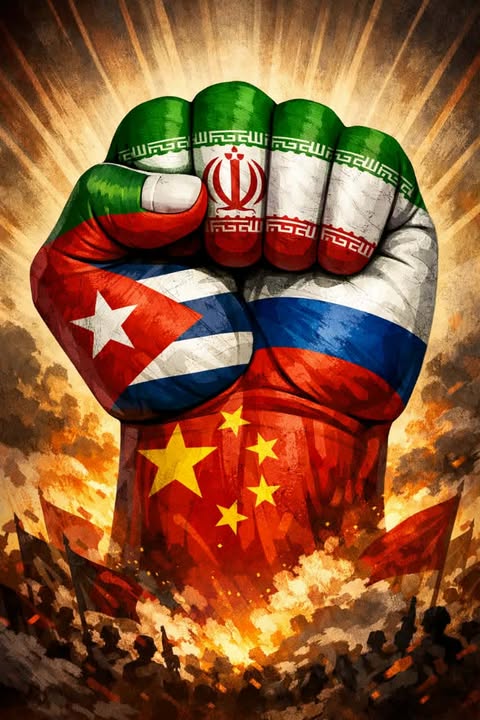
It is very much in the interest of the world working class that the workers’ movement comes to Iran’s defence. Most of the US population is opposed to this aggression – we need political strikes against it, in the US and elsewhere. Socialists must militantly oppose all such imperialist aggression and also welcome such assistance as adversaries of the imperialist West, such as the Chinese deformed workers state, Russia, etc, are able to give to Iran. Iran is being supported indirectly by China and Russia, but this support is insufficient against the imperialist power, which has as a strategy the strangulation of Chinese supply chains, and then attacks China. If it loses Iran, then Venezuela (and then Brazil?), China will lose 1/5 of its oil supply. Iran’s victory is vital, not only for Iran itself, but for China and the BRICS. The diplomatic, economic and military aid that these states have given to Iran is important, but much more is necessary – much more than the ‘market socialist’ bureaucratic caste that leads the Chinese deformed workers state, or Russia with its statified variant of capitalism – still at odds with imperialism because it is deformed by remnants of the October revolution that counterrevolution proved unable to eliminate – are remotely capable of. We need the rebirth of a genuine communist movement, rooted in the proletariat in all countries, to both fight for, and hopefully to lead, a massive anti-imperialist united front. A unified fist to defeat this imperialist aggression and lay the basis for a renewed offensive for world socialism against the declining US empire, the Zionist regime, and their imperialist allies and lackeys.
Workers, Anti-Imperialists, Russia, China – Unite!
Defeat Zionist-US and All Imperialist Criminals! Defend Iran, Cuba, Palestine and the Donbass!
This presentation was given at a Consistent Democrats forum on 1st March 2026. .
A recording of the full presentation and discussion at this meeting is available here.
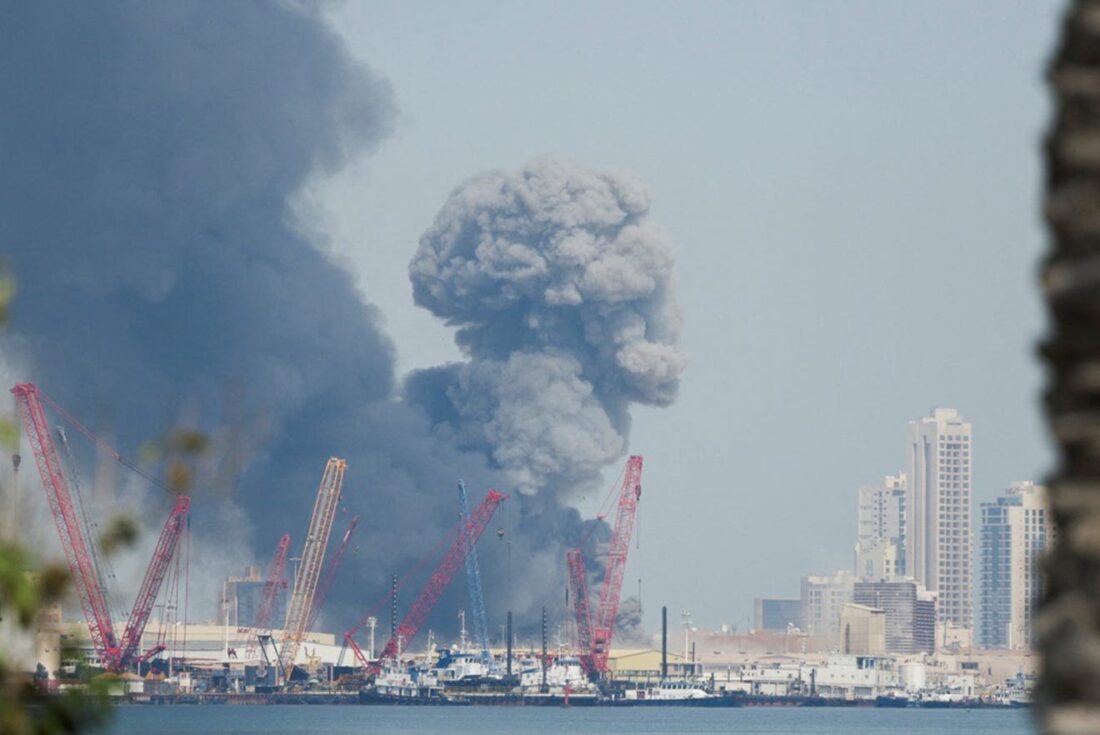
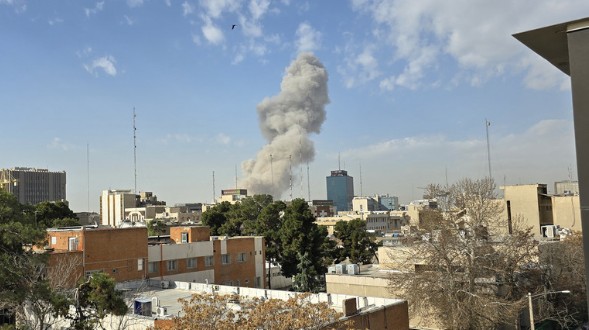
Iranian Missile hits US installation in Bahrain, March 1 2026
The world, and the working class, are now in very dangerous circumstances thanks in large measure to a combination of two linked major questions: One is the decline of US world hegemony vis-à-vis Russia and China, two major world-power states that, in different ways, owe their present power in the world to factors related to the 1917 Russian Revolution. The other is Israel and the Jewish question as manifested in the Middle East. The existence of Israel as a rogue, transplanted imperialist power with a major base of support in the older imperialist world, and a project of attempting to dominate West Asia and North-East Africa, the area of the world usually known as the Middle East, complicates the world situation and has brought it to the brink of a major world confrontation.
I will talk about some of those issues later. But first I will focus on Your Party, which in a way, is a product of these contradictions, of the activities of the dominant pro-Zionist element of the imperialist bourgeoisie. Clearly the pro-Zionist wing of British imperialism will not tolerate any even reformist opposition to support for Israel, its oppression of the peoples of the Middle East, and sees that as a make-or-break issue for any party as to whether it will be tolerated, or not. Likewise, regarding support for NATO and its wars, particularly the proxy war in Ukraine. That is the reason why Your Party, much delayed, came into existence in the first place. Even though Corbyn’s opposition to Zionism and NATO was tepid, and he capitulated on both questions, it still put him, and more importantly the movement behind him, beyond the pale.
The Blairite infatuation with neoliberalism is also important, but the bourgeoisie would be more prepared to tolerate a fully social imperialist party, at least for a while, that was at variance with the neoliberal ethos to an extent. They realised in the past that such a Labour Party was useful if the masses threaten to escape their control. However, so disturbed was the bourgeoisie by the rise of a mass movement that expressed popular discontent with these issues behind Corbyn in the mid 20-teens, that it has seriously attempted to steer politics toward bringing the far right to power. That is what Starmer represents. A Labour government that, coming off fourteen years of Tory government that exhausted that party in a manner that would normally take it two or three terms to recover from, being replaced by a ‘Labour’ regime more brutal and reactionary than its Tory predecessor. That is a ticket for its collapse and being later replaced by a far-right party. Starmer is thus a transitional figure to that.
This is a risk for capital though, as it can also bring into an existence a left-wing nemesis of the Labour Party. The Corbyn leadership, though they seemed radical in 2015 when gained office in Labour, proved very tame. After his ejection from the Labour leadership after the engineered defeat of 2019, Corbyn procrastinated for so long and only dared to begin the creation of a new party when were pushed by a younger and more militant figure on the newer Labour left, Zarah Sultana, whose radicalisation has gone much further than Corbyn was capable.
Those are the underlying reasons for what is happening now, and the division in YP. Corbyn did not really want Your Party, though much of his base did, and largely still do. The real difference between the Corbyn led TM slate, and the pro-ZS Grassroots left, is that the programme of the Corbyn wing is a vague left populism – they chose the name, which is anodyne, and they have little explicit to say about policy. Whereas the GL is overtly opposed to NATO, overtly hostile to Zionism, defends oppressed groups forthrightly who the ruling class wants as a scapegoat and a thin end of the wedge – trans rights, and its leader openly advocates ‘class war’ politics. Also, they advocate a ‘party of the whole left’, which means no witchhunts, and the opportunity for all trends to contend and gain influence according to their political strength (or lose it according to their weaknesses)
So that was what the contest between slates was about, and why it was correct to involve ourselves in the GL. The GL is very heterogenous, and it includes people who are often not a model of clarity or anti-imperialism, some with awful or naive views on things like Ukraine, Iran, etc, but in conflict nevertheless with the Corbyn group over many questions. We have no reason to be fearful of this, evidently, as orthodox Marxists. Our record in the SLN can serve as an example of what can be done, as we won it to a correct position on Ukraine, for instance. There is real comradeship emerging in the GL; this is the progressive aspect – the antidote to sectarianism. But the results remain to the be seen.
The results of the election for the CEC were: 13 seats to The Many slate, 7 to the Grassroots left, and 2 friendly independents elected including one from Scotland. There seems to have been a major rise in the Your Party electorate, from around 25,000 at the time of the founding conference in November – when only 11,000 actually voted, to today, when there are, out of just short of 60,000 members, 35,000 or so actually verified and able to vote through the website. Though again, the actual number who voted was much less, around 25,000 this time. There were also a very small number of postal votes – only a couple of dozen valid ones, according to sortitioned observers of the electoral process. So that aspect of it was negligible. More to the point was the monopoly of data in the hands of the Corbyn faction, The Many. Behind the scenes, the apparatus that had charge of the data and organised the election was completely in the hands of supporters of the TM faction. I.e., the likes of Karie Murphy and other apparatchiks who work with her. She is both a former UNITE official and the partner of ex-General Secretary Len McCluskey, who it will be recalled, used UNITE’s block vote to ram the IHRA definition of anti-semitism through the Labour NEC in 2018 – supposedly to disarm the issue. He then was surprised that this failed, that the witchhunt against the left accelerated once this had been done. But of course, if you give an inch to the Zionists, they will take a mile. This is elementary.
These are the kind of people who controlled the electoral process, with very little oversight as to how they controlled the data. I know that I and many others repeatedly got emails promoting TM, despite that I never signed up for such promotions. They got this from the membership list – that is clearly true. The GL did not have access to the membership list. And the TM slate and its bureaucratic supporters were no slouch. As pointed out, the number of verified members, able to vote, rose considerably between the conference and the CEC vote. In fact, it seemed to grow considerably between the end of endorsements, and the actual vote – there was a big effort to get voters verified and work on them with many being sent repeated campaign literature by the TM people, who could evidently access the data. This is clearly why the results of endorsements of candidates was so different from the results of the actual vote. The electorate had effectively doubled by these means.
Otherwise, where did all these emails from TM, come from? Not there is anything wrong with expanding the voting membership. But only one side had access to the data to do this. Anyway, the results were that, whereas the Grassroots left in London overwhelmingly won the endorsements, only one of our two people won the CEC seat. This was the product of the TMs monopoly of the membership data. There were simply large parts of the membership that no one else other than TM could reach. Then there was the choice of Imperiali as the method of STV that was chosen to use for the election. This one is significant in that it strongly favours larger blocks. As it was though, there was a risk that with this, it could potentially favour the GL just as much as the TM. So, it had to be supplemented with the use of the TM’s data monopoly to make sure Imperiali worked the ‘right’ way. (much of the work done in analysing this was done by Matt Cooper of the AWL, whose politics are unconscionable – and who did not endorse the GL – but were useful nevertheless).
Anyway, what is the result of this? The CEC is elected, but members are worried that there seems to be no sign as yet that the CEC is being convened. The CEC should be running the party, it should meet regularly, take control of the data, appoint and oversee the apparatus, etc. It is early days, but no sign of that yet. It is speculation, but will the TM and Corbyn try to sideline the CEC and carry on with running the party as much as possible the way they were before? Will the proto branches get the data? Hannah Hawkings proposal to bar existing officers of proto branches from standing for real branch offices. She has apparently rowed back on that. But the 20% quorum to establish branches at an initial meeting is stupid and will have to be revisited. Quorums need to wait for branches to be really established. Otherwise we have a catch-22 where the branch cannot inspire the members to come to meetings through its activity because it is not a allowed to be an official branch at all!
Will there be an attempt to continue to run YP bureaucratically, without real member input or a real CEC? Will that even be possible? If they try, it will result in more factional conflict. It may even result in a re-founding of the party in some form – I will leave open the format – there are several variants possible, but we just don’t know. The point is that, while this is a sizeable party, it is not a truly mass party as yet. And the idea that a truly mass party can be built by bureaucratic methods is fantasy. Remember the Labour Party was able to be built with mass trade unions – often bureaucratic – as its base. YP does not have that. If TM people want to have a mass party that can do things, they will have no choice but to relent on some of this bureaucratism.
Finally, we must move on to the greater events. The obvious big one that leaps out at you is the US -imperialist attack on Iran, and the murder of Ayatollah Khamenei. Obviously, for all the professed distaste for Trump, there is a barely concealed consensus in favour of this from our rulers. It brings into play all the issues mentioned earlier – the rapid decay and evident loss of US world hegemony to Russia and China, together with the influence of the Greater Israel project over the ruling classes of the West. Iran has already defeated Israel once, in the 12-day war last June, and this is the attempt to reverse that. It is ferocious, and once again, Iran appeared naïve – allowing its leaders to be lured to death with the promise of negotiations from the US and Zionists. Yet Khamenei appeared to be very willing to be martyred. They have a backup plan. They will replace him, likely with someone much more hard-line. They have also been considerably well armed with more powerful missiles, air-defence and even warplanes by Russia and China. They are still likely to defeat Israel and the US. Our leaflet calling for an Iranian victory was exemplary, in my view. There will be more to come.
The other is the Gorton and Denton by -election, and the victory of the Green Party, beating both the far-right Reform and Labour, pushing Labour into third place. This really shows that politics abhors a vacuum, and just because Your Party is not consolidated as yet does not mean that social discontent cannot find other, left-wing outlets. Obviously, what happened is not unwelcome in the circumstances. But we cannot give the Green Party, as it currently is, any political endorsement, as it is an overtly petty bourgeois radical party and this is an imperialist country. It is a satellite party of an imperialist bourgeoisie. We need to build a genuine working-class party that can win over the socialist-minded element of the Greens, as well as undercutting the appeal of the right to the sections of the working class that, having been abandoned by Labour, have been driven to Reform. There need to be partial tactics for doing so that stop short of any liquidation of class politics into a political bloc with the Greens. This is likely a subject for future discussion. But I will leave that there for now and open this up for discussion.
For a Worldwide Anti-Imperialist United Front! Workers, Anti-Imperialists, Russia, China – Unite!
Defeat Israel/US and all Imperialist Criminals! Defend Iran, Cuba, Palestine and the Donbass!
Today’s attack on Iran is a major escalation towards all out regional war in West Asia, in pursuit of the Greater Israel project. Symbolically, Israel attacked Iran on Purim, the most militaristic of the Jewish religious festivals, which supposedly involved Jews slaughtering large numbers of would-be gentile killers in ancient Iran (Persia). This is akin to the Zionist regime citing ‘Amalek’ from the Torah to ‘justify’ the extermination of Palestinians in Gaza – a restatement of the genocidal religious fanaticism of today’s Zionist imperialism. Which paradoxically was founded by non-believers, who nevertheless regarded ancient religious texts as their licence for genocide right from the start. It is reminiscent of the mythology of Hitler’s Operation Barbarossa invasion of the USSR in 1941. The Trump administration effectively committed itself pretty much from the start to support for this project. But now they may have bitten off more than they can chew.
The home-grown version of Trump’s own strategy for US imperialism is retrenchment in the Western Hemisphere, with the outrageous aggression against Venezuela, the kidnapping of Maduro, and the starvation blockade of Cuba, aiming at a ‘takeover’, meaning a small-scall version of Hitler’s 1941 USSR invasion in the Gulf of Mexico/Caribbean against the island workers state. Irrespective of these important complexities and nuances in the relations between the imperialist aggressors, we say: Victory to Iran! Defeat Israel and the US! Defeat Trump’s deadly attack on the Cuban Revolution!
This is the content behind MAGA’s sometime claim to be opposed to the neocon ‘forever wars’ that the US has waged mainly in West Asia since the collapse of the USSR, mainly on Israel’s behalf, beginning with the duplicitous green light US Ambassador April Glaspie gave to Iraq’s Saddam Hussein to seize Kuwait in 1990, which led to the 1991 first major US attack on a Middle Eastern country for Israel. The first of several – revealed by Wesley Clark in 2007 – continuing with Iraq in 2003, Libya in 2011, and the decade-long covert US -funded Jihad against Assad’s Syria that concluded in early 2025, accompanied by Israel’s genocide of Gaza Palestinians, now spreading to the West Bank.
Now we have another Ziocon war against Iran, for colonial conquest, or ‘regime change’, and the restoration of the Pahlavi monarchy. This was the objective of the Mossad -armed and funded attempted ‘colour revolution’ at the beginning of 2026, as the US, on Israel’s behalf, engineered a major attack on Iran’s currency and sought to exploit the resulting plight of the population to take control of Iran. But after a short period of turmoil, the population, including many who are not fond of Iran’s clerical leadership, turned on the provocateurs and rightly rallied to defend Iran against the Mossad/US puppet killers.
Trump’s rise to power, ‘America First’ rhetoric notwithstanding, was funded by Netanyahu’s Likud party in Israel, and it appears that he is a puppet dancing on a string, impaled by his deep involvement in the Epstein child-sex trafficking operation. This is evidently part of the Zionist lobby’s means of cementing effective Israeli control of US West Asia policy, and to a considerable degree that in West Europe as well, including Britain, as the central role of Peter Mandelson as the ideological/practical centre of Blair and Starmer’s regime’s show – the Iraq invader and the Gaza genocidaire.
In the case of the United States, the contradiction between Trump’s sometimes isolationist words, and his subservience to the imperialist bourgeoisie’s cult of Zionism is stark and has fragmented his base. The projected war against Iran, which has now started, has only 20% approval among the US population, which is incredibly low. The evident passive mutiny among the 4000-strong crew of the aircraft carrier Gerald R Ford, sabotaging hundreds of onboard toilets and leaving it swimming in sewage, is another indication of popular opposition within the military to this war for the Greater Israel imperialist project.
It is good that Iran effectively defeated Israel in the 12-day war of June 2025: Netanyahu was reduced to pleading with Trump to secure him a ceasefire as one-third of Tel Aviv suffered severe damage from Iran’s ballistic missile arsenal. They hardly even used their most potent hypersonic missiles and still Israel had to back off. Though at the beginning of the war Iran suffered from a treacherous surprise attack and several leading figures including from its military defence forces were murdered, it soon recovered – the attackers completely failed to eliminate its civilian nuclear facilities, which are mendaciously portrayed as being somehow connected with nuclear weapons. And since then, Russia and China, who regard Iran as an important ally and partner in BRICS, have supplied Iran with much more powerful conventional weaponry, including more advanced hypersonic missiles and much improved air defence, and military aircraft. Iran has threatened to respond to US and Israeli aggression by retaliating against Israel and US bases throughout West Asia, in Iraq, Qatar and other Gulf states, Syria, you name it.
It is to Iran’s cost that the semi-pacifistic, humanistic religious beliefs of its clerical leaders, centred on Imam Ali Khamenei, rejects the idea of possessing nuclear weapons even for self-defence. Over the last few decades, they could easily have obtained them and if they had they would now be impossible for the US and Zionists to attack. That, along with their penchant for neo-liberal, capitalist economics and repeated illusory attempts to negotiate with their enemies, are legitimate reasons to criticise the clerical regime from the left. But irrespective of that, we need an anti-imperialist united front to defend Iran urgently and defeat this imperialist aggression.
It is very much in the interest of the world working class that the workers’ movement comes to Iran’s defence. Most of the US population is opposed to this aggression – we need political strikes against it, in the US and elsewhere. Despite Starmer’s public refusal to allow US bases in Britain to be used for this attack – a concession to popular opposition – there is information indicating that British intelligence is involved in this just as it is involved in the reactionary pro-Nazi proxy war in Ukraine against the Russian-speaking people of the Donbass. Socialists must militantly oppose all such imperialist aggression and also welcome such assistance as adversaries of the imperialist West, such as the Chinese deformed workers state, Russia, etc, are able to give to Iran. We need a massive anti-imperialist united front, a unified fist to defeat this imperialist aggression and lay the basis for a renewed offensive for world socialism against the declining US empire, the Zionist regime, and their imperialist allies and lackeys.
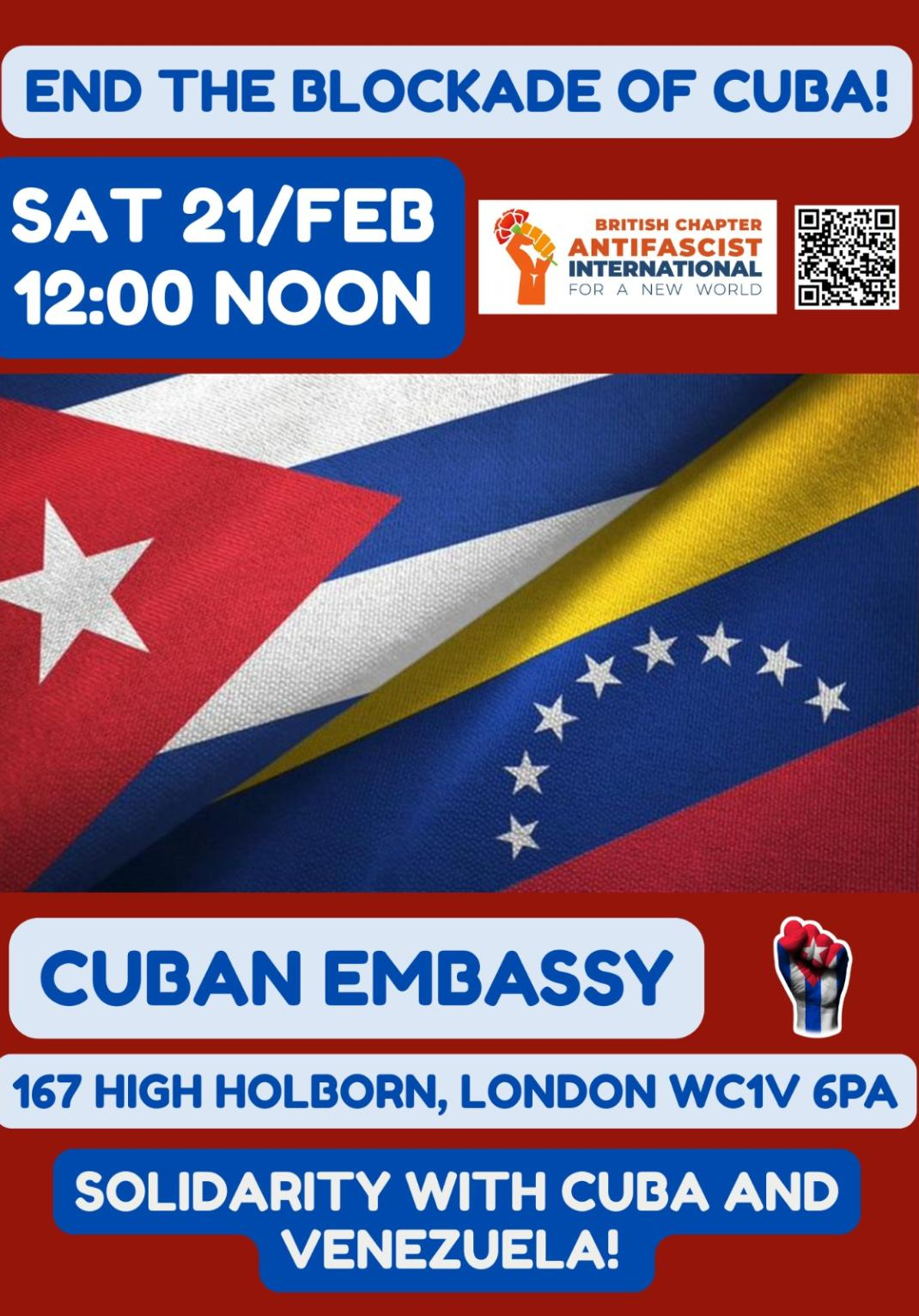
Trump’s intensified blockade of Cuba, in the aftermath of the January 3rd attack on Venezuela, and encompassing an attempt at a total oil blockade, threatens the gains of the Cuban Revolution, and the Cuban people with starvation and genocide potentially in the manner of Gaza.
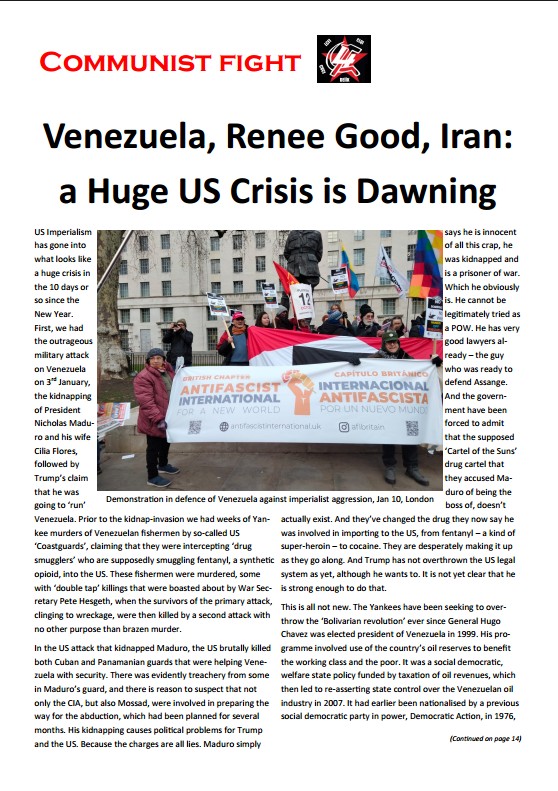
This demonstration, called by the Anti Fascist International, is supported by the Consistent Democrats, and we call on all communists, socialists and class conscious workers to support it. Defend the Cuban People and the Cuban Workers’ State!
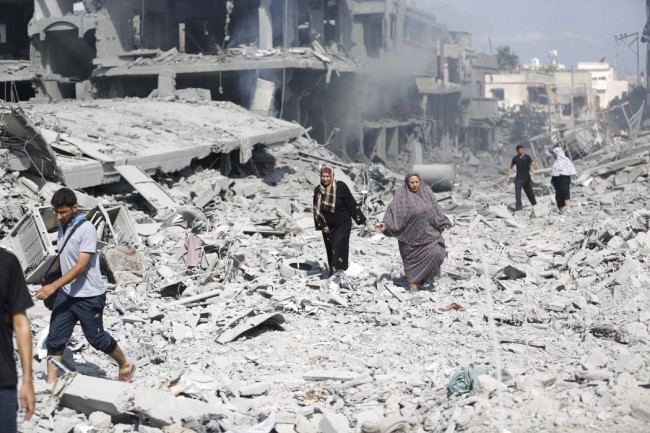
Gaza genocide includes massive environmental destruction and ecocide on the top of mass murder.
The terms ‘Left’ and ‘right’ in politics are defined by which class interests they express, however distantly. “Green” today is broadly defined by its attitude to protecting the environment and the ecosystems it supports.
Zionism expresses the programme of defending the state of Israel above all other objectives, and to this end Zionists are comfortable with actions that are totally at odds with socio-political, and indeed to right to human existence for some ethnic and religious groups.
Such specific goals now mean that Zionists have imposed restrictions on such basic rights for Palestinians as well as non-Palestinian people who support their rights, including freedom of religion. Destroying their religious sites, many millennia old, their archeological history and artefacts as well as carrying out atrocities intended to destroy their culture and eradicate all traces of their civilisation.
In addition to genocide by bombs, poisoning wells and aquifers, contaminating the ground water with sewage and destroying desalination plants, Zionists also restrict the access of Palestinians to food, contaminate farmland with white phosphorus and glyphosate (toxic and cancer-causing chemicals) intended to destroy food sources across many occupied areas. Not just Gaza and the West Bank, but also Lebanon and Syria, repeating the US atrocities in Vietnam and Cambodia like spraying Agent Orange, which led to long term health and birth defects, and such later atrocities as those in Iraq and Serbia where NATO used depleted uranium. This led to extensive birth defects and cancers long after US armies moved on to other criminal ‘regime change’ enterprises.
When the Maidan Coup in 2014 installed a pro-US, CIA led government in Ukraine and attempted to forcibly suppress its Russian-speaking population (which first drove Crimea to unify with Russia), the West conveniently ignored the deliberate attempts by the Kiev regime to cut off water and energy, food and other supplies. After 8 years this resulted in the oppression of millions of people, by their treatment as 2nd class citizens in their own country, with their land devastated to the point of permanent ecocide.
The greatest harm to the environment is being done by NATO, led by the US who are often subservient to Israel’s own imperialist projects when they are not pushing their own imperialist agenda. Under those complementary strategies they sanction more than 60 countries, ensuring economic devastation, increasing poverty, inequality and mortality, leading to at least half a million deaths a year, the vast majority of those deaths being caused by US/UK and EU sanctions.
Regime change wars by NATO carried out in the interest of the Zionist agenda have been noted for the genocidal, ecocidal efficiency with which they have been carried out against civilians, devastating the land and the survivors long after the military industrial complex has moved on to the next target.
While Russia has not been a workers’ state since the collapse of the USSR in 1991, it is not imperialist and has no imperialist bourgeoisie. Its weak, oligarchic proto-bourgeoisie has no real tradition or stability except a sometime aspiration to be an imperialist client, and a parvenu gangster ethos and practise. The full-blooded neoliberal shock treatment that the counterrevolution of these lackey privateers imposed on Russia after 1991 caused massive suffering, starvation and countless despairing suicides. The fall in life expectancy of 5 years in the 1990s can only be explained by millions of early deaths. This fuelled a huge backlash from below, refracted through the productive and administrative apparatus left over from the workers state, which the counterrevolution was unable to rapidly destroy. That backlash elevated Putin, representing a remnant of the workers state that still had organic connections to the masses, to power, imposing a massive post-capitalist deformation on the weak capitalism that was all the counterrevolution was able to create. Although Putin is a representative of the old apparatus, this partial rollback of the counterrevolution does not define him and his faction as any longer ‘communist’. In formal ideological terms, Putin is a centre-right lesser-Russian nationalist, but sui generis, given his very contradictory social and political role.
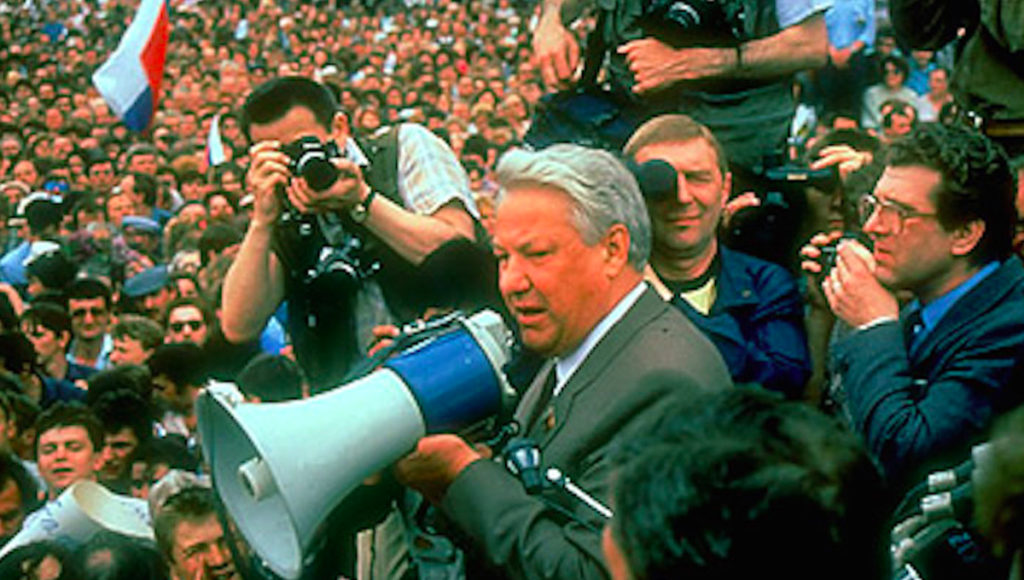
Yeltsin, the leader of the privateers who raped Russia for the imperialist West, forced out to make way for Putin, man of the apparat.
The USSR prior to 1991 was a degenerated workers state. This was a correct designation because immediately after 1917 for several years under the revolutionary leadership personified by Lenin and Trotsky, the working class held direct political power, albeit in very difficult conditions. Only in the mid-1920s was workers democracy extinguished, by degrees, with the death of Lenin and the brutal factional war to defeat Trotsky and his supporters. The degenerated USSR was characterised by massive, qualitative deformations derived from the necessary imposition of bourgeois norms of distribution on its embryonic socialist construction. It struggled to create the beginning of a higher mode of production in conditions of involuntary national isolation and insufficient technological and material development and succumbed to the rule of a regime that resembled that of a labour bureaucracy, albeit one with state power. This bureaucratism eventually led the USSR, several decades later, to collapse. Post-Soviet Russia, under Putin today, is a deformed capitalist state, that is, a capitalist state with massive ‘socialist’ deformations, a dialectical complement of the bureaucratised workers state that was the USSR.
This is a unique form of combined and uneven development, with elements of the capitalist mode of production intertwined with embryonic elements of a higher, socialist mode. The Putinist deformation of the counterrevolution put the weak oligarchy in a subordinate position, including the West’s favourites, the likes of Khodorkovsky and Gusinsky, who were effectively socially and politically neutralised as part of (re)creating a much more statified, mixed economy heavily based on the state apparatus and industrial productive forces inherited from the workers’ state.
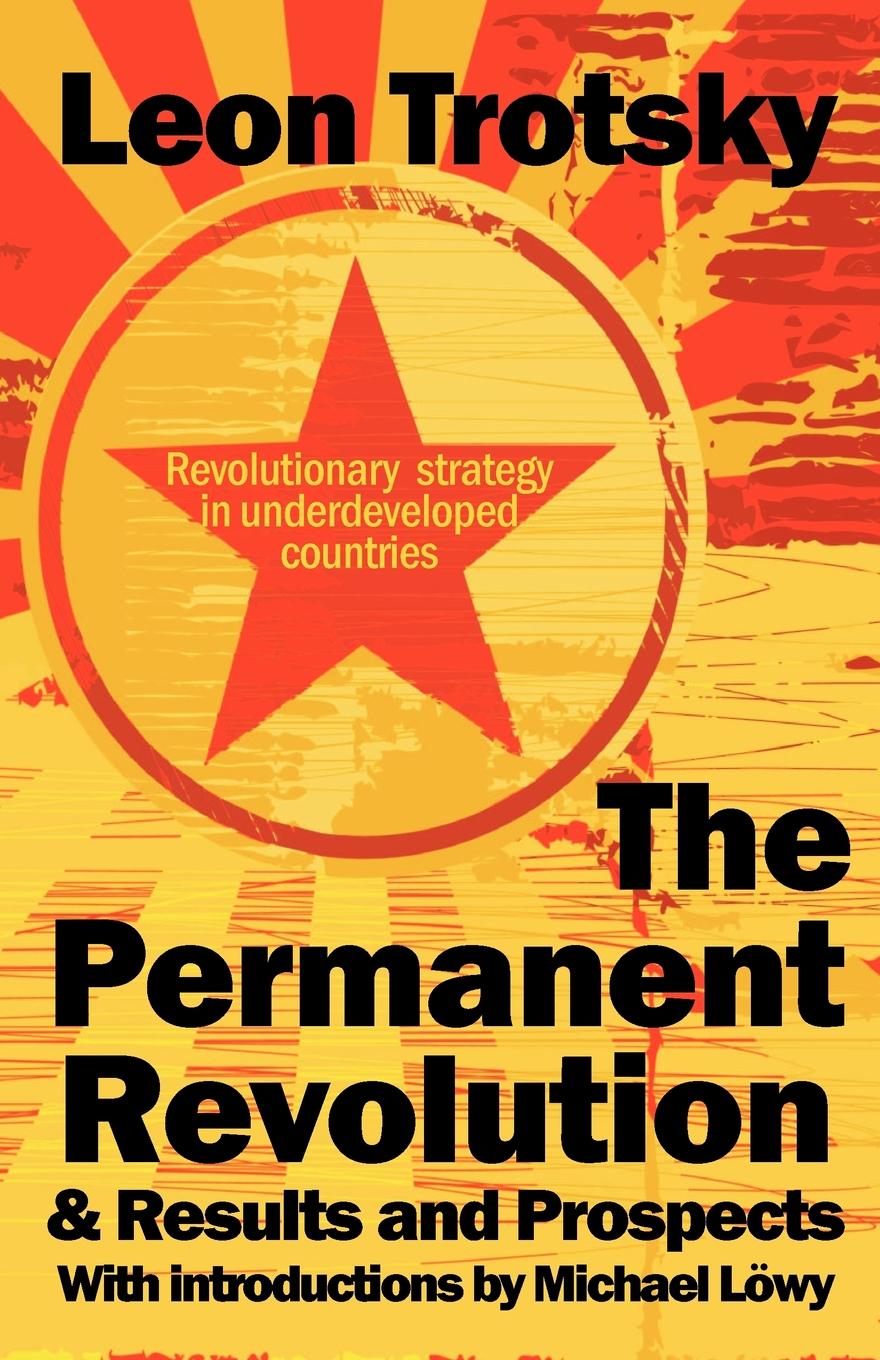
The principle of combined and uneven development is well known from Trotsky’s understanding of Permanent Revolution. It involves the interpenetration of capitalist development in backward countries with feudal and other pre-capitalist modes of production, to produce complex social forms where the working-class movement has to incorporate the demands of those whose oppression is rooted in earlier modes of production in its programme for power. But the (partially failed) counterrevolution in Russia, the central part of the USSR, has led to a new form of interpenetration of capitalism with an embryonic socialist mode of production, which ‘invades’ Russian capitalism, to paraphrase Engels’ concept of the ‘invading socialist society’ in Anti-Dühring.
The imperialist bourgeoisie understood that the accession of Yeltsin’s counterrevolution in 1991 did not mean the outright end of ‘socialism’ in Russia, which is why they began NATO Eastward expansion even under Yeltsin. Gradually with the rise of Putin, Cold War hysteria and anti-Russian warmongering re-emerged, despite the claim that the Cold War was over. In fact, it never ended. Only now it takes an uglier form – rather than old style anti-communism which could be conceived of as ethnically neutral, today’s racist demonisation of Russians, or Russophobia, resembles Hitler’s racist demonisation of Jews, who he considered organically ‘Bolshevik’. Today’s bourgeoisie considers Russians to be organically proto-communist and disobedient to neoliberalism and its ‘rules-based order’, noting the very high popularity of Putin in Russia. The reason for this high popularity is simply the popular memory of the horrors of Yeltsin’s counterrevolutionary economic shock, and how Putin’s change of course rolled much of it back. So, now we see open imperialist hatred of the Russian people themselves, which is why you get glaringly racist bans on references to or works by even long dead Russians like Gagarin, Dosteyevsky and Pushkin, from Western cultural events. And the supposedly liberal imperialist bourgeoisie, figures like Biden, Starmer and Macron, vehemently but covertly support outright Nazis in Ukraine, while at the same persecuting anyone who exposes this for supposedly peddling ‘disinformation’.
Russia’s intervention in Ukraine is thus a defensive one against an imperialist war drive that is aimed at breaking up Russia into several semi-colonies as the final act of destroying the entire legacy of the October Revolution. Socialists should defend Russia, and especially the peoples of the Donbass and Crimea, who are targets in a Western-inspired racist proxy war that blatantly uses outright Nazis, with genocidal aims. Not today against Jews, but against Russians, in the spirit of Hitler’s war on the Eastern Front, participated in eagerly by Ukrainian collaborators like Bandera and Shukhevych, where the Nazis exterminated 20 million Russians in that barbaric racist rampage. Somewhat unexpectedly for the imperialists, given their contempt for Russia, the Ukraine proxy war has gone badly for NATO and its Nazi dogs of war, and the post-capitalist elements of Russia’s productive apparatus are the main reason for that. Economic sanctions have backfired and considering the strain the country is under, Russia‘s economy has flourished during this difficult period, and it has moved ahead of the United States in some aspects of military technology, notably hypersonic missiles, which the West has no answer to. The dramatic use of Oreshnik to destroy a major covert NATO military installation at Dnipro, Ukraine, in November 2024 was a major manifestation of this. There are some resemblances and commonality between Russia’s technological advances and those of China, but also major differences between them.
China: A Deformed Workers’ State
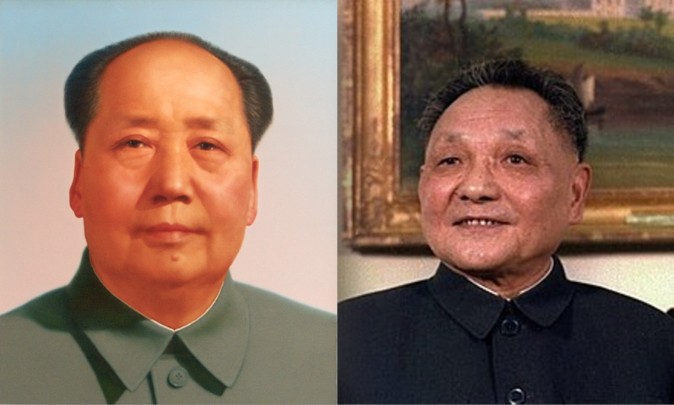
China poses the question of Cold War and socialism even more sharply. Because China is still a deformed workers state. It was never ruled according to the basic norms of Soviet democracy, unlike early Soviet Russia/USSR. It was deformed from birth. Its Communist Party abandoned the proletariat in the cities after the defeated workers revolution of 1925-7 and transformed itself into a peasant-guerilla, petit-bourgeois formation. Its peasant-based armies defeated the Kuomintang and in part Japan. Despite its petit-bourgeois bureaucratic nature, formed up in the prolonged guerilla struggle including the famous Long March, it could develop no independent class basis separate from the main classes of capitalist society – the proletariat or the bourgeoisie. Simply to defend itself against imperialist attempts to destroy it, it was forced to adopt the property forms of the proletarian revolution, but crucially without Soviet democracy, after 1949. This was a flawed, but still historically progressive, social revolution. The Stalin-like bureaucratic regime of Mao Zedong made considerable progress in a primitive modernisation of the country but also engaged in dangerous and wrong-headed intra-bureaucratic feuds with the leadership of the USSR.
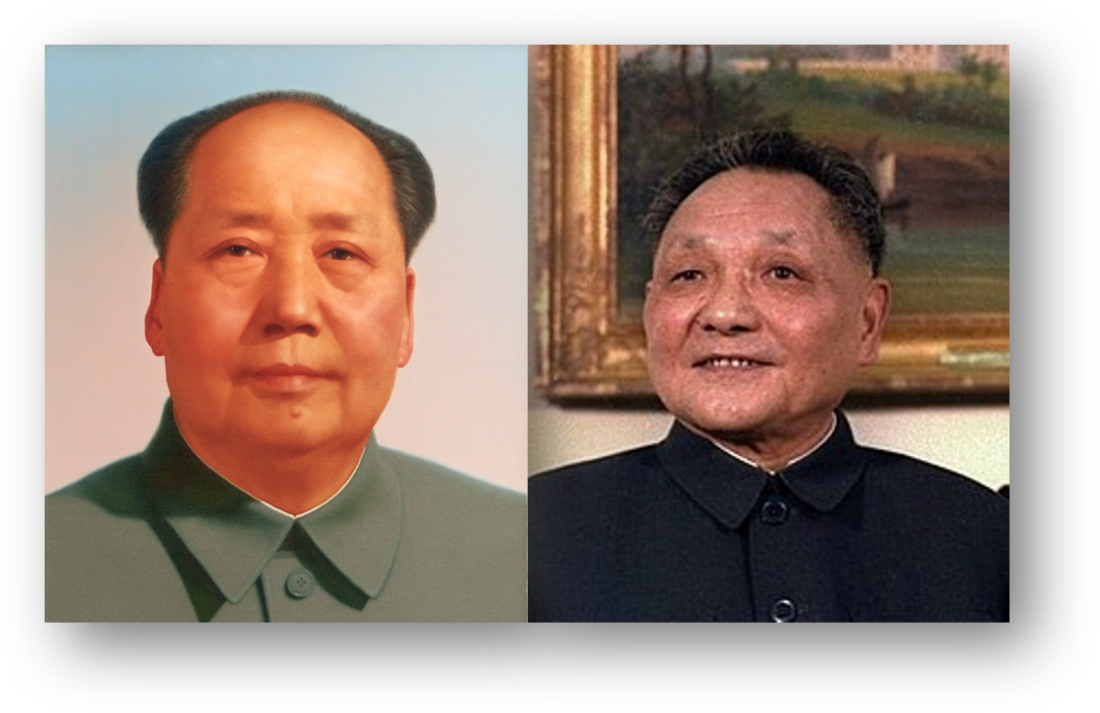
Mao Zedong and Deng Xiaoping
After Mao’s death in 1976 his followers were defeated by those of Deng Xiaoping and his programme of “socialism with Chinese characteristics”, a form of market ‘socialism’. Under both Mao and Deng China even allied with US imperialism against the USSR. That alliance helped the West to cause the collapse of the USSR through an enormous imperialist war drive and neoliberal political offensive. Since Deng’s rise, and up to today, China’s social and political regime resembles more the economic programme of Bukharin than that of Stalin. Despite the upheaval of Tien-An-Mien Square in 1989, when student demonstrations that evidenced pathetic faith in Western ‘democracy’ triggered off a naïve working-class upheaval (which was soon crushed), the central planning apparatus remained intact through all Deng’s market ‘reforms’.
A key part of the neoliberal ‘Thatcher/Reagan revolution’ in the West, which was continued under more ‘liberal’ administrations such as those of Clinton and Blair, eventually spreading also to the main EU countries, was the outsourcing of heavy industry to low wage countries such as those on the Indian subcontinent, Indonesia and the Far East … and China. China, as a workers’ state, slipped under the Western ‘radar’ in that period and managed to take advantage of this to massively expand its industrial productive forces. The result was a kind of mixed economy, still mainly statified, with industrialisation utilising a partially capitalist market, controlled by the bureaucracy of a deformed workers state. The outsourcing of heavy industry was a major, strategic change in the social structure of the imperialist countries, driven by the contradictions and decay of capitalism, and particularly the historical tendency of the rate of profit to fall. Falling profit rates were the root cause of the major economic crisis that manifested as ‘stagflation’ in the Western countries in the 1970s. As soon as the technological means came into existence – though widespread computer technology – to allow such outsourcing on a mass scale, the imperialists took advantage of this, deindustrialising their own economies in pursuit of higher profits among capable, but lower paid, workforces.
But this manoeuvre, driven by profit-hunger, backfired spectacularly as the Chinese deformed workers state, still intact, massively expanded its productive capacity. China is now a major non-imperialist world power because of this. Unlike Russia, where planning is somewhat limited in scope and a residue of a social system that has been overthrown, in China the economy is driven by a form of planning, with capital not in the driving seat. The Chinese Communist Party bureaucracy has permitted wide latitude to private capital – to the point that it had for a brief period in the 20-teens and early 2020s more billionaires in absolute terms than the United States. However, in terms of population, China is four times larger than the US, and its billionaires are much less wealthy than those in the US. They are also subordinate to the state – those who step out of line are likely to end up having wealth confiscated through massive fines, serving long prison sentences, or even being shot, for corruption and various related financial crimes that in the capitalist world might not even register.
In October 2024 the Asian news website Firstpost noted that:
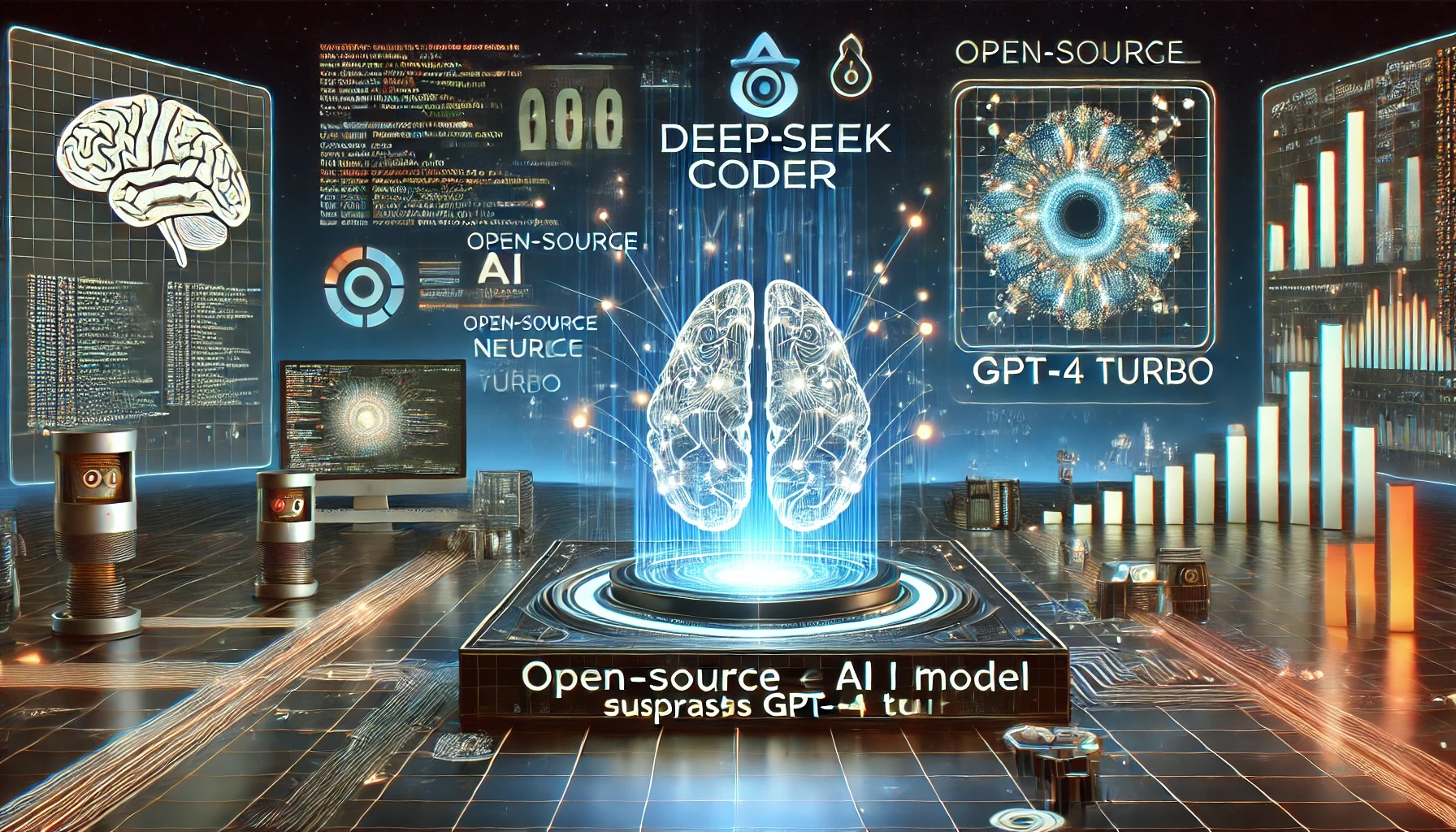
Over the past four decades, as China has risen to be a world power, 700 million people have been lifted out of extreme poverty. And now China’s economic advance means it has effectively caught up with the United States as the world’s leader in production of hi-tech, computer-related goods. The advent of Deepseek, its open-source flagship AI system, shows it pulling ahead of the US, particularly as the energy needed to run Deepseek is less than half of that consumed by the energy-guzzling US AI systems.
It ought to be clear that such a powerful capitalist force within a workers’ state is potentially a danger to the existence of that state, as a bourgeois class, driven by the imperative of capitalism, to realise surplus value and convert that into profit, will necessarily seek political conditions that maximise its ability to do that. This is what led Trotsky to conclude in the late 1920s that Bukharin’s programme of marketisation, which was mainly in the Russian countryside, allowing the Russian Kulaks (richer peasants) to “enrich themselves”, posed an immediate danger of counterrevolution. This he gave a degree of critical support, at least initially, to Stalin’s programme of collectivisation, before the brutal dimensions of that course became brutally apparent, when he denounced its irrationality. But in China, up to now, the bureaucracy has managed to avoid the danger of a counterrevolution.
It is possible now, with a considerable degree of hindsight, to say that one thing Trotsky was not able to fully anticipate with his analysis of the degeneration of the USSR, and such potential counterrevolutionary threats, is that post-capitalist relations of production could interpenetrate with capitalist relations for a extended period, and that two variants of such combined and uneven development are possible. One where a workers’ state continues to exist and defend proletarian property relations and the beginnings of the communist mode of production, dubbed ‘socialist’ in its less developed form, and at the same time considerable elements of capitalism continue to exist and even grow for a while. The other variant is where the workers state is overthrown, and an embryonic new bourgeois state attempts to impose a social counterrevolution, and yet proletarian property relations are sufficiently embedded in society and its production relations are already somewhat superior to capitalist relations, to the extent they are able to subvert the new bourgeois state and fundamentally deform it in a post-capitalist direction. It is arguable that these two variants of combined and uneven development are both unstable and ultimately fleeting phenomena and can exist side by side. China today is an example of the first variant; Russia is an example of the second.
Defend Russia and China against imperialism and ‘regime change’
Thanks to a strategic miscalculation by neoliberal imperialism, we now have a new, and unexpected international situation, as Russia and China are very different to the backward, impoverished countries that they were in 1917 and 1949. One of the preconditions for socialism is a development of the productive forces, and paradoxically the Western neoliberal outsourcing project has allowed a development of the productive forces in China to the point that China has become what Britain was in the 19th Century, but on a massively bigger scale: “the workshop of the world”. This has brought China to the brink of overturning the world hegemony of US imperialism, established after WWII. Russia, thanks to the partially defeated counterrevolution and its own targeting for attempted ‘regime change’ by US imperialism, has forged an alliance with China on an economic, diplomatic and partially military level that eluded the USSR Stalinist regime due to intra-Stalinist rivalry. The different social regimes in Russia and China seem to have eliminated that as a factor. But both Russia and China have elements of a higher mode of production within them that have made them natural allies in the present world situation. And the combined military and economic weights of Russia and China are clearly at least the equal of the Western powers in geopolitical terms. This is shown by Russia in its successful resistance to the imperialist proxy war in Ukraine; meanwhile the attempt of the West to foment a similar conflict with China over Taiwan looks less likely as China looks technologically and militarily too strong for this to be a viable proposition anymore.
Russia and China are not ‘imperialist rivals’ of the United States and the West, as various left capitulators to the ideological terror of imperialism say. They are natural allies of smaller non-imperialist countries that conflict with predatory imperialism. This includes smaller deformed workers states such as Cuba, North Korea and Vietnam, as well as semi-colonial countries struggling against imperialism such as Venezuela, Iran, Yemen and the insurgent countries of the Sahel such as Mali, Niger and Burkina Faso. The conflict between Russia/China and the West, in geopolitical terms, is not about who can get the most military bases, and who can send gunboats to repress the masses in their respective empires. Instead, they behave in a manner that focuses mainly on achieving diplomatic solutions to crises, not fighting to defeat imperialism through revolutionary struggle.
Russia and China: Unite and fight for World Socialism!
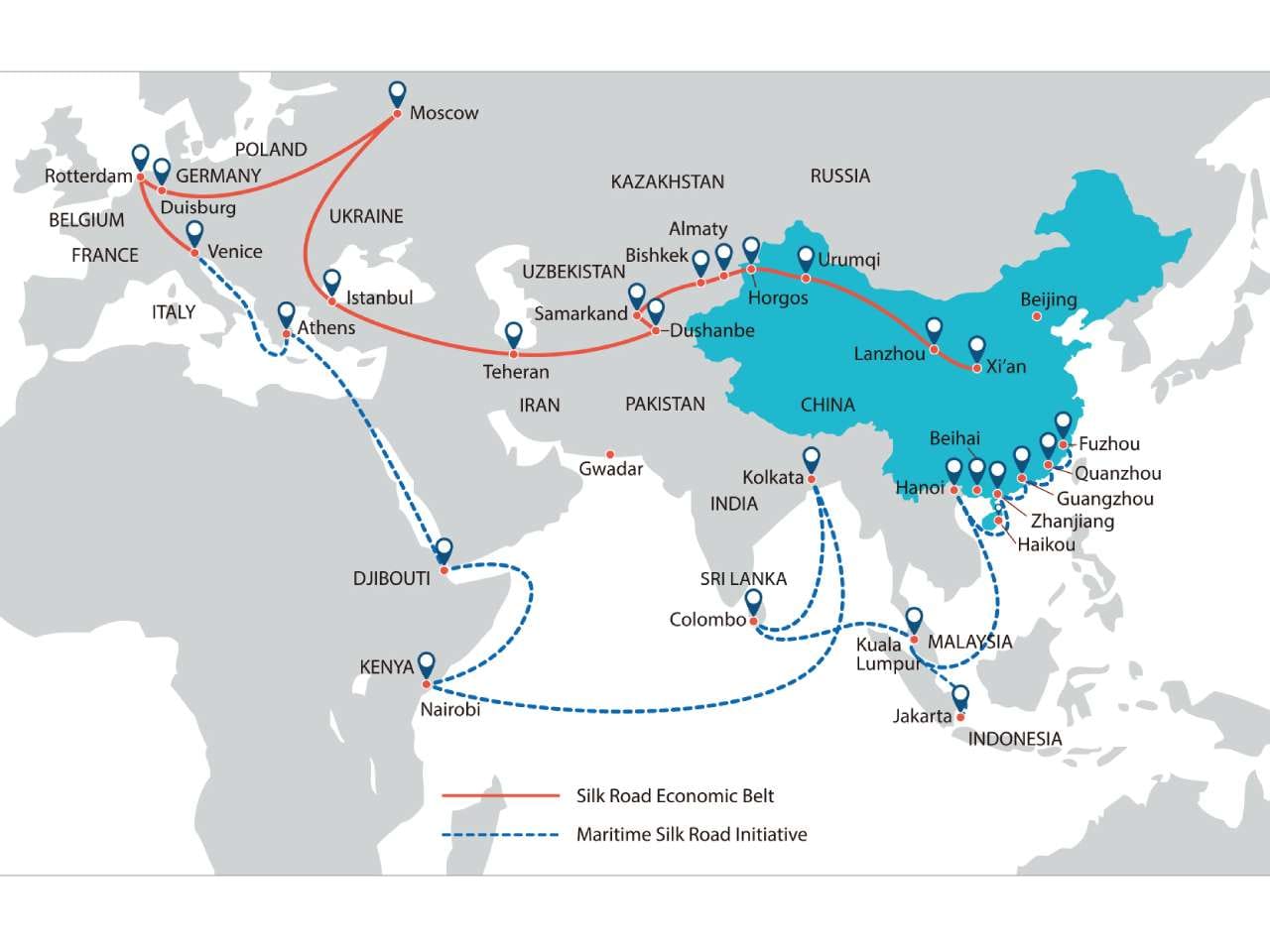
Thus, the Russia-China bloc behaves similarly to the way the USSR behaved in the Cold War, giving aid to those countries in conflict with imperialism, or who seek to find leverage to gain more independence from imperialism. They talk, which is to be expected given the bureaucratic, modified-Stalinoid and similar politics that dominates the bloc, of a ‘multipolar world’, which amounts to a modified version of the ‘peaceful coexistence’ with imperialism that drove the politics of the degenerated USSR. China’s most spectacular international initiative, the “One Belt, One Road” infrastructure-building project, is not a means of exploiting those countries involved, though China does derive economic benefits from it. It has a similar character to Russian and Chinese aid to Venezuela, Iran or Cuba – helping them to maintain independence against imperialist terrorism.
Thanks to the crisis of neoliberalism, we now have one giant workers state with advanced productive forces that are the equal of imperialism, which has another giant ally whose capitalism is marked by sufficient proto-socialist deformations to the point that it could relatively painlessly ‘revert’ to developing that higher mode of production. And yet these relatively far more advanced productive forces, and the proto-socialist elements that drive them, are still constrained by a labour bureaucracy in China, and an anomalous and contradictory formation in Russia, neither of which are remotely in tune with the demands of socialism. These productive forces, were they put consciously in the service of world revolution, of the fight to mobilise the world working class to take power in its own name, are enough to bury the capitalist system once and for all. To bring that about, we need the creation of a conscious international socialist/communist movement. Wherever it originates, it must spread around the world and create conditions allowing the existing administrations in Russia and China to be overcome by a rebirth of soviet democracy, as in early Soviet workers’ state under Lenin and Trotsky, to put these huge resources fully in the service of world socialism. That would bring about a rapid end to capitalism internationally.
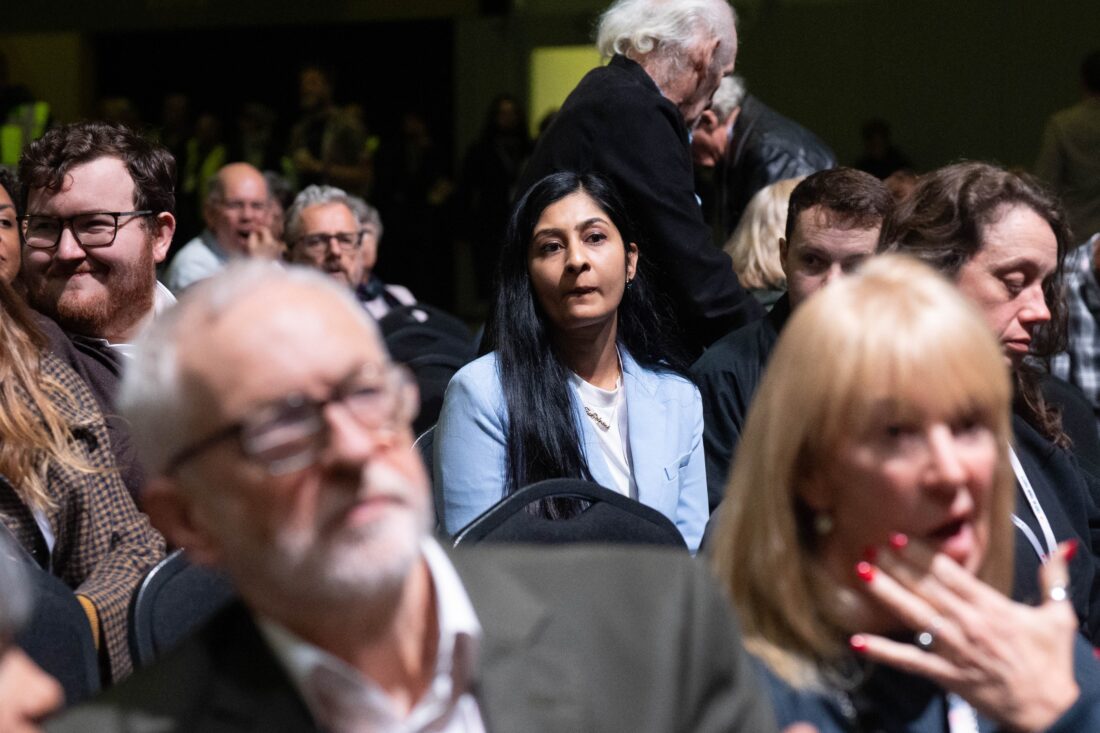
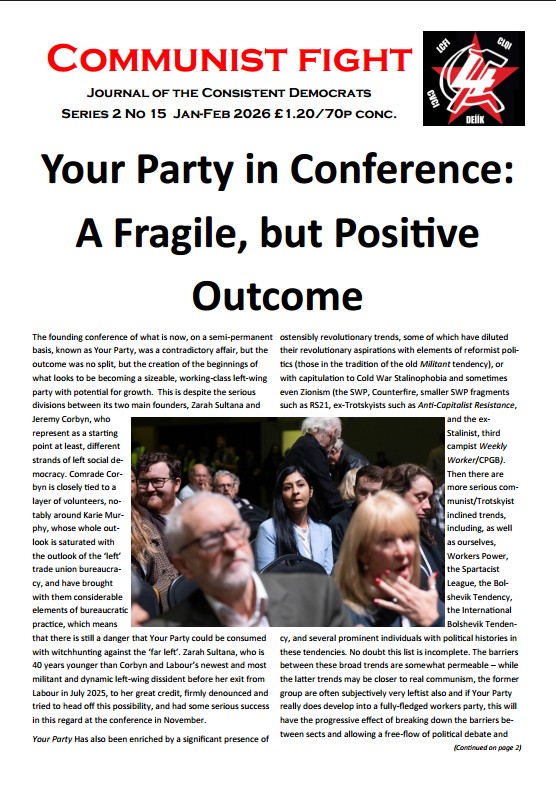
The founding conference of what is now, on a semi-permanent basis, known as Your Party, was a contradictory affair, but the outcome was no split, but the creation of the beginnings of what looks to be becoming a sizeable, working-class left-wing party with potential for growth. This is despite the serious divisions between its two main founders, Zarah Sultana and Jeremy Corbyn, who represent as a starting point at least, different strands of left social democracy. Comrade Corbyn is closely tied to a layer of volunteers, notably around Karie Murphy, whose whole outlook is saturated with the outlook of the ‘left’ trade union bureaucracy, and have brought with them considerable elements of bureaucratic practice, which means that there is still a danger that Your Party could be consumed with witchhunting against the ‘far left’. Zarah Sultana, who is 40 years younger than Corbyn and Labour’s newest and most militant and dynamic left-wing dissident before her exit from Labour in July 2025, to her great credit, firmly denounced and tried to head off this possibility, and had some serious success in this regard at the conference in November.
Your Party Has also been enriched by a significant presence of ostensibly revolutionary trends, some of which have diluted their revolutionary aspirations with elements of reformist politics (those in the tradition of the old Militant tendency), or with capitulation to Cold War Stalinophobia and sometimes even Zionism (the SWP, Counterfire, smaller SWP fragments such as RS21, ex-Trotskyists such as Anti-Capitalist Resistance, and the ex-Stalinist, third campist Weekly Worker/CPGB). Then there are more serious communist/Trotskyist inclined trends, including, as well as ourselves, Workers Power, the Spartacist League, the Bolshevik Tendency, the International Bolshevik Tendency, and several prominent individuals with political histories in these tendencies. No doubt this list is incomplete. The barriers between these broad trends are somewhat permeable – while the latter trends may be closer to real communism, the former group are often subjectively very leftist also and if Your Party really does develop into a fully-fledged workers party, this will have the progressive effect of breaking down the barriers between sects and allowing a free-flow of political debate and engagement, from which the most consistently communist and revolutionary trends can only gain.
The conference itself had some ominous omens beforehand, over the preceding five months since the impending creation of the party was announced in July, after Zarah Sultana, who had been suspended from the Labour whip for many months, resigned from Labour in early July and announced her intention to co-lead a new party along with Jeremy Corbyn. Corbyn, Labour’s left social-democratic leader from 2015 to 2020, though remaining a critic of neoliberalism and imperialism at many levels, had failed to properly stand up to the ferocious witchhunt and wrecking operation against himself and his supporters during this period. Instead, he tried to appease the Zionists and Blairites, throwing many of his most outspoken supporters to the wolves in the process. That was while he was leader. After being ousted after the sabotaged 2019 General Election failure, he was suspended from Labour by Starmer and deprived of the whip. The lack of the whip forced him to stand against Labour in the 2024 General Election to keep his Islington North seat (which he duly did and won).
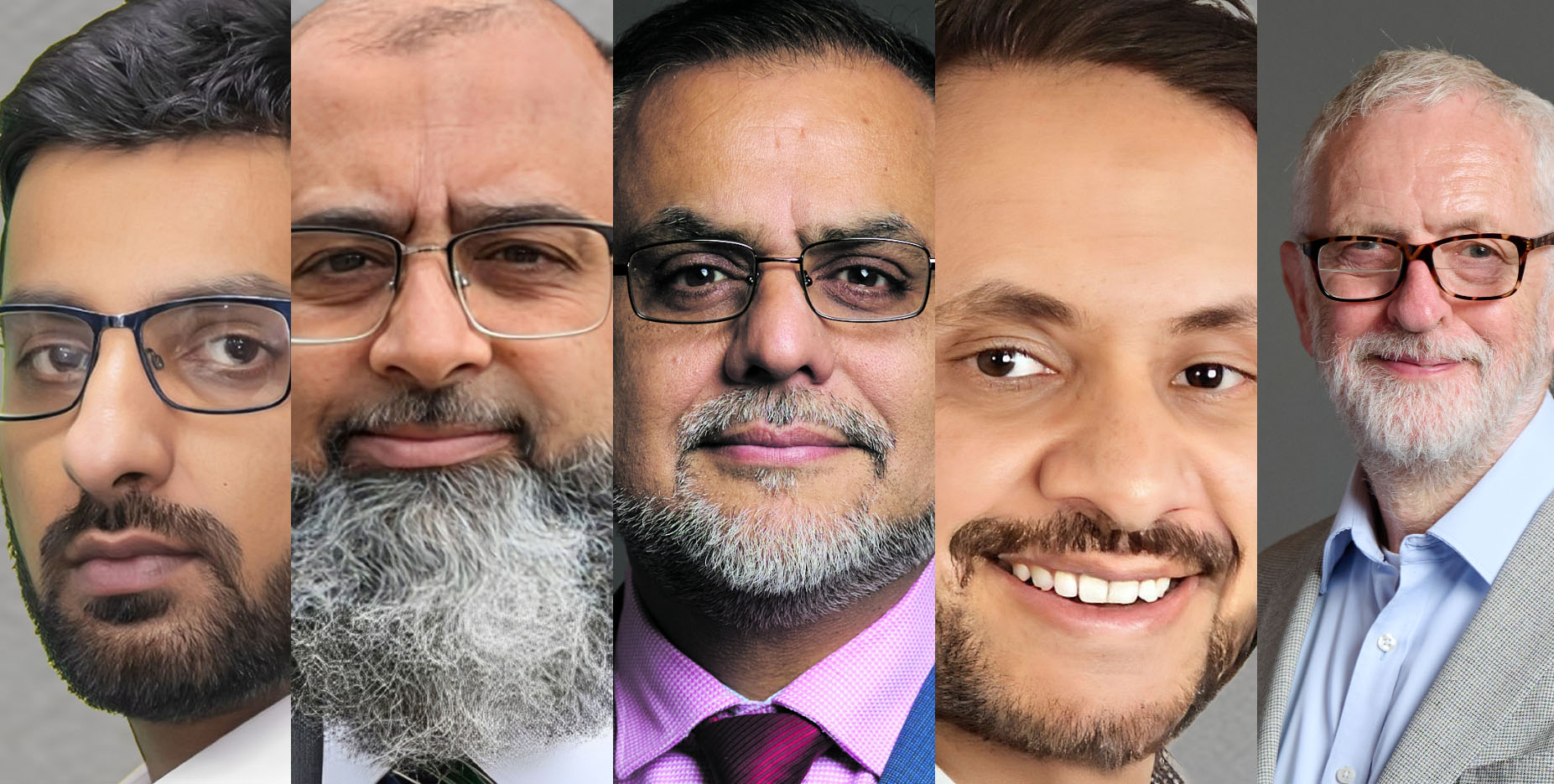
Four other independent MP’s won seats in the General Election, all of them Muslims who ran on the issue of the support of both main parties for Israel’s genocidal assault on Gaza. It was clear that they were part of a diffuse social democratic/radical liberal opposition to both bourgeois parties that had enough ties to the labour movement and the organised left through the Palestine movement, to make them critically supportable by communists in the General Election. There were several other independent left/working class candidates in a similar mould around the country. Leanne Mohammad came very close to defeating Wes Streeting in Ilford North, and Andrew Feinstein did respectably well in challenging Starmer himself in Holborn and St Pancras. Though this movement had many weaknesses.
After the General Election, when Starmer’s Labour Party won a substantial majority despite only getting just under 34% of the vote (dependent on the collapse of the Conservative vote to only 24%), it became clear that the new government was the most unpopular since universal suffrage began. It had no ‘honeymoon’; within weeks of its election, it was staggering under the blows of a wave of far-right agitation and rioting. In 2025 that intensified with attacks on refugee hostels all over the country, and the rise of Nigel Farage’s Reform Party to first place in the opinion polls. Starmer’s government was up to its neck in support for genocide in Gaza, and the West’s proxy Nazi war against Russian-speaking Ukrainians and actual Russians in Ukraine; its response to the rise of Reform was to try to outdo Farage in racist rhetoric and to crack down on migrants still more.
Splitting from Labour “At a Snail’s Pace”
It was clear that there was a desperate need for a new working-class party. Indeed, it had been clear for several years, since the demise of Corbyn’s Labour. Yet he was extremely reluctant to burn his bridges with Labour by founding a new party. He literally left it to the last possible moment to announce his independent candidacy in the General Election. And he stonewalled on the creation of an independent party for around a year afterwards. Though it was known that semi-secret, invitation-only meetings of a body called ‘Collective’ were taking place during this period, it was not clear that the talks were getting anywhere. Until Zarah Sultana MP ignited the issue in July 2025 by resigning from Labour and declaring the intention to found and co-lead a new party to oppose Labour from the left. After this announcement, it took Corbyn three weeks to overcome his own hesitation and confirm Sultana’s announcement.
This split should have come seriously on the agenda as soon as Corbyn was suspended from Labour in late 2020. When it finally was announced in 2025, 800,000 people expressed interest in joining via the new Your Party website, on top of the 72,000 who did the same for Zarah Sultana’s ‘Team Zarah’ website earlier in July 2025 after she announced the beginning of the project. This base existed in 2020 – Starmer was in the process of driving them – hundreds of thousands of socialist-minded people – out of Labour then. It remained intact but in a kind of ‘limbo’ over this period while the Labour Party went down from over 600,000 members under Corbyn to around 200,000 today. If Corbyn had bit the bullet in 2020 and initiated a new party then it is virtually certain that it would have outgrown the Starmer-led Labour Party, which would simply have haemorrhaged members directly to a new party. Such is how historic opportunities for working class politics are allowed to slip – or at least be interminably delayed.
The mass base of Corbynism never dispersed and never ceased to oppose neoliberal attacks on the working class. That is why hundreds of thousands rallied to give support to Your Party when it was announced. The basic problem has been the glacial pace (and paranoia about those to their left) of Corbyn and the legacy left bureaucrats around him, which clashed with the entirely progressive desire for a working-class political party of his mass base. This conservative element in Corbyn’s politics has now rightly been challenged by the youthful left-wing former Labour MP Zarah Sultana.
Zarah Sultana’s Left-Wing Trajectory
Zarah Sultana has positioned herself considerably to the left of Corbyn on some of the most important political questions. Notably Zionism, where she has criticised Corbyn’s Labour leadership for appeasing the Zionists and capitulating to the witchhunt. Since the conference her strong anti-Zionism has manifested itself in her excellent work leading protests outside Bronzefield Prison in Surrey, demanding medical care for Palestine Action hunger strikers among the Filton 21, who face two years remand on phoney charges they are likely to, eventually, be acquitted of. Her actions on this alone have boosted Your Party’s standing as a principle left-wing force.
She has insisted that Your Party must come out strongly for the rights of Trans people; she has strongly opposed exclusions and witchhunts against Marxist and revolutionary-inclined left-wing groups. In public speeches she has laid down what appears to be the beginning of an extensive programme of statification of industry that appears to point more to a full-blooded anti-capitalist position than mere social democratic nationalisations; she has forthrightly emphasised the importance of mass anti-fascist mobilisations particularly in the context of the debacle of left’s failure to effectively counter the openly racist “raise the colours” movement that erupted over the summer of 2025, and Yaxley-Lennon’s mass rally in London on 13th September. She has called for the politics of ‘class war’, and opened a real possibility of the party, or a large section of it, evolving politically beyond social democracy altogether.
Though she has not, so far, evolved beyond social democracy on questions involving conflicts with imperialism that are a legacy of the Russian Revolution – when put on the spot about the imperialist proxy war in Ukraine, she denounced Putin as a ‘dictator’ and called Russia’s 2022 Special Military Operation an “illegal invasion”, while also saying that Zelensky is an enemy of the working class of Ukraine. She has also said nothing on China yet. This is not a consistently anti-imperialist approach, and it is crucial that Your Party, or its serious anti-capitalist wing, move beyond Labourite politics and seriously address the legacy of the 1917 workers revolution in Russia, and the role its by-products, including non-imperialist Russia, the roles that various remaining workers’ states such as China, Cuba and North Korea, play in the world and their place in the worldwide struggle for socialism. Rather than go into all these arguments in detail here, we have written a companion piece to this article (“Russia, China and Socialism”) which addresses these questions in depth.
Trump’s drive to war against Venezuela also puts a number of these questions on the agenda. Both Russia and China are allies of Venezuela and yet the Labourite programme that sees them as ‘imperialist’ enemies of ‘Western democracy’ logically leads would be socialists to line up behind NATO. It is very clear that comrade Sultana does not want that – she has been outspoken in advocating that Your Party should break with NATO because of its imperialist nature. But the more left-sounding capitulation to imperialism is from those tendencies who effectively bury the legacy of the Russian revolution and the attempt at world revolution in the 20th Century, and equate Russia and China with US imperialism, as another supposed set of imperialist powers.
The logic of that position is terrible in the context of US imperialism’s attacks on Venezuela, as that country has backing from both Russia and China, and according to a worldview that sees Russia and China as another imperialist ‘camp’, to consistently carry out this logic would mean supporting neither side. The same when the US threatens Cuba, still a deformed workers state, which is clearly also an ally of the Russia-China bloc. The US bullying of states involved in BRICS, headed by Russia and China, which includes Brazil, India, Indonesia and Iran – all to varying degrees victims and targets of US and indirectly NATO imperialism, is logically a matter of indifference if Russia and China are cast as rival imperialists. Iran in particularly is also a major target of the US/Israel Zionist bloc in West Asia. The core of BRICS consists of countries that US and NATO imperialism would like to defeat and subordinate as part of maintaining the ‘rules-based order’, which really means US imperialist hegemony. Though Comrade Sultana’s evolution to the left is notable, and her desire to build a genuine working class socialist party that is not a Labour 2.0 is commendable, key strategic questions fundamental to socialism need to be addressed before Your Party can really break with Labourism.
Contradictions of Creating Your Party
Getting hundreds of thousands to express their support in an elementary way for the idea of a new party is one thing – creating that party was never going to be simple. And another complication has been the presence of the four Muslim Independent MP’s, who were elected mainly on the question of Gaza, without much of a broader socialist outlook at all. On other questions they were often socially conservative. Since the Independent Group was given considerable power over the process of setting up the party, there have been clashes between the most conservative of them, and Comrade Sultana over the pace of the party’s formation and its political direction.
Jeremy Corbyn (right) and four independent Muslim MP’s who won seats in the 2024 General Election mainly over Gaza. They are, left to right: Adnan Hussain, Iqbal Mohammad, Ayoub Khan and Shockat Adam, They have been involved in the founding of Your Party, but the first two are no longer involved due to political disputes.
It repeatedly became clear that Jeremy Corbyn, his entourage and the Independent Group of MPs were resisting Zarah Sultana’s initiatives to push the party forward. The three-week silence of Corbyn after Sultana announced their joint endeavour at the beginning of July was unnerving and signified that he was having to be pushed faster than he wanted to get the party off the ground. It is also evident that there was resistance to launching a portal to allow people to join the new party, as opposed to just register interest in it. Frustration with this led to the dispute over the membership portal launched by Zarah Sultana on 18th September when an earlier, agreed timetable appeared to be slipping because of obstruction by the more conservative elements in the Independent Group. This portal was falsely denounced by the Independent MP’s group as fraudulent, though it was launched as result of a dispute about timing, creating a legal standoff that briefly threatened to tear the party apart.
Once the immediate issue was overcome there followed a technical-legal problem about how to deal with membership and the funds collected on the earlier portal, when another ‘agreed’ portal was created. Like with the announcement of the party, the root cause of this appeared to be the glacial, ultra-cautious methods of Corbyn and those around him. The sporadic issuance of public denunciations of Sultana by the Independent Group continued until an incident in October, when, as she appeared on BBC Question Time, another missive signed by all the Independent MPs, including Corbyn, was issued, denouncing her over the funds from the earlier membership portal. Corbyn immediately denied signing it, and dissociated himself, and straight away Adnan Hussain resigned from the body that was setting up Your Party, followed later by Iqbal Mohammad. They cited disagreements over issues like Trans rights and other matters and accused Your Party of being ‘intolerant’. Even after this, anonymous briefings appeared in the media denouncing Zarah Sultana, with the result that she and Corbyn held separate eve-of-conference rallies on November 28th.
The conference itself was wracked by political tensions and conflicts. The leadup to the conference had some elements of democracy, but with a considerable degree of arbitrary diktat on some key questions. The use of sortition – a random method of selection by demography to try to achieve gender, age and geographical balance of attendees at the conference, akin to that used by the state to select people for jury service, was an unusual feature of the conference. It can hardly be called democratic, but neither could be called bureaucratic and anti-democratic, because of the strong element of randomness in the selection. But the sortitioned attendees were not the sole people allowed to vote – in fact the entire confirmed membership online was able to vote on a whole range of contested issues and amendments at the conference, and the leadership layer around Corbyn lost several important votes. Though largely because of difficulties in signing up members online and ‘confirming’ them, there number voting was much less than it could have been.
The real democratic defect was arguably in the process whereby the four documents to be dealt with at the conference, and the various amendments, were prepared. The four documents were: the proposed Constitution; the Standing Orders, the Operational Plan for the First Year, and the Political Statement. Of course, each of these documents had to be drafted by someone – that is not at all undemocratic. They were then opened to the membership online through the members area to propose edits and amendments. It does appear that many such proposals were made. The documents were also examined by a series of local/regional assemblies, where members from proto-branches grouped into impromptu ‘regions’, in groups of around 10, got to discuss them and propose possible changes to ‘facilitators’, that is, volunteers who had been trained to lead such discussions and note down feedback and proposed changes from the members. It then appears that all these amendments, both those submitted online and through the regional assemblies, were processed by Artificial Intelligence to distil them into a coherent set of alternative choices for the members, both present and remote, to vote on. That was the most questionable part of the procedure, as it produced a set of contested options that many considered to be inadequate and not reflecting the full range of issues in dispute among the members.
“Dual Membership” and Witchhunts
The most contentious issue in the draft constitution was the question of dual membership of other political parties. This is a can of worms, as the question of how such ‘parties’ are defined massively affects the democratic or otherwise functioning of the party. The proposal that appeared to carry most wait, that ‘party’ for this purpose means a fully-fledged national political party that stands in elections and is registered with the Electoral Commission to do so, was not explicitly up for debate. Though it does appear, from some discussions on this question, that this was the definition of ‘party’ held to by Jeremy Corbyn himself. One of our comrades had moved an amendment to explicitly define a ‘party’ in this way, but this did not make its way through the collating/compositing process.
Unclarity on this question produced a mutually reinforcing paranoia between the leadership group centred on Corbyn, and members of several far-left organisations, some of whom had thrown themselves enthusiastically into building Your Party. At a meeting of an inclusive bloc of far-leftists, which our comrades attended, the Socialist Unity Platform (SUP), a couple of evenings before the conference itself, a proposal was aired, to be moved by the Socialist Workers Party and supported by Counterfire, to move an emergency motion at the beginning of the conference to replace the existing group of conference organisers with a committee elected from the floor of the conference. This did not go down well with many at the SUP event, including us, as it would inevitably be seen as by many members whose main inspiration was Jeremy Corbyn, as an arrogant sectarian stunt, aimed to unseat the organisers of a founding conference of a new party even before it got underway. Indeed, it got such a negative response at the SUP meeting that the SWP decided not to go through with it.
Unfortunately a draft of the proposed motion had been circulated, which inevitably was leaked to the leadership, and as a result on the opening morning of the conference, a number of prominent SWP members, including its National Secretary, Lewis Neilsen, were bureaucratically expelled for supposedly breaking a rule against dual membership which had never been voted on by the membership. Others, including leading members of Counterfire, such as John Rees and Independent socialist councillor Michael Lavalette – who is associated with Counterfire – were also excluded from the first day of the Conference. Also excluded was ex-Labour member and present councillor James Giles from Kingston, a close ally of Zarah Sultana, who appears to have been targeted because of his support for comrade Sultana over the September attempt to set up a membership portal. This latter, and the more general exclusions, prompted a protest boycott by comrade Sultana on the first day of the conference – when she got to speak on the second day, she sharply denounced the exclusions.
(Left) James Giles, (Right) SWP National Secretary Lewis Neilsen
The exclusions of Counterfire people and comrade Giles, though not those of leading SWP comrades, were rescinded on the second day. Regarding Counterfire this appears to be because Counterfire is not particularly large, does not stand as a supposed party in elections, and is not registered with the Electoral Commission. Indeed, Jeremy Corbyn himself admitted this was correct, and that Counterfire did not therefore count as a ‘National Political Party’ in a published WhatsApp exchange with John Rees. But though the SWP is larger, it also does not stand in elections and is not registered. So, confusion and ambiguity reigns on this key question and would continue to do so whichever of the two ‘dual membership’ options were passed by the members.
These exclusions produced a backlash from the members. There were two counterposed proposals on ‘dual membership’ to be voted on at the conference. One called for dual membership to be completely forbidden, the other called for it to be permitted, but under the control of the incoming Central Executive Committee of the party, which is due to be elected in February. The second proposal passed overwhelmingly – the total ban was defeated by nearly 70% to 30%. However, as noted, what was missing was a clear definition of what a competing ‘party’ is for this purpose – this clarification was not included by the compositing process.
In our view it is perfectly reasonable to have a clause to exclude dual membership of registered parties such as the Labour Party or the Greens, as some safeguard against right-wing infiltration. We did not support its complete removal, as did many on the left. Nor do we support indiscriminate ‘inclusion’ of every single group that claims to be ‘left’. ‘Left’ Zionist groups, such as the Alliance for Workers Liberty, do represent a concrete danger of Zionist infiltration, and should be proscribed as Zionists to protect Your Party. Any potential ‘Friends of Israel’ grouping should be anathema.
Registered parties who want to participate in Your Party could reasonably be expected to de-register with the Electoral Commission to show they had no ill-intent. Transform has done just this. It is arguable that the SWP would be well advised to do something similar. They are not registered with the Electoral Commission and do not stand in elections. But calling themselves a ‘Party’ is thus a conceit. They could substantially disarm this issue by reverting to their old name of International Socialists, and even make the SWP name available to Your Party – that would actually gain them kudos on the left of the party. Also not included for a vote was an amendment from comrades in Sheffield YP that explicitly recognised the right of YP members to form tendencies and platforms. The absence of such clarifications means that the democratic rights of YP members are still unclear. But it is also clear that the defeat of the total ban on ‘dual membership’, however defined, was a victory for the membership over the more conservative, bureaucratic elements in YP and for a more democratic, open and left-wing party.
Qualified Victories for the Left
There were several other important votes that went the way of the left. Clearly the overwhelming sentiment is that Your Party should be an explicitly socialist party, centred on the working class, that fights for all the oppressed. The vote in favour of YP explicitly signalling “that it is a socialist party” in its political statement passed by over 80% to 20%. The proposition that YP should explicitly signal “that the working class is at the heart of the social alliance that it seeks to build” passed by nearly 78% to 22%. The vote to include a commitment to “socialist, anti-imperialist and anti-oppression principles” passed by 89% to 11%. Two votes were held on Trans rights, the one to “commit to the fight for trans liberation” passed by 72% to 28%, another to “explicitly mention trans liberation” in the political statement by 68% to 32%. An amendment to ban second jobs and limit donations and gifts for £250 (a tiny amount) for elected representatives passed by nearly 95%. The proposal that there should be default two-term limits for internal party officials and publicly elected representatives passed by 59% to 41%. The proposal that members should be able to recall their local party officers by a simple majority, passed by 92% to 8%. All these show the overwhelming socialist and democratic sentiment that drives the membership of your party and really underlies that it is by far the most left-wing incipient major force in British politics.
The results were not uniformly victories for the left, however. A couple of votes were not quite so good, though not necessarily disastrous. The first being on “How do we choose members to go to conferences”, in which they were two options: Elected Branch delegates, together with those from organised sections, party branches, etc. And another proposal which supplemented those with “a portion of delegates selected by sortition”, which tends to dilute the elected nature of future conferences with an element of random selection. This is not necessarily disastrous but does dilute the element of direct democracy somewhat. The proposal with sortition won by 67% to 33%. The other less than perfect result was on the election of the Central Executive Committee, the 16-strong body that will be the central leadership of the party. By a 58.6% to 41.4% majority, it was decided that the CEC membership in England should be elected on a regional basis, not nationwide. Which might not be so bad if the CEC were larger, but for one of only 16 members is restrictive and may be open to undemocratic manipulation of various kinds.
Two votes were less decisive. The first being the party name, where nothing explicitly socialist was on the ballot, the nearest being the vague “For the many” but even that was far too cryptic. This led to the anodyne ‘status quo’ name Your Party winning with 37% of the vote, which is hardly overwhelming. From the above votes, if something explicitly socialist/working class had been on the ballot, it likely it would have won. But the biggest loss for the bureaucratic right-wing around Karie Murphy was the vote on collective leadership vs. individual leadership. This was close: by 51.6% to 48.4% the party voted not to have a single leader, but a party “collectively led by ordinary members elected to the Central Executive Committee, with the Chair, Vice Chair, and Spokesperson in particular serving as the public political leadership”. Albeit this is temporary: it will be reviewed by the CEC “in the party’s second year” to be voted for by membership vote in late 2027, before that year’s conference. The last decision was a significant, but narrow, victory for the left of the party grouped generally around Zarah Sultana, as were the more decisive votes on questions to do with socialism, the working class.
Post Conference Developments
Since the conference there have been some significant events. In London, there has been an unofficial assembly that had delegates and representatives from many active London borough branches, that had lively debates on both domestic and international questions, from people from a range of left-wing trends within Your Party. There will be another such assembly in early February, with branches encourages to submit policy motions for debate. Meanwhile the interim leadership of Your Party is trying to modify the decisions made by the conference already, trying to get membership support to change the number of seats on the CEC from 16 to 18 to allow a regional setup similar to the US senate, where each of 9 regions gets two CEC members irrespective of how many members are in each region. This would have the strange impact of lessening representation of those areas with the most members, which is very inequitable, and would resemble the undemocratic representation involved in the US Senate.
They are also trying to enforce a ban on so-called ‘dual members’, e.g. those in the SWP, standing for the CEC, saying that only the CEC (which has not been elected yet) can legitimate so-called ‘dual membership’ of ‘National Political Parties’ (whose definition is in any case unclear, contested and a major source of potential conflict – see earlier). This despite the conference voting against a ban on dual membership. This is something of an outrage, as the membership have never had a straightforward vote on any of these bureaucratic measures, which therefore have no legitimacy. There is nothing in the constitution as adopted at the conference that gives any legitimation to what could easily appear to be an attempt to effectively gerrymander the election of the CEC against the left.
The worst-case scenario is if YP members who have Marxist views and are in groups like Counterfire which are not registered with the electoral commission, do not stand in elections, and in most cases have never even claimed to be parties, are banned from standing on such a false pretext. Jeremy Corbyn has already conceded in writing that that would be wrong. But suspicions remain that some of those around him want such exclusions, that they want a CEC shorn of those tending towards Marxism and adherence to workers/party democracy by the back door, so that the decision of the Conference to allow ‘dual membership’, in spite of the ambiguity in the text of the Constitution adopted, can be overruled in practice by a CEC elected under such restrictions.
If they try such a stunt, they will likely run afoul of the obvious fact that the overwhelming majority of YP members agree with Zarah Sultana’s criticisms of manifestations of Labour style witchhunting, which was shown very clearly by some of the very high percentages rejecting the politics of YP’s embryonic right wing, as shown in the votes above. Starting such a witchhunt in YP would brand those responsible with something akin to the mark of Cain, or at least of Kinnock, and would show exactly who is really trying to build something akin to a Labour Party 2.0, that is, another bourgeois workers’ party, instead of a genuine workers’ party open to full-blooded anti-capitalist evolution.
It is not pre-determined that any existing trend, no matter how fervent and correct its cadre believe they are politically, really represents the historic interests of the working class. This includes us. Though we do pride ourselves on our serious development of theory in addressing the crucial issues of today, our experience is still likely one-sided and needs much more development. We are all products of a political environment, of attenuated politics of the working-class movement caused by an accumulation of defeats going back to the degeneration of the Russian Revolution in the 1920s. The degeneration of the Communist movement for a whole period strengthened social democracy and put the genuine communist minority trends in a difficult position. That over time led to the dominance of sectarian moods on the left and undercut real political development of the socialist and communist movement. That is what Your Party opens the opportunity for correcting, and that is why genuine Marxists must engage with it seriously in the spirit of Marx and Engels’ words in the Communist Manifesto:
“The Communists do not form a separate party opposed to the other working-class parties.
“They have no interests separate and apart from those of the proletariat as a whole.
“They do not set up any sectarian principles of their own, by which to shape and mould the proletarian movement.
“The Communists are distinguished from the other working-class parties by this only: 1. In the national struggles of the proletarians of the different countries, they point out and bring to the front the common interests of the entire proletariat, independently of all nationality. 2. In the various stages of development which the struggle of the working class against the bourgeoisie has to pass through, they always and everywhere represent the interests of the movement as a whole.
“The Communists, therefore, are on the one hand, practically, the most advanced and resolute section of the working-class parties of every country, that section which pushes forward all others; on the other hand, theoretically, they have over the great mass of the proletariat the advantage of clearly understanding the lines of march, the conditions, and the ultimate general results of the proletarian movement.”
The new issue of Communist Fight journal is out now!
Its lead article is an extensive report on Your Party – the new party initiated by Zahra Sultana with Jeremy Corbyn – which held its founding conference at the end of November. As is well known by now, there was considerable factional turmoil and division even as the party was beginning to form up. The most crucial difference was Zarah Sultana’s public dissent from the record of Jeremy Corbyn’s Labour leadership in capitulating to the Zionist witchhunt against supporters of Palestinian struggle. Corbyn on the other hand appeared unenthused about creating a new party at all – and certainly less than enthused about the kind of politics ZS advocated, which brought her support from many whose aspirations are to build something qualitatively to the left of Labour. The various conflicts and even sporadic witchhunting that have accompanied the birth of your party are analysed in some depth here.
There is also an important article on “Russia, China and Socialism” which explains why, for different reasons, both Russia and China should be defended against imperialism. This article is in part a spin off from the Your Party report, dealing with some complex political questions that need separating for explanatory reasons, on why socialists need to defend those states that, in complex ways, are the legacy of the Russian revolution. It also explains our positions on Russia and China in one article, and addresses the relationship between them, so we hope it will be a positive contribution towards educating wider layers.
There is also a substantial article on the multifaceted crisis in the US, triggered by the murder of Renee Good in Minneapolis, the kidnap raid on Venezuela, when they abducted President Maduro and his wife, the threat of another US-Israeli war on Iran, the threats to Cuba, Colombia and Mexico. It also addresses the possibility of US-Europe inter-imperialist conflict over Greenland.
Finally, there is also a leaflet that the Consistent Democrats issued on the day of Maduro’s abduction by US imperialism, that was distributed on protests in London.
Privacy & Cookies: This site uses cookies. By continuing to use this website, you agree to their use.
To find out more, including how to control cookies, see here: Cookie PolicyClose & Accept
Manage consent
Privacy Overview
This website uses cookies to improve your experience while you navigate through the website. Out of these, the cookies that are categorized as necessary are stored on your browser as they are essential for the working of basic functionalities of the website. We also use third-party cookies that help us analyze and understand how you use this website. These cookies will be stored in your browser only with your consent. You also have the option to opt-out of these cookies. But opting out of some of these cookies may affect your browsing experience.
Necessary cookies are absolutely essential for the website to function properly. These cookies ensure basic functionalities and security features of the website, anonymously.
Functional cookies help to perform certain functionalities like sharing the content of the website on social media platforms, collect feedbacks, and other third-party features.
Performance cookies are used to understand and analyze the key performance indexes of the website which helps in delivering a better user experience for the visitors.
Analytical cookies are used to understand how visitors interact with the website. These cookies help provide information on metrics the number of visitors, bounce rate, traffic source, etc.
Advertisement cookies are used to provide visitors with relevant ads and marketing campaigns. These cookies track visitors across websites and collect information to provide customized ads.