Three steps back, when the moment of geopolitical conflict requires forward steps
Érico Cardoso
https://emancipacaodotrabalho.org/Publicacao.aspx?id=700480

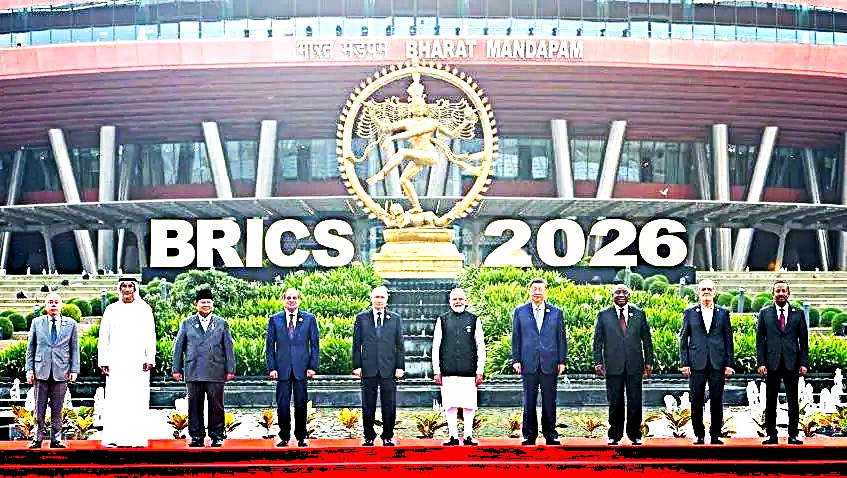
BRICS held its 18th Summit in New Delhi between 12 and 13 September 2026, under the presidency of India, with the participation of 10 of its 11 members. For a number of reasons, including the heterogeneous and unequal intertwining of the economies of its participating members with the economies of the imperialist system, the bloc, composed of dependent and semi-colonial capitalist states and China (a workers’ state), has set aside confrontational geopolitical narratives, believing that it will be able to focus on concrete deliveries and internal institutional strengthening.
The central theme was “Building Resilience, Innovation, Cooperation and Sustainability”. One cannot blame only the host nation and the political alignment of its right-wing, pro-US government for the disarming character of the Summit, this is also a reason, but not the only one. The bloc decided to take steps back, avoiding, as it has done in these 20 years of existence, forming itself into an instrument of organized resistance to the imperialist offensive, while the G-7 and company carry out a new arms race in Europe against Russia; the US and in the midst of the Zionist war against Iran, Palestine, Lebanon and Yemen; expansionism in Latin America; escalations that have as a strategy the defeat of the most powerful and developed adversary, China. Despite these “Western” offensives, the New Delhi summit retreated three crucial steps: 1. it began to bet on the recovery of multilateral organizations from the imperialist system to build its multilateralism; 2. If postponed again the creation of a common currency and 3. it barred the entry of new nations.
Would it be possible to build a new multilateralism based on the reform of the multilateral organizations of the imperialist system?
The New Delhi Declaration (with 140 points) reinforced the need to reform institutions such as the UN, WTO and IMF to reflect the multipolar reality. There was explicit condemnation of unilateral sanctions and coercive measures contrary to international law.
After World War II, the main imperialist nations were indebted or occupied by US bases. The main losers in the war, Germany, Italy and Japan became military colonies. This hegemony established the dollar as the standard currency of world market exchanges and a set of multilateral financial, commercial, civil and military organizations (WB, IMF, WTO, UN, NATO). This imperialist system entered into crisis during the financialization of the economy and the crisis of 2008. BRICS believes that an opportunity is opening up to promote a kind of democratic revitalization of the organisms that served the hegemony of the United States for 70 years and are now being abandoned by it.
The government representing the interests of US imperialism today despises the multilateral organizations of the imperialist system, which suffer economic disinvestment by the US that acts with ultrapotitism, punctual military alliances, reconcentration of forces in the Western Hemisphere (Donroe Doctrine) to prioritize the “America First” policy, seeking maximum freedom to override the entire international legal system and reduce US financial spending abroad and replace collective alliances with bilateral direct transaction agreements. In January 2026, Trump signed a proclamation determining the immediate withdrawal from the country of 66 international organizations, 31 of which are linked to the UN and 35 independent entities. According to the White House, these bodies act against American national interests.
No one can complain that Trump has not helped the BRICS, accentuating the isolation of the US and pushing other nations into the arms of China. This is the case of India itself, whose government prefers to be a vassal of the US, thinks it is an ally of Washington and feeds historical, economic and border rivalries with China, but has been pushed by Trumpist protectionism to ally itself with its Asian neighbour. A rapprochement that has strengthened in New Delhi, between Modi and Xi Jinping, thanks to the fact that India has been surprised and frustrated by the various tariff attacks and threats by the Trump administration since 2025, dispelling illusions about a supposed special partnership relationship with the US.
Postponing De-Dollarization and New Mechanisms Again
The summit abandoned the idea of a common BRICS currency, which was considered unfeasible. The strategy adopted is intended to be pragmatic. Payment interconnection – it seeks to connect systems such as UPI (India), Pix (Brazil), MIR (Russia) and CIPS (China) to make cross-border transactions cheaper. Settlement of bilateral transactions in local currencies: Stimulation of trade without going through the dollar, with possible savings of 2-3% in conversion costs. In addition to these mechanisms, they are betting on the BRICS Multilateral Guarantees, a pilot initiative of the New Development Bank (NDB) to attract private capital and reduce financing costs for infrastructure. The bloc’s countries have also adopted a multifaceted strategy to reduce dependence on SWIFT. The main collective mechanism used and in an advanced stage of implementation is BRICS Pay. BRICS Pay works as a decentralized digital infrastructure that connects the domestic payment systems already existing in the member countries. Instead of recreating a global network from scratch, it promotes the direct bridge between successful local platforms such as mo PIX, UPI, MIR and CIPS. These are all lateral measures, relatively timid, as long as an anti-dollar global currency could favor the breakdown of the financing of imperialism at this time of crisis of the petrodollar system due to the defeats of imperialism and Zionism in Southeast Asia.
The control of money and the banking system is not only a measure of monetary policy, but a fundamental political weapon and strategy for the anti-imperialist struggle. Despite copying or re-editing initiatives of the post-war imperialist system, such as industrialization, multilateral organizations, and the expansion of the global market, BRICS has not been consistent in the establishment of a new standard currency that serves to supplant the dollar, a very important mechanism of imperialism’s exchange hegemony over the world economy. The main accelerating motivation for de-dollarization is the need for geopolitical security. When the United States and its allies froze about $300 billion in Russia’s foreign exchange reserves in 2022 due to the war in Ukraine, it became clear to BRICS members that dependence on the dollar represents a sovereignty risk. Countries fear that, in any future diplomatic conflicts, they may also be cut off from the Western financial system (such as the SWIFT payment mechanism). Currently, if Brazil sells products to China, the transaction often needs to convert Reais to Dollars and then Dollars to Yuan. This process involves duplicate bank fees and risks of currency fluctuation. By establishing local currencies or a common unit of account for international trade, countries reduce costs and increase the efficiency of trade exchanges within the bloc.
With the Anglo-Saxon tech giants (Bigtech) that control much of the world’s communications and information traffic on the other side, the summit made the debate around technology a central pillar, focusing on digital sovereignty and the right to development of the countries of the Global South. The declaration on Global Governance of AI was the bloc’s first consensus document on the subject, expressing the intention to reduce technological dependence on Bigtech and supporting the creation of the Digital Public Infrastructure Library (DPI), for sharing good practices and interoperability between members’ digital systems. Getting lost in reunionism without the necessary steps that the geopolitical dispute requires at the moment, they settle for administrative measures that fall short of what is needed, creating, for example, in the midst of the annual rotation of the presidency, a Continuity and Implementation mechanism to monitor initiatives via the Troika (previous, current and next presidency), with a digital repository to monitor deadlines and status and an Emergency Support Network for Seafarers to coordinate assistance (medical, evacuation, communication with family members) to seafarers in crisis situations.
Containing Its Own Expansion
Today, the real weight of the BRICS stems more from its existence itself than from its willingness to be an alternative to the imperialist bloc, an aspiration that its members who adhere to a worsened version of the policy of “peaceful coexistence” of the twentieth century do not have.
The weight of BRICS stems from the size of its members. It includes the two most populous countries on the planet (India and China); three of the five largest countries in territorial extension (Russia, China and Brazil); and five of the largest economies in the world (China, India, Russia, Indonesia and Brazil). Another striking feature – the group includes the three countries that are in confrontation with the collective West – China, Russia and Iran. The activity of BRICS is followed with concern in Washington and in European capitals. Donald Trump has threatened BRICS several times, trying to scare the most fearful or most vulnerable members of the group. (DCM, The BRICS summit in India: political and financial results).
After the wave of new members, which brought the institution to 11 members (Brazil, Russia, India, China, South Africa, Egypt, Ethiopia, Iran, Indonesia, United Arab Emirates and Saudi Arabia) the Indian summit chose to pause the formal expansion to consolidate internal mechanisms. More than 20 countries that have already expressed interest in joining the bloc are thus vetoed, Belarus, Kazakhstan, Thailand, Vietnam, Bolivia, Venezuela, Algeria, Cuba, Nigeria and Uganda.
The focus has shifted to strengthening the network of partner countries (such as Vietnam) and practical cooperation in areas such as food security, energy, and health. The bloc has temporarily pulled the handbrake instead of expanding its cooperation to the areas of defense and security. As a historical leader of the Brazilian PT, Markus Sokol, aptly summarized, “there is a search among the peoples for a global alternative to the system in crisis, but this alternative is not BRICS, which does not want more than that, to accompany the world order in crisis” (OT Newspaper, 970).
For a consistent anti-imperialist struggle
In short, the New Delhi summit consolidated the BRICS as a bloc that, instead of seeking confrontation or even organized common resistance, believes it is prioritizing the construction of its own technical and financial infrastructure to increase the resilience and autonomy of the Global South. Capitalist aspirations that decadent imperialism sabotages and literally bombs, nothing preventing the system from dragging humanity into a new world war and a barbarism with no return, in full flight, slaughtering multilateralist illusions in full flight.
The resolutions of the New Delhi summit fall short of the recent victories of the oppressed nations over imperialism in the wars won in Afghanistan or still in progress: Ukraine and Iran. Victories that were only feared possible thanks to the bilateral and trilateral articulations between Russia, China, Iran and North Korea, in military coalitions formed more by a kind of antagonistic cooperation against an aggressive common enemy than by a common strategy for the defeat of imperialism by nations that are victims of it.
Although the official list of full members of the group has 11 countries, Saudi Arabia was on the official agendas of the New Delhi Summit, but did not confirm the sending of a presidential delegation to the main debates. In addition to these full members, the meeting in India brought together 10 other countries as new official “partner countries” of the bloc. It is worth noting that Saudi Arabia is being defeated once again by the Yemeni Houthi guerrillas, supported by Iran. The US could have been left with only the defeat in the Persian Gulf to Iran, but it decided to push Saudi Arabia to the precipice and now it screwed with the defences of the Arabian Peninsula, the traffic of the Red Sea, the passage through the Bab al Mandab, the petrodollar system, they screwed everything.
Despite the recent victories of some of its members over imperialism, the BRICS have proved incapable of defending key nations from the geopolitical dispute such as Venezuela, Cuba, Colombia, Bolivia, Peru, Argentina and Chile. For this reason, we believe that the tactic of taking steps backwards is a strategic mistake. It means abandoning all of Latin America to its fate, letting imperialism continue to advance in its backyard, appropriating inputs that today are vital for China itself and that once in the hands of imperialism will grant it a life, not to mention the cost of this offensive for Latin American workers.
Finally, it is important to understand that the tariff, military and technological victories obtained by the “Global South” have recently been possible thanks to the crisis of the imperialist Military-Industrial Complex, with overpriced weapons and in loss of power of domination given the deindustrialization that the imperialist system is going through. Private capital in the era of financialization is more parasitic and rentier than ever. Therefore, in order to develop their national economies, oppressed peoples and countries need to decouple their economies from the imperialist system, and bet on the industrialization and nationalization of their economies, not feeding illusions in Public-Private Partnerships or in the illusion that the G20 is “the main global forum for international economic cooperation to provide a platform for dialogue between emerging and developed economies in conditions of equality and mutual benefit”.
Imperialism attacks but loses ground in the three continents of the old world, while maintaining a consistent advance by recolonizing the American continent under the Donroe doctrine. A situation that proves that the consequent anti-imperialist struggle depends on the responsibility placed on the shoulders of the working class and the proletarian internationalism of the oppressed peoples.