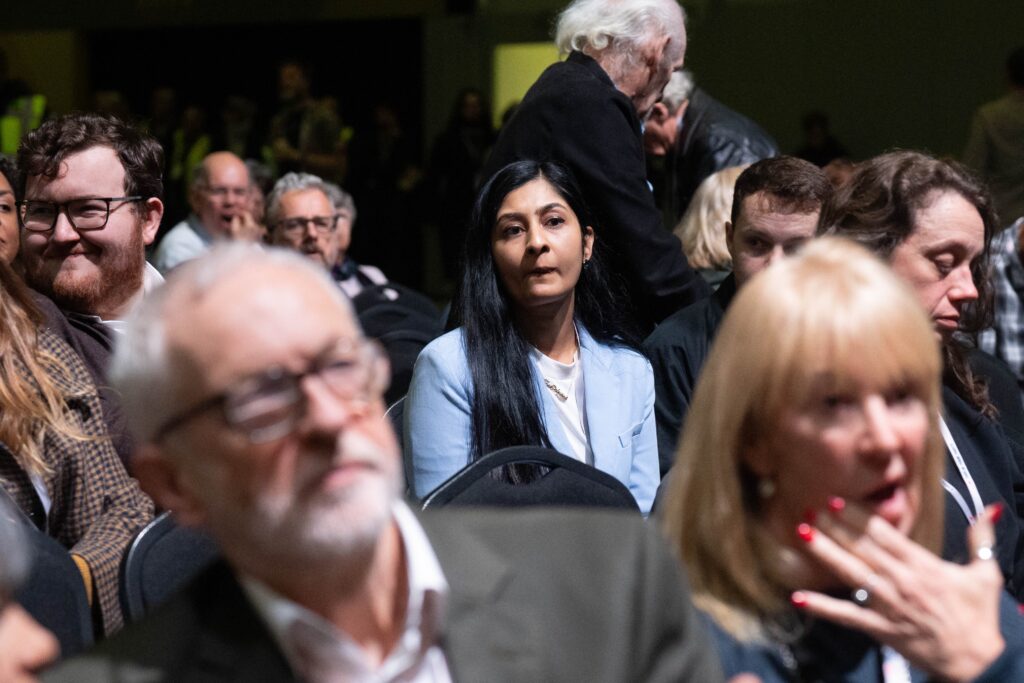
The founding conference of what is now, on a semi-permanent basis, known as Your Party, was a contradictory affair, but the outcome was no split, but the creation of the beginnings of what looks to be becoming a sizeable, working-class left-wing party with potential for growth. This is despite the serious divisions between its two main founders, Zarah Sultana and Jeremy Corbyn, who represent as a starting point at least, different strands of left social democracy. Comrade Corbyn is closely tied to a layer of volunteers, notably around Karie Murphy, whose whole outlook is saturated with the outlook of the ‘left’ trade union bureaucracy, and have brought with them considerable elements of bureaucratic practice, which means that there is still a danger that Your Party could be consumed with witchhunting against the ‘far left’. Zarah Sultana, who is 40 years younger than Corbyn and Labour’s newest and most militant and dynamic left-wing dissident before her exit from Labour in July 2025, to her great credit, firmly denounced and tried to head off this possibility, and had some serious success in this regard at the conference in November.
Your Party Has also been enriched by a significant presence of ostensibly revolutionary trends, some of which have diluted their revolutionary aspirations with elements of reformist politics (those in the tradition of the old Militant tendency), or with capitulation to Cold War Stalinophobia and sometimes even Zionism (the SWP, Counterfire, smaller SWP fragments such as RS21, ex-Trotskyists such as Anti-Capitalist Resistance, and the ex-Stalinist, third campist Weekly Worker/CPGB). Then there are more serious communist/Trotskyist inclined trends, including, as well as ourselves, Workers Power, the Spartacist League, the Bolshevik Tendency, the International Bolshevik Tendency, and several prominent individuals with political histories in these tendencies. No doubt this list is incomplete. The barriers between these broad trends are somewhat permeable – while the latter trends may be closer to real communism, the former group are often subjectively very leftist also and if Your Party really does develop into a fully-fledged workers party, this will have the progressive effect of breaking down the barriers between sects and allowing a free-flow of political debate and engagement, from which the most consistently communist and revolutionary trends can only gain.
The conference itself had some ominous omens beforehand, over the preceding five months since the impending creation of the party was announced in July, after Zarah Sultana, who had been suspended from the Labour whip for many months, resigned from Labour in early July and announced her intention to co-lead a new party along with Jeremy Corbyn. Corbyn, Labour’s left social-democratic leader from 2015 to 2020, though remaining a critic of neoliberalism and imperialism at many levels, had failed to properly stand up to the ferocious witchhunt and wrecking operation against himself and his supporters during this period. Instead, he tried to appease the Zionists and Blairites, throwing many of his most outspoken supporters to the wolves in the process. That was while he was leader. After being ousted after the sabotaged 2019 General Election failure, he was suspended from Labour by Starmer and deprived of the whip. The lack of the whip forced him to stand against Labour in the 2024 General Election to keep his Islington North seat (which he duly did and won).
Four other independent MP’s won seats in the General Election, all of them Muslims who ran on the issue of the support of both main parties for Israel’s genocidal assault on Gaza. It was clear that they were part of a diffuse social democratic/radical liberal opposition to both bourgeois parties that had enough ties to the labour movement and the organised left through the Palestine movement, to make them critically supportable by communists in the General Election. There were several other independent left/working class candidates in a similar mould around the country. Leanne Mohammad came very close to defeating Wes Streeting in Ilford North, and Andrew Feinstein did respectably well in challenging Starmer himself in Holborn and St Pancras. Though this movement had many weaknesses.
After the General Election, when Starmer’s Labour Party won a substantial majority despite only getting just under 34% of the vote (dependent on the collapse of the Conservative vote to only 24%), it became clear that the new government was the most unpopular since universal suffrage began. It had no ‘honeymoon’; within weeks of its election, it was staggering under the blows of a wave of far-right agitation and rioting. In 2025 that intensified with attacks on refugee hostels all over the country, and the rise of Nigel Farage’s Reform Party to first place in the opinion polls. Starmer’s government was up to its neck in support for genocide in Gaza, and the West’s proxy Nazi war against Russian-speaking Ukrainians and actual Russians in Ukraine; its response to the rise of Reform was to try to outdo Farage in racist rhetoric and to crack down on migrants still more.
Splitting from Labour “At a Snail’s Pace”
It was clear that there was a desperate need for a new working-class party. Indeed, it had been clear for several years, since the demise of Corbyn’s Labour. Yet he was extremely reluctant to burn his bridges with Labour by founding a new party. He literally left it to the last possible moment to announce his independent candidacy in the General Election. And he stonewalled on the creation of an independent party for around a year afterwards. Though it was known that semi-secret, invitation-only meetings of a body called ‘Collective’ were taking place during this period, it was not clear that the talks were getting anywhere. Until Zarah Sultana MP ignited the issue in July 2025 by resigning from Labour and declaring the intention to found and co-lead a new party to oppose Labour from the left. After this announcement, it took Corbyn three weeks to overcome his own hesitation and confirm Sultana’s announcement.
This split should have come seriously on the agenda as soon as Corbyn was suspended from Labour in late 2020. When it finally was announced in 2025, 800,000 people expressed interest in joining via the new Your Party website, on top of the 72,000 who did the same for Zarah Sultana’s ‘Team Zarah’ website earlier in July 2025 after she announced the beginning of the project. This base existed in 2020 – Starmer was in the process of driving them – hundreds of thousands of socialist-minded people – out of Labour then. It remained intact but in a kind of ‘limbo’ over this period while the Labour Party went down from over 600,000 members under Corbyn to around 200,000 today. If Corbyn had bit the bullet in 2020 and initiated a new party then it is virtually certain that it would have outgrown the Starmer-led Labour Party, which would simply have haemorrhaged members directly to a new party. Such is how historic opportunities for working class politics are allowed to slip – or at least be interminably delayed.
The mass base of Corbynism never dispersed and never ceased to oppose neoliberal attacks on the working class. That is why hundreds of thousands rallied to give support to Your Party when it was announced. The basic problem has been the glacial pace (and paranoia about those to their left) of Corbyn and the legacy left bureaucrats around him, which clashed with the entirely progressive desire for a working-class political party of his mass base. This conservative element in Corbyn’s politics has now rightly been challenged by the youthful left-wing former Labour MP Zarah Sultana.
Zarah Sultana’s Left-Wing Trajectory
Zarah Sultana has positioned herself considerably to the left of Corbyn on some of the most important political questions. Notably Zionism, where she has criticised Corbyn’s Labour leadership for appeasing the Zionists and capitulating to the witchhunt. Since the conference her strong anti-Zionism has manifested itself in her excellent work leading protests outside Bronzefield Prison in Surrey, demanding medical care for Palestine Action hunger strikers among the Filton 21, who face two years remand on phoney charges they are likely to, eventually, be acquitted of. Her actions on this alone have boosted Your Party’s standing as a principle left-wing force.
She has insisted that Your Party must come out strongly for the rights of Trans people; she has strongly opposed exclusions and witchhunts against Marxist and revolutionary-inclined left-wing groups. In public speeches she has laid down what appears to be the beginning of an extensive programme of statification of industry that appears to point more to a full-blooded anti-capitalist position than mere social democratic nationalisations; she has forthrightly emphasised the importance of mass anti-fascist mobilisations particularly in the context of the debacle of left’s failure to effectively counter the openly racist “raise the colours” movement that erupted over the summer of 2025, and Yaxley-Lennon’s mass rally in London on 13th September. She has called for the politics of ‘class war’, and opened a real possibility of the party, or a large section of it, evolving politically beyond social democracy altogether.
Though she has not, so far, evolved beyond social democracy on questions involving conflicts with imperialism that are a legacy of the Russian Revolution – when put on the spot about the imperialist proxy war in Ukraine, she denounced Putin as a ‘dictator’ and called Russia’s 2022 Special Military Operation an “illegal invasion”, while also saying that Zelensky is an enemy of the working class of Ukraine. She has also said nothing on China yet. This is not a consistently anti-imperialist approach, and it is crucial that Your Party, or its serious anti-capitalist wing, move beyond Labourite politics and seriously address the legacy of the 1917 workers revolution in Russia, and the role its by-products, including non-imperialist Russia, the roles that various remaining workers’ states such as China, Cuba and North Korea, play in the world and their place in the worldwide struggle for socialism. Rather than go into all these arguments in detail here, we have written a companion piece to this article (“Russia, China and Socialism”) which addresses these questions in depth.
Trump’s drive to war against Venezuela also puts a number of these questions on the agenda. Both Russia and China are allies of Venezuela and yet the Labourite programme that sees them as ‘imperialist’ enemies of ‘Western democracy’ logically leads would be socialists to line up behind NATO. It is very clear that comrade Sultana does not want that – she has been outspoken in advocating that Your Party should break with NATO because of its imperialist nature. But the more left-sounding capitulation to imperialism is from those tendencies who effectively bury the legacy of the Russian revolution and the attempt at world revolution in the 20th Century, and equate Russia and China with US imperialism, as another supposed set of imperialist powers.
The logic of that position is terrible in the context of US imperialism’s attacks on Venezuela, as that country has backing from both Russia and China, and according to a worldview that sees Russia and China as another imperialist ‘camp’, to consistently carry out this logic would mean supporting neither side. The same when the US threatens Cuba, still a deformed workers state, which is clearly also an ally of the Russia-China bloc. The US bullying of states involved in BRICS, headed by Russia and China, which includes Brazil, India, Indonesia and Iran – all to varying degrees victims and targets of US and indirectly NATO imperialism, is logically a matter of indifference if Russia and China are cast as rival imperialists. Iran in particularly is also a major target of the US/Israel Zionist bloc in West Asia. The core of BRICS consists of countries that US and NATO imperialism would like to defeat and subordinate as part of maintaining the ‘rules-based order’, which really means US imperialist hegemony. Though Comrade Sultana’s evolution to the left is notable, and her desire to build a genuine working class socialist party that is not a Labour 2.0 is commendable, key strategic questions fundamental to socialism need to be addressed before Your Party can really break with Labourism.
Contradictions of Creating Your Party
Getting hundreds of thousands to express their support in an elementary way for the idea of a new party is one thing – creating that party was never going to be simple. And another complication has been the presence of the four Muslim Independent MP’s, who were elected mainly on the question of Gaza, without much of a broader socialist outlook at all. On other questions they were often socially conservative. Since the Independent Group was given considerable power over the process of setting up the party, there have been clashes between the most conservative of them, and Comrade Sultana over the pace of the party’s formation and its political direction.

It repeatedly became clear that Jeremy Corbyn, his entourage and the Independent Group of MPs were resisting Zarah Sultana’s initiatives to push the party forward. The three-week silence of Corbyn after Sultana announced their joint endeavour at the beginning of July was unnerving and signified that he was having to be pushed faster than he wanted to get the party off the ground. It is also evident that there was resistance to launching a portal to allow people to join the new party, as opposed to just register interest in it. Frustration with this led to the dispute over the membership portal launched by Zarah Sultana on 18th September when an earlier, agreed timetable appeared to be slipping because of obstruction by the more conservative elements in the Independent Group. This portal was falsely denounced by the Independent MP’s group as fraudulent, though it was launched as result of a dispute about timing, creating a legal standoff that briefly threatened to tear the party apart.
Once the immediate issue was overcome there followed a technical-legal problem about how to deal with membership and the funds collected on the earlier portal, when another ‘agreed’ portal was created. Like with the announcement of the party, the root cause of this appeared to be the glacial, ultra-cautious methods of Corbyn and those around him. The sporadic issuance of public denunciations of Sultana by the Independent Group continued until an incident in October, when, as she appeared on BBC Question Time, another missive signed by all the Independent MPs, including Corbyn, was issued, denouncing her over the funds from the earlier membership portal. Corbyn immediately denied signing it, and dissociated himself, and straight away Adnan Hussain resigned from the body that was setting up Your Party, followed later by Iqbal Mohammad. They cited disagreements over issues like Trans rights and other matters and accused Your Party of being ‘intolerant’. Even after this, anonymous briefings appeared in the media denouncing Zarah Sultana, with the result that she and Corbyn held separate eve-of-conference rallies on November 28th.
The conference itself was wracked by political tensions and conflicts. The leadup to the conference had some elements of democracy, but with a considerable degree of arbitrary diktat on some key questions. The use of sortition – a random method of selection by demography to try to achieve gender, age and geographical balance of attendees at the conference, akin to that used by the state to select people for jury service, was an unusual feature of the conference. It can hardly be called democratic, but neither could be called bureaucratic and anti-democratic, because of the strong element of randomness in the selection. But the sortitioned attendees were not the sole people allowed to vote – in fact the entire confirmed membership online was able to vote on a whole range of contested issues and amendments at the conference, and the leadership layer around Corbyn lost several important votes. Though largely because of difficulties in signing up members online and ‘confirming’ them, there number voting was much less than it could have been.
The real democratic defect was arguably in the process whereby the four documents to be dealt with at the conference, and the various amendments, were prepared. The four documents were: the proposed Constitution; the Standing Orders, the Operational Plan for the First Year, and the Political Statement. Of course, each of these documents had to be drafted by someone – that is not at all undemocratic. They were then opened to the membership online through the members area to propose edits and amendments. It does appear that many such proposals were made. The documents were also examined by a series of local/regional assemblies, where members from proto-branches grouped into impromptu ‘regions’, in groups of around 10, got to discuss them and propose possible changes to ‘facilitators’, that is, volunteers who had been trained to lead such discussions and note down feedback and proposed changes from the members. It then appears that all these amendments, both those submitted online and through the regional assemblies, were processed by Artificial Intelligence to distil them into a coherent set of alternative choices for the members, both present and remote, to vote on. That was the most questionable part of the procedure, as it produced a set of contested options that many considered to be inadequate and not reflecting the full range of issues in dispute among the members.
“Dual Membership” and Witchhunts
The most contentious issue in the draft constitution was the question of dual membership of other political parties. This is a can of worms, as the question of how such ‘parties’ are defined massively affects the democratic or otherwise functioning of the party. The proposal that appeared to carry most wait, that ‘party’ for this purpose means a fully-fledged national political party that stands in elections and is registered with the Electoral Commission to do so, was not explicitly up for debate. Though it does appear, from some discussions on this question, that this was the definition of ‘party’ held to by Jeremy Corbyn himself. One of our comrades had moved an amendment to explicitly define a ‘party’ in this way, but this did not make its way through the collating/compositing process.
Unclarity on this question produced a mutually reinforcing paranoia between the leadership group centred on Corbyn, and members of several far-left organisations, some of whom had thrown themselves enthusiastically into building Your Party. At a meeting of an inclusive bloc of far-leftists, which our comrades attended, the Socialist Unity Platform (SUP), a couple of evenings before the conference itself, a proposal was aired, to be moved by the Socialist Workers Party and supported by Counterfire, to move an emergency motion at the beginning of the conference to replace the existing group of conference organisers with a committee elected from the floor of the conference. This did not go down well with many at the SUP event, including us, as it would inevitably be seen as by many members whose main inspiration was Jeremy Corbyn, as an arrogant sectarian stunt, aimed to unseat the organisers of a founding conference of a new party even before it got underway. Indeed, it got such a negative response at the SUP meeting that the SWP decided not to go through with it.
Unfortunately a draft of the proposed motion had been circulated, which inevitably was leaked to the leadership, and as a result on the opening morning of the conference, a number of prominent SWP members, including its National Secretary, Lewis Neilsen, were bureaucratically expelled for supposedly breaking a rule against dual membership which had never been voted on by the membership. Others, including leading members of Counterfire, such as John Rees and Independent socialist councillor Michael Lavalette – who is associated with Counterfire – were also excluded from the first day of the Conference. Also excluded was ex-Labour member and present councillor James Giles from Kingston, a close ally of Zarah Sultana, who appears to have been targeted because of his support for comrade Sultana over the September attempt to set up a membership portal. This latter, and the more general exclusions, prompted a protest boycott by comrade Sultana on the first day of the conference – when she got to speak on the second day, she sharply denounced the exclusions.

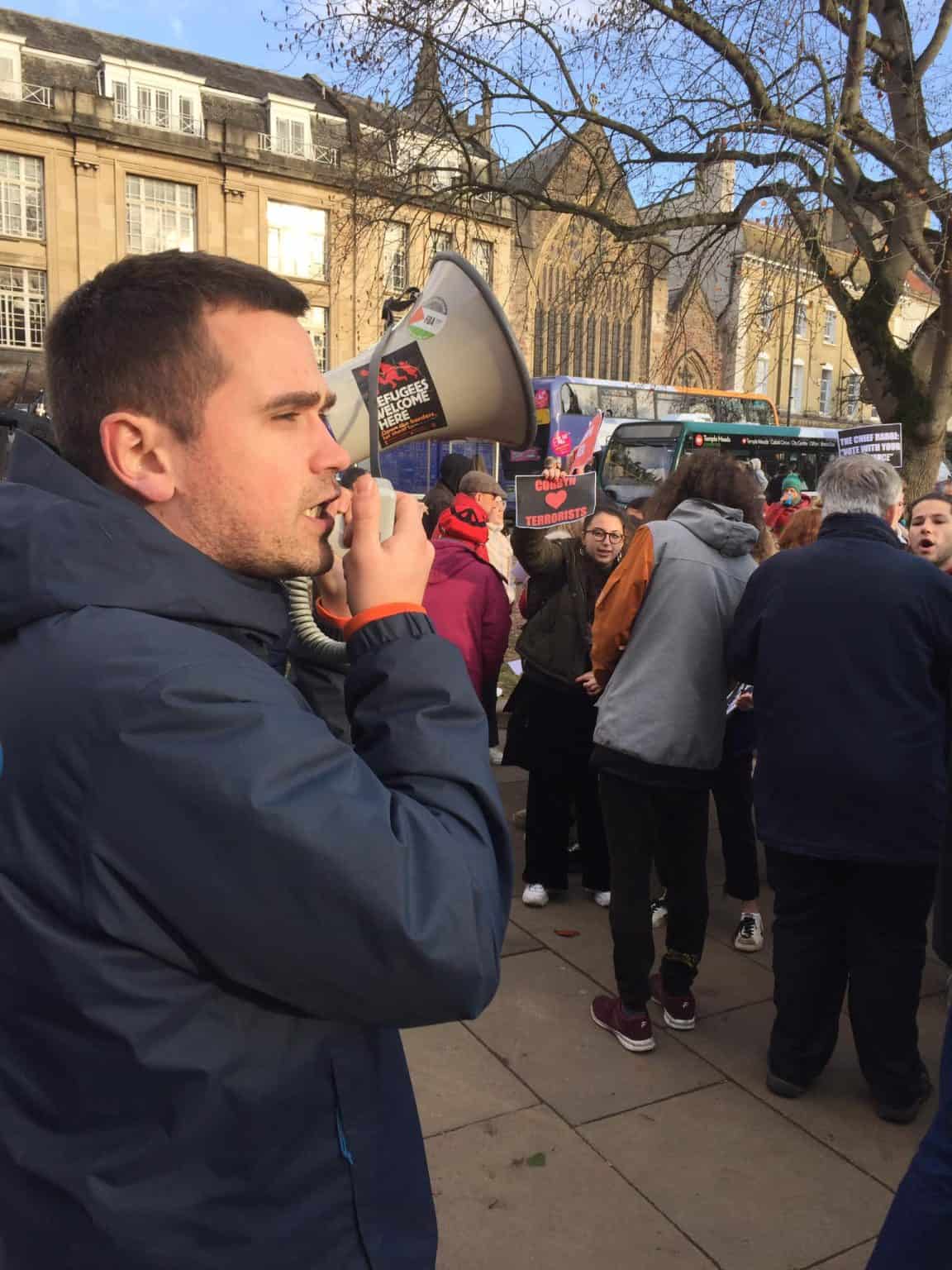
The exclusions of Counterfire people and comrade Giles, though not those of leading SWP comrades, were rescinded on the second day. Regarding Counterfire this appears to be because Counterfire is not particularly large, does not stand as a supposed party in elections, and is not registered with the Electoral Commission. Indeed, Jeremy Corbyn himself admitted this was correct, and that Counterfire did not therefore count as a ‘National Political Party’ in a published WhatsApp exchange with John Rees. But though the SWP is larger, it also does not stand in elections and is not registered. So, confusion and ambiguity reigns on this key question and would continue to do so whichever of the two ‘dual membership’ options were passed by the members.
These exclusions produced a backlash from the members. There were two counterposed proposals on ‘dual membership’ to be voted on at the conference. One called for dual membership to be completely forbidden, the other called for it to be permitted, but under the control of the incoming Central Executive Committee of the party, which is due to be elected in February. The second proposal passed overwhelmingly – the total ban was defeated by nearly 70% to 30%. However, as noted, what was missing was a clear definition of what a competing ‘party’ is for this purpose – this clarification was not included by the compositing process.
In our view it is perfectly reasonable to have a clause to exclude dual membership of registered parties such as the Labour Party or the Greens, as some safeguard against right-wing infiltration. We did not support its complete removal, as did many on the left. Nor do we support indiscriminate ‘inclusion’ of every single group that claims to be ‘left’. ‘Left’ Zionist groups, such as the Alliance for Workers Liberty, do represent a concrete danger of Zionist infiltration, and should be proscribed as Zionists to protect Your Party. Any potential ‘Friends of Israel’ grouping should be anathema.
Registered parties who want to participate in Your Party could reasonably be expected to de-register with the Electoral Commission to show they had no ill-intent. Transform has done just this. It is arguable that the SWP would be well advised to do something similar. They are not registered with the Electoral Commission and do not stand in elections. But calling themselves a ‘Party’ is thus a conceit. They could substantially disarm this issue by reverting to their old name of International Socialists, and even make the SWP name available to Your Party – that would actually gain them kudos on the left of the party. Also not included for a vote was an amendment from comrades in Sheffield YP that explicitly recognised the right of YP members to form tendencies and platforms. The absence of such clarifications means that the democratic rights of YP members are still unclear. But it is also clear that the defeat of the total ban on ‘dual membership’, however defined, was a victory for the membership over the more conservative, bureaucratic elements in YP and for a more democratic, open and left-wing party.
Qualified Victories for the Left
There were several other important votes that went the way of the left. Clearly the overwhelming sentiment is that Your Party should be an explicitly socialist party, centred on the working class, that fights for all the oppressed. The vote in favour of YP explicitly signalling “that it is a socialist party” in its political statement passed by over 80% to 20%. The proposition that YP should explicitly signal “that the working class is at the heart of the social alliance that it seeks to build” passed by nearly 78% to 22%. The vote to include a commitment to “socialist, anti-imperialist and anti-oppression principles” passed by 89% to 11%. Two votes were held on Trans rights, the one to “commit to the fight for trans liberation” passed by 72% to 28%, another to “explicitly mention trans liberation” in the political statement by 68% to 32%. An amendment to ban second jobs and limit donations and gifts for £250 (a tiny amount) for elected representatives passed by nearly 95%. The proposal that there should be default two-term limits for internal party officials and publicly elected representatives passed by 59% to 41%. The proposal that members should be able to recall their local party officers by a simple majority, passed by 92% to 8%. All these show the overwhelming socialist and democratic sentiment that drives the membership of your party and really underlies that it is by far the most left-wing incipient major force in British politics.
The results were not uniformly victories for the left, however. A couple of votes were not quite so good, though not necessarily disastrous. The first being on “How do we choose members to go to conferences”, in which they were two options: Elected Branch delegates, together with those from organised sections, party branches, etc. And another proposal which supplemented those with “a portion of delegates selected by sortition”, which tends to dilute the elected nature of future conferences with an element of random selection. This is not necessarily disastrous but does dilute the element of direct democracy somewhat. The proposal with sortition won by 67% to 33%. The other less than perfect result was on the election of the Central Executive Committee, the 16-strong body that will be the central leadership of the party. By a 58.6% to 41.4% majority, it was decided that the CEC membership in England should be elected on a regional basis, not nationwide. Which might not be so bad if the CEC were larger, but for one of only 16 members is restrictive and may be open to undemocratic manipulation of various kinds.
Two votes were less decisive. The first being the party name, where nothing explicitly socialist was on the ballot, the nearest being the vague “For the many” but even that was far too cryptic. This led to the anodyne ‘status quo’ name Your Party winning with 37% of the vote, which is hardly overwhelming. From the above votes, if something explicitly socialist/working class had been on the ballot, it likely it would have won. But the biggest loss for the bureaucratic right-wing around Karie Murphy was the vote on collective leadership vs. individual leadership. This was close: by 51.6% to 48.4% the party voted not to have a single leader, but a party “collectively led by ordinary members elected to the Central Executive Committee, with the Chair, Vice Chair, and Spokesperson in particular serving as the public political leadership”. Albeit this is temporary: it will be reviewed by the CEC “in the party’s second year” to be voted for by membership vote in late 2027, before that year’s conference. The last decision was a significant, but narrow, victory for the left of the party grouped generally around Zarah Sultana, as were the more decisive votes on questions to do with socialism, the working class.
Post Conference Developments
Since the conference there have been some significant events. In London, there has been an unofficial assembly that had delegates and representatives from many active London borough branches, that had lively debates on both domestic and international questions, from people from a range of left-wing trends within Your Party. There will be another such assembly in early February, with branches encourages to submit policy motions for debate. Meanwhile the interim leadership of Your Party is trying to modify the decisions made by the conference already, trying to get membership support to change the number of seats on the CEC from 16 to 18 to allow a regional setup similar to the US senate, where each of 9 regions gets two CEC members irrespective of how many members are in each region. This would have the strange impact of lessening representation of those areas with the most members, which is very inequitable, and would resemble the undemocratic representation involved in the US Senate.
They are also trying to enforce a ban on so-called ‘dual members’, e.g. those in the SWP, standing for the CEC, saying that only the CEC (which has not been elected yet) can legitimate so-called ‘dual membership’ of ‘National Political Parties’ (whose definition is in any case unclear, contested and a major source of potential conflict – see earlier). This despite the conference voting against a ban on dual membership. This is something of an outrage, as the membership have never had a straightforward vote on any of these bureaucratic measures, which therefore have no legitimacy. There is nothing in the constitution as adopted at the conference that gives any legitimation to what could easily appear to be an attempt to effectively gerrymander the election of the CEC against the left.
The worst-case scenario is if YP members who have Marxist views and are in groups like Counterfire which are not registered with the electoral commission, do not stand in elections, and in most cases have never even claimed to be parties, are banned from standing on such a false pretext. Jeremy Corbyn has already conceded in writing that that would be wrong. But suspicions remain that some of those around him want such exclusions, that they want a CEC shorn of those tending towards Marxism and adherence to workers/party democracy by the back door, so that the decision of the Conference to allow ‘dual membership’, in spite of the ambiguity in the text of the Constitution adopted, can be overruled in practice by a CEC elected under such restrictions.
If they try such a stunt, they will likely run afoul of the obvious fact that the overwhelming majority of YP members agree with Zarah Sultana’s criticisms of manifestations of Labour style witchhunting, which was shown very clearly by some of the very high percentages rejecting the politics of YP’s embryonic right wing, as shown in the votes above. Starting such a witchhunt in YP would brand those responsible with something akin to the mark of Cain, or at least of Kinnock, and would show exactly who is really trying to build something akin to a Labour Party 2.0, that is, another bourgeois workers’ party, instead of a genuine workers’ party open to full-blooded anti-capitalist evolution.
It is not pre-determined that any existing trend, no matter how fervent and correct its cadre believe they are politically, really represents the historic interests of the working class. This includes us. Though we do pride ourselves on our serious development of theory in addressing the crucial issues of today, our experience is still likely one-sided and needs much more development. We are all products of a political environment, of attenuated politics of the working-class movement caused by an accumulation of defeats going back to the degeneration of the Russian Revolution in the 1920s. The degeneration of the Communist movement for a whole period strengthened social democracy and put the genuine communist minority trends in a difficult position. That over time led to the dominance of sectarian moods on the left and undercut real political development of the socialist and communist movement. That is what Your Party opens the opportunity for correcting, and that is why genuine Marxists must engage with it seriously in the spirit of Marx and Engels’ words in the Communist Manifesto:
“The Communists do not form a separate party opposed to the other working-class parties.
“They have no interests separate and apart from those of the proletariat as a whole.
“They do not set up any sectarian principles of their own, by which to shape and mould the proletarian movement.
“The Communists are distinguished from the other working-class parties by this only: 1. In the national struggles of the proletarians of the different countries, they point out and bring to the front the common interests of the entire proletariat, independently of all nationality. 2. In the various stages of development which the struggle of the working class against the bourgeoisie has to pass through, they always and everywhere represent the interests of the movement as a whole.
“The Communists, therefore, are on the one hand, practically, the most advanced and resolute section of the working-class parties of every country, that section which pushes forward all others; on the other hand, theoretically, they have over the great mass of the proletariat the advantage of clearly understanding the lines of march, the conditions, and the ultimate general results of the proletarian movement.”