Socialist Labour Network: Steps Forward and Back

The involvement of the British Section of the LCFI, the Consistent Democrats, in the Socialist Labour Network (SLN) has been a bumpy ride at times over the past couple of years, but our comrades have played a constructive role in trying to push it forwards. A number of our comrades were elected to the Steering Committee last year – three stood together on a joint platform as supporters of the Consistent Democrats, and played an important role in sorting out a proper website presence for the SLN, and drafting a resolution that outlined a role for the SLN as a kind of think-tank promoting unification of the various left-wing electoral challenges to Starmer’s neoliberal, hard-Zionist, anti-left Labour Party.

That there is a crying need for such a party is shown by the obvious flaws of those pretending to offer such an alternative. First you have the Workers Party, led by George Galloway, which on the positive side has solid anti-imperialist positions on Gaza and defending the people of the Donbass against NATO’s proxy war. But on the negative side you have their mimicking of the reactionary chauvinism of Nigel Farage’s Reform Party, and others on the populist and far right, in demonising immigrants, and their hostility to oppressed groups such as trans and gays. This has not done them any favours – in the recent Runcorn by-election they touted candidate Peter Ford, as a real challenger to Labour and Reform for working-class votes. But their candidate revealed himself as in no sense to the left of Labour, and by chauvinist anti-migrant slogans they even implicitly attacked Starmer for not being ‘tough’ enough on immigration. Ford got a pathetic 164 votes.

Then there is Transform, which was founded in 2023 from a unification of the very youthful left-wing Breakthrough party, the Liverpool Community Independents, and Left Unity. Transform is much better in defending migrants, and oppressed groups such as trans and gays, and different trends of left-wing thought within it, but echoes imperialist Russophobia. Those signed up for Transform emails in November 2024 received one headlined: “Victory for Putin, Netanyahu and Musk, more misery for the American people” which then went on to rave that “Trump’s victory was a big moment of triumph for Vladimir Putin”. Thus, buying into the Democrats’ ‘Russiagate’ hoax from the Trump first term. You would not get the slightest indication from this that Russia has been the target of an imperialist proxy war since 2014, when NATO, led by the US Democratic Party administration of Barack Obama, spend $6 billion on a far right coup in Ukraine overthrowing the elected president, Yanukovych, put in positions of power nationalist politicians like Poroshenko and Zelensky, who have treated such Nazi collaborators as Stepan Bandera and Roman Shukhevych as national heroes, while persecuting the nearly half of Ukrainian people who speak Russian. During Trump’s first term, he tore up the 1987 Reagan-Gorbachev INF treaty banning intermediate range nuclear missiles from Europe, a major nuclear escalation against Russia, and he also groomed Zelensky as a Jewish front man to deflect criticism of the obvious pro-Nazi politics of the Maidan regime. But he wasn’t anti-Russian enough for some of the left Russophobes in Transform, who implicitly prefer Biden, who in the two months after he lost the November 2024 US election, went for broke and risked WWIII in encouraging ‘Ukraine’ to be a base for firing obviously NATO controlled cruise missiles such as Storm Shadow into Russia (which has now resumed under Trump).

We are pleased that in June 2023, our comrades moved to an SLN All Members Meeting, and got carried, a motion that clearly stated the need for “an anti-war movement that is principled, anti-fascist and anti-imperialist, and stands against the drive of the far-right Maidan regime in Kiev to destroy and ethnically cleanse the Russian speaking population of what was the South-East part of Ukraine (Donbass). We must stand with the Donbass people”.  The motion also criticised the politics of the Stop the War Coalition: “Although Stop the War condemns the US and NATO, it also condemns Russia. This is to condemn the Russian assistance to the people of Donbass to resist ethnic cleansing and to avoid being forced into NATO”. Thus, the SLN changed its position to a principled anti-imperialist defence of the targets of NATO’s anti-Russian proxy war. We followed this up in September 2023 with a successful motion for the SLN to support International Ukraine Anti-Fascist Solidarity (IUAFS), which campaigns to defend the Donbass people. These were important policy changes that our comrades initiated, which were a real step forward for the SLN.

Origins of the SLN

The SLN was founded as a merger of two former bodies from within the Labour Left during the period of Corbyn’s leadership, Labour Against the Witchhunt (LAW) and Labour In Exile Network (LIEN). Labour Against the Witchhunt was effectively a front for supporters (in both the narrow and broad sense) of the Communist Party of Great Britain/Weekly Worker, the third-campist splinter from the old official Communist Party of the same name when it renamed itself the Democratic Left after the collapse of the USSR in 1991. This group previously published the Leninist, but in 1991 they took the CPGB name and began publishing the Weekly Worker, claiming to be the (albeit ‘provisional’) leadership of the Communist Party. Those in the old party who wanted to carry on as before continued publishing the daily Morning Star, and in time reestablished themselves as the Communist Party of Britain, leaving a confusion of names for the uninitiated.

The Weekly Worker group was quite an energetic, younger group around Jack Conrad, but with erratic, centrist politics that rejected aspirations to orthodox Marxism and Trotskyism, instead influenced by social-democratic (and in fact liberal Zionist) critics of the Trotskyist movement like Shachtman and Hal Draper. They have been an interventionist force among the left-of-labour political initiatives since the 1990s, and they involved themselves heavily in the Corbyn movement. Politically, they appeared as a less-virulently pro-imperialist version of the Alliance for Workers Liberty. They prided themselves as being neutral, or ‘dual defeatist’ in conflicts between oppressed Arab or Muslim countries and imperialism, including Israel. They were for a long time two-statists regarding Israel-Palestine, though prepared to be ambiguous when they allied with leftists like Tony Greenstein who rejected two-states. They are also neutral in the conflicts between imperialism and Russia/China, though their main leader Conrad, appears to consider Russia not to be imperialist, but China to be so. (https://weeklyworker.co.uk/worker/1446/notes-on-the-war/).

Irrespective of all this, the role of the CPGB in Labour was, albeit with some degree of subtlety, promoting its own eccentric version of third-campism, Islamophobia and soft-Zionist apologetics. They were probably the main initiators of LAW, which we in Socialist Fight, (our predecessor group as the British section of the LCFI), an orthodox Trotskyist group who also worked within Labour and the Corbyn movement for straightforward Marxist reasons, regarded as a correct and positive initiative. We attended its founding meeting, seeking active involvement.  The CPGB then showed their real political nature by seeking to have us expelled from LAW for alleged ‘anti-Semitism’ – that is, for our orthodox Marxist/Trotskyist understanding of Zionism and the Jewish Question. Derived from the political tradition of Karl Marx and Abram Leon, this position is explained in both factual and historical terms here (https://www.consistent-democrats.org/draft-theses-on-the-jews-and-modern-imperialism-sept-2014/)

The CPGB, and some of the allies around it, had previously, in 2014 excluded one of our leading comrades from its ‘Communist Platform’ bloc within Left Unity for supposed ‘anti-Semitism’ for writing this set of Theses in the first place. But when similar accusations of ‘anti-Semitism’ were laid against him in Left Unity itself, he was exonerated by their disciplinary body. It was a politically motivated smear by these semi-Zionist third campists. On the Labour Left, including some who gravitated around the CPGB in this period, there were several Jewish comrades, some driven by leftist forms of identity politics, who considered criticism of a Jewish layer of the imperialist bourgeoisie with Zionist politics – a prime mover of the Israel lobby – as an ‘anti-Semitic’ concept. No matter how many facts could be cited in support, to them this was ‘anti-Semitism’. The CPGB got support from this layer. When SF challenged this in an LAW meeting in December 2017, the CPGB and co. lost the vote. So they called a ‘national mobilisation’ for a meeting in January 2018, and mobilised all kinds of people with reactionary positions, including supporters of Maidan Ukraine and the so-called ‘Syrian revolution’. Socialist Resistance, now called Anti-Capitalist Resistance, who were notorious then for all these things and even cheering for the imperialist intervention in Libya that overthrew Gaddafi, turned up to vote us out. Predictably, this rotten bloc had more voting power than our own smallish group. The whole affair made national headlines at the time as an eccentricity: an obvious, public witchhunt within Labour Against the Witchhunt.

The other component of what became the SLN was the Labour in Exile Network, simply a network of former Labour Party members, victims of the extensive purges that took place in Labour during the late Corbyn period. After the 2019 election, when Corbyn was forced out, Starmer took over, LAW and LIEN were proscribed and there was an obvious objective case for them to merge, to act as an organising centre to keep together the many leftists who had been purged. When that happened, the CPGB walked away, as they feared they would be unable to control it, though some of their allies, such as Tony Greenstein, stayed in. Our longer-standing comrades were able to join the merged group in part through joining LIEN and no objections were raised by those such as Tony Greenstein who had previously accused us of ‘anti-Semitism’.

Policies and Mission of the SLN

As recounted above, we were instrumental in bringing to the SLN a much better policy on Ukraine. But the problem with the SLN was what its purpose was. The lack of a clear purpose somewhat stalled its growth and led to a certain decline in late 2023 and early 2024. So later, in September 2024, the organisation held a ‘re-founding conference’ – and our group drafted the main resolution, which defined the SLN as a kind of think-tank, to draw together the various initiatives that aimed to provide a left alternative to Labour, though principled debate:

“… the watchword of any new party should be ‘freedom of criticism, unity in action’. This goes right beyond the limits of the present democratic-socialist and social-democratic parties and the bureaucratised ‘communist’ parties and ‘Trotskyist’ groups, where dissent is seen as a challenge to their leaderships. Working class democracy is not an optional extra, it will be the most effective weapon for building such a party.

“We in the SLN cannot declare ourselves to be such a party. But we can advocate unification of the various forces that have been driven out of the Labour Party by its authoritarian and neoliberal decline, together with other socialists, to come together as a network, on the same basis as ourselves, to deepen collaboration and lay the basis for such a Party. We need a convention of the Left to be convened on a broad basis to begin this task.” (https://socialist-labour-network.org.uk/the-need-for-a-democratically-run-party-of-the-socialist-left/)

This was to be the role of the SLN, through providing a forum for such debates, to lay the foundation for such a unifying process to draw these strands together.

Unfortunately, it did not work out that way in the last few months, in part because Tony Greenstein insisted, in the context of the genocide in Gaza, in treating the SLN as virtually his property. The SLN organised a couple of well-attended public meetings, one (co-sponsored with Jewish Network for Palestine) on 27th January for Holocaust Memorial Day, denouncing the Gaza genocide, with a good platform and mainly Jewish, but also Palestinian and other Arab speakers. And one on 10th February defending the Right to Protest, notably in the context of a series of repressive arrests using “Anti-Terrorism” laws of journalists and pro-Palestine activists. Those victimised included Tony Greenstein himself, David Miller, Richard Medhurst, Sarah Wilkinson, Natalie Strecker and many more. Organising these events was completely correct and 100% supported by us.

But Tony objected to organising broader political discussions with those with a broader range of views on Palestine and Zionism. Proposals to organise public debates involving such speakers as David Miller, Lowkey, Chris Williamson, Ian Donovan of the Consistent Democrats, as well as speakers from Jewish Network for Palestine, were ruled out by Tony Greenstein on the supposed ground that a number of these speakers held ‘incorrect’ views on the influence of the Zionist lobby, or more bluntly were ‘anti-Semitic’. Since Tony had been the main person organising these public meetings, he was in the short term able to make it very difficult to do anything else. This issue came to a head after our comrades were mandated by the Steering Committee to co-write a motion critical of the International Holocaust Memorial Alliance (IHRA) ‘working definition’ of ‘anti-Semitism’, a crucial tool in the witchhunt against the Corbyn movement, which has now been de facto incorporated into US law as part of criminalising and persecuting opponents of today’s Zionist genocide.

The IHRA and ‘anti-Semitism’

The IHRA is quite a complex tract, incorporating a short, banal ‘definition’ whose real purpose is as an introduction to 11 ‘illustrations’ or ‘examples’ of supposed ‘anti-Semitism’. These are of three types – those that resemble Neo-Nazi positions (Nazi holocaust denial and similar), those that are associated with pro-Palestinian anti-Zionism (saying that Israel is a ‘racist endeavour’), and some that are formulated to be ambiguous. The whole thing is an amalgam, that equates anti-racist hostility to the persecution of Palestinians, with Nazi racism against Jews, in quite a subtle, interwoven manner. Previous critiques of the IHRA had been defensive and criticised it merely for ‘conflating’ anti-Zionism and anti-Semitism, with the aim of showing that anti-Zionism is not anti-Semitism. The motion we produced included a full analysis of the various amalgams with the text of the fake-definition, and concluded that its overall purpose and effect was that of a tract which treated Palestinians as inferior human beings – prohibiting meaningful criticism of their racist victimisation as “racist” itself, and thus like Hitler’s Nuremburg Laws. Also, in the context of today’s Gaza holocaust it has played the role of a ‘warrant for genocide’, as originally said about the Protocols of the Elders of Zion for the Nazi holocaust, seeking to prohibit criticism of, and indeed justify as part of a struggle against supposed ‘anti-Semitism’, what clearly has been an accelerating progression of atrocities whose logic was always a genocide.

The motion was unwieldy, as it had the complex analysis of the amalgams embedded in the body of the motion. At the 7th February AMM it was referred back to the Steering Committee for reworking, where it was to be redrafted for the next AMM. This was done by changing the format, so that it contained a few simple points at the beginning, and the bulk of the analysis in an appendix. The opening points included the analogies with the Nuremburg laws and the Protocols. Tony Greenstein vehemently objected to these and sought their removal. We formulated his objections into an amendment, removing these points, and replacing them with the traditional points about ‘conflation’ of anti-Zionism and Anti-Semitism, ready to be proposed by Tony and voted on at the 11th April AMM. But Tony objected to this proposal, instead creating his own version of the motion, with many other small amendments, as well as the two changes he was really driving at. The net result was that two similar looking texts were voted counterposed, with Tony’s voted as a ‘delete all and insert’ amendment, but with the two contentious points removed. Not only that, but Tony moved, a day or two before the meeting, another motion denouncing David Miller among others as theorists of the idea that the “tail wags the dog” – i.e. that US imperialism’s Middle East policy is influenced or dictated by the Zionist lobby. Roughly coinciding with this, Tony denounced David Miller on his blog, and the site of Jewish Voice for Labour, for supposed ‘anti-Semitism’. We, who have considerably different views on David Miller and Zionism, countered that by initiating an Open Letter in his defence (see opposite).

Tony then submitted a second motion, aimed at David Miller and us, attributing the genesis of Zionism as a movement to non-Jewish Christian ideologues in the early days of capitalism, when to Marxists capitalism was still its progressive epoch. This being derived from the form of Jewish identity politics that Tony adheres to, which denies that any Jews played any real role in the creation of the Zionist movement at all. In response to that, we responded with a ‘delete all and insert’ amendment reaffirming that Zionism is a product of imperialist capitalism from the late 19th century onward and rejecting the anti-Marxist position that seeks to dissociate Zionism from imperialism. This is a complex debate, and this online version of this article includes links to the motions so that readers can make their own judgements.

Two things distinguished the AMM on 11th April. One was that those invited were not all members. It was Tony’s idea that all previous members of LAW and LIEN should be invited, as the SLN membership was supposedly in the doldrums. This, in hindsight, was clearly a ploy to mobilise his base. The other was confusion about which amendment was for which motion. The agenda was a confused mess. This was raised by us as a point of order at the beginning of the meeting, but Tony, among others, dismissed this. This may not have been deliberate but caused confusion. Parts of the discussion had to be re-run as it became clear that the motion/amendment order was indeed scrambled. In some heated exchanges, Tony blamed the chair of the meeting, although most of the confusion came from his behaviour. In the end, Tony got his motions through with what appeared to be a voting bloc of around 30, whereas most of the remaining members abstained, probably out of confusion. So, Tony won his votes, though apparently with the help of quite a few who were not actually SLN members.

A Pyrrhic Victory

It proved to be a pyrrhic victory. Regarding his attempted witchhunt of David Miller, we countered this with a collective statement/petition which, though not huge, included some prominent names. The real political upshot of his ‘victory’ at the AMM was that he had mobilised a crowd of his old supporters, many of whom were not even members of the SLN, to dilute a criticism of the IHRA fake definition that he considered to be too sharp (or ‘hyperbole’ as he put it). In mobilising for this, and afterwards, he accused supporters of the CD group of anti-Semitism, on the same basis as he did in previous encounters, such as in 2014 and 2018. This argument has continued after the AMM in Steering Committee forums, with Tony denouncing our comrades for our supposed ‘anti-Semitism’, and our people countering with criticism of his form of identity politics.

The upshot of this is that Tony Greenstein resigned from both the Steering Committee and the SLN. He also approached non-CD members of the Steering Committee offering to withdraw his resignation if they would back a motion saying that, because the Consistent Democrats derive from Socialist Fight, which was excluded from LAW in 2018, CD should be proscribed from the SLN. But this is unviable – he has been working with us in the SLN without complaint since 2023 and earlier and has earlier defended our comrades against the same allegations, knowing full well what our views are, from other critics who for their own reasons, walked away from the SLN. He only resorted to this when a concrete difference arose, over the IHRA. Given that, endorsement of such a motion would simply discredit anyone who co-signed it.

The problem for Tony Greenstein is that the world has changed since the days when he, and the Weekly Worker, were able to excommunicate so-called ‘left-wing anti-Semites’ (i.e., authentic Marxist anti-Zionists) from their version of the ‘labour movement’ and influence the Corbynite left. Today, fearless leftist critics of bourgeois Zionist Jewry, such as David Miller strike a chord among left wing opinion in the context of the genocide, and the likes of Tony Greenstein, for all his undoubtedly genuine anti-Zionism, look like backsliders and capitulators when they trot out their form of Jewish identity politics. Which to a degree they are. They should seriously examine the authentic Marxist analysis of Zionism we put forward, and thereby politically rearm themselves.

So now we are making proposals to try to drive the SLN forward on the lines of the September 2024 relaunch conference, proposing some public meetings/debates on resisting Starmer’s austerity attacks, and a proper, open debate on Palestine and the genocide, with a range of speakers with counterposed views when they exist. Hopefully, in implementing this perspective, the SLN can go forward.

Starmer’s Government: Hated and in Free Fall!

Orwell’s 1984 lives under Der Stürmer (Starmer), the genocidal bomber of Yemen. Troops from the NATO-Nazi puppet regime in Ukraine, which celebrates  Hitler collaborator Stepan Bandera as a hero, march in London for to supposedly celebrate victory over Nazism. But the real Victory Day Parade in Russia, who as the USSR did most of the fighting and dying, is threatened with    terrorist attack by these Nazi scum.

The local election results, and Reform’s defeat of Labour by 6 votes in the Runcorn and Helsby By- Election (previously one of Labour’s safest seats) shows that Starmer’s government is in free fall, the weakest and most hated British government less than a year after winning a general election outright, that anyone can remember. It should be recalled that Tony Blair’s political ‘honeymoon’ after his landslide election victory in 1997 lasted for the entirety of his first term, until 2001, and in some ways only fully ended with the eruption of the mass movement against the Iraq War. Starmer’s government, which was elected with an overall majority in the House of Commons of 174 seats, only received just over 33.7% of the vote in July 2024, and is now in second place behind Nigel Farage’s right-wing populist Reform party, with the Tories in third place, according to most opinion polls. Liberal Democrats and Greens are coming up behind as Britain’s two-party system, as previously known, shows sign of disintegration.

Starmer’s government is riven by severe contradictions. Sometimes it seems like a far-right government itself, but objectively it is a government of very right-wing social-liberals, not even traditional right-wing social democrats, but still formally attached to the labour movement through the Labour Party’s long-time link with the trade unions. It was not created as part of any class-based election campaign or class polarisation. It was openly touted by many in the ruling class as a failsafe for them given the chronic dysfunction of the Conservative Party, which came close to disintegration in its final post-Brexit term, with three different Prime Ministers: Johnson, Truss and Sunak, and obvious decay.

This government has a huge majority, but a weak social base. It retained the Tories hated two-child benefit cap, attacked the winter fuel payment for pensioners, and now undertaken a large-scale austerity attack on the disabled. The attacks on pensioners and the disabled, grotesquely, happen concurrently with many in the government, including Starmer, promoting the Assisted Dying Bill (i.e., legalising euthanasia for the elderly and sick). This now seems to be in parliamentary trouble. There have been revolts before against these attacks, but the local elections and Runcorn seem to have bought about blind panic in the Labour Party. So, there is now talk of the attacks on pensioners and the disabled being reversed, so desperate is Labour to try to regain some sort of initiative. This is despite Rachel Reeves’ insistence that these attacks were supposedly essential for economic stability. Now blunting their impact on Labour’s political fortunes appears to be essential for the government’s political stability. So, some of Reeves’ policies could be thrown overboard.

Starmerite privatisation of the NHS

There is more turmoil and polarisation on the way. The government has also made a show of putatively attacking and cutting the Tories’ previous neoliberal bureaucracy in the damaged National Health Service, phasing out the ‘NHS England’ quango, and local Integrated Care Boards which are also Tory creations as part of their stealth privatisation drives in the Cameron and May governments, mostly preceding Johnson and Brexit. But this is a deceptive flank attack from Labour’s uber-Zionist Health Secretary, Streeting, who is heavily invested in private healthcare himself. It appears that by attacking Tory-created NHS admin, it is using a ‘thin-end-of-the wedge’ tactic that will be used for alternative models of stealth privatisation later.

The only sop the government has made to the workers movement is some gains for trade union rights, extending protection against unfair dismissal to day one of employment. It also promised to outlaw zero-hour contracts. The latter has been considerably diluted, but this is one of the very few things on which leftists must support the government insofar as it acts, however tepidly. This is the only aspect of Corbynism it was unable to simply abolish, because it depended on right-wing trade union leaders, who had to deliver something, to tolerate its purges of the left.

This was buried since the election with an avalanche of attacks on democratic rights particularly of those critical of the government’s support for genocide in Gaza. Almost the first crisis it faced after the election was a wave of far-right near pogroms occasioned by a murder of children in Southport, Merseyside, by a deranged young person who was widely misreported as being a Muslim asylum seeker. The Starmer regime supressed the pogroms as best it could by mobilising the police, but it was the anti-racist left, including left-wing forces around the SWP, who mobilised a mass protest response that successfully undercut the wave of attempted pogroms. However, since then the government has gone on the warpath, starting its own campaign of deportations and further attacks on refugees and migrants.

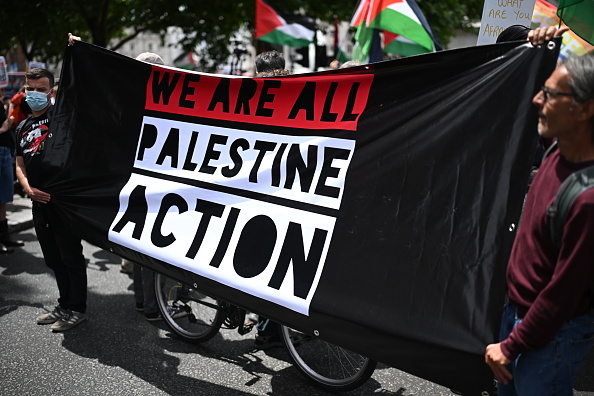
But the most outrageous attacks by the government have been on the Palestine Solidarity movement, and to a lesser extent other causes, such as environmentalists and more recently, there have been outrageous arrests of those protesting Labour’s disability benefit cuts. Regarding the Palestine movement, there have been a plethora of phoney charges of support for ‘terrorism’ and vicious, police-state type raids on Palestine activists, as well as harassment and attempts to ban Palestine solidarity events in the face of the genocide that have gone much further than the Tory regime ever dared. Tory Home Secretary Suella Braverman had to resign after she tried and failed to find a pretext to ban Palestine marches, but Labour in power found a pretext to forbid the coalition that calls the marches – Palestine Solidarity Campaign, Stop the War Coalition and Friends of Al Aqsa – from assembling at the BBC on 18th January. There were numerous arrests over that, including of some of the key organisers of the protests. Even MPs who participated were threatened by the cops. The pretext being that there is a synagogue half a mile away. Now the government is seeking to pass new anti-protest laws to give the police powers to ban protests that supposedly might disrupt religious services by passing near to some prayer house. It’s obviously designed to find excuses to arbitrarily ban demonstrations, particularly against the Gaza Holocaust. Thus, this pro-genocide government is as big a threat to democratic rights as Trump in some ways.

Reform, racism and working-class alienation from Labour

A revolt against the government’s anti-worker character being directed through substantial working-class electoral support for the right-wing populist Reform is a dangerous occurrence in many ways, given that only last summer Britain erupted in a wave of racist riots and attempted pogroms led by people who are very much on the radar as part of Reform’s social base. Reform is a racist, xenophobic party, and a great deal of its appeal is to the most backward sections of the working class who given the defeats inflicted on the left in the previous period by Starmer, have gained influence in the wider working class. There is evidence in the public domain that Starmer’s project for the ruling class always was to destroy the Labour Party as a party with roots in the working class and hand it over to such right-wing forces, and even grounds for suspicion that Starmer was some kind of operative for British intelligence, or something similar, even in the days in the early 1980s when he professed to be a supporter of Militant and other more obscure factions of the Trotskyist left. He was promoted with great rapidity by the ruling class after serving some kind of apprenticeship, it seems.

Reform victorious in Runcorn by-election
 

Those in the Labour Party who want to throw Starmer/Reeves’ draconian attacks overboard to save the Labour Party are behaving quite logically. For Reform, while much of its appeal to backward layers of the working class is simply xenophobic and racist, there is also an element reflects working class discontent with neoliberalism that a working-class party ought to find ways to give expression to. There were already, before the May elections, the beginnings of stirrings of opposition in the labour movement to the government’s attacks: threats of large-scale rebellion by MPs pushed by opposition to the disability benefit cuts. Though these MP’s, except for the fringe of leftists such as Zahra Sultana who were previously punished by Stamer for rebelling also over the two-child cap, tend to be opportunists whose words mean little. There is agitation against the cuts in some trade unions, particularly the Fire Brigades Union, and there is already a major local clash between the government and the UNITE union over a bitter, and militant, bin workers strike in Birmingham, whose council is bankrupt due to austerity. The possibility of some attempt to impose conscription of young workers to fight in Ukraine is a possibility, though maybe remote due to the sclerotic state of the British armed forces. Whether they could even organise conscription effectively is open to massive doubt. But this is also a possible source of mass opposition.

Such things are tangential to the contradictions within Reform’s base. Craig Murray points out:

“So what are the actual politics of this? Well, Reform voters are primarily motivated by dislike of immigration. While there are respectable economic arguments over the desirability of immigration, the simple truth is that most Reform voters are rather motivated by racist dislike of foreigners. I know that I have commenters here who like to deny this, but frankly, I do not live under a rock, I have fought elections, I used to live in the then-UKIP hotspot of Thanet, and I do not have a romanticised regard for the working class, and I have no doubt that Reform primarily channels racism.

“But the interesting thing is that does not mean that Reform voters are ‘right-wing’ in an economic sense. Opinion polls have found that most Reform voters favour renationalisation of public utilities, for example, and Farage has appealed to this by advocating for the nationalisation of the water industry and backing the nationalisation of the steel industry. Reform voters also favour rent controls, employment protections, and minimum wage legislation. On the left/right axis in economic policy, Reform voters are very substantially to the left of their party leadership, who almost certainly do not really believe in any of those things at all, though they may sometimes pretend.” (https://www.craigmurray.org.uk/archives/2025/05/the-strange-death-of-social-democratic-britain/)

This really is a symptom of how the Labour Party has betrayed the working class. Over 50 years since the Wilson-Callaghan government kicked off the neoliberal offensive with its 1976 IMF-dictated cuts in the Welfare State and the NHS, and then Labour betrayed the miners’ strike of 1984-5 on the road to transforming itself into an openly pro-capitalist, neoliberal party under Tony Blair by abolishing Clause 4, Labour’s formal commitment to something approximating to parliamentary socialism. One particularly salient aspect of Craig Murray’s narrative is the way he points out how George Galloway’s Workers Party of Great Britain (WP) has adapted to this mixed sentiment, including the xenophobia and implicit racism, instead of acting to separate out these two strands in its intervention in the Runcorn by-election:

“George Galloway with the Workers’ Party has attempted to provide the mix of social conservatism in culture wars, including anti-immigration messaging, combined with left-wing economic policy, which might define a kind of left-wing populism, but failed miserably in Runcorn. It is only fair of me to make my own position clear, having stood for the Workers’ Party in the General Election on the issue of stopping the genocide. I do not support the culture wars agenda of the Workers’ Party and would not associate myself with the ‘Tough on Immigration, Tough on the Causes of Immigration’ messaging the party used in Runcorn, even with the second half of that message emphasising an end to imperialist destabilisation of vulnerable countries. It is still too dog-whistle for my taste.”

Galloway’s Workers Party panders to Reform xenophobia
 

The Workers Party, in pandering to anti-migrant sentiments of this sort, even though to a degree it is benefiting from an element of semi-submerged class-consciousness that is part of the political makeup of Reform’s base, is not acting as an independent working-class force. Divide and rule is the agenda of the British ruling class – dividing the working class along xenophobic and racist lines. In tailing after Reform, the WP is tailing after the agenda of the British ruling class. Those rulers may have serious disagreements with Trump about Ukraine, but they are broadly in favour of his social reactionary measures and the role they are playing in dividing workers. This lack of class politics is also shown in the Workers Party’s approval of the British Supreme Court’s recent ruling against transexual rights. The “Workers Party’s” idea of the working class appears to resemble Alf Garnett.

A Fascistic Attack on Transexuals

This judgement asserted the ‘primacy’ of ‘biological sex’ in determining who is allowed to go where when single sex facilities are open to the public, the most common of which are public toilets. As a result of this judgement, and the Equalities and Human Rights Commission ‘guidance’ that was rushed out shortly afterwards, it has been pointed out that in some cases transwomen – male to female transexuals – will be banned from using women’s toilets, while in other cases, the same transwomen will be banned from using men’s toilets as well. The converse is also likely to be true for transmen – female to male transsexuals.

Transsexuals are a tiny minority of the population, and this is a policy of the ruling class in using them as scapegoats, again for a divide-and-rule agenda.  This is a fascist-like agenda that is obviously designed to terrorise and exclude trans people from public activities generally, and to whip up bigots and vigilantes against them. It is fitting that the new US administration whose political clout no doubt acted upon the minds of Britain’s lackey Supreme Court ‘Justices’ in coming up with this decision, at its inaugural in January, greeted the world with two Nazi salutes from the world’s richest billionaire, Elon Musk, which signified the culture wars the Trump regime intends to wage against workers and oppressed minorities around the world, including first of all against the social and political gains of the US civil rights movement of the 1950s and 1960s. The British ruling class are on this, as on so many other issues, simply lackeys of the US.

Starmer certainly is a lackey of the US, and a partner in crime of Trump. In this regard he immediately did another about-face and wholeheartedly backed the British Supreme Court’s anti-trans judgement. Though he, and others in Europe, have been whinging for the past few months that Trump had not been on board for Biden’s previous policy of arming and funding Ukrainian Nazis, which culminated in the last period of Biden’s presidency in Britain being given permission to fire Storm Shadow cruise missiles into Russia, skirting WWIII  (at least Biden was sufficiently discreet as to not have his leading spokespeople giving Nazi salutes at public events, however). Starmer must be very pleased that now Trump has now once again given the green light for such blatant acts of war, which they clearly are since Ukraine does not have the skills or satellite equipment to fire and target Storm Shadow. The latest Starmerite provocation in this regard is a contingent of troops from Nazi Maidan Ukraine marching on VE Day, supposedly to celebrate the defeat of Hitler, while these Nazis engage in terrorist threats and actual attacks against Russia aimed at the real 9th May Victory Day celebrations of those who actually did defeat the Nazis, in Moscow.

For all the confected outrage from various US and European social liberals and the like over Trump’s pause in Biden’s war, Starmer hastened to Washington to kiss Trump’s posterior, and now even jointly attacked Yemen with Trump’s forces in defence of the genocide of the Palestinian people. This joint action with a US president who has openly endorsed the forcible expulsion of the Gaza population to make way for an Israeli-US ‘Riviera’ in the Gaza Strip intensifies even more Labour’s involvement in the genocide. The only government in the region that has tried to enforce the Genocide Convention against Israel is that of Yemen, and now British forces have joined Netanyahu-Trump’s SS Einsatzkommandos in directly committing atrocities against those resisting the genocide, which has apparently forced Yemen into a ceasefire. It could well be the most successful act of genocidal solidarity since Hitler destroyed the Czech village of Lidice in 1942 as retaliation for the Czech partisan assassination of Reynard Heydrich, the Nazi butcher of Prague.

What is really missing is a party that can crystallise opposition to this dying neoliberal regime on a class struggle, Marxist basis. The British section of the LCFI participates in all initiatives that point in that direction, such as the Socialist Labour Network, with the aim of crystallising such a party programmatically capable to developing in a revolutionary direction beyond failed social democracy, whose neoliberal remnants are strangling the labour movement.

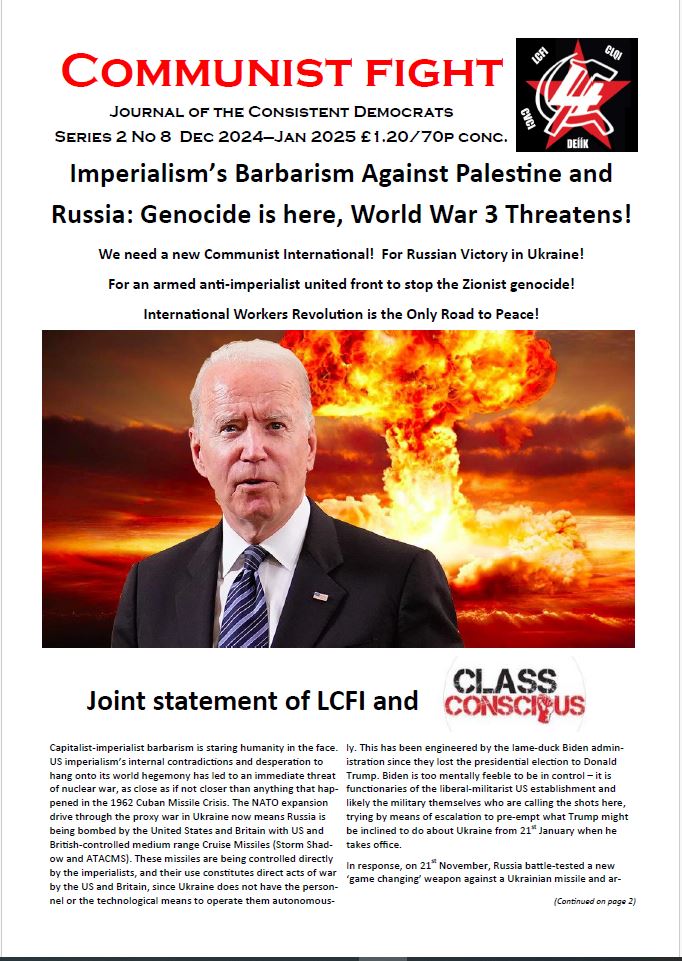
Communist Fight series 2: 11-12 – double issue – out now!

This is a special double issue of Communist Fight. We won’t be doing this often, but the reason for this is that this issue contains a major document on China, which elaborates why our international tendency, the Liaison Committee for the Fourth International, have changed our position on the class nature of China. Notwithstanding its large capitalist sector, which is subordinate to the central state power, we consider that China remains a deformed workers state. In that sense, we see it as fundamentally different from Russia, where capitalist restoration took place after the catastrophic collapse of proletarian state power after August 1991, which was followed by the even more catastrophic neoliberal economic shock imposed by Yeltsin with his Western advisers.

In our most recent statements since the beginning of Russia’s 2022 defensive Special Military Operation in Ukraine, we noted that capitalism in Russia is fundamentally weak, not so much vis-a-vis imperialism, but in the face of the legacy of three quarters of a century of post-capitalist economic development under the USSR, which was destroyed by counterrevolution in 1991. Yeltsin’s eclipse and the rise of Putin represented elements of the shattered state apparatus partly reconstituting and asserting power over the new capitalism. The form of capitalism that emerged in Russia after 1991 was unable to escape massive deformations that derived from its main productive forces and material assets being created under the dictatorship of the proletariat, the harbinger of a higher mode of production.

However, in China, the main state apparatus was never shattered, nor did anything like the Yeltsin shock happen. The Chinese bureaucracy’s alliance with US imperialism against the USSR led to China not being particularly targeted for the kind of military pressure and economic warfare that caused the USSR to implode. Rather, as imperialist capitalism went into its phase of neoliberal globalisation, the large-scale outsourcing of industry from the imperialist countries to lower wage countries became a major phenomenon. Ironically, this benefitted China enormously, and because the central state was still intact, it was able to take advantage of this phenomenon, with its large-scale capitalist investment, leading to a massive rise in China’s productive capacity.  This phenomenon did not just assist a nascent capitalist class in China, it also strengthened the material power of the workers state itself. Without a conscious revolutionary purpose – far from it! – the effect was to fuse the higher elements of imperialist technological advance with a state that still embodies nascent elements of a higher mode of production.

The Bolsheviks under Lenin attempted something analogous with the 1921 NEP, acknowledging that the backwardness of Russia put the proletarian dictatorship in acute danger, and seeking through allowing a significant controlled capitalist element to operate within the workers’ state, to bring about an expansion of the productive forces. For them this was linked to a programme of world revolution. The Chinese Communist Party has no such programme – very far from it. But the impact of this was to lead to a major growth of the productive forces in a deformed workers state that was still basically intact at the same time as imperialist capitalist powers were divesting themselves of much of their domestic industrial power in search of greater profits, reacting to the continuation into the late 20th and then 21st centuries of the tendency Marx noted of the falling rate of profit under capitalism.

This has created another paradoxical situation where world imperialism has become to a degree dependent on a powerful economy which, even though it has a powerful capitalist sector, is basically post-capitalist in its central core. There are huge contradictions within the Chinese deformed workers state, but there are also huge problems for imperialism in this, and both the phenomenon of Trumpism, with its renewed Cold War hysteria against China, and its evident inability to handle China, with the tariff wars, demonstrate imperialism’s own problems. The article concludes by pointing out the complete lack of proletarian internationalism of the CCP leadership, and the need for a rebirth of Bolshevism in a new, and very different world context.

The lead article in this issue chronicles the reactionary viciousness of Starmer’s regime here – its attacks on the most vulnerable sections of the working class, including the disabled and the retired, literally taking from these to finance genocidal imperialist atrocities in Palestine and Ukraine. It chronicles the government’s flagrant attacks on democratic rights, particularly of those protesting the holocaust in Palestine, and the rapid collapse of its political authority, quicker than that of any government in living memory. It noted how discontent is being misdirected though support to the right-wing populist Reform party, but we went to press before Starmer made his ‘island of strangers’ speech echoing Enoch Powell to pander to Reform supporters with anti-migrant bigotry.

We also have an account of some recent problems and conflicts within the Socialist Labour Network, which we are heavily involved in, and the emergence of differences centring on Zionism, culminating in a strange All Members Meeting in April, in which an attempt by our comrades to initiate a campaign against the IHRA pseudo-definition of anti-Semitism was met with a determined, and initially successful, manoeuvre to overrule and dilute the critique we proposed, by one individual, amid spurious allegations of anti-Semitism against ourselves from that individual. This proved to be a pyrrhic victory however, and the individual who insisted on these changes walked away from the SLN when he realised that he had not really won the argument and that we intended to continue to argue for a correct position. During these discussions, the comrade concerned launched an attack on David Miller, the left-wing academic unlawfully sacked by Bristol University, which evidently had the two-fold purpose of reviving the public witchhunt against David Miller for supposed anti-Semitism, thus playing into Zionist hands, and using this as a factional weapon within the SLN. We initiated a statement defending David Miller against this new witchhunting attack, which gathered some prominent endorsements – this is reproduced in this issue also.

We reproduce in this issue the May Day statement signed by the LCFI and ClassConscious this year, which also contains analysis of the international situation as well as brief analyses of the domestic conjunctures in Argentina, Australia, Brazil, Britain and the US. And a short article by a CD comrade examining the role of the US military (Military-Industrial Complex) in enmeshing much of humanity in debt and endless imperialist wars.

Escalation of the India-Pakistan conflict

Hindustan, the new global front for the siege of anti-imperialist resistance

By Chritian Romero, TMB – Argentina

The escalation of the conflict between India and Pakistan took a leap forward after the pro-US, neo-fascist, and Islamophobic Modi government cut off water supplies to Pakistan (India froze its participation in the Indus Water Treaty, a measure that could have humanitarian consequences for Pakistan, a country highly dependent on that water resource) via its management of the Indus River’s hydraulic system.

Modi’s neo-fascist BJP government needs to sustain itself by leveraging anti-Pakistani Islamophobia and xenophobia, as well as the territorial conflict with the People’s Republic of China.

As a comrade from the National Democratic People’s Front of India points out in this context,

“The conflict between India and Pakistan is centered on the Bihar Assembly elections. It seems the BJP needs a community atmosphere to win.The Bhartiya Janta Party wants to win the Assembly elections in Bihar. Therefore, the BJP and the RSS could take charge of the mass campaign.

“It is important to note in the pro-imperialist role that the Islamophobic Modi government has, the support it has from Zionism”In the first reaction of the Zionist regime to the military confrontations between India and Pakistan, the Israeli ambassador sided with New Delhi and accused Islamabad of “supporting terrorism”

https://www.resumenlatinoamericano.org/2025/05/07/internacional-contrario-al-mundo-israel-apoya-ataques-de-india-a-pakistan/

“The solidarity between Zionism and Hindutva [fascist ideology of Hindu “purism”, xenophobic against the Muslim population of India and all minorities] is not metaphorical. It is material. India is now one of the largest buyers of arms from Israel. Surveillance systems perfected in the West Bank now monitor neighborhoods in Kashmir. The Israeli drones that terrorize the skies of Gaza are being sold to India to monitor unrest in Muslim-majority regions. The exchange is not limited to weapons, but to ideology, strategy, and impunity. https://www.resumenlatinoamericano.org/2025/05/07/palestina-de-gaza-a-cachemira-el-ataque-de-la-india-a-pakistan-es-sacado-directamente-del-manual-israeli/

On April 22 in the town of Pahalgam, in Kashmir. An explosive device was detonated, whose authorship was attributed to the Resistance Front (TRF) group, linked to the Lashkar-e-Taiba organization. The Modi government, without presenting evidence, denounced the Pakistani intelligence services of being behind the attack.

On May 6, the Indian government launched the so-called “Operation Sindoor,” justifying the offensive as a targeted counter-terrorism action aimed at dismantling Pakistani logistical centers as a way to neutralize possible relevant Pakistani responses to Indian attacks.

Official sources in Islamabad confirmed that the Pakistani Armed Forces had carried out retaliatory attacks against Indian military installations in the Jammu and Kashmir region. The offensive, which reportedly included airstrikes targeting an airbase in Srinagar, was reportedly a direct response to the recent “Operation Sindoor” launched by India.

According to preliminary reports released by media outlets linked to the Pakistani government and regional security sources, the retaliation also reportedly resulted in the downing of at least two Indian combat aircraft, although these claims have not yet been independently verified. The exchange of fire came just hours after New Delhi confirmed a series of missile attacks targeting nine targets in Pakistani territory.

In a new escalation of warfare between two nuclear powers, India launched a series of missiles at multiple targets in Pakistani territory early on Wednesday morning, May 7. Hours after the bombing, the Pakistani government declared a state of emergency in the affected region and activated its air defense systems. Prime Minister Shehbaz Sharif publicly stated that “a robust response is underway” and that the country “reserves the right to respond at the time and place it deems appropriate.”

In this context, Islamabad claimed to have shot down five Indian fighter jets . However, there was no confirmation from India regarding these losses, although local media reported that three aircraft crashed in different areas of Indian territory, including Punjab and Kashmir.With over 1.6 billion people between both nations, the Hindustan subcontinent is the geographical region that comprises most of historical India , currently divided between the states of India , Pakistan ,  Bangladesh , Nepal and Bhutan . [1] For cultural and geographical reasons, the island states of Sri Lanka and the Maldives are also considered part of the subcontinent . Together, the Hindustan subcontinent (of which India and Pakistan are the largest countries) covers around 25% of the world’s population, denoting how key the current situation in Hindustan is to the situation of the global class struggle.

Today, Pakistan is a fundamental ally of China, the siege against Pakistan must be seen in the siege that US imperialism and Zionism are building against countries that can put up a relevant resistance against imperialism itself. Israel’s advances in Lebanon and Syria meant imperialist advances in the dynamics of weakening Iran and leaving it without allies. The formation of the anti-China America between the United States and Japan aims to besiege China on its Pacific coast. The Ukrainian fronts of the Western imperialist powers as a whole serve to weaken Russia. Now, the attack on a Chinese ally like Pakistan, to which must be added the issue of the Sela Tunnel as a directly territorial offensive against the Chinese workers’ state, where Modi’s neo-fascism enjoys the explicit support of US imperialism.

Regarding everything else, it is proven that without the formation of a global front of resistance to imperialism, and if China continues to maintain its political-military “isolationism” in the face of attacks on centers of resistance to imperialism, including the “shot in the foot” that would mean a defeat for Pakistan as a military ally of China while also being on its borders. Also on China’s border is the Indian province of Kashmir, with a majority Muslim population, and along it, Modi’s Islamophobia is advancing.

Both India and Pakistan are semi-colonial countries, so we are careful in our claims. We defend the Muslim population of the Indian province of Kashmir while also defending the territorial integrity of Pakistan and the Chinese workers’ state.

Nevertheless, we place these demands at the heart of the struggle for a federation of socialist republics of Hindustan, where the mobilization of the exploited masses of India’s countryside and cities will play a fundamental role. This mobilization must include the same role that exploited Indians who identify with Hinduism must play, defending the Muslim masses of India (and its minority populations) from Modi’s segregationist xenophobia.

For the defense of the Muslim population of Kashmir!

Against Modi’s Islamophobia!

For the defense of Pakistan’s territorial integrity!

Let China defend Pakistan’s territorial integrity!

For the formation of a global front of resistance to imperialism!

No to the encirclement of the Chinese workers’ state and its unconditional defense!

For the federation of socialist republics of Hindustan, as a fundamental part of the world revolution!

India-Pakistan: Down with the imperialist-driven war in Hindustan!

By Christian Romero, TMB – Argentina

For the unity of the Hindustani masses in an anti-imperialist front that stands united in defense of China on the path to building a socialist federation of Hindustan! Let us defend all the peoples who are targets of imperialist maneuvers, for the defense of the territorial integrity of Pakistan! No to Modi’s Islamophobia in India! For the rights of the people of Kashmir!

The Hindustan subcontinent is the geographic region comprising most of historical India , currently divided between the states of India , Pakistan , Bangladesh , Nepal , and Bhutan . [1] For cultural and geographic reasons, the island states of Sri Lanka and the Maldives are also considered part of the subcontinent . All of these countries are part of the South Asian Association for Regional Cooperation (SAARC ) . The Hindustan subcontinent was known for centuries as Hindustan and is equivalent to the territory that, until the demise of the British Raj in 1947, was known as “British India”. In total, the area of ​​the Indian subcontinent is about 4,480,000 km².

The Hindustan subcontinent is one of the most densely populated regions in the world. Over 1.6 billion (as of 2019) people, a quarter of the world’s population , live in the region. The population density of 350 people per square kilometer is seven times higher than the world average.

The current India-Pakistan conflict, originating from Kashmir and the border with the Chinese Workers’ State and Pakistan’s role in China’s alliance system.

Escalation of the conflict between India and Pakistan after the attack in the Indian province of Kashmir (please understand that here we refer to Kashmir as a province of India, there are also areas of so-called “classical” Kashmir that are now part of Pakistan and China). Kashmir, as a province of India, has an overwhelming majority of Muslims closely linked to Pakistan. The escalation of the conflict (it is worth noting that both India and Pakistan are nuclear states) has been going on since the Islamophobic Modi government accused Pakistan of the attack without evidence, as there have now been calls for the withdrawal of diplomatic corps by both countries, toughening of anti-immigrant measures by the Modi government itself and conflicts generated by India over the joint management of the Indus River water system. In the Indian province of Kashmir, opposition groups are active against New Delhi, including separatists or those seeking unification with Pakistan. The Indian province of Kashmir has a population of 13 million and borders China.

The border between Kashmir and China and that between Pakistan and China itself, forces us to observe the current state of relations between Pakistan and China (since the second half of the 20th century they have historically been allies, but this has been a process of ups and downs, especially in recent decades). In short, it would be necessary to observe whether, behind this escalation against the Muslim majority in Kashmir and the siege of Pakistan, there is not, in essence, a maneuver by imperialism for a relatively “indirect” approach (for offensive military purposes) against China; the Modi government in India, at the level of its geostrategic deployment in the Indo-Pacific, has already demonstrated its pro-American orientation.

Defending the Muslim population of Kashmir – the vast majority – from the Islamophobia of the pro-imperialist Modi government, we must take a stand against Pakistan, China’s role in the region and, as a strategic objective, call for a socialist federation of Hindustan – the Hindustani subcontinent – of which India and Pakistan are the main countries – together they concentrate 25% of the world’s population by 2024, that is, we are facing a fundamental issue from the point of view of the international situation.

In the specific case of Pakistan, it is important to highlight that, despite being a nuclear state, Pakistan also borders Iran to the southwest. Iran is currently facing an increasing siege by American-Zionist imperialism, whose goal is to eliminate any space for independence for Iran itself.

To highlight how the threat of attack on Pakistan is also part of a (for now) “indirect” approach against the Chinese workers’ state, it is necessary to highlight Pakistan’s role as part of China’s alliance system, which plays a central role because it is on China’s very border and therefore on the front line (for or against) China.

As part of this, the following military ties between China and Pakistan can be noted.

By 2025, military cooperation between China and Pakistan will continue, with a focus on joint exercises, technology transfer and naval capacity development. Joint counter-terrorism exercises such as Warrior VIII have been conducted, and joint submarine construction programs are underway.  

Details of military cooperation:

Joint exercises: The Chinese and Pakistani militaries conduct joint exercises, such as the “Warrior VIII,” to enhance military cooperation and assess operational capabilities.

Technology transfer: China supports Pakistan in developing its nuclear program and acquiring military technology.

Naval cooperation: Pakistan and China are working together to build Hangor-class submarines.

Participation in multinational exercises: Pakistan organizes multinational naval exercises, such as the AMAN, in which China participates, demonstrating its commitment to regional maritime security.

Naval cooperation: Pakistan and China are working together to build Hangor-class submarines.

Participation in multinational exercises: Pakistan organizes multinational naval exercises, such as the AMAN, in which China participates, demonstrating its commitment to regional maritime security.

Information exchange and training: Exchanges between the People’s Liberation Army of China and the Pakistani Army include participation in international military competitions, such as the “Pakistan Army Team Spirit.”

Strengthening strategic communication: Both sides have agreed to strengthen strategic communication to enhance mutual understanding.

State visits: High-level visits, such as the visit of the President of Pakistan to China in February 2025, strengthen diplomatic and economic ties and cooperation in areas such as defense and security.

The siege of China is growing in Hindustan on several fronts

As part of the siege that is being built against China (also from Hindustan), it is important to highlight that not only are the maneuvers against Pakistan intensifying, but also that, for now, in an incipient way, the territorial points of conflict against China itself, currently led by the pro-American and xenophobic government of Modi, are growing.

In this sense, it is worth highlighting the case of the Sela Tunnel, where the United States has explicitly supported India and, in addition, China’s diplomatic maneuvers to try to “calm down” the issue (part of the Chinese Communist Party’s policy of trying to delay as much as possible the progression of a conflict with imperialism), which is ultimately weakening China itself, not only in its alliance system, but, as the case of the Sela Tunnel demonstrates, is already beginning to threaten China’s own territorial integrity.

As of 2025, there are no reports of a specific conflict related to the Sela Tunnel between China and India. However, the construction of this tunnel in the Himalayas, which facilitates access to the disputed border, has exacerbated pre-existing tensions between the two countries. The border dispute, which includes the Line of Actual Control (LAC), remains a point of contention, and the Sela Tunnel has become a new flashpoint.

Sela Tunnel and border tensions:

The Sela Tunnel: The tunnel, built in the state of Arunachal Pradesh, has been interpreted by China as a move to complicate the border dispute.

Arunachal Pradesh: China claims Arunachal Pradesh as its territory and calls it “Zangnan”, while India considers it part of its territory.

LAC: The Line of Actual Control (LAC) is the de facto border between China and India, but there is no agreement on the actual boundary, leading to territorial disputes.

Position: China has criticized the construction of the tunnel and Prime Minister Modi’s visit to Arunachal Pradesh, accusing India of complicating the border situation.

Tensions: The construction of the Sela Tunnel and Modi’s visit have increased tension between the two countries, despite diplomatic efforts to ease the friction.

United States: The United States has recognized Arunachal Pradesh as Indian territory and rejects Chinese claims to the region.

Border Patrol Agreement: In 2024, a border patrol agreement was signed between India and China, which restored patrol rights in the Depsang Plains and Demchok region.

China’s conciliatory diplomacy, rather than publicly denouncing US imperialist interference in the conflict, sought formal agreements with India, which unsurprisingly did not deter Modi’s provocations. In this regard, China sought to ensure that both sides abide by the agreement to resume patrol operations in the Ladakh region.

In short, the construction of the Sela Tunnel and Modi’s visit to Arunachal Pradesh have exacerbated border tensions between India and China, although efforts have been made to resume cooperation through agreements such as border patrol.

In the face of the current India-Pakistan conflict, the following demands can be put forward immediately:

1) The defense of the territorial integrity of Pakistan against any pro-imperialist attack from any area. 2) The defense of the Chinese workers’ state against any attempt at encirclement by China, as well as the defense of the territorial integrity of the workers’ state. 3) The demands related to the principle of nationalities must in any sense be aimed at defending the Muslim majority in Kashmir, its national rights (which may include broad autonomy within India, independence, union with Pakistan, etc.), insofar as it does not become an imperialist enclave. It must be made clear that the principle of nationalities is subordinate to the struggle against imperialism. Contexts such as the case of Kosovo in the Balkans are very explicit in the sense that the claim to the principle of nationalities must not serve under any circumstances to favor imperialist expansion or generate new oppressions. 3) The role of the Hindustan subcontinent (of which India and Pakistan are the largest) concentrates together 25% of the world’s population and therefore everything that happens in Hindustan will have a global impact. Finally, the strategic orientation of a socialist federation of Hindustan, which, given the decisive role that Hindustan plays in proportion to all humanity, this socialist federation could well be the trigger for the world revolution.

Modi and xenophobia, drift to the right, paramilitaries and pro-imperialism, political representation of a bourgeoisie based on crony capitalism that finds its role as a junior partner of imperialism in Hindustan and the ultra-right drift as a way to extend its accumulation based on obscurantism and economic concentration, taking control of the state machinery.

Narendra Damodardas Modi [a] ????(born 17 September 1950) [b] is an Indian politician who has served as the Prime Minister of India since 2014. Modi was Chief Minister of Gujarat (the fifth largest state in India and bordering Pakistan)

from 2001 to 2014 and is the MP for Varanasi . He is a member of the Bharatiya Janata Party (BJP) and the Rashtriya Swayamsevak Sangh (RSS), an organisation composed of xenophobic far-right Hindu members.

In May 2014, Narendra Modi, a member of the Bharatiya Janata Party (BJP), won the national election in India, becoming the new Prime Minister. Thus, after 66 years of independent existence in the country, a separate grouping of the Indian National Congress Party (INC) emerged.

The Modi government in Guayaquil is a testing ground and springboard for xenophobia and anti-Muslim pogroms.

In Gujarat, Modi has built a political system based on four complementary pillars. He became the Hindu Hriday Samrat (Emperor of Hindu Hearts) after an anti-Muslim pogrom occurred less than six months after he took office. The violence, which resulted in the deaths of around 2,000 people, was triggered by an attack on Hindu nationalists—attributed to local Muslims—on a train at Godhra station. Modi not only allowed the armed wing of the RSS—starting with the Bajrang Dal 5 thugs —to carry out bloody retaliatory operations, but also seized the opportunity to test a new political repertoire, having prematurely dissolved the State Assembly to hold regional elections in a highly unusual context. During the autumn 2002 election campaign, Modi effectively imposed a national-populist style that only Bal Thackeray, the leader of neighboring Maharashtra, had promoted, also with a xenophobic logic, as reflected in his repeated attacks on Islamists, and even on Muslims in general and neighboring Pakistan, accused of being behind the so-called “jihadist attacks” of which Gujarat was allegedly a victim. Modi established himself as the tribune of the Hindus of Gujarat, a favorite theme that became one of his trademarks and made him the “emperor of Hindu hearts.”

The crony capitalism implemented by Modi in Gujarat in the 2010s has taken on a new dimension since he assumed the post of prime minister. That only a handful of businessmen benefited from this political economy at the state level was already remarkable, but to transpose this “model” to the national level is truly extraordinary, even more so when the winners are practically the same. Particularly notable is the central figure of Gautam Adani, who became the owner of several ports and airports privatized by the Modi government. These oligarchs continue to fund the BJP’s election campaigns, notably through a new electoral bond system that allows donors to remain anonymous. https://nuso.org/articulo/307-narendra-modi/

Modi’s Hindu xenophobia continues to herald the replacement of Muslims (and even Christians) with the status of second-class citizens. This process is the result, first of all, of the maneuvers of vigilante organizations, which act as a veritable cultural police on the streets and on university campuses to prevent, manu militari, young Muslims from visiting young Hindus (in the name of their fight against what they call the “love jihad,” an operation that Islamophobic xenophobia would present as a “seduction” aimed at converting Hindu women to Islam). They also fight the “land jihad” to discourage Muslims from buying or occupying houses in Hindu-majority neighborhoods—a veritable process of ghettoization. Worse still, in the name of protecting the cow, the sacred animal par excellence in Hinduism, vigilantes persecute—and even lynch—Muslim cattle herders who transport cattle. Indian secularism is being undermined not only by these practices but also by legal reforms, as reflected in the Citizenship Amendment Act of 2019, which reserves access to Indian citizenship for non-Muslim refugees from Bangladesh, Afghanistan, and Pakistan. In addition, many BJP-ruled states have passed laws that make interfaith marriages and conversions very difficult.

In this regard, the masses of India, including those who identify as Hindus, who play a key role, must unite their struggle for their demands as exploited peoples in the countryside and in the city with the defense of the rights of the Muslim masses of India, as well as of all religious minorities.

US imperialism, in its Trumpist form, sees Modi as a fundamentally important ally.

Vice President J.D. Vance made a four-day, largely personal visit to India last week with his wife, the daughter of Indian immigrants, and their three children; he used the opportunity to discuss trade issues between India and the United States .

He said on Tuesday, April 22, that the United States wants to sell more energy and defense equipment to India to strengthen ties, repeatedly praising Prime Minister Narendra Modi during talks on progress on a trade deal.

The remarks come as India seeks a quick trade deal with the United States , its largest trading partner, before the end of a 90-day pause on high tariffs announced by the Trump administration.

 JD Vance eyes major business alliances in India

Visiting the northwestern Indian city of Jaipur, Vance praised what he called India’s vibrancy compared with the drabness of some Western nations, following U.S. President Donald Trump ‘s criticism of India’s high tariffs on cars, farm goods and other products.

The rebalancing of global trade due to Trump’s tariff measures “will yield enormous benefits for the people of India,” Vance said, as India seeks to position itself as a manufacturing base while China faces high U.S. tariffs.

“If India and the United States work together successfully, we will see a prosperous and peaceful 21st century… But I also believe that if we do not work together successfully, the 21st century could be a very dark time for all of humanity,” Vance told an audience of hundreds of students, businesspeople, government officials and politicians in Jaipur.

Given that both countries hold regular military exercises, he said it would be natural for India to buy more defense equipment from the United States, including Lockheed Martin’s F-35 LMT.N fighter jets.

“We want to work more closely together and have your nation buy more of our military equipment,” he said.

He noted that the United States is seeking to increase its energy exports to India and to help develop the country’s energy resources, such as its offshore natural gas deposits and strategic mineral reserves. He also emphasized that nuclear energy represents a key axis of cooperation between the two nations.

“Prime Minister Modi is a tough negotiator. He is very tough in his negotiations,” Vance said, drawing laughter from the audience.

Vance said he and Modi, who hosted his family for dinner at his home on Monday, had made significant progress in trade talks and confirmed that both sides had finalized terms of reference for the negotiations. For her part, India’s

Finance Minister Nirmala Sitharaman said Monday in San Francisco that India, the world’s fastest-growing major economy, expects to successfully conclude the first part of a trade pact by the fall. “This lays a roadmap for a final agreement between our nations,” he said. Relations between JD Vance and Modi are close. The Indian president even visited Vance’s family on his second son’s birthday while both leaders were in France for an artificial intelligence conference in February. “I think he’s a special person,” Vance said.

This renewed interest in the Trumpist-led faction of US imperialism in India should be read (also) in terms of the differences that US imperialism is currently having with its allies in the European Union regarding the direction of Trumpism, and hence the need to seek support from (global actors) for the direction of Trumpism outside the European Union itself.

The Indian bourgeoisie (which, in its current hegemonic position with the Islamophobic Modi government, aims to be a junior partner of US imperialism in the Hindustan subcontinent) seeks to profit from the trade war that Trumpism is waging against China. In this case, there is an opportunity for Indian suppliers of US multinationals, given the possibility of a Trump-led anti-China trade war.

In a very recent context, we have already seen such phenomena in the so-called information industries.

Although the US also imposed reciprocal tariffs of 26% on India, this measure was suspended for 90 days while the country tries to negotiate a bilateral trade agreement with the US. However, the universal US tariffs of 10% on Indian products have not been suspended.

Apple has revealed that it plans to move the assembly of all its iPhones sold in the US to India, according to the Financial Times. Currently, the company still assembles the majority of its iPhones in China. This could happen as early as next year, as the company tries to reduce its dependence on China in the wake of the current escalation of trade and tariff tensions between the US and China.

Some other Apple suppliers, such as Pegatron Technology India and Wistron, also have production facilities in India. However, given the size of the iPhone market in the US, Apple will likely need to further increase its investment in Indian manufacturing facilities to fully meet demand and reduce its dependence on China. https://es.euronews.com/business/2025/04/25/apple-plans-to-translate-to-india-el-ensamblaje-del-iphone-en-un-golpe-a-china

India as part of imperialism’s containment network against China

The ties that the pro-US bourgeoisie in India is building with American imperialism itself are not only economic, but also geostrategic, which must be seen in light of India’s role as a center of gravity in the Indian Ocean basin.

India is part of a military alliance driven by US imperialism, with its expansion towards Japan (Ameripon) and the participation of Australia, with the aim of forming part of an encirclement of China from the countries of the Indian Ocean basin, thus completing the encirclement that is being built against China today by Asia-Pacific imperialism.

The Infobae newspaper (which is known as the press of the US embassy in Argentina) refers to it explicitly in this way.

The US, Australia, India and Japan have reaffirmed their commitment to countering hostilities by the Chinese regime in the Indo-Pacific.

Foreign ministers of the Quad alliance have confirmed the organization of a leaders’ summit, which will be held this year in New Delhi and which could be one of Trump’s first international visits.

The new administration of US President Donald Trump has announced plans for a leaders’ summit in New Delhi this year, together with its partners in the Quad, a strategic alliance formed by Australia, Japan, India and the United States. 

This was confirmed on Tuesday by the foreign ministers of the four countries in a joint statement after a meeting in Washington.

“We look forward to advancing the work of the Quad in the coming months and will meet regularly as we prepare for the upcoming Quad Leaders’ Summit hosted by India,” the foreign ministers said in the statement, highlighting their commitment to strengthen cooperation in maritime, economic and technological security in the face of growing threats in the region, an implicit reference to China.

The meeting marks US Secretary of State Marco Rubio’s first meeting in his new role, just a day before Trump’s inauguration. https://www.infobae.com/estados-unidos/2025/01/22/eeuu-australia-india-y-japon-reafirmaron-su-compromiso-para-frenar-las-hostilidades-del-regimen-de-china-en-el-indopacifico/

As part of building an anti-imperialist front in India, the elementary demand for India’s break with the Quad must be taken up, which in its development not only aims to consolidate an anti-China military encirclement, but will also end up suffocating all vestiges of India’s independence, paving the way for Imperialism’s increasing control over India itself.

Both India and Pakistan are semi-colonial countries (although with a wide space of autonomy, as seen by the fact that they possess nuclear weapons); therefore, from a Marxist perspective, the strategic defeat of either of the two can never be advocated in a mutual confrontation. We can defend the territorial integrity of one of them when it is the target of attacks by pro-imperialist maneuvers, which may well be used by a pro-imperialist government in one of the semi-colonies in question.

The demands of Marxists in the face of the growing conflict in the Hindustani subcontinent include: 1) the defense of the Chinese workers’ state; 2) the role of the Hindustani subcontinent (of which India and Pakistan are the largest states), which together concentrate 25% of the world’s population and therefore everything that happens in Hindustan will have a global impact. In this sense, it is clear that we must emphasize the defense of the Muslim majority of Kashmir, its national rights (which could include autonomy within India, union with Pakistan, etc.) to the extent that it does not become an imperialist enclave or a platform for the expansion of imperialism; it must be clear that we subordinate the principle of nationalities to the struggle against imperialism. Contexts such as the case of Kosovo in the Balkans are very explicit in the sense that the claim to the principle of nationalities should not serve under any circumstances to favor imperialist expansion or generate new oppressions. Finally, the strategic orientation of a socialist federation of Hindustan, which, given the decisive role that Hindustan plays in proportion to all humanity, such a socialist federation could well be the trigger for the world revolution.

The struggle for all these demands must have as its fundamental actors the exploited and oppressed masses of the cities and the countryside of India, both those who consider themselves Hindus and those who are Muslims, and all minorities. Marxists must strive to unite all the exploited and oppressed of India under a program that, while opposing Modi’s xenophobic Islamophobia, does not use its own working masses as bait in a war engineered by imperialist interests using an ultra-right government. This is part of a task that plays a central role in the unity of the exploited and oppressed throughout Hindustan.

These demands must be accompanied by the hand of proletarian internationalism, promoting an international campaign that is linked to the campaigns against Islamophobia in the West (which today is a growing component of fascism in the West itself, just as before the end of the Second World War, hate campaigns against Jews were a component of Western fascism). This campaign of mobilization against Islamophobia can be strengthened by having as an important basis the set of campaigns that took place in Europe and the Americas against the genocide in Gaza and, in the case of the United Kingdom and the European Union, they must be seen as part of campaigns to defend an increasingly Muslim working class and the object of Islamophobic hatred on the part of its ruling classes. In the specific case of the United Kingdom, the growing role of the Muslim population in its working class must be added to that of immigrant minorities, largely from its former colonies, remembering that in the case of the population of Pakistani origin, it brings together both tendencies.

The defeat of imperialist maneuvers in the Hindustani subcontinent could well be a heavy defeat for imperialism, which, while aiming to strengthen the Chinese workers’ state, allows for an anti-imperialist unity of all the peoples of Hindustan and the motorization of a wave of solidarity against Islamophobia at the international level that would give a decisive boost to the reconstruction of proletarian internationalism, all as part of a struggle for a federation of socialist republics of Hindustan that would undoubtedly be a gigantic advance in the triumph of the world revolution.

CD Forum: China and the New Cold War

Below is a presentation given by a Consistent Democrats speaker at a Zoom forum on 4th May. The whole discussion is available as a podcast here.

In this period of neoliberalism, and the deindustrialisation of major imperialist powers, such as the US, or even not so major ones, like the UK, China has become known as the workshop of the world. A key part of the context of politics today, and the reason for the rise of such right-wing forces as Trumpism and Brexit with a working-class, or ex-working-class base, is this deindustrialisation. What has happened to the industrial jobs that used to provide the material base for strong working-class movements in the imperialist countries? They migrated overseas, to what appeared at first to be congenitally lower-income countries. China was possibly the classic case.

To understand how this became possible, we must look at the context of the Cold War since WWII. And in particular the Sino-Soviet split. In the early 1960s Mao’s China was perhaps more demonised than the USSR because of the ‘revolutionary’ rhetoric of its leadership. China was and is an enormous country, with the largest population of any in the world for most of that time, though it has recently been overtaken by India.

But the context in which the modern Chinese state was created was the Russian revolution, and then the bureaucratic degeneration of that revolution from the mid-1920s, when the bureaucracy by degrees took power away from the working class in a direct sense. The Chinese Communist Party originally was a classical Marxist organisation, led by an inexperienced but genuinely Leninist-Communist leadership around Chen Hu-Tsiu that based itself on the city proletariat in the great cities of China: Shanghai, Canton, Hong Kong, Wuhan for that matter.

However, the defeat of the Chinese revolution of 1925-7 happened in large measure because the CCP was instructed by the Comintern to carry out a long lived, unprincipled entry into the Kuomintang, the party of the national bourgeoisie. These were the instructions of the Stalin-Bukharin bloc in the Comintern, which was then dominant. It was a rightist position, based on political support for the national bourgeoisie as the agent of revolution – said to be in two stages – first the democratic revolution, led by the national bourgeoisie. Later there would be a socialist revolution. But the CCP had a mass working class base in those cities. The national bourgeoisie was far from keen on that – it was very afraid of it – and regarded it as more dangerous to its interests than imperialism or feudal warlords, etc. So, the Kuomintang conspired against the communists, notwithstanding the CCP’s policy. It aimed to crush that working class base, which the CCP politically disarmed. Chiang’s coup of April 1927, centred in Shanghai, smashed the communists and crushed the proletariat. There were similar purges by the Wuhan-based left wing of the Kuomintang in July. Then laid the basis for the  Canton commune in December 1927, a  bureaucratically-led workers uprising, an adventure, not prepared, not in tune with workers consciousness, and so a failure.

After these defeats of the CCP in 1925-7, the party left the cities, and sank roots into the peasantry instead, you had Mao’s long march, peasant-guerilla warfare, and as those forces began to take root, gave birth to a different type of party, based on peasant-based warfare, Maoist guerillaism. Trotsky raised the possibility that such peasant armies could come into conflict with the working class. This was a crucial issue much later, when the revolution was victorious, but it took forms that were difficult for anyone to anticipate at the time. The politics of the CCP were very much in the same mould as that of Stalin’s leadership of the USSR, which represented a conservative workers bureaucracy that had abandoned the goal of world revolution and sought ‘peaceful coexistence’ with imperialism to stave off dangers to the workers’ state.

The CCP based itself not on the proletariat in China’s cities, but on China’s enormous, impoverished and oppressed peasantry, and its struggle, initially aimed at national liberation and a bloc with the national bourgeoisie, with ‘socialism’ postponed until a later stage, was still a mighty struggle of the peasant masses.  The bureaucratic regime in the CCP and its armies resembled Stalin’s regime in the USSR. On taking power, it was confronted with the reality that the national bourgeoisie preferred the support of imperialism, and such a multi-class regime was impossible. This was demonstrated particularly in the counterrevolutionary war imperialism waged in neighbouring Korea, where the imperialists at one point threatened China itself.

So, the Chinese Communist Party’s bureaucratic regime, for its own self-preservation, was driven to unleash a fully-fledged social revolution, establishing a deformed workers state with a bureaucratic regime similar in many ways to that in the USSR under Stalin and his successors.  This social revolution made a huge leap in quality in relation to the evolution of production relations and for 40 years it struggled to develop the productive forces. In this period, it had to drain enormous resources from the peasantry to industrialise. It did not succeed. Until the 1980s China’s GDP was lower than Brazil’s.

It was only from the 1980s onwards that China began to be boosted by capitalist-imperialist investments. Because China’s break with the Soviet Union in the Cold War made the Chinese Communist Party appear relatively reliable for imperialism as an ally. So that it invested huge masses of capital to transplant the global production of commodities to China and make the country the “workshop of the world”. This was to take advantage of low labour costs for a literate working-class population. Objectively, this CCP policy was a pro-imperialist policy, and a treacherous one particularly in respect of imperialism’s war drive to destroy the USSR, which they did in time succeed in doing. However, it also had a paradoxical result, in that whereas the Soviet bloc was subjected to the massive economic shock treatment, that caused a massive economic decline in the USSR, whose driving force was a kind of Western-backed economic war against the recalcitrant bureaucracy in the USSR, China was basically left alone.

Indeed, imperialist investment and outsourcing provided it with material and productive resources, into a political and economic space within which the basic system of economic planning remained intact, notwithstanding Deng’s market ‘reforms’, which gave that basic structure the opportunity to massively upgrade its productive forces and material wealth at a time when the industrial capacity of imperialist countries were being outsourced and disposed of. This is a paradox. Deng’s market reforms did not go anywhere near as far as what Yelstin did in Russia, they did not dissolve the central state, and this is a decisive difference between them. Russia is not a workers’ state, though Putin has gone some way towards trying to reconstruct elements of the central state in Russia, he has only partially succeeded. That he was able to even do this, and that he was driven to do so at all, is an indication that the workers state, as a bearer and harbinger of a new and higher mode of production than capitalism, was not quite so easy to eliminate as the bourgeoisie hoped, and the Trotskyist movement feared. Even when the state ceased to exist, its higher production relations, even if they had been merely embryonic, were still able to deform its bourgeois successor.

A new bourgeois state was created in the former USSR as a result of 1991, the 1993 conflict over the parliament, Yeltsin’s tremendous and terrible economic shock, and Putin leading the retreat and re-armament of Russia to resist imperialist subjugation. But this did not and could not re-create the workers’ state. All it could do was massively modify the capitalism that came into being, fundamentally deforming it in that a mixed economy sui generis came into being. That is, one in which the statified element within it derives not merely from bourgeois nationalisation, but from elements of a higher mode of production – communism – that interpenetrates with it from the period where it was a workers’ state. But because in China the central state was never dissolved, we have a symmetrically opposite phenomenon – the capitalist elements are severe deformations on the still existing workers’ state.

We are not merely talking about the deformed workers state as it existed in the USSR under Stalin. Because after 1929, forced collectivisation put an end to NEP. NEP was an earlier policy of the Bolsheviks, that legalised to a limited degree, capitalist relations in the countryside in particular, in order to revive the economy of Soviet Russia after the civil war. In the lead-up to 1929, there was a conflict of the Trotskyists particularly with Bukharin over this. Bukharin, with Stalin’s support, had allowed NEP to go much further, and the NEPmen, capitalist traders, and particularly the wealthy peasants or Kulaks, had become much stronger. The Trotskyists warned of the danger of a revolt by these capitalist elements and advocated a planned industrialisation through taxation to reduce the weight of capitalist elements in the economy. They were denounced as ‘super-industrialisers’ by the Stalin-Bukharin bloc, as part of the campaign that defeated them.

But then there was a Kulak revolt against taxation, and against the Soviet state, which endangered the planned economy. The Stalin faction broke with Bukharin, and forcibly collectivised agriculture in response. The Trotskyists gave a degree of critical support to Stalin on this, because they viewed the Kulak revolt as an immediate threat of counterrevolution. Though they were harshly critical of the manner and some of the objectives of forced collectivisation, which was not based on any mass mobilisation. Remember though that the original motive of NEP was to use capitalism in a controlled manner to expand the productive forces. Remember also that the chief cause of the degeneration of the Russian revolution was the isolation of that revolution in a state with chronically underdeveloped productive forces. What appears to have happened in China is the result of a different situation. We now have a serious development of the productive forces in China. Deepseek is a prime example, but there is much more.

The development of China has kept the central state intact, in contradiction to what happened in the USSR. And imperialist investment, going hand in hand with the deindustrialisation of the West, gifted the Chinese state the opportunity to develop the productive forces in such a way. It’s as if what has happened in China is an extended version of NEP, which has created a situation where a workers’ state, with a large capitalist or NEPman sector to be sure, has developed the productive forces far beyond what was possible in the period of the degeneration of the USSR. It has even created a situation where parts of imperialism have become to a degree economically dependent on China, which for all its large layer of billionaire NEPmen, still at its core has a post capitalist state apparatus. It also has productive forces that in some spheres are more advanced than that of US imperialism. It is on the verge of having greater economic power than US imperialism also. For all its powerful NEPman/capitalist sector, the driving force that has propelled it to that position is not capitalism itself, but a capitalism supervised by economic planning at a basic level.

This in part is what was the idea of NEP. However, it is a paradox that the decline of capitalism in the early 21st century has meant that a power where a form of the dictatorship of the proletariat remained intact, has gained access to advanced productive forces comparable with the most advanced capitalism, in such a manner that appears self-sustaining. Such things as its Belt and Road initiative, which is about building infrastructure for global South countries, and thereby increasing its political influence by helping those countries traditionally victimised by imperialism find additional resources to resist. This is the cause of the Trumpian hysteria over China. This was not supposed to happen. This basically is why the US has allowed a regime of tariffs and economic nationalism to come to power. And yet it looks like it is going to fail.

Yet the CCP has nothing like an internationalist leadership. Its attitude to the foulest imperialist atrocity of our time, the Zionist genocide in Gaza, for instance, is purely a diplomatic opposition. A genuinely, communist leadership would have a very different approach, actively seeking to mobilise mass working class movements, and on top of that, resources, to aid the struggle against the genocide. The tepid policy of the Chinese workers state is massively different from that. Yet logically, the Chinese Communist Party ought to be open to a degree of debate over this. China has huge productive resources and is not in a state of fear of imminent collapse as Stalin’s USSR was in 1930s, when it treated criticism from its left as akin to pro-fascist opposition. An important danger to the workers state comes from the NEPman billionaire layer, whose role needs to be understood dialectically. In a sense, it is both the state planned core of the economy and the NEP that have combined to develop China economically and lift hundreds of millions out of poverty. Economic growth in China has not led to a massive growth in inequality as has neoliberalism in the West.

But at the same time, the NEPmen billionaires do potentially endanger that, as is shown in the West, ultimately profiteering classes do not take kindly to limits on their profiteering and will seek to remove obstacles to that. And while Chinese development has not led to the impoverishment of the masses, still the growth of such a billionaire class even though through state-supervised exploitation, is an affront to the aspirations of communism. Thus, there are minority trends in and around the CCP that look back to Mao for inspiration. But Mao was also an isolationist, nationalist figure, for all his radical rhetoric at times, whose influence also led to the alliance of China with the US against the USSR. Although that may have had paradoxical results, this was hardly the plan. It is still an affront to working class unity against imperialism. So, the CCP left, present and future, needs something better to crystallise around. Something that stands in the tradition of the Bolsheviks, of Lenin, Trotsky and Chen Hu-Tsiu, that sees the international working-class movement as its central focus programmatically. China needs to see a rebirth of workers democracy and genuine Soviet power.

The evolution of our position on Russia and China has been uneven, and we all have come from traditions of Western “Trotskyism” that have been to a degree flawed, and even tending towards centrism. In 2023 we modified our understanding of Russia, rejecting our previous position that counterrevolution had made Russia into a highly developed mere semi-colony. The initial position that we had, sort of inherited from trends within “Trotskyism” too much influenced by a strategic affinity to British Labourism, tended to see Russia and China as fundamentally similar, as ex-workers states morphed into semi-colonies. The merit of this is that we at least called for their defence against imperialism. However, its defect was that it could not really explain what drove the imperialist hostility to Russia and China that drove the new Cold War of the 20-teens, particularly regarding NATO expansion.

In 2023 we modified our understanding of both Russia and China, rejecting the notion that they were mere semi-colonies, in favour of the understanding that the power of these states, their ability to stand up to imperialism, derived from deformations on the post-Soviet forms of capitalism, derived from the weakness of the capitalism that had been restored given that their productive forces were created under the embryonic manifestations of a higher mode or production, communism. This explained a lot, but while it was correct about Russia, and the basis for principles and effective defencism, it was still unsatisfactory about China. Because while they are clearly closely allied, they are not the same. As elaborated above, the central state in China remained intact, and there was no neoliberal shock to break economic planning. So, we have been discussing and correcting our position for several months now, and this change is the result. We hope this will provide food for thought and discussion anyway.

May Day Greetings 2025

The undersigned revolutionary Marxist tendencies and groups extend May Day Greetings to all communists, socialists, class conscious workers, anti-imperialists and partisans of the oppressed around the world.

Protesters demand freedom for Mahmoud Khalil, Algerian student at Columbia University, New York, with Green Card (Permanent Residency) seized for deportation by Trump regime for protesting Gaza genocide.
 

This May Day the world faces the accelerated decline of US imperialism under the Trump administration. The change in US strategy with the end of the Biden administration has caused a significant rift with the US’s European NATO allies, centrally Britain, France and Germany, who have threatened, very unconvincingly, to continue arming Zelensky’s regime in place of the US and even sending troops into Ukraine themselves, trying feebly to pressure the Trump administration, which is not remotely interested, to agree to this. The European Union and Britain is in considerable crisis and turmoil over Ukraine. The EU powers-that-be regard Trump’s strategic shift over Ukraine as the most disastrous change since WWII.

At the same time, Trump is stepping up US support for Israel’s genocide and escalation in West Asia/the Middle East. Trump was helped to take office again by the Zionists, and in return they expect help to exterminate the Palestinians, advance into the West Bank, destroy those who try to stop them, such as Iran, Yemen and Hezbollah, and even continue with the Greater Israel project, with expansion into post-Assad Syria, ruled by ISIS.

Nearby, between Iran and China, Trump is provoking the appetites of the Indian bourgeoisie, encouraging the rekindling of the conflict with Pakistan, in addition to transferring some US multinational factories from China to India.

The overall situation is accelerating the decline of the US. In this context, we see the vacillating tariff war, which supposedly aims to pave the way for the reindustrialization of the United States, but has already caused losses of several trillion dollars to US capital. The withdrawal from Ukraine has been offset by threats to extend US power in the Western Hemisphere/Americas and things like the annexation of Greenland and Canada.

But beyond the oppressed countries and allies, arguably the main target is China, the giant deformed workers state whose growth in productive capacity is now outpacing the West. This has already created a situation where there is a degree of economic dependence of the West on the advanced productive capacities of China for much in the sphere of electronics, among other things. Even though China is not led by anything like an internationalist, communist leadership, its planned and regimented form of capitalisation contradicts capitalist logic and means that it is at least incipiently stronger economically than the West.

We now go to the national groups for analysis of the situations of those countries on their domestic terrain:

Argentina

Milei’s neo-fascist government is increasingly unleashing an attack on workers. The government justifies the policy of low wages to “contain” inflation, and unemployment is growing month by month. In the context of the exhaustion of the economic cycle of the Milei government, the IMF and other multilateral organizations came to the aid of the neo-fascist government. The debt contracted represents 61% of the loans granted by the international financial organization with all its creditors. The IMF and other multilateral organizations came to the aid of Milei’s government in the face of the exhaustion of the economic cycle of empowerment of the role of financial-speculative capital that originated it. In this context, Trumpism expressed support for Milei’s government, which has not (yet) disassociated itself from China. In essence, there were no new advances by China in Argentina. But there is the latent danger for imperialism that in a Post-Milei the government will be advanced by tendencies more inclined towards China. Behind the IMF loan to Argentina was pressure from Wall Street. The speculative capitals that will enter Argentina to do short-term financial business seek to withdraw before the economic situation becomes more unstable. Then the cost of that debt must be paid by the workers. In the immediate term, the Miel government begins to program the adjustments demanded by the IMF. To guarantee the payment of the debt in the coming months, the following are pointed out: the increase in electricity and gas rates, the pension adjustment that is coming, labour flexibility. In this he also attacks if he includes the so-called “tax reform”, that is, the unloading of the burden of taxes, even more, on popular consumption. Whatever the pace of the economic and political exhaustion of Milei’s government, whatever its duration, we cannot foresee. Workers must prepare to face the attacks that will come from a neo-fascist government that is eroding its base of support. They must take advantage of the difficulties and struggles with all sectors of capital that the crisis of that exhaustion itself will generate. This must be done with the orientation of building an independent tool of the working class so that the contexts of exhaustion and political and economic crises, of tendencies that are based on attacks on workers, can provide a way out that means an advance for the working class.

Australia

Australia will hold a Federal election only two days after May Day. The party of government, the Australian Labor Party (ALP) is a hollowed out social democratic party. The Liberal Party opposition is a conservative right-wing party that openly flirts with far-right politics. Both parties are united in their defence of imperialism and profits.

Trump’s return to power and the shift of the US to “America First” fascism is creating problems for Australia as a junior imperialist power. Its desire to continue profiting from economic ties with China but its reliance on the US to maintain imperialist control of the region are threatened. Such tensions can only deepen as the war drive against the rising Chinese workers state quickens.

Regardless of who wins the election the period ahead will be turbulent. The Australian ruling class anticipating deepening working class resistance to its agenda of war and austerity has utilised the massive Palestinian solidarity mobilisations to further its police state powers. The ruling class in its attack on the militant construction union (CFMEU) is signalling it expects industrial struggles to also deepen. The time ahead must be used urgently to build and bring closer together the small anti-imperialist communist forces that do exist to influence the struggles ahead. 

Britain

British imperialism plays a parasitic role, largely as a lackey of US imperialism. The Starmer Labour government was not created by any class polarisation but openly touted by the ruling class as a failsafe given the dysfunction of the Conservative Party, which came close to disintegration after Brexit. Both this and the previous government have been defined by NATO’s Ukraine proxy war, the Gaza genocide, and continued austerity. It is the antithesis of the left social democratic leadership of Jeremy Corbyn from 2015-2020, the product of a determined effort at destabilisation waged by the social-liberal (“Blairite”) wing and the powerful Zionist component, that destroyed Corbyn’s leadership. They engineered a severe election defeat in 2019. Starmer the remainer became a flag-waving Brexiter. He supported Zionism “without qualification”. In October 2023 he stated Israel had every right to starve Gazans of all fuel, power, food and water. Statmer won in July 2024 with a majority of 171. He made Labour ‘fit to govern’ for the ruling class but got fewer votes than Corbyn (33.8%), compared to 2019 (32.1%), and fewer actual votes, on a much lower turnout, only 60%, the lowest since 2001. A contingent of left-wing independents won seats – Jeremy Corbyn, and four independent Muslims critical over Gaza.

This hated government kept the Tories two-child benefit cap, attacked pensioners and the disabled with large-scale austerity attacks. It cut the Tories’ neoliberal bureaucracy in the National Health Service, but Labour’s privatisers are heavily invested in private healthcare themselves. Almost the first crisis it faced was a wave of far-right near-pogroms when a terrible murder of children was misrepresented as the work of a refugee. The regime supressed them using police, but it was the anti-racist left who mobilised a protest response that undercut the attempted pogroms. Since then, they waged further attacks on refugees and migrants. There has been an avalanche of attacks on democratic rights – on the Palestine Solidarity movement, and other causes, such as environmentalists, and arrests of those protesting disability cuts. There is the beginning of opposition in the labour movement, with threats of rebellion by MPs, and agitation in some trade unions. Conscription of young workers to fight in Ukraine is a possibility, though problematic due to the decrepit state of the British armed forces. The British section of the LCFI participates in initiatives, such as the Socialist Labour Network, aiming to crystallise a genuine working-class party.

Brazil

Brazil is the largest and most populous country in Latin America. It is a semi-colony associated with the BRICS, under permanent political siege by US imperialism, through the national financial oligarchy, as demonstrated by the coup d’état of 2016. Lula’s victory over Bolsonaro in the 2022 presidential elections was a great demonstration of the class consciousness of Brazilian workers and anti-fascist mobilization. It was a great surprise for those who no longer believed in the strength of the working class. But the conscious policy of the leadership of the PT and the Central Única dos Trabalhadores of depolarization and the non-mobilization of workers in the streets to crush and annul the Bolsonarist forces favors the return of the extreme right to government. Meanwhile, the Lula government, hated by imperialism and financial capital, continues to maintain policies of capital accumulation against the working class: privatizations, high interest rates, fiscal framework and indebtedness. In addition to the belief in the strategic alliance with the sectors of the dominant classes (broad front) for the achievement of some superficial reforms. This policy is isolating the Lula government, and disorganizing the workers, and strengthening it from the extreme right and capital.

Pressured by the fall in popularity, the government has been making important gestures such as the exemption from income tax for those who receive up to five thousand reais, a range in which 95% of the Brazilian working population is found. Also important was the massive demonstration of March 30, in São Paulo, against the amnesty for the coup plotters in order to reconquer the streets. But so far, they are only progressive spasmodic gestures that have not been reversed into a consistent policy and a new course for the government or the party. Bolsonaro and the military coup plotters have been made defendants in the Supreme Court and part of the financial capital is betting on the Governor of São Paulo, Tarcisio, or others to replace him more effectively against the workers. We defend the arrest and expropriation of all the coup plotters, of yesterday (1964-1985) and today (2016-2023) and, above all, of their bourgeois sponsors. If we do not continue with larger mobilizations against amnesty for the coup plotters

United States

Trump is leading a government of the most parasitic layers of American finance capital. The circle of billionaires tapped for the Trump administration is worth four thousand times more than the previous Biden cabinet.  At $383 billion this club holds more wealth than the combined gross product of 172 countries. Elon Musk, the world’s richest man, is overseeing the slashing of $1 trillion from the state budget by mass firing of federal workers, outlawing their collective bargaining rights, gutting essential social insurance benefits, and destroying entire government departments. The Trump regime is a billionaire oligarchy masquerading as a government.

Two things stand out:

1. The American political superstructure has been brought into alignment with the real social relations of property in the United States

2. This concentration of power within the state apparatus facilitates mobilization for a world war of imperialist aggression

Trump is in the process of overturning the basic norms of parliamentary democracy in order to concentrate all authority of the state in the executive branch. He is using the Enemy Aliens Act (1798) to construct a wartime presidential dictatorship during peacetime. By inventing an invasion at the Mexican border and signing a flood of ultra reactionary decrees he hopes to create enough fear and chaos to overwhelm and paralyze potential resistance before it can coalesce. Just three months after the inauguration the Trump regime has:

—kidnapped and deported to the CECOT terrorist confinement centre in San Salvador hundreds of undocumented immigrants

—Revoked the visas of over 300 Foreign students and abducted pro- Palestine campus activists and sent them into the dungeons of the US prison system

 —Arrested judges in their own courtrooms for aiding illegals

— Defunded universities for failure to suspend pro-Palestine students

The US has not witnessed such targeted state repression since the days of the FBI Cointelpro covert operation against the Black Panther Party in the 1960s. And that was done under the cover of darkness!

By refusing to obey the orders issued by the courts, including by the conservative Supreme Court, Trump has deliberately provoked a constitutional crisis. Scores of court orders remain unfulfilled as the executive branch is openly challenging the judiciary.

Despite the rampage of police state repression, outright gangsterism, and Trump’s challenge to judicial authority, the campaign to solidify dictatorial rule has not yet succeeded. The US is neither a fascist society, nor has Trump succeeded in imposing his personal dictatorship.

Despite appearances of unity there are sharp internal conflicts and divisions within the administration. There is a major conflict between the Wall Street faction and the tariff/MAGA faction. To prevent a sell off of US Treasury notes, hedge fund billionaire Scott Bessent, prevailed on Trump to rescind the tariffs. Similarly, when Federal Reserve Chair Jerome Powell refused to lower interest rates as Trump demanded, Wall Street made Trump back down, acting again through Treasury Secretary Bessent.

There has been no political opposition from the Democrats as a party. Although they lost the election to Trump by a margin of less than 2% the Democratic Party is playing the role of loyal opposition party. Even as Trump‘s approval ratings plunge the Democrats are accepting the conventional status of bipartisanship, passively waiting for the 2026 congressional elections. While its liberal and reformist base has shown itself ready and willing to fight, the party fears mobilizing its own activist supporters much more than it fears Trump.

The absence of official opposition from the liberals reflects the underlying unity of the two political parties of capitalism around the fundamental issue of war with China. The real division within the ruling class is over the best strategy to defeat China and regain the lost hegemony of American imperialism. One faction wants to tie Russia down by continuing the proxy war in Ukraine; the other wants to disengage from Ukraine to better attack China by both economic and military means. And they remain solidly united on unconditional support to the genocidal Zionist entity, and for increased aggression against Iran.

Since Trump’s return to the White House public support for the Dems has dropped to a record low, with only 29% of Americans viewing the party favorably. Yet millions of people, previously considered Democrats, have turned out for mass demonstrations in early April.  Outraged that their party has mounted no opposition to Trump’s agenda they’ve taken to the streets across the country. Reformist senator, Bernie Sanders, has drawn large crowds to his Fight the Oligarchy rallies, including over 30,000 last week in Denver, which he said is the largest turnout he has ever had. Sanders himself, In contrast to those at his rallies, will not tolerate any show of  support for the deportees, foreign students, or Palestinian solidarity. The contradiction between Sanders and his supporters came to a head at Coachella when a Palestinian flag was unfurled and he allowed police to remove the protestors. The crowd then erupted in chants of “Free, Free Palestine!” Now the Sanders tour is facing criticism from major Democratic Party politicians.

Another key sign of the pent up anger and outrage seeking expression appeared this week at the Coachella music festival when the hip-hop band, Knee Cap, brought thousands to their feet when they projected three screens:

“Israel is committing genocide against the Palestinian people”

 “It is being enabled by the US government who arm and fund Israel despite their war crimes”

“Fuck Israel. Free Palestine.”

During the performance, band member Mo Chara said: “The Irish not so long ago were persecuted at the hands of the Brits, but we were never bombed from the… skies with nowhere to go. The Palestinians have nowhere to go.”

The band led the audience in chants of: “Free, free Palestine”.

The Knee Cap video has since gone viral

The working class is not yet playing an independent role and remains tied to the trade union bureaucracy which has loudly supported Trump‘s protectionist tariffs. But as the tariffs spark layoffs in auto and steel, empty shelves and soaring prices appear at the grocery store, and fears of recession grow, pressure will mount on the trade union bureaucrats.

The expressions of opposition to the fascist agenda we have seen so far are of critical importance for showing that a collective will to resist is seeking an outlet. In the face of a Trump lead drive to fascism and war there can be neither room for reformist illusions, nor longing for a liberal saviour like Sanders. Resistance to the fascist danger requires the organized power of the working class acting in its own name.

The above is signed by the following tendences and groups.

Liaison Committee for the Fourth International, consisting of:

— Consistent Democrats (Great Britain)

— Emancipação Do Trabalho (Brazil)

Tendance Militante Bolchevique (Argentina)

ClassConscious.org (Australia and United States)

LCFI Declaration: China, a possible Advanced Nucleus of an International System of Transition from Capitalism to Socialism

“The relations between different nations depend on the extent to which each of them has developed its productive forces, the division of labor and internal exchange. This principle is generally recognized. But not only the relation of one nation to others, but also the whole internal structure of that same nation depends on the level of development of its production and its internal exchange. The extent to which the productive forces of a nation are developed is most clearly shown by the degree of development of the division of labour.”

(Karl Marx, The German Ideology, 1846).

Summary

  1. Introduction
  2. Overcoming the historical issue of productive backwardness
  3. The question of prices: overtaking in the international class struggle
  4. A workers’ state, on which the capitalist mode of production has become dependent
  5. A powerful combo for the transition: Developing forces and conquering the world market
  6. The national and international class struggle for prices, de-dollarization and tariff war
  7. The inequality that grows in the capitalist world, decreases in China
  8. “New imperialism”, “Weberian developmental state” and “State capitalism”
  9. A system in transition threatened by dangerous structural and geopolitical contradictions
  10. In defense of socialist internationalism!

1. Introduction

China is the world’s factory, it hegemonizes the world capitalist market, but, exceptionally, it is not controlled by the imperialist financial system, nor by the international monopolies, nor by the richest Chinese billionaires.

China is controlled by its state, which is controlled by the Chinese Communist Party (CCP). This second exceptionality ensures the existence of the first. Capital does not command the state or guide the economy because the state controlled by the communist party is the one that controls everything, to the detriment of and against capital. The state controls most companies, the financial system is dominated by state-owned banks, the land ownership system is largely dominated by local and municipal governments.

The following document will point out how the China of the 21st century has overcome several limitations of China, the Union of Soviet Socialist Republics (USSR) and the smaller transitional states created in the 20th century.    in the production of commodities, in internal exchange, with wage increases, the reduction of inequalities and misery, in the external exchange of these commodities, produced at a lower price and with greater technology than in competitors, achieving hegemony in the world market. However, this process occurred at the expense of a relative setback in the division of labor and privatizations that have been mediated and reversed in recent years by the incorporation of technologies in production, but still in coexistence with strenuous working hours.

On the geopolitical level, apart from a few diplomatic and formal protests, China does not show any trace of proletarian internationalism against the aggressions, sanctions and blockades carried out by the imperialist powers against oppressed nations and peoples.

This working day and this geopolitics, as well as a billionaire, growing and powerful bourgeois class, despite the flight of capital and capitalists in recent years, weaken China in the medium and long term in the confrontation with capitalism internally and extremely, and can compromise its evolution towards socialism.

2. Overcoming the historical issue of productive backwardness

China has been solving, on the basis of planned state control, the historical problem of the development of the productive forces. Contradictorily, the beginning of the resolution of this historical problem was given by the combination of two opposing global forces: on the one hand, world monopoly capital, through productive investments (industrial and technological) from the setting up of the Special Economic Zones, in 1979-80; on the other hand, the greatest planetary productive force united in a single nation, the Chinese proletariat, composed of one billion workers.

The question of the backwardness of the productive forces was a historical, chronic problem common to all workers’ states that emerged from socialist revolutions in the twentieth century, which occurred in backward, semi-colonial capitalist states or weaker links in the chain of capitalist-imperialist states, such as Russia. For this reason, the epigraph that opens this document, written by Marx, highlights: “The relations between different nations depend on the extent to which each of them has developed its productive forces, the division of labor and internal exchange” (Marx, German Ideology, 2007, p.89).

The Paris Commune, the first workers’ government in history during capitalism, which took place in 1871, was established for only two months, although in an advanced capitalist nation, which could therefore have the best possible conditions at the time for the development of the productive forces, did not constitute a workers’ state or seize economic power.  the Bank of France.

All human evolution is based on the development of the relations of production, of social life among men and of the evolution of the productive forces.

Relations of production are the social relations that are established in the process of production and in the distribution of that production, including the way in which the means of production are owned and how the labor force is organized and exploited. The evolution of relations lies in the overcoming or attenuation of the exploitation of man by man, which exists, for example, in the passage from slavery to capitalism in Brazil with the abolitionist revolution of 1888.

Productive forces in general are the means of production, they refer to the development of science, technological inventions, the division and combination of labor, the improvement of the means of communication, the creation of the world market, machinery, etc. However, from its gestation in the Paleolithic period to the agricultural revolution and all subsequent historical development, the productive forces in general depend on the productive force of human labor (the labor capacity of individuals). Therefore, “the main productive force [is] the human being himself” (Marx, Grundisse, 2011, p. 346). The evolution of the productive forces can be measured by the improvement of the living conditions of the human being.

The evolutionary dialectic between these two elements, relations of production of social life and productive forces, is what determines the mode of production. In other words: The combination of material production with the corresponding form of exchange constitutes the mode of production. And what is fundamental for us to understand at what moment in the historical process towards a developed communism we find ourselves.

For thousands of years, the primitive communist form of the relations of production, based on social labor, mediated man’s relationship with nature and transformed nature in general and human nature in particular. The genus Homo has existed for at least 1.5 million years. Class society, less than 10 thousand years ago. It was primitive communism that was responsible for the appearance of homo sapiens in the terrestrial fauna, approximately 300 thousand years ago, separating it from the other wild higher primates. Man is man only because of primitive communism, because of the relations of production developed by men among themselves in community to survive in nature.

It was very recently in the course of this evolution, with the evolution of the productive forces, that contradictorily the relations of production retreated from primitive communism to class society. This step backwards promoted other steps forward in the evolution of the productive forces and in the relations of production, from the original slave society to the current capitalism.

Trying to solve the problem of the backwardness of the productive forces, in 1917, Russia made a socialist revolution, made a huge leap in the evolution of the relations of production, but 4 years later, it had to take a step back in these relations of production to develop the productive forces, creating the New Economic Policy. Russian backwardness, attacked and sabotaged on all sides by world imperialism and Nazism, created by imperialism against communism and the USSR, prevented a further development of the productive forces. Be that as it may, the Russian experience was advanced for its time, or perhaps precocious.

In 1949, a powerful social revolution took place in China when the Chinese Communist Party (CCP)’s guerrilla armies took power and established a workers state, defeating the Kuomintang, the party of the national bourgeoisie, which was backed by US imperialism and its allies such as Britain. This took place in the broader context of the defeat of Nazi Germany and imperial Japan in the Second World War, which was both a war of self-defence by the USSR workers state agaisnt Hitler’s invasion of the USSR, and an inter-imperialist war between Germany/Italy/Japan and the US and its West European allies. At the end of the war, Soviet troops fought Japanese imperialism in Mongolia and Manchuria, and that helped create the context for the later victory of the CCP forces.

The politics of the CCP were very much in the same mould as that of Stalin’s leadership of the USSR, which represented a conservative workers bureaucracy that had abandoned the goal of world revolution, and sought ‘peaceful coexistence’ with imperialism to stave off dangers to the workers state. The CCP based itself not on the proletariat in China’s cities, but on China’s enormous, impoverished and oppressed peasantry, and its struggle, initially aimed at national liberation and a bloc with the national bourgeoisie, with ‘socialism’ postponed until a later stage, was still a mighty struggle of the peasant masses. The bureaucratic regime in the CCP and its armies resembled Stalin’s regime in the USSR. On taking power it was confronted with the reality that the national bourgeoisie preferred the support of imperialism, and such a multi-class regime was impossible. This was demonstrated particularly in the counterrevolutionary war imperialism waged in neighbouring Korea, where the imperialists at one point threatened China itself. So the Chinese Communist Party’s bureuacratic regime, for its own self-preservation, was driven to unleash a fully-fledged social revolution, establishing a deformed workers state with a bureaucratic regime similar in many ways to that in the USSR under Stalin and his successors.  

This social revolution made a huge leap in quality in relation to the evolution of production relations and for 40 years it struggled to develop the productive forces, in this period it had to drain enormous resources from the peasantry to industrialize, it did not succeed, until the 1980s China’s GDP was lower than Brazil’s. Then, it was only from the 1980s onwards that China began to be crossed by capitalist-imperialist investments, because China’s break with the Soviet Union made the Chinese Communist Party relatively reliable for imperialism so that it invested huge masses of capital to transplant the global production of commodities to China and make the country the “workshop of the world” as Lenin called England at the beginning of the twentieth century.  in his book “Imperialism,…” of 1916.

The development of the Chinese productive forces, with imperialism blowing in favor and no Nazi threat as the USSR saw in the superpowerful imperialist Germany in the hands of Hitler, and the flexibilization of the relations of production created in China ideal conditions for a new attempt at socialism, counting in its favor an incomparable abundance of the greatest productive force on the planet.  the factor of greatest creation of social wealth, the human labor force, which copied, studied and catapulted another productive force, technology. In these respects, China resumes the course and prospects of the socialist evolution of mankind towards a developed communism. Financialized and deindustrialized imperialism realized the danger only after three decades of investments and the 2008 crisis itself, which weakened it even more. Regardless of the singular characteristics or the comings and goings that world politics has had in the last 17 years, imperialism has recreated the Nazi monster to recover the lost hegemony in the market, in technology, in world politics and in the development of the productive forces, which the American neo-Nazi movement translates into Make American Great Again (MAGA).

But this attempt to stop the course of history came late and even if it came early, it is not possible to establish an end to history without liquidating the human species and also planetary nature.

This tariff war, a harbinger of military war, is only succeeding in isolating the United States of America (USA) from an economic point of view, which could weaken the United States at the beginning of a third world war. And this may even abort the third war, so damaging is the Trumpist tactic of making America great again. He will not reindustrialize the country, and in these almost 100 days in office, he is also ruining financial capitalism itself. Big Techs and Wall Street have lost 10 trillion dollars since February, between the bursting of the speculative bomb of Artificial Intelligence (AI) and the threats of tariffs, and have recovered by a merely speculative movement, four of these 10 trillion dollars with the suspension of tariffs for three months. But this is just another demonstration of the unstoppable condition of Chinese development, as Haway, BYD, DeepSeek, etc. have been.

The positive resolution of the problem of the development of the productive forces is only possible through the conscious mediation of the state’s planned control of this development, through reinvestment in research, the improvement of the living conditions of the working class, through the urbanization of society, the reduction of poverty and the increase of wages (in spite of the still strenuous working day),  of measures against arrests to reduce the costs of constant capital that in every capitalist environment generates the reduction of profit rates.

We suppose that, while the capitalist West becomes even more bizarre and bestial, persecuting and combating the materialist and historical methods of understanding life in society and the capitalist economy, as has been happening in the witch hunt promoted by the Trump administration to American universities, the economic planning controlled by the Chinese Communist Party is based on the critique of Marxist political economy and tries to mitigate the consequences of the market and capitalism in the economy Chinese.

In this way, by making constant capital cheaper, China has taken the lead in the technological revolution of AI, as occurred with the recent case of the extraordinary overcoming in costs, energy expenditures, yields, and the release of the use of DeepSeek in relation to the AI applications developed and monopolized until then by the USA. Despite any criticism of AI, the powerful Chinese counterpunch, using a weapon that was developed immanently in the sanctions policy, is an anti-imperialist and anti-monopoly counterattack on technology by imperialism. In reducing the constant capital costs of their companies, China’s technocrats employ measures they learned from Marx’s study. In Book III of Capital, Marx enumerates six causes against arrests for the law of the tendency of the interest rate to fall. One of them, the third, is the cheapening of the elements of constant capital. (see also Emancipation of Labor: Humberto Rodrigues, DeepSeek – the missile that pierced the speculative bubble of big techs, https://emancipacaodotrabalho.org/Publicacao.aspx?id=566942)

3. The question of prices: overtaking in the international class struggle

The Lenin Question “Who Will Win?” is Decided in Favour of Socialism Against Capitalist Elements in Town and Country. Poster created by the Artists’ Brigade in Moscow and used in a traveling exhibition entitled “The Results of the First Five-Year Plan and the Objectives of the Second Five-Year Plan”. 1933.

At the beginning of the Bolshevik government, despite all the determination of the proletariat and its leadership in the USSR, there was doubt as to who would win the international class struggle, the proletariat of the USSR or imperialism. At the Second All-Russian Congress of Departments of Political Education, on October 17, 1921, Lenin updated his “What is to be done?” by asking the audience with the concrete questions of the time:

What do you want to do?

The whole question is: who will overtake whom?

— Lenin

Trotsky in 1925 and Stalin in 1929 took up Lenin’s question again under different tactics. The question came to be used as a formula that describes the inevitability of the class struggle, that is, who (which of the two antagonists) will dominate the other. In this view, all compromises and promises between enemies are just expedients—tactical maneuvers in the struggle for supremacy.

Trotsky resumes the debate in 1936, in Revolution Betrayed:

“The question posed by Lenin – Who will prevail? – is a question of the correlation of forces between the Soviet Union and the world revolutionary proletariat, on the one hand, and, on the other, international capital and the hostile forces within the Union. The economic successes of the Soviet Union enable it to strengthen, advance, arm itself, and, when necessary, retreat and wait—in a word, resist. But at its core, the question of Who will prevail – not only as a military question, but even more so as an economic question – confronts the Soviet Union on a world scale. Military intervention is a danger. The intervention of cheap goods in the luggage trains of a capitalist army would be incomparably greater. The victory of the proletariat in one of the Western countries would, of course, immediately and radically alter the correlation of forces. But as long as the Soviet Union remains isolated and, worse than that, as long as the European proletariat suffers setbacks and continues to retreat, the strength of the Soviet structure will ultimately be measured by the productivity of labor. And this, in a market economy, is expressed in the costs and prices of production. The difference between domestic prices and prices on the world market is one of the main means of measuring this correlation of forces. Soviet statisticians, however, are forbidden even to address this issue. The reason is that, despite its condition of stagnation and decomposition, capitalism is still far ahead in terms of technique, organization and qualification of the workforce.

 (Trotsky, 1936, Revolution Betrayed, 2. Comparative estimates of these achievements; emphases in bold ours,

https://www.marxists.org/archive/trotsky/1936/revbet/ch01.htm#ch01-2).

None of this, which haunted the Bolshevik leaders in the first decades of Soviet power, worries China today! Not only does China not run the risk of being invaded by low-priced Western goods, but it has been promoting the opposite movement on the world market for decades. Moreover, it is the richest capitalist power in the entire history of the world that feels threatened by Chinese goods and resorts to a violent and desperate tariff policy to “defend itself”. China celebrates victories upon victories “in the costs and prices of production”, the “difference between domestic prices and prices in the world market” has demonstrated, “one of the main means of measuring this correlation of forces”, has been shown the superiority of China in the correlation of forces; and increasingly, as recent disputes with Haway, BYD and DeepSeek have revealed, China “is far ahead in terms of technique, organization and qualification of the workforce”. All this indicates that, in response to this subtitle and Lenin’s question, China is overtaking imperialism.

4. A workers’ state, on which the capitalist mode of production has become dependent

China is the largest contemporary “manufacturing power”. This condition, achieved by the country only in the twenty-first century, makes China the largest producer of the “immense collection of goods” used and exchanged all over the planet. This set of commodities is the form in which the wealth of bourgeois society in the capitalist mode of production is presented at first sight. Beyond appearance, China is effectively responsible for the production of the commodity in its dual nature, that of use value and that of exchange value, which supplies the world population [1].

In 2023, China’s industrial production was US$ 4.659 trillion and China accounted for 29% of global industrial production, surpassing the next four largest economies combined (USA, Japan, Germany and South Korea). That put the country nearly 12 percentage points ahead of the second-placed United States, which used to have the world’s largest manufacturing sector until China overtook it in 2010.

In 2024, China became responsible for 32% of global industrial production.

In the first quarter of 2025, industrial production by large Chinese companies rose 7.7%, compared to the same period in 2024, the country’s statistics office, the NBS, reported.

“In March, the value added of industrial enterprises above the designated size increased by 7.7% […] are enterprises with annual revenue of the main business exceeding 20 million yuan […] The total value of exports was 2,251.5 billion yuan, an increase of 13.5 percent.”

(NBS: The national economy got off to a good start in the first quarter, 16/04/2025,

https://www.stats.gov.cn/english/PressRelease/202504/t20250416_1959313.html).

Exchanges between human beings evolved from local trade – after the enormous initial leap for the development of the productive forces made by the agricultural revolution that created the surplus of production – to trade between city-states, between neighboring regions, continents and passed to the world market. All of this was enhanced by the so-called globalization of trade, a growing process between the sixteenth and twenty-first centuries of integration and interdependence between nations, encompassing the circulation of goods, services, information, capital and people on a global scale.

China was the nation that benefited the most productively and technologically from the globalization of the neoliberal stage of the imperialist phase, due to the liberalization of the transfer of industrial plants and production technologies to the Asian country by imperialist monopolies. The capitalist metropolises chose to deindustrialize and benefit from the capitalist world circuit, keeping the financial and speculative dividends of the global market.

In the last 15 years, between 2010 and 2025, after the economic crisis of 2008 and the Covid-19 pandemic, which potentiated financial decay, deindustrialization and virtualization of the world imperialist system, China first achieved quantitative hegemony in the world market and then made a qualitative leap in this hegemony. The country started from exporting low value-added manufactures to achieve its technological sovereignty and scale in the export of high value-added manufactures.

The growth process has taken a leap in quality in recent years. China has climbed the value chain and has become the largest producer of low- and high-value-added goods. Although part of the production of lower value-added goods has been dispersed to neighboring Asian nations, such as Vietnam and India, China continues to dominate the world export of manufactured goods such as clothing, appliances, footwear, but also goods with the highest technology incorporated, such as smartphones, lithium-ion batteries, electric cars and Artificial Intelligence.  automated machine tools and robotics; aerospace and aeronautical equipment; marine equipment and high-tech transportation; modern rail transport equipment; energy equipment; agricultural equipment; new materials; and biopharmaceuticals and advanced medical products. Between 1995 and 2020, the quality of goods for export changed and reversed:

“In 1995, clothing and other textiles accounted for 20% of total Chinese exports, while electronics accounted for less than 9%. In 2020, this scenario was reversed: electronics accounted for 24% of Chinese exports and textiles, only 10%.

“This process, often referred to as moving up the value chain, requires capital investment and technical expertise to build and operate modernized manufacturing facilities. In previous generations of industrial planning, Chinese manufacturers absorbed these factors of production from foreign companies, generating frustrations with technology transfer that fueled trade tensions in the 2010s. In some areas, however, Chinese technology leaders have caught up with—or surpassed—their international competitors, requiring greater reliance on domestic innovation”

(China Power: Measuring China’s Manufacturing Might,

https://chinapower.csis.org/tracker/china-manufacturing/#:~:text=China’s%20Manufacturing%20Dominance,-China%20has%20rapidly&text=China’s%20lead%20has%20widened%20since,%2C%20Germany%2C%20and%20India ).

China has become hegemonic over the world market because this whole process described above has led China to the condition of the largest exporting economy in the world and the second largest importer, second only to the US until 2024. However, it is very likely that, after the unprecedented import tariffs announced by Donald Trump’s government on practically all its trading partners, the greater protectionism of the US will reduce the amount of goods exported from other countries, isolating it commercially from the rest of the planet, and result in the loss of the title of the world’s largest importer and China will consolidate its trajectory as the largest exporter and importer in the world market.

The dependence that the capitalist mode of production has on China has become even more evident, explicit and shameful for the US, after Trump raised his package of tariffs on imports from China to 245% and then had to exempt from them a list of 20 categories of products, such as cell phones, computers, semiconductors, etc.  memory chips and flat-panel displays.

The U.S. government’s tariff war against China demonstrates that world imperialism does not rule China. The military and financial leadership of world capitalism does not govern the core of the production of world commodities – although most of the imperialist monopolies continue to have gains in profitability with their plants installed in China since the implementation of the Special Economic Zones – an unprecedented situation in the history of the capitalist mode of production.

5. A powerful combo for the transition: developing forces and conquering the world market

In The German Ideology (1845-6), written after the Economic and Philosophical Manuscripts (1844), historical materialism will incorporate the concepts of labor and alienation and will gain an improved format that will outline the rest of Marx and Engels’ work.

“This ‘alienation’ [Entfremdung], to use a term comprehensible to philosophers, can only be overcome, of course, under two practical presuppositions. In order for it to become an “unbearable” power, i.e., a power against which a revolution is made, it must have produced the mass of humanity as absolutely “propertyless” and at the same time in contradiction to a world of existing wealth and culture, conditions which presuppose a great increase in productive power, a high degree of its development – and, on the other hand, this development of the productive forces (in which at the same time human empirical existence is contained, given not on the local plane, but on the world-historical plane) is a practical presupposition, absolutely necessary, because without it scarcity is only generalized, and therefore, with the famine, the struggles for the necessary foodstuffs would begin again and all the old filth would eventually be re-established; Moreover, only with this universal development of the productive forces is a universal exchange of men established  , and thereby the phenomenon of the ‘propertyless’ mass (universal competition) is produced simultaneously in all peoples, making each of them dependent on the revolutions of the other; and, finally, empirically universal, world-historical individuals are put in the place of local individuals. Without this, 1) communism could exist only as a local phenomenon; 2) the forces of exchange themselves could not have developed as universal forces, and therefore as unbearable forces; they would have remained as domestic-superstitious “circumstances”; and 3) any extension of exchange would have surpassed local communism. Empirically, communism is only possible as a ‘sudden’ and simultaneous action of the dominant peoples, which presupposes the universal development of the productive force and the world exchange associated with this development.

(Marx’s notes, written in the margin of the manuscript that were published as footnotes to the book German Ideology, 2007, p. 38).

With the transition to the urban life of the majority of humanity (in which China is a central player) and with the industrialization of agriculture, the conditions for the abolition of class society and the transition to the future communist society are increasingly being created. It should be noted that information technology and telecommunications create the conditions for the central planning of production and change at the international level in an integrated manner and without any type of bureaucratization; cybernetics, including artificial intelligence, make it possible to pave the way for the abolition of the difference between manual and intellectual work, etc.

By promoting a great increase in the productive forces (general and labor) – “a practical assumption, absolutely necessary, because without it scarcity is only generalized and, therefore, with the famine, the struggles for the necessary foodstuffs would begin again and all the old filth would eventually be reestablished” – simultaneously with the conquest of hegemony over the world market, in the (capitalist) condition of the largest exporting economy and the second largest importer of goods on the planet,  by developing universal and unbearable forces for the hegemony of imperialism, China shows that it is situated in the transition between capitalism and socialism, whose advance to communism, empirically, is only possible as a “sudden” and simultaneous action of the dominant peoples, which presupposes the universal development of the productive force and the world exchange associated with this development.”

In this last sentence may lie where the peaceful and defensive nature of Confucian thought (from 551 and 479 B.C.), a system of social and political ethics that emphasizes harmony, order and morality identified with the old Asian mode of production, inherited by the ruling layer of the CPC resists the dynamic of revolutionary proletarian Marxism to act as a decisive subject for the “sudden action” that turns the Chinese proletariat from the “dominant people” into a class” leader”, as Gramsci would say, in addition to exercising dominion over the means of production, also exercises political, cultural and ideological leadership over the process of universal historical evolution in opposition to decadent imperialism and in favor of all peoples oppressed by it.

6. The national and international class struggle for prices, de-dollarization and tariff war

China, in its “thousand-year NEP”, escaped the “Scissors Crisis”, a contradiction generated by the implementation of the New Economic Policy (NEP) in the USSR in 1923, which promoted the gap between the prices of agricultural and manufactured products. China has recently escaped the “Shock Therapy” imposed by imperialism on the workers’ states of the USSR and Eastern Europe in the processes of capitalist restoration, which radically liberalized prices and trade, simultaneously privatizing the state, leading the economies of these countries to collapse in the 1990s.

China has been winning not only the internal price war, but the global price war, which is why it has become the world’s largest producer and exporter of goods.

It is necessary to establish here the differences between the dual nature of commodities, use value, exchange value, and the categories of value, price and money, which are distinct but related concepts, as Marx himself elucidates in Chapter I of Capital. Every commodity is the product of human labor. Use value consists of the individual function of the object useful to human beings. The other forms of value are created from the relation of the commodity to the other commodities, both by the use of human labour (a special commodity which creates the others) in the manufacture of the commodity, that is, by the relation between labour-power and the commodity; and by the relation which this commodity acquires to the other individual commodities; as well as by the domestic or foreign market value that this commodity will assume. Value is the objective expression of human labor in the commodity.

It is human labor that gives the social unit of measurement for the comparison of different commodities, this social unit is determined by the labor time socially necessary for the production of the commodity. Exchange value is the relation of the commodity to other commodities, a comparison that can only exist by the existence of value. Exchange value is the form of value, though not its content. But just as value is not equal to exchange value, exchange value is not automatically the price of commodities.

The price of commodities is the monetary manifestation of the exchange value of a commodity. The price is influenced by factors such as supply and demand, and may diverge from the value in certain cases. Money is a commodity that functions as a measure of value, a means of circulation, its use value is to be a universal equivalent value for the exchange between commodities within a local, regional or world market. “When commodity production has reached a certain degree of development (…) It (money) becomes the universal commodity of contracts” (Marx, 2013, p. 213). However, when commodity production overflowed the national markets, so did money. “Only in the world market does money function fully as the commodity whose natural form is, at the same time, the immediately social form of realization of human labor in abstracto” (Marx, 2013, p. 213). In China, with an employed labor force of one billion people, humanity has concentrated in a single country the largest productive force in history.

In 1944, the dominant capitalist nations, the USA and Britain; then the world’s largest producers of goods, established in Bretton Woods that the dollar will be “THE” standard currency for world transactions. The USA assumed this hegemony at a time when Great Britain, violently demolished in World War II by Germany, had lost its status as the “factory of the world”.

Now, China, being the current factory of the world, is impelled to question the hegemony of the dollar, even if it does not propose that its currency is automatically the substitute for the dollar, but that it claims not to pay the “use tax” to the US, in exchanges in which the latter is not involved. De-dollarization is a trend in the world economy in a process in which the US is no longer the largest producer of goods and its dollar commodity already becomes dysfunctional, inflationary for global trade. But, above all, this impasse in the dispute for the world currency was generated because, since China is the current factory of the world, it is in China that “the immediately social form of the realization of human labor in abstracto” is more produced than in any other part of the globe. Trump’s tariff war against the world is a desperate reaction in fulfillment of the threat he made shortly after being elected in November 2024 that he would overtax the BRICS if they advanced the project of de-dollarization of trade transactions.

7. Inequality that grows in the capitalist world, decreases in China

In most capitalist countries, as the research of Thomas Piketty, author of Capital in the Twenty-First Century, attests, inequality has increased. One of the main findings of the study is that there has been an increase in wealth inequalities after 30 years and the fact that wealth inequalities are more pronounced in the US. The growing social barbarism, resulting from the deindustrialization and financialization of the Western world (including Japan and Australia) produces the formation of immense pockets of misery and populations living on the streets as “homeless”, despite the growth of empty properties.

In any capitalist state, the accumulation of capital catapults growing misery. On the law of increasing misery, for Marx and for Marxists,

“Within the capitalist system, all methods of raising the productivity of capitalist labor, as capital accumulates, must worsen the condition of the worker, whether his remuneration rises or falls. an accumulation of misery corresponding to the accumulation of capital. Therefore, the accumulation of wealth at one pole is, at the same time, the accumulation of misery, the torture of work, slavery, ignorance, brutalization, and moral degradation at the opposite pole.”

 (Marx, 2013, p.721).

Conversely, China has lifted more than 700 million people out of extreme poverty (defined by the World Bank as an income of less than US$ 2.15 per day or R$ 209 per month), representing one of humanity’s greatest and fastest advances in poverty reduction in history. This process occurred simultaneously with the last four decades that projected China as a world power.

The reduction of extreme poverty was in the wake of the doubling of the consuming middle class and associated with the increase in wages.

“In January 2025, millions of civil servants in China received a significant pay raise, the first in a decade. The average increase was about 500 yuan ($68.50) per month. This January wage adjustment aims to stimulate domestic consumption and boost the economy amid persistent economic challenges. Comparing data from the ILO (International Labor Organization) while average wages in China grew 564% between 2000 and 2015, countries such as Australia, Germany, South Korea, the United States and Chile recorded increases of 17%, 10%, 24%, 15% and 35%, respectively.”

(Abert: China’s Average Wage is the fastest growing in the world and boosts the domestic market, 03/02/2025,

https://abet-trabalho.org.br/salario-medio-dos-trabalhadores-na-china-e-o-que-mais-cresce-no-mundo-e-impulsiona-mercado-interno/)

In all capitalist societies, the accumulation of capital, that is, the existence of billionaires, generates increasing misery. However, in China today, with an overaccumulation of capital, that is, with the construction of the largest multinational companies in history and billionaires, the rural population has risen from the misery they lived, wage earners are earning more and the so-called Chinese middle class, which was already 400 million people, is doubling in size (ADB: The Rise of the Middle Class in the People’s Republic of China,  February 2011, https://www.adb.org/publications/rise-middle-class-peoples-republic-china).

Wages have been raised, reducing China’s dependence on the oscillations and crises of the world capitalist market, while increasing the dependence of the world market on China.

8. “New imperialism”, “Weberian developmental state” and “State capitalism”

China’s empowerment in the capitalist world market, confronting US imperialism in the economic and diplomatic field, instead of attracting, frightens many leftists who have come to characterize the Asian country as a new imperialist nation. For these leftists, the message that Lenin sent to the leftists of the time (Mensheviks, Left Socialist Revolutionaries, and anarchists) when he defended the NEP in his famous document “On the Tax in Kind, the Meaning of the New Economic Policy and Its Conditions” is valid:

“Socialism is inconceivable without the great capitalist technique, based on the last word of modern science, without a harmonious state organization which subjects tens of millions of people to the strictest observance of a single norm in the production and distribution of products. We Marxists always talk about it and it is not worth spending even two seconds to talk about it with people who do not understand at least this (anarchists are a good part of the left-wing esserists).

At the same time, socialism is inconceivable without the domination of the state by the proletariat: this is also elementary. And history (from which no one, except the obtuse first-class Mensheviks, expected ‘integral’ socialism to take place in a smooth, quiet, easy, simple way) followed such an original path that it generated, until 1918, two separate halves of socialism; one next to the other, just like two chicks under the same wing of international imperialism. In 1918 Germany and Russia most clearly embodied the material realisation of the social, productive and economic economic conditions of socialism on the one hand and its political conditions on the other.” (Lenin, On the Tax in Kind, 1922, p. 148).

Lenin’s words fit like a glove for us to understand that: 1) the present conditions in China express the domination of great capitalist technique, based on the last word of modern science, under a harmonious state organization that subjects tens of millions of people to the strictest observance of a single norm in the production and distribution of products; 2) and the relationship between China and its partners such as Russia,  Iran and, to a certain extent, the BRICS, which embodied, in 2025, “in the most obvious way, the material realization of the economic-social, productive and economic conditions of socialism” in a higher stage of productive and economic conditions, but hesitate to geopolitically challenge the hegemony of the imperialist system.

The characterization that China embodies a new type of imperialism has no adherence to reality. From this characterization that China is imperialist, the situation worsens, because the Mensheviks, Esserists and anarchists of the 21st century, whether they come from Stalinist, Maoist or Trotskyist shades, who immediately expected the realization of an “integral socialism” and, as reality did not immediately meet their idealizations, took the opportunity to adhere to the ideological propaganda of the imperialist enemy,  claiming a policy of double defeatism in the face of conflicts between China and the USA, just as they do in the war between NATO and Russia, which takes place in Ukraine. We understand that this is a tacit, shameful and cowardly way of allying with imperialism against Russia and China in the escalation of the world conflict.

Marxists take sides in all conflicts involving imperialism and nations oppressed by it (even if this oppression is tariff or in the form of sanctions), they are unconditionally on the opposite side of imperialism.

Part of the centrist leftists, who claim to be Marxists, characterize China as a kind of “state capitalism”, and not a few among them have been advancing from this centrist position to state that China represents the evolution of state capitalism to a new type of imperialism, after all, it cannot be said that the Chinese government is a mere management committee of the affairs of the internal or external bourgeoisie,  no matter how much exceptionalities are recognized in the supposed Chinese version of state capitalism.

Many scholars characterize China as a “Weberian developmental state” (So, 2003; Dickson, 2008; McNally and Wright, 2010; van der Pijl, 2012, 2016; Yao, 2010, 2011), therefore, a capitalist technocratic state. The problem with this reasoning lies in believing that the State would have full capacity to maintain control over the national bourgeoisie, disregarding the class struggle.

These two characterizations consider a relatively cooperative and harmonious coexistence between the state and the Chinese bourgeoisie and minimize the existence of a class struggle between capital and labor in China and on the planet involving the global role occupied by China in the class struggle, regardless of whether or not its ruling political layer wants to occupy this role.

Both have an increasingly weak argumentative and political support, especially after the pandemic and the fact that relations between the State and Chinese billionaires have soured, due to the flight of capital promoted by the latter and the repression of the former.

Since 2023, the “tense alliance” between the national bourgeoisie and the state, which marked the 2009-2022 period, has been broken by the Xi Jimping government.

“The pressure on business elites has not eased, and now that the borders are open, many are considering exit plans. Last month, Hui Ka Yan, founder of ailing Evergrande and Asia’s former richest man, was arrested for unspecified crimes. Bao Fan, a renowned investment banker once seen as a kingmaker in the tech business world, was detained in February and has not been seen since. Other executives were banned from leaving.

“The current scenario is a marked change from the 1990s and early 2000s, when China was preparing to join the World Trade Organization (WTO) in 2001 and implementing a series of market reforms that allowed Chinese entrepreneurs to amass enormous wealth. That was an era when making money came before anything else. But under Mr. Xi, who has consolidated his personal power more than any other leader since Mao, the emphasis has shifted back to political control rather than economic freedom.

“’The arbitrary punishment imposed on the wealthy class is unlike anything we’ve seen since the 1990s,’ says Victor Shih, a professor of political economy in China at the University of California, San Diego. ‘This has led many of this class to think about diversifying their businesses out of China […]Wealthy Chinese are also looking for ways to move, and also to take their money, out of China. About 13,500 high-net-worth individuals are expected to leave China this year, up from 10,800 last year, according to Henley & Partners, an immigration consultancy.

“’The Chinese government plays for keeps, as Jack Ma and many others have discovered,’ says David Lesperance, an independent consultant who helps high-net-worth people move. ‘So we need to look at how to protect their assets and their well-being.’’”

(The Guardian: China’s billionaires are looking to move their money and themselves out. 30/10/2023, https://www.theguardian.com/world/2023/oct/31/chinas-billionaires-looking-to-move-their-cash-and-themselves-out#:~:text=Of%20the%20world’s%20estimated%202%2C640%20billionaires%2C%20at,money%2C%20and%20themselves%2C%20out%20of%20the%20country ).

This movement is real, apparently consistent and scandalizes the British imperialist press which increases the demonization of China. The participation of private capital has been reduced and the influence of the State in the economy of companies has been expanded in the last five years. This trend is evident in the growing number of state-owned enterprises and mixed-ownership enterprises whose majority stake belongs to the Chinese party-state.

“Panel ‘a’ of the chart shows the aggregate market capitalization share of the top 100 listed companies in China, by company ownership, while panel ‘b’ shows the aggregate revenue share of all Chinese companies included in the Fortune Global 500, also by company ownership.

“This tracker is based on the methodology set out in our 2022 Working Paper. The private sector is narrowly defined as companies with less than 10% state participation. The state-owned sector includes both mixed-ownership enterprises (SMEs), in which the state owns between 10% and 50%, and majority-owned state-owned enterprises (SOEs).

“Private companies’ share of market capitalization among China’s 100 largest listed companies has fallen from a peak of around 55% in mid-2021 to just 33% at the end of June this year, a decline of more than 40% in just three years (see panel ‘a’). At the same time, the share of state-owned enterprises, i.e. those majority-owned by the Chinese party-state, has risen steadily from less than a third to around 54% […]

“These developments look increasingly structural. The authorities’ stance since 2020, including regulatory tightening and COVID-free lockdowns, appears to have done lasting damage to China’s private economy, whose dynamism has been a defining feature of its economic miracle over the past four decades. Nearly 20 months after China’s reopening due to COVID, the private sector has yet to recover, despite many pro-private statements and gestures from the Chinese leadership. In short, the findings corroborate the view that China continues to suffer from “prolonged economic COVID.”

Panels ‘a’ and ‘b’ are an integral part of the article: China’s private sector has lost ground as state sector has gained share among top corporations since 2021, written by Tianlei Huang and Nicolas Véron in September 2024 for the Peterson Institute for International Economics https://www.piie.com/research/piie-charts/2024/chinas-private-sector-has-lost-ground-state-sector-has-gained-share-among .

Everything indicates that after the Covid-19 epidemic, the Xi Jimping government took the opportunity to deepen and consolidate a structural statist trend, increasing the concentration of the means of production in the hands of the state.

Former Chinese President Hu Jintao (2003 and 2013) is removed from his seat, during the closing ceremony of the 20th National Congress of the Communist Party of China, at the Great Hall of the People in Beijing, on October 22, 2022 — Photo: REUTERS/Tingshu Wang. Xi Jimping succeeded Hu, the gesture of forced withdrawal seems to want to mark a break with a period that imperialism identified as “one of openness to the outside world and greater tolerance to new ideas”.

It seems, which may not be a consolidated trend, that the forms of property and capitalist relations of production that have developed since the end of the 1970s continue to evolve as in the last four decades and the struggle between socialist and capitalist relations of production in the national and international context is intensifying.  ultimately, between world monopoly capital and the Chinese proletariat. This progressive conjuncture gives rise to the negation of the negation in favor of the continuity of the revolution that began in 1949.

Debating the terminology of “state capitalism”, the leader of the Bolshevik revolution, Leon Trotsky (1879-1940), highlights the revolutionary perspectives of the structural nationalization of the economy:

“Under an integral ‘state capitalism’, this law of the equal rate of profit would be realized not by tortuous ways – that is, by competition between different capitals – but immediately and directly by state accounting. Such a regime, however, has never existed, and because of profound contradictions among the owners themselves, it never will, all the more so since, in its capacity as the universal repository of capitalist property, the state would be too tempting an object for social revolution.

(Leon Trotsky, The Revolution Betrayed; Chapter 9 – Social Relations in the Soviet Union: State Capitalism, 1936,

 https://www.marxists.org/archive/trotsky/1936/revbet/ch09.htm#ch09-1 )

According to the thinking of the Ukrainian revolutionary, the state monopoly of the rate of profit, eliminating competition between different capitals, makes accounting and state control even more favorable, and therefore favors economic planning in the short, medium and long term.

He considered that such a regime never existed and could never exist. In fact, the present Chinese regime, as well as the Soviet political regime in its early years, has come closest to this hypothetical regime in which the “profound contradictions between the owners” are subject to state intervention that tends to overcome with socialist measures the quality of the sole representative of the monopoly of ownership of the means of production.

Trotsky did not envision, nor could he at the time, that the hypothetical country to install “integral state capitalism” would have a political regime established by a social revolution that remained in power for 76 long years. The rupture and overcoming of the stage of the “tense alliance” (2009-2020) between the Chinese state and the fleeing Chinese bourgeoisie, points to the deepening of a revolutionary tendency that was too tempting for the political regime established by the Chinese revolution of 1949.

If China were capitalist or imperialist, it must be agreed that it would be a very rare model, not because we believe that there is an ideal classical model to which China should be compared, but because, in fact, despite the wage-earning of labor power and capitalist exchange and accumulation relations existing in China, it is very necessary to define it as a capitalist state because several tendential laws of the capitalist economy,  postulated by Marx; and imperialist economy, postulated by Lenin, do not apply in the Asian country.

For example, the law of increasing misery, resulting from the accumulation of capital; the modification of the technical composition of capital, with the variable part becoming smaller and smaller in relation to the constant part of capital, also resulting from capitalist accumulation; from the foregoing process would also derive the tendency of the rate of profit; the formation of an industrial reserve army. But none of this is proven. Perhaps, as Lenin supposes in his “Imperialism, the Highest Stage of Capitalism” (1916), what can be inferred from Lenin’s prognostications lies in the fact that certain advanced elements of the Chinese economy may be gestating the opposite of imperialism, perceived by imperialism more than by many leftists. For example: when he supposes that the monopoly economy

It has reached a certain very high stage of its development, when certain fundamental features of capitalism begin to become its antithesis, when traces of the epoch of capitalism’s transition to a higher economic and social structure take shape and manifest themselves in every line. Monopoly is the transition from capitalism to a higher regime (Lenin, 2002, p. 67)

If some fundamental features of capitalism begin to become its antithesis, and if monopoly is an indication of the transition from capitalism to a higher system, the more advanced will be the process in which monopoly is under the tutelage of socialist state planning.

9. A system in transition threatened by growing structural and geopolitical contradictions

There is one constant in all capitalist countries: the state is the political representative of the interests of the capitalists. Bourgeois or bourgeois workers’ parties, such as the Labour Party in Great Britain or the Workers’ Party in Brazil, exercise temporary government, but not absolute power over the political regime, which is the set of political institutions through which a state organizes itself in order to exercise its power over society. But, even in the cases of the LP and the PT, the State is not an instrument of the proletariat against the bourgeoisie, at most, at most, there are governments to contain the most voracious appetites of the bourgeoisie, making increasing concessions to neoliberal policies.

In all the workers’ states that were thus constituted after the social revolutions of the twentieth century, communist parties were the main or only governing parties and leaders of the established regimes. This is maintained in Cuba, North Korea, Vietnam and China.

The current Chinese state is a creation of the 1949 revolution and all the changes, contradictions, and internal struggles carried out by the Chinese Communist Party since then. Never has any capitalist state in history been ruled by a communist party, not even for 5 years, let alone for 76 years. In China, as much as there have been palace infighting between factions of the CCP, the political regime is the same as that which was instituted in 1949.

Today, the CCP controls 96 state-owned business conglomerates, almost all of which are global monopolies, and party members are stationed in all executive bodies of all companies with more than 100 employees. The CCP controls the four largest banks on the planet (Industrial and Commercial Bank of China Limited, China Construction Bank, Agricultural Bank of China, Bank of China). It is this control that prevents the imperialist system and its “multilateral” organizations, created and developed after the Second World War, as well as the all-powerful world finance capital from controlling China. At the same time, this economic power has favored the creation of a new system of multilateral organizations of oppressed peoples, such as the BRICS, the New Development Bank (NDB), the Shanghai Cooperation Organization.

Members of the Shanghai Cooperation Organization (SCO), a Eurasian multilateral political, economic, international security and mutual defense organization established by China and Russia in 2001.

The Communist Party organizes and expresses the interests of the proletariat, the peasantry, the petty bourgeoisie and the national bourgeoisie in a contradictory way, as the four stars of the Chinese flag express the four factions into which the Chinese people are divided. The organized numerical strength of the working class, of one billion people, as an active labor force, is what presses the orientation of defensive actions to contain the appetites of Chinese billionaires and the private monopolies of imperialism. These are the aspects that make China a workers’ state and not a capitalist state or a capitalist power like the components of the G-7.

It has been said that great power generates great responsibilities (Stan Lee). This same powerful nation, which cannot be treated only as a mere nation-state of the modern capitalist era, but already as a nucleus of an international system that is the productive engine of the planet that supplies the world market of goods, has been relieving itself of responsibility for the defense of the oppressed peoples of the globe.

China does not go beyond a few timid diplomatic demonstrations, in defense of the other peoples and nations oppressed by imperialism and the workers of the rest of the world under the worst attacks of the states and armies of international capital throughout the oppressed world, as in Palestine, for example. Even compared to institutional programs, such as the Export of Health Services from Cuba, which began in the 1960s, the state of China does not offer anything similar to the workers of the world that are brothers of the Chinese. China does not even move to help countries in economic difficulties aggravated by imperialist oppression and sanctions such as Cuba, Venezuela, Yemen or Iran. A Chinese task force in support of Cuba or Venezuela would break all the ties of sanctions and blockades imposed on the two countries and enable extraordinary growth of their economies and societies.

On the international level, in geopolitics, China limits itself to timid manifestations of protests and diplomatic votes in the multilateral bodies of the imperialist system, but it does not carry out any proletarian internationalism against the exploitation and oppression exercised by big international capital against the proletariat and oppressed peoples, in the form of aggressions, sanctions and blockades.

The Chinese workers’ state is now at a crossroads between capitalism and socialism. Imperialism discovered late the danger it helped to create when it boosted China’s productive development by transferring its larger factories to the Asian country. The prospects of this crossroads will be decided by the revolutionary anti-imperialist and communist struggle both on the world arena as well as by the power struggle between the four classes in China.

The policies of the CCP bureaucracy of staying quiet in world geopolitics, moving only slowly in the dispute for markets, hoping to gain time in the face of the decay of the imperialist system and hoping to be spared a more fulminating attack now, weaken China in the confrontation with capitalism internally and extremely, and may not only compromise its evolution towards socialism,  but its existence as an independent nation. A Chinese intervention in the Palestinian question, with all the productive capacity and the high development of the country’s geoengineering, would rebuild Gaza, the West Bank, Lebanon and Yemen, devastated by the genocidal Zionist-imperialist escalation, in less than a year. Such an intervention can certainly lead to a military confrontation with Israel and the US, but it can also contain the escalation of recolonization of West Asia carried out by Washington and Tel Aviv, a vital space that cannot be completely replaced by the Arctic route, for the development of the New Silk Road (BRI).  a Chinese initiative exponentially superior to the US Marshall Plan.

China’s New Silk Road project reaches 60 more countries, a population 12 times larger, and has received 10 times more investment than the Marshall Plan, the largest U.S. foreign investment project.

Imperialism intends to close the siege of world maritime trade – crucial to the global economy, responsible for 80% of the volume of world trade – against China in the Panama Canals, Suez, and the Straits of Bab El Mandab and Malacca.

Nationalism in this respect is the antithesis of proletarian and socialist internationalism, and therefore weighs on China’s retreat towards capitalism. Technocratic and capitalist deformations are to the post-capitalism of the 21st century, what the bureaucratization of the USSR was to the post-capitalism of the 20th century.

The current trade war between China and imperialism, like all other conflicts between China and imperialism, were all on the initiative of imperialism and not of the Chinese non-internationalist communists.

The CPC seeks a peaceful coexistence with imperialism. It is imperialism that, for its part, does not tolerate Chinese growth. It is then thanks to enemy pressure that this illusory policy of peaceful coexistence becomes impossible and the leadership of the party is pushed into the anti-imperialist struggle.

The accumulation of capital and the specifically capitalist mode of production develop as two factors which, in the combined production of reciprocally giving impulses, modify the technical composition of capital, increasing the costs of constant capital. But, as we have seen and proven in the fight for AI between China and US big techs, China has been reducing the costs of constant capital.

Our program allowed itself to be contaminated by the anti-defencist influence of pseudo-Trotskyism and by impressionism with the imperialist ideological offensive, generalizing and equating the Asian workers’ states with the defeats we suffered in Eastern Europe and the USSR, without making a concrete analysis of the concrete situation not only in China, but also in Vietnam, Laos, Cambodia, maintaining the status of workers’ state only for North Korea and Cuba. We had a centrist characterization that has been defeated by the evolution of the concrete relationship between China and imperialism in recent years. Although we made several correct characterizations of the decay of the financialized imperialist system and also correctly defended China and Russia against all the onslaughts of imperialism, we believed that China and Russia were at a similar stage and were new social formations, which were “capitalist, non-imperialist states, positively deformed by decades of non-capitalist development” (LCFI Statement:  Marxism and the Post-Counterrevolution Cold War: The Diminution of Imperialism and the Rise of Non-Imperialist Capitalism, Deformed by Decades of Non-Capitalist Development, in Russia and China,

https://www.consistent-democrats.org/uncategorized/lcfi-statement-marxism-and-the-post-counterrevolution-cold-war/). Under this centrist and impressionistic policy, we hastened to recognize that capitalist restoration in China had already been completely consummated, despite the immense exceptionalities of the Chinese state for both the internal and international class struggle.

Neither the Tianamen Square conflict (1989) in Beijing nor China’s entry into the WTO (1992) changed the political regime or the mode of production of the 1949 revolution. Tianamen was the failure of a liberal-anti-bureaucratic colour counterrevolution, one of the many promoted by the CIA between 1989 and 1991. China’s entry into the WTO was only a formality to try to adapt the country to the rules of international trade, however, despite the privatisation reforms, China was far from adopting shock therapy, whose original laboratory was Pinochet’s Chile, which completely deregulated prices, trade and privatized the economy, as happened in Yeltsin’s Russia.

The proof that Russia and China followed qualitatively different restorationist patterns is also proven by the consequences for Russia of the application of shock therapy, the difference in the two-way price system policy:

“The macroeconomic outcome of China’s market reform policies was the opposite of Russia’s: inflation was low or moderate, but output growth was extremely rapid (see figures below). Rather than destroying the existing system of prices and planning, with the hope that a market economy would somehow emerge ‘from the ruins’, China adopted an experimentalist approach, which used the given institutional realities to construct a new economic system. The state gradually recreated markets from the margins of the old system. […] reforms in China were gradual—not only in terms of pace, but also in terms of movement from the margins of the old industrial system toward its core. Triggering a dynamic of growth and reindustrialization, the gradual entry into the market ended up changing the entire economic policy, at the same time that the State maintained control over the strategic sectors of the economy. The most prominent manifestation of China’s approach is the two-way pricing system, which is the opposite of shock therapy. Instead of releasing all prices in one big bang, the state continued to plan the industrial core of the economy and fix the prices of essential goods, while the prices of surplus products and non-essential goods were successively released. As a result, prices began to be gradually determined by the market. The two-way street system is not simply a pricing policy, but also a process of creating and regulating the market through the participation of the State”. (Weber, 2023, p. 29)

Share of China and Russia in world GDP (1990-2017). “Shock Therapy” has crashed the Russian economy.
Consumer Price Index (CPI) in real GDP 1980-2016) in the USSR and Russia (from 1990 onwards). After the “Shock Therapy” domestic prices skyrocketed in Russia.

Evidently, the difference was due to the control of the state over the economy and the control of the state by a centralized Party, vindicating the revolutionary and communist traditions of the social revolution of 1949.

Another element that needs to be overcome in our previous elaboration, and the present document points in this direction, is the need to radically break with the nihilistic influences of the triumphalist ideology of imperialism on the international communist movement, with the implicit influence of the imperialist theses of the end of history (F. Fukuyama). We believed that the struggle for socialism suffered a long-term, almost strategic, defeat after the defeats of the 89-91 process.

Despite our mistakes, we continue to join the progressive sectors of Trotskyism and Stalinist centrism that defend China and the oppressed countries (including Russia and Iran) against imperialism.

We have not been consistent in separating to the necessary extent the critique of politics from the critique of economics. According to the history of political science, a social and political revolution is possible in backward, very backward countries such as Cambodia or even in half a country such as the Korean peninsula. But the development of the social bases for socialism is not possible without a development of the productive forces.

In Capital, in fact, Marx stated that “the capitalist mode of production presents itself […] as a historical necessity for the transformation of the work process into a social process”. For him, the social productive power of labor develops gratuitously whenever workers are under certain conditions, and it is capital that places them under these conditions.” Marx understood that the most favorable circumstances for communism could only have been realized with the expansion of capital. The development of the social bases for socialism is not possible without the development of the productive forces,” which seems to be the case with China’s economy.

That is why the most revolutionary party in the world, the Bolsheviks, was forced to take “a step back” with the NEP. Our criticism of the Chinese process lies in the fact that the Chinese NEP was operated, from Mao Zedong to Xi Jimping, passing through all the others, in a process of class conciliation with the main enemy of humanity, US imperialism.

Another argument against the working-class character of the Chinese state lies in the existence of billionaires, being the country with the second most billionaires in the world economy. The existence of billionaires does not represent a capitalist state if the state is not controlled by these billionaires. The existence of billionaires only attests to the fact that under the workers’ state contradictions of bourgeois norms of distribution coexist and that the bureaucracy itself has a bourgeois character, as Trotsky attested in the USSR, in spite of the fact that, unlike contemporary China, the bourgeoisie has been eliminated as a social class in the USSR:

“The assertion that the bureaucracy of a workers’ state has a bourgeois character must seem not only unintelligible, but completely meaningless to people with a formal mentality. However, chemically pure types of state have never existed and do not exist in general. The semi-feudal Prussian monarchy carried out the most important tasks of the bourgeoisie, but it carried them out in its own way, i.e. in a feudal, not a Jacobin, style. In Japan we still observe an analogous correlation between the bourgeois character of the state and the semi-feudal character of the ruling caste. But all this does not prevent us from clearly differentiating between a feudal and a bourgeois society. It is true that it may be objected that collaboration between feudal and bourgeois forces is immeasurably easier to achieve than collaboration between bourgeois and proletarian forces, since the former case presents a case of two forms of class exploitation. This is completely correct. But a workers’ state does not create a new society in a day. Marx wrote that in the first period of a workers’ state, the bourgeois norms of distribution are still preserved. (On this, see The Revolution Betrayed, section Socialism and the State, p. 53.) It is necessary to ponder well and reflect on this until the end. The workers’ state itself, as a state, is necessary precisely because the bourgeois norms of distribution still remain in force.

“This means that even the most revolutionary bureaucracy is to a certain degree a bourgeois organ in the workers’ state. It is clear that the degree of this bureaucratization and the general trend of development are of decisive importance. If the workers’ state loses its bureaucratization and gradually disintegrates, it means that its development moves in the direction of socialism. On the contrary, if the bureaucracy becomes more and more powerful, authoritarian, privileged and conservative, this means that, in the workers’ state, bourgeois tendencies grow at the expense of socialist ones; in other words, that internal contradiction which, to a certain degree, has lodged itself in the workers’ state since the first days of its rise, does not diminish, as the “norm” demands, but increases. However, as long as this contradiction has not passed from the sphere of distribution to the sphere of production and has not destroyed nationalized property and the planned economy, the state remains a workers’ state. (Trotsky, Not a Workers’ and Not a Bourgeois State?, 1937).

In a transitional state between capitalism and socialism, there continues to be class struggle and bourgeois norms of distribution, which agitate the struggles of the working class. From the empirical data that we present throughout this document, it can be seen that the ownership of the means of production has become increasingly nationalized in recent years, especially after the pandemic, and that at no time in the last four decades has the economy ceased to be planned.

If, as Marxists, we understand that the state is ultimately the special detachment of armed men, we must ask ourselves whether the Chinese armed forces today intervene in favor of or against the interests of the billionaires, in the consolidation of their power over the state conglomerates in China. In Russia, between 1985 and 1991, a hegemonic fraction of the bureaucracy modified the country’s political, social and economic regime and operated capitalist restoration. This did not occur in China.

The current economic war between the US and the Chinese workers’ state emerges as a prelude to a third world war, between the imperialist system and the bloc of oppressed nations led by China, Russia and Iran. But other issues of the internal class struggle are even more dangerous because they could jeopardize the future of the core of power in the Chinese economy: structural problems with the proletariat.

The comparative advantages achieved by China in the development of the productive forces have come at the expense of the relations of production. At first, the formation of the Chinese urban proletariat in the last decade of the twentieth century resembled the process of original accumulation of British capital in the sixteenth century, when the capitalist era began (Marx, 2017, p. 787). The pressures of exhausting working hours, on the one hand, and petty-bourgeois pressures, on the other, can lead China to a social crisis that aborts the course of the transition to socialism.

The Chinese working day is one of the most strenuous. If, in various parts of the world, there are struggles for the reduction of the 6×1 workday, that is, for the end of work on six of the 7 days a week, in China, contrary to the labor legislation itself, the workday is 6 or 7 days a week, from 9 am to 9 pm, resulting in a 72-hour workweek.

The “996” culture has been associated with physical and mental health problems, stress, burnout, and difficulties in reconciling work and personal life. The pressure to work excessively can also lead to a lack of creativity, innovation, and job satisfaction. This practice, while not officially mandatory in all companies, is common in sectors such as technology and Chinese startups.

Many young people of the new generations carry out an individual movement of resistance to these working days, opposing work or claiming free time. The term “involution” (or neijuan in Chinese, literally translated as “screw”) has come to be widely used to express a sense of exhaustion derived from work and to criticize the process in which population growth does not result in productivity improvements or innovation. Billionaire Jack Ma (owner of the Alibaba conglomerate, a kind of Jeff Bezos, owner of Amazon, Chinese), is one of the defenders of the Culture of 996, which he calls a “blessing”.

Some movements in favor of free time and for the reduction of working hours and rhythms have been exploited by the imperialist press.

“The anthropological term “involution” (or neijuan in Chinese, literally translated as “screw”) refers to a social concept according to which population growth does not result in productivity improvements or innovation. Today, the term is widely used to express a sense of exhaustion. The trend began on the campuses of the country’s elite universities with the publication of images of students hard at work on the internet. These images went viral last year. In one of the photos, a student at Tsinghua University used his laptop while riding his bike. The student was christened the “‘involuted’ king of Tsinghua”. The idea of devolution began to permeate the entire young generation in China, with a special echo among millennials and the so-called generation Z. On Weibo, the country’s largest social network, keywords related to devolution were viewed more than 1 billion times. The term was also included in a popular ranking of last year’s top 10 buzzwords.

The idea behind tang ping — not working too hard, being satisfied with achievable goals, and allowing yourself time to relax — has been praised by many and inspired countless memes. This became a kind of spiritual movement.” (Fan Wang and Yitsing Wang, BBC, 29 June 2021 ‘Neijuan’: the new generation rebelling against excessive work for success in China, https://www.bbc.com/portuguese/internacional-57609077).

Despite the development of the productive forces, the policies of wage increases, triggered by many workers’ strikes – which favors the domestic consumer market, reducing China’s dependence on the international market – despite the reduction of misery to 700 million people, Culture 996 is a component of the setback in the relations of production, of exploitation of absolute surplus value and discourages the young proletarian generations in the generational reproduction of the power of work.

The struggle of the working class for free time, simultaneous with the increase in productivity, development of the productive forces and technology, must be one of the priorities for the workers and for the future of China. An aggressive campaign for the reduction of the working day with the maintenance of the policy of wage appreciation would also reduce the focus of imperialist propaganda for “democracy” and “freedom”, against the alleged Chinese slavery, propaganda that seeks to rely on real contradictions in society in favor of pro-imperialist color revolutions.

10. For socialist internationalism!

In short, we come to characterize China as a deformed workers’ state, which can become an advanced nucleus of the international system in transition to socialism. It must lead a coalition of the oppressed with nuclear weapons to defend peoples who are under an open policy of extermination, such as the Palestinians. But this will only be possible if its leading Communist Party transforms its nationalism, progressive in relation to imperialism, into socialist internationalism.

This requires a major political change, and it unlikely to just happen spontaneously out of the existing political framework of the CCP. Genuine, internationalist communist currents must crystallise among China’s communists, based on a programme that consciously seeks to put the resources of the very advanced, but still deformed, Chinese workers state consccioiusly and consistently at the disposal of the world revolution and the struggle agaisnt imperialism. This must particularly base itself on the strategic necessity for the Anti-Imperialist United Front, as formulated by the Communist International in the period when it was still animated by the Bolshevik programme of international revolution. We need a new World Party of Socialist Revolution, and Chinese communists must play a crucial role in creating that. Whether under the CCP banner or a new one is an open question. The class conscious working class needs to be fully in power within the Chinese workers state, to put its mighty resources fully at the disposal of the world revolution – this would be a revolutionary change from the politics of peaceful coexistence and avoiding conflicts with capitalism.

Be that as it may, we continue to unconditionally defend China against any and all military, diplomatic, political and tariff attacks by imperialism.

We believe that imperialism’s economic or nuclear war against China threatens to abort the current course of the country’s transition, but, paraphrasing Trotsky, we consider infinitely even more dangerous 1) the unovercome consequences of the process of implementing market measures, such as Culture 996, which sickens and depresses the Chinese proletariat; 2) the non-expropriation and nationalization without compensation of all the bourgeois monopolies; 3) the renunciation of the government of China to defend economically, geopolitically and militarily the other oppressed peoples.

We advocate the overcoming of bureaucratic obstacles through the defencist and revolutionary struggle towards a genuine proletarian democracy of people’s communes, based on socialist internationalism between the powerful Chinese working class and its working and oppressed brothers all over the world.

Notes:

“The wealth of bourgeois society, at first sight, appears as an immense accumulation of commodities, its unit being a single commodity. Every commodity, however, has a double aspect: use value and exchange value.” Marx first formulated this sentence in his “Critique of Political Economy” (1859) and later developed it in Capital (1867), inspired by a passage from Aristotle’s Republic. For Marx, this discovery was so important that it is the opening sentence of two of his most important works on the critique of bourgeois political economy. The passage from Aristotle that inspired Marx is as follows: Aristotle, De Republica, LI, C. “Of everything we possess there are two uses:… one is one’s own, and the other is improper or secondary use. For example, a shoe is used for wear and is used for changing; Both are uses of the shoe. The one who gives a shoe in exchange for money or food to whoever wants it, does indeed use the shoe as a shoe, but this is not his proper or primary purpose, for a shoe is not meant to be an object of exchange. The same can be said of all possessions…” (Aristotle, 380 B.C., apud in Karl Marx: Critique of Political Economy. 1859, Part I – THE COMMODITY) -. In Capital, published 18 years after the “Critique” of 1859, Marx makes small changes to the original text: “The wealth of societies in which the capitalist mode of production prevails presents itself as “an immense accumulation of commodities”, its unit being a single commodity. Our investigation must therefore begin with the analysis of a commodity.” (Karl Marx. Capital Volume One; Part I: Commodities and Money; Chapter One: The Commodity). https://www.marxists.org/archive/marx/works/1859/critique-pol-economy/ch01.htm

References

LENIN, V.I. On the Tax in Kind, 1922, Global Editora. 1987.

MARX, Karl. Capital, critique of political economy, Book I, the process of production of capital, Editora Boitempo, 2017.

MARX, Karl. Grundrisse, Editora Boitempo, 2011.

MARX, Karl. The German Ideology, Editora Boitempo, 2007.

TROTSKY, Leon. Revolution Betrayed, 2. Comparative Estimates of These Achievements, 1936, https://www.marxists.org/archive/trotsky/1936/revbet/ch01.htm#ch01-2

TROTSKY, Leon. Not a Workers’ and Not a Bourgeois State?, November 1937. https://www.marxists.org/archive/trotsky/1937/11/wstate.htm.

WEBER, Isabella M. How China escaped shock therapy. Editora Boitempo, 2023.

War and Debt; how the West loots the rest of the world

by Kalliste

The Military Industrial Complex (MIC), a vast array of American companies dominated by Lockhead Martin, RTX (Raytheon), Northrop Grumman, General Dynamics and Boeing, but with dozens of other research and development companies who work with governments, to shape weapons procurement and foreign policies to ensure that NATO, AUKUS, AESEAN can continue to project US power across the world. 

The US spends about $1 trillion a year on ‘defence’-related purposes, including personnel and weapons, about 50% of the world’s total defence spending, in order to make war on dozens of countries that resist US hegemony, or are simply in the way of their “grand chess game”. They bomb from a safe distance, killing more civilians than enemy soldiers, and destroy infrastructure from dams to hospitals, bridges to schools, all in the name of “world peace”. 

Before they bomb however, they sanction. The US uses its petro-dollar hegemony to prevent countries from freely trading their own resources on the world market, stop them from buying the resources they need, often restricting medical equipment, vaccines, food and energy, fertilizers and building equipment, in order to punish the people for the refusal of their governments to enter into unfair and unequal contracts with US and Western companies. These actions, like the sieges of old, strangle economies, cause untold misery and suffering and increase poverty and ill-health. Many more die of starvation, dehydration and easily treatable disease than the bombs, mines and bullets.

Alongside that, the CIA, in collaboration with other secret services, especially MI6 and Mossad, sponsor terrorist groups, use the SBU and other agencies to carry out assassinations of officials, scientists and popular generals, diplomats and religious leaders to disrupt any resistance to regime change. They also stage “false flag” events, crimes against humanity that are blamed on other countries, or their own government, in order to manipulate public opinion at home or abroad, from ‘Russiagate’, to use of chemical weapons attacks, while quietly cyber-hacking nuclear power stations and using depleted uranium weapons themselves, as NATO does, while claiming they don’t cause ecocide and birth defects, as has been found from Serbia to Iraq. 

Hand in hand with the NED and NGOs, Foreign Aid and certain “charities in name only” comes the World Bank and International Money Fund, who loan countries money at exorbitant rate to rebuild their countries, or persuade corrupt and ‘regime changed’ political leaders to build vanity projects (because those loans allow money to be diverted into personal pockets), choose the most expensive contracts and leave the people saddled with massive debts that continue long after the projects have been finished (if they are not abandoned because they are unfit for purpose). 

Wall Street and the City of London control both the banking and financial industries, from setting the price of metals to the cost of insurance of shipping, from mortgages and bank rates to credit ratings, dictating who can borrow money and how much, to what prices they will buy and sell, controlling where money is invested or withdrawn. They manipulate the cost of those loans to impose austerity measures that leave the people destitute, but increase profits for those financial institutions. 

The sanctions now cover more than 60 countries, from Cuba to Syria, the wars are endless, with the US/NATO bombing at least one country and its civilians every year since WW2 despite claiming to “keep the world safe”, and overall poverty increases as wealth is funnelled upwards to an increasingly small number of people; now 1% of the world population control 50% of the world’s total wealth. 

Just as all this inequality and social injustice has happened through deliberate organisation, none of this has happened without resistance. When the UN recognised the inception of Israel and White South Africa in 1948 they didn’t necessarily recognise that “righting some wrong” by one ideology would result in the atrocious imposition of another, i.e. apartheid and the construction of ethno-fascist states would ensue. Resistance to occupation and injustice is a human right, but increasingly it has been weaponised against us by labelling it “terrorism” while real terrorists are used for ‘regime change’ and to suppress genuine resistance. South Africa was freed of political apartheid in 1994, but Israel has continued its policy of ethnic cleansing and genocide protected by the US and Western governments, despite universal condemnation of its crimes against humanity in the rest of the world. However, Gaza is not the only place where genocide is used by the West to further its political agenda. It has been used by Imperialist and Colonial powers for centuries, then whitewashed from our history. 

The West is an Empire of Lies, where we are lied to about what is really happening to us, and to the rest of the world, and why. Its media is controlled centrally by monopoly companies to promote propaganda and dumb-down the population, distracting them with trivia and sports/betting. The entertainment industry promotes violence and dehumanisation of minorities and decadence. While Western countries have been de-industrialised as multinational corporations out-sourced industry to other parts of the world, so the workers in the west are relegated to low-paying service and caring jobs and reliance on imports while being manipulated into hating those who continue to be self-sufficient or produce the necessities that so many can no longer afford.

Ordinary people are encouraged to identify with the ruling class and believe the fantasy that their obscene wealth is all because of superiority or “manifest destiny” – that they are deserving of their success, rewarded for their greater “work ethic”. Their media encourages us to ignore the grim realities of inequality and injustice inflicted on the majority. Instead, we are supposed to believe that when austerity measures are imposed to maintain exorbitant profits it is because we are the “victims” of other countries’ over-production or trade restrictions, not the sanctions and tariffs of our own governments pursuing profits for the few at the expense of the many.

The media – their media, the bosses’ media, is censored and misinforms us about the activities, agenda and true goals of military and financial institutions, imperialist governments, UK, EU, NATO and the US. This is why the Empire of the West has earned the disgust of the rest of the world for the crimes these governments commit in our name. 

When we protest about the genocide in Gaza we must also protest about the genocide in Yemen, the genocide in Syria, and the genocide in Donbas, and who is funding it, facilitating it, and doing it – using the proxies of the West, Israel and Ukraine. 

It is not enough to call for a ceasefire, or a just peace. That is just kicking the can down the road.  We must dismantle imperialist capitalism itself, including its military industrial complex which is only good for endless war, genocide and ecocide, and the financial institutions that serve the ruling class against the workers. We need the working class to rule society.