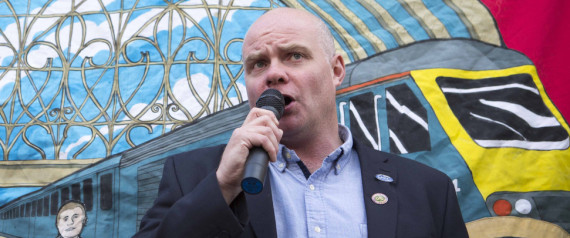
The Trotskyist Faction of Socialist Fight gives full support to Steve Hedley, Assistant General Secretary of the Rail, Maritime and Transport union (RMT), against the vicious attacks by the Tories and the Murdoch press propaganda machine.
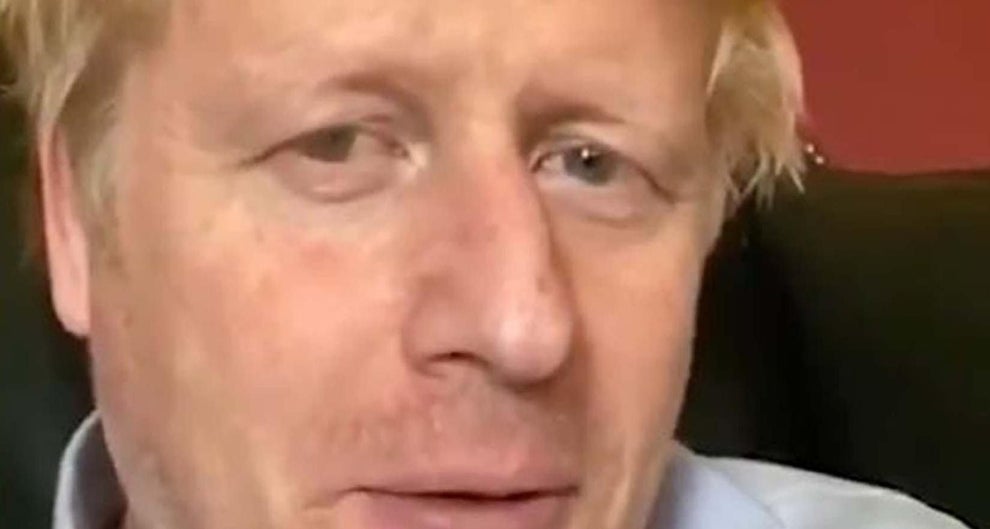
Steve Hedley has been suspended from his position after he recently made ‘offensive’ remarks on Facebook. Replying to another comment on a Facebook post, he said: “I don’t want to offend you, but if Bojo pops his clogs, I’m throwing a party.” He later added: “I hope the whole Cabinet and higher echelons of the Tory party have been touching various bits of him.” These remarks followed Johnson’s admission into St. Thomas’s Hospital on 5th April after his Covid-19 symptoms worsened.
The Murdoch press, who have been fawning over themselves in their support for Johnson for years, described Steve Hedley’s comments as ‘vile’. These attacks from these gutter rags are not new. The propaganda against the RMT has been going on for years with attacks on Bob Crow who always confronted the government and its media lackeys, simply because the RMT is one of the last remaining militant trade unions representing its workers. As a direct result of this attack on him in the Murdoch Press, the bureaucrats in the RMT have capitulated to this right wing attack suspending Steve from his position pending a disciplinary investigation.
In a joint letter/statement on 10th April sent to the RMT membership, President Michelle Rodgers and General Secretary Mick Cash said: “Steve Hedley’s comments do not represent the views of this trade union and are wholly unacceptable.” He added: “The comments have attracted widespread negative media coverage which has led to an extraordinarily large volume of complaints, from both RMT members and the public, through social media and also directly to the union and our staff with unprecedented levels of hostility.” A spokesman for the RMT said: “Following a meeting of the union’s National Executive a decision has been made to suspend senior assistant general secretary Steve Hedley with immediate effect while a formal investigation takes place into his conduct.” We suspect that the majority of members actually support Steve Hedley, and it is they alone who should democratically decide who represents them, not the right wing establishment and the union bosses kowtowing to pressure from Murdoch et al.
Some people may have mixed views on the remarks made by Steve Hedley, as to whether his personal remarks in a personal social media post were ‘offensive’ and in keeping with someone in his position as a representative of a trade union. What is offensive are the Tories attacks on the working class. Where is the outrage about someone who is homeless dying on the streets every 19 hours, the reliance on food banks and 4 million children languishing in poverty in the fifth richest nation, the cut in 17,000 hospital beds since 2010, or deliberately allowing people to succumb to COVID-19 with lack of testing and adequate provision of PPE to frontline NHS staff? These are the issues that should animate people, not this faux outrage against someone who expressing his personal views on someone that has been a champion for the ruling class with their attacks against the poorest in society.
The attacks on the working class in this country are integral to the class project of the Tories, this is not new. When Nye Bevan delivered his most famous speech, on the eve of the creation of the NHS at the Belle Vue Rally in Manchester on 4th July 1948, he said “So far as I am concerned they are lower than vermin,” he went on. “They condemned millions of people to semi-starvation. I warn you young men and women, do not listen to what they are saying, do not listen to the seductions of Lord Woolton. They have not changed, or if they have they are slightly worse.” His own bitter experiences growing up in Wales led him to have a deep hatred of the Tory party; a party that consistently objected to the forming of the NHS and the ‘Welfare State’ in the first place. Bevan was not wrong then and Steve Hedley is not wrong now. We do not give sympathy to those that are waging war, an ideologically driven class war, against the workers and poor of this country.
These recent attacks from the right wing and the gutter press come on the back of a deliberate targeting of the RMT, which has been brewing for some time. It was no coincidence that Steve Hedley was violently attacked outside a London pub on 14th July 2018 by fascist Tommy Robinson supporters. Steve and his kind of union militancy represent organised labour, and also have a history of fighting racism and homophobia. These attacks from the right on the RMT have been drip fed in the media, whether it was Bob Crow going on holiday, which incidentally came from Boris Johnson himself when he wrote an article for the Telegraph in 2014, or the attack on Steve Hedley accusing him of anti-Semitism in November 2019 with calls for him to resign when a video surfaced of him berating Richard Millett – a hardened Zionist, in a speech attacking the oppression of the Palestinians in 2011.
Johnson’s dislike of the RMT has been simmering since last November when there were calls for action to be taken against the union for its planned 27 day strike against South Western Railway in December over safety concerns in operating trains without guards with the imposition of driver only operations. The government’s response after its December election win was to deliver a Queen’s speech that contained 30 bills, which included further anti-strike legislation. The proposed legislation will ensure a minimum level of service on various modes of public transport, including trains and buses, has to be maintained during strikes. The Tories have a majority of 80 MPs, which allows them to continue their full frontal attacks on the working class, an extension of where Thatcher and Major left off. The speech includes for the first time ever new legislation that effectively bans strike action. The upholding of the right of workers to withdraw their labour and the improvement of conditions in the workplace is an abomination for the Tories, who see it as something to be crushed.
Grant Shapps, Secretary of State for Transport, stated that “It is a basic right for workers to be able to get to work,”….. “The ability of a few people to prevent everyone from being able to earn a living has to come to an end. The new law will prevent London being brought to a standstill, with all the additional environmental damage done by people reverting to cars. There will be a bare-bones service provided, preventing ordinary workers being effectively held to ransom.” The safety of the public and workers is being used as a subterfuge to smash the union under a pretext of the environment and the rights of other workers. This attack on the last vestiges of union and worker militancy is in keeping with the Tories’ drive towards the Singapore model come post Brexit, which this Queen’s speech was all about.
Support for Steve Hedley has been widespread amongst comrades on the left, who can see that this is another step on the journey by both the Tories and the neoliberal Blairites who have now reclaimed the Labour Party as their own. The attacks on Steve is part of a concerted attack on the left by Tories and Blairites, and their capitulators and agents in the unions. An open letter has been submitted to the Morning Star, which has been refused publication by its editor, Ben Chacko. This can only be interpreted as further capitulation to right wing pressures and shows how the trade union bureaucracy, even the ‘lefts’, act as agents of the bosses in the workers movement when the chips are down. Indeed Steve Hedley is being punished by the ‘left’ bureaucracy – whose house organ is the Morning Star – not for the first time – for going further than worthies like Cash and Rodgers are prepared to go in opposing the bosses.
It is true that the labour movement started in Europe during the industrial revolution. Previously, the idea faced great resistance. However, the labour movement was active in the early to mid-nineteenth century and various labour parties and trade unions were formed throughout the industrialised world. The labour movement has a very long past in this region, though industrialisation took place very late in Bangladesh. The beginning of labour agitation in the Indian sub-continent was in Bengal.
In 1860, there was a strong protest against the inhuman working conditions and hardship of cultivation workers. A further organised form of trade union activities in this region was started thereafter. Unfortunately, illiteracy and disunity among workers, the negative attitude of employers and unnecessary politicization hampered trade union growth in Bangladesh. This article made an attempt to analyse the historical context as well as the plight of the industrial workers and trade unions and their impact on the overall productivity of the workers in Bangladesh.
The trade union movement in Bangladesh has a very long history. The beginning of labour agitation in India was in Bengal. In 1860 in Bengal a noted dramatics and social reformer Dinbandhu Mitra along with some of his journalist friends protested the inhuman working conditions and hardship of cultivation workers. He wrote a drama title Nil Darpan. A drama about slave like behavior to worker by the cultivator Nil. This drama had a great impact in the minds of people and the social elite. People realized the deplorable and inhuman conditions of workers. This was beginning of the labour movement.
Some years latter, in 1875 Sarobji Shapuri in Bombay made a protest against poor working conditions and brought this to the notice of the Secretary of State for India. The first Factory Commission was, thereafter, appointed in 1875 and as a result the Factories Act,1881 was enacted. But this Act did not reflect the aspirations of workers. There was no provision for child labour and women workers. Another Factory Commission was appointed in 1884. In the same year a conference of the Bombay (presently Mumbai) factory workers organised by N.M. Lokhande had demanded a complete day of rest on Sunday, half an hour recess each working day, working hours between 6.30 a.m. and sunset, the payment of wages not later than 15th of the month, and compensation for injuries.
In 1889, in Bombay, workers from spinning and weaving mills demanded Sunday as a holiday, regularity in the payment of wages, and adequate compensation in cases of accidents. But trade union activities in this region of the Indian sub-continent started in the 18th century.
The trade union movement then was generally led by philanthropists and social reformers who organised workers and protected them against inhuman working conditions. One of them was Anusuyaben Sarabhai. She was daughter of a mill agent in Ahmedabad. She had visited England and seen for herself trade union activities there. After returning to India in 1914, she began working among textile workers and poorer sections of the society in Ahmedabad.
She established schools and welfare centres and worked for the betterment of the workers and poor people. In 1917, the workers of Ahmedabad mills resorted to a strike to demand an increase in wages. Anusuyaben was among the leadership in that strike. Ahmedabad textile workers organised themselves in a trade union under her leadership on December 4, 1917. it is notable that the Russian socialist revolution also influenced Indian working people.
The strike was a success and workers got a wage increase. The first regular Union was formed in Ahmedabad in 1920 for the Trestle Department Workers. This was followed by different trade- or craft-based Unions. The same year another trade union was formed in Madras with the name of Madras Labour Union. This was formed by B.P. Wadia under the leadership and guidance of Dr. Mrs. Annie Besant. But the growth of the trade union movement gained momentum at the end of the First World War. Industry and trade had grown following the War. Many trade unions were formed throughout India. There were a number of strikes during 1919 to 1922. The Russian Bolshevik Revolution created a reaction in India, as it did elsewhere.
The Bolshevik triumph demonstrated that an organised working-class movement could seize state power. The communist movement in India organised the workers in trade unions with as objectives: first, to secure immediate goals such as higher salaries and better working conditions; and ultimate goal to build a long-range movement that would topple the bourgeois state and free India from British rule. This speeded up the pace of the trade union movement. In 1920 the All-India Trade Union Congress was formed. This was initiated by forces of different ideology. The communist and also nationalist forces were there.
Later, after the independence of India, the labour leader associated with the National Congress Party left AITUC and formed the Indian National Trade Union Congress in 1947. The colonial ruler finally introduced the Indian Trade Union Act, 1926. Before that the Indian workers were denied the fundamental rights of freedom of association. The Indian Trade Union act, 1926 was enacted with a view “to provide for the registration of Trade Unions and in certain respects to define the law relating to registered trade unions.” The right to strike and lock-out were ultimately recognised in India indirectly under the provisions of the Indian Trade Dispute Act, 1929.
The act provided for an ad-hoc Conciliation Board and Court of Inquiry for the settlement of trade disputes. The Act prohibited strikes and lock-outs in public utility services and general strikes affecting the community as a whole. In Pakistan era there were three main national centres in the then East Pakistan: the East Pakistan Federation of Labour, the Mazdoor Federation and the communist-led Purbo Pakistan Sramik Federation. Beside these central federations, the Revolutionary Socialist Party (RSP)-led Chotkal Sramik Federation had a great and significant role in organising jute mill workers. The jute mill workers strikes in 1964 and 1967 were launched by this industrial federation.
In the March 1971 civil disobedience movement against the Pakistani Military rulers, trade unions had played an important role. They virtually took over management of industry and executed the orders they received from Bangobandhu Sheikh Mujibur Rahman.
After the independence of Bangladesh, the government had to take over the industries and establishments that were abandoned when the owners left Bangladesh for Pakistan. After independence the ownership structure in the industrial sector was: Pakistani Private Ownership: 47% EPIDC: 34% Bangladeshi Owners: 18% Foreign Owners: 1% Abandoned industries and EPIDC. Together this was 81% and was taken over in March, 1972 of which 77% were kept nationalised and the remaining 4% were offered for sale.
These taken-over industries were put under different sector corporations.
Furthermore Jute, Textile, Sugar and Financial Institutions and big industries were nationalised. Suddenly trade unions found they had to play a big role to manage and run the industries and establishments in absence of owners and managers, which they were not prepared for. For time being they became managers of many industries and establishments. Many self-seekers had also joined trade unions to seek personal gain. In 1972, Bangladesh adopted the Industrial Relations Ordinance 1969 with a view to regulating labour relations and disputes in the country. May Day, the 1st of May was declared a national holiday. An Industrial Worker’s Wage Commission was constituted in 1973 to fix wage levels and other benefits for the industrial workers in the public sector. The State-owned Manufacturing Industries Workers (Terms and Conditions of Service) Act was enacted to implement the wage scale and fringe benefits determined by the wage commission.
Restrictions and Bans on Trade Union Activities:
After the liberation of Bangladesh workers enjoyed a great deal of freedom and trade union rights. Most of the plant level trade unions had joined with the ruling party trade union center Jatiyo Sramik League. Many new plant level trade unions were registered. The trade unions were powerful contenders for authority over factories, mills and establishments abandoned by previous owners and subsequently taken over by the government. The political local elite had joined trade unions to control and benefit from the taken-over industries and establishments. Traditionally most of the workers were from outside of the workplace localities and from different districts and now local people wanted to have jobs there, as industrial workers were better paid than in the informal sector.
There were many riots between locals and non-locals in different industrial districts. The worst situation had arisen in the Chittagong and Tongi industrial districts. The local ruling party leadership, in order to grab the unions there, had started agitation against non-local workers, for the trade union leadership were non-locals. Control over the trade unions would gain the local elite gains much. The first being that they can buy the products at the mill rates and sell on the market at high rates; second they can supply raw materials to the mills at high rates, and third by inducting their own people as workers and employees they can have control over the establishment and local politics. The mill rates and market rates of cotton yarn, fabric, jute product, butter oil and many other products differ very much. One could become millionaire overnight by having a dealership of Kohinoor Chemical Company, a cosmetic and toiletries industries, or have an allotment of the quota for cotton yarn from Muslin Cotton Mills of Kapasia or a quota of the allotment of matches from Dhaka Match Factory of Postogola.
Agenda and issues of Trade Union Movement:
There was a shift of government in August 1975, which was followed by a shift in economic policy as well. The socialistic policy of the Mujib government was abandoned and privatisations began, which were initiated by the succeeding government of Ziaur Rahman. Privatisation started with disinvestment and denationalisation of state owned enterprises (SOEs). All the governments till now continued the same economic policy. The present Awami League government in order to make the privatisation process of SOE’s faster formed a new institution called The Privatisation Broad, which is entrusted with the responsibility of selling off those SOEs identified for privatisation. Among disinvested industries a government survey from ministry of industries has found a few of them only running fully, some are partially and a large number are not functioning at all. The workforce in those industries has been drastically reduced.
The leading sectors like jute and textile where traditionally trade union movement was strong got weakened due to loss of the jobs of their members. To protect employment and trade union rights trade unions got united, formed Sramik Karmachari Oikya Parishad (SKOP) in 1983, and launched a series of action programmes to press their demands including job security, higher wages, trade union rights and others. In 1984, government and SKOP came to an agreement that a wages commission be set up to recommend a new wage structure. But it was implemented only in the public sector. Another important issue was the job security of disinvested industries and no further disinvestment without consulting workers. This part of the agreement was also not respected by the government. There was also an agreement that the government form a commission to draft a democratic labour legislation.
National Minimum Wage:
At present the main agenda of the Trade Union movement is a National Minimum Wage. But there is tremendous opposition from the employers to fixing a national minimum wage. They argue it should be sector wise. There are many sectors whose employers have no ability to pay such a minimum wage. Trade Unions argue that the Minimum Wage has to be looked upon as a basic right, a minimum requirement for leading a healthy working and social life. This will have to be uniform for all. They further argue that the labour is not a commodity. It is both, input into production as well as the object of production. Minimum wages are a signal to society that this is what is expected and nobody will fall under. It is also a very important incentive for business to upgrade, for certain wage structures force competitive high roads by cutting wages and degrading working conditions. Trade Unions also demand that there should be regular readjustments of wages in line with the rate of inflation.
Violation of trade union rights;
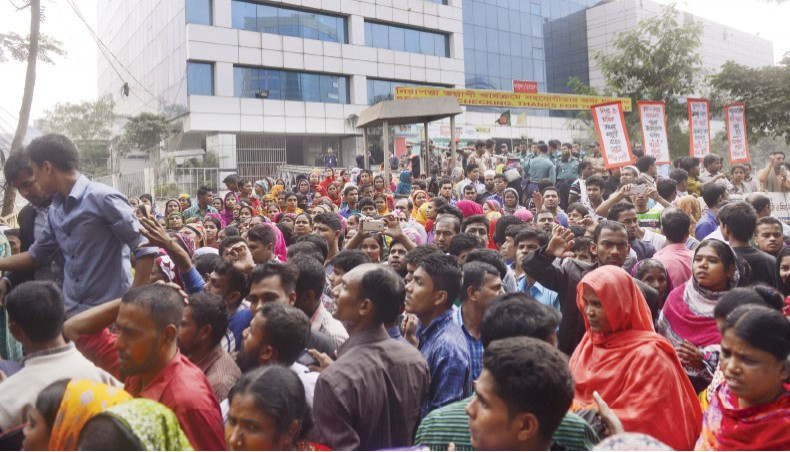
From the beginning of 80’s a new non-traditional industry, the garments industry has emerged. And now the growth of employment there nearly is 45 lakh (4.5 million) and the workforce mostly are women and not organised in trade unions. The employers do not allow workers to form trade unions. The Ministry of Labour is suspiciously silent about violations of trade union rules. The government also forbids trade union activities in the EPZ (Export Processing Zone).
Now, government is having pressure put upon it from the USA and also from the ILO to open up trade union activities in EPZ. Industries in the EPZ’s are allowed duty-free imports of raw materials and other components; they do not have to pay excise duty on local goods and are eligible for tax holidays. The idea is to create an environment that is conducive to facing competition in the export market. So that investors will be attracted to invest here and it will increase employment, revenue and technology transfer. All most all EPZ’s elsewhere offer similar packages to foreign investors.
Now the questions are these, how much local employment is being generated by these industries in EPZ’s and how much transfer of technology has taken place in reality from these industries? How much port and other charges have we received from them, how much profit sharing we could make from them? Till now existing two EPZs employ less than one lakh (100,000) workers and most of the industries here are textiles, shoes and other small scale industries where small number of workers are employed and no high technology is adopted.
But we are offering these investors remarkable amounts of land, power supply, infrastructure facilities etc. The question is also why should trade union activities be prohibited there? The government cannot restrict human rights of its citizens for the cost of foreign investment? Moreover, this is not the only issue that investors need. Peace and non-disturbance in worker relations will certainly attract the foreign investors, but the foreign investors are also need congenial atmosphere, infrastructure like banking, communication support and facilities, those are more important to them than the benefit of no trade union activities.
The Structure of Trade Unions:
The Industrial Relations Ordinance, 1969 (as amended up or date) is intended to regulate trade union activities and permit workers to organise themselves into trade unions. The trade union is required to be registered with the Register of Trade Unions. The trade unions in Bangladesh may be divided in structure into three categories, the first is basic trade union – a primary organisation of workers at their workplace. The second is the Industrial Federation or trade federation compose of a number of basic trade unions related to the same type of industry, such as Jute Workers Federation, Textile Workers Federation, Garments Workers Federations, and the third is National Trade Union, a federation of basic unions irrespective of job categories.
A National Federation may be constituted by two or more basic trade unions irrespective of their trade. Apart from these there are craft unions, though there are not many. This is organised craft-wise like Railway Karigar Union, an union of technicians of Bangladesh Railway or Biman Cabin Crew union. Non-employees and non-workers cannot be elected to the committees of a basic trade union but can be elected to the committee of Industrial Federation and National Federations. But they cannot be more than 20% of the total number of committee members.
Under the rules no unregistered trade union or federation of trade unions can function as a trade union. In case there is only one registered trade union in an establishment or a group of establishments, that trade union is deemed to be a collective bargaining agent for that establishment or group, provided it has a minimum membership of one-third of the total number of workers employed in the establishment or group of establishments. In case there is more than one registered trade union, upon receipt of an application from any trade union or management of the establishment, the Register of Trade Unions determines the bargaining agent through a secret ballot for a period of two years. But they have to get a minimum of one-third of the total number of votes of the workers employed in the establishment or group.
There was no restriction before for non-workers to be members of trade unions; the restriction came when the then-military government amended the Industrial Relations Ordinance on 26th July 1980. The tradition and history of trade unions of Bangladesh was always that non-workers took leading roles in organising the trade unions. It is always social or political activists who organise the trade unions. The neighbouring countries of Bangladesh like Sri Lanka, India and others have no restrictions on this, only the proportion of committee members from outside is defined.
The ILO’s conventions also do not have any restrictions on outsiders. Trade unions have to submit an annual statement of their income and expenditure, assets and liabilities in the prescribed form to the Register of Trade Unions, the changes of office bearers should also be intimated to the Register of Trade Unions. A person shall not be entitled to be a member or officer of a trade union formed in any establishment or group of establishments if he is not actually employed or engaged in the establishment or group of establishments.
Registration of Trade Unions:
For the registration of trade unions the applicants have to apply to the Joint Director of Labour and Register of Trade Unions while fulfilling certain requirements and procedures. For Industrial and national federation or national unions the Director of Labour and Register of Trade Unions office is responsible for registration. The National Union means those have members throughout the country – such as banks, railways and others. The trade union executive committee shall consist of 5 to 30 people depending on its membership. Up until l 50 members the committee will consists of 5 persons, and 30 committee members where there are more than 5000 union members. The applicants for union registration have to submit all the applications of membership of the proposed union in a prescribed form and also the register of membership, and the resolution of the meeting where the decision was taken to form a trade union, a list of committee members, a list of general members and the constitution of the union along with the application.
The constitutions should provide the name of the trade union, objects for which the trade union has been established, purpose for which the general fund of a trade union shall be applicable, the maintenance of a list of the members of the trade union, the admission of who shall be persons actually or potentially employed in an industry or establishment with which the trade union is connected, the payment of a subscription by members of the trade union, the executive and the other office-bearers of the trade union shall be appointed and removed, the manner in which the rules shall be amended, safe custody of funds and audit, the manner in which the trade union may be dissolved. The State-owned Manufacturing Industries Workers Ordinance, 1985 restricts collective bargaining in the nationalised sector on certain issues like wages, leave, house rent, conveyance allowances, medical allowances, festival bonuses and provident funds. A number of Acts and Ordinances provide that the Industrial Relations Ordinance 1969 shall not apply to certain establishments.
Labour Movement:
Labour Movement (to 1947)
Prior to 1947, there were only a few industrial concerns in the eastern part of Bengal (Present day Bangladesh). These included about 25 tea gardens in Chittagong and Sylhet employing about 12,000 labourers, 6 cotton textile mills (four in Dhaka and one each in Kushtia and Khulna) employing about 10,000 workers. There were also some workers in Chittagong port. The tea-estate labourers were mainly recruited from aboriginal tribes of Chhotanagpur region. Others were mostly local people from both Hindu and Muslim communities.
The first signs of labour unrest were seen during the days of the khilafat and non-cooperation movements (1920-22). The striking tea-garden workers from Chargola Valley in Sylhet (Assam) left the gardens in an exodus. Men of the East Bengal Railways and Chandpur Steamer Services started sympathetic strikes in May 1921. Striking coolies, stranded at Chandpur, faced great hardships. But it was politically regarded as a great victory of the Bengal Non-cooperators. Finally in August 1921, at Gandhi’s request, the strike was called off. The unrest in Chittagong by Burma Oil Co workers in April-May 1921 under the leadership of JM Sengupta created quite a stir.
In 1927, the Dhakeswari Cotton Mills Workers’ Union was founded. But the union was weakened by a series of strikes called within four months of its formation. Due to the Great Depression the labour movement, however, slowed down. The communist activists were mainly behind the movement but the non-communists like the official Congress and anushilan samiti, backed by the management opposed the communists’ tactics of militancy and thus acted as a constraint on any long-drawn movement. The cotton workers’ strikes in 1937-40 may be regarded as the turning point of the movement both in frequency and intensity. Mention may be made of four strikes in Mohini Mills, Kusthia (Feb-May, 1937; July-September, 1937; August-October 1939 and February-April, 1940) and the strikes in the Dhakeswari Mills (July 1939 and January-February, 1940). The movement failed to generate steam. Naturally it had a demoralising effect on the Communist-dominated Workers’ Union and no further movement was on record up to 1947. The Wartime was a period of ‘uneasy calm’ in Dhaka. The immediate post-war years witnessed the revival of militant labour agitation leading to strikes in Acharya Prafulla Chandra Mill, Khulna (December 1945 – January 1946) and the four mills in Dhaka (February-May 1946).
Since 1942 the Chittagong tea garden workers were connected with the activities of the local Communist Party. They organised a few strikes around specific economic issues in the post-World War II period, with little success. With the partition, the Communist organisers, mostly Hindus, left for India. The immigrant tea-labourers of Chhotanagpur had no desire to go back to their place of origin. Left without leaders, the labour organisation became very weak. The workers of EB Railways were best organised and politically most conscious. But they were divided between nationalist and Communist dominated unions.
Trade Union Movement
The trade union movement organised activities of workers to improve their working conditions. In the early stage of industrial development when there were personal contacts between employers (master) and workers (employee), there was no need of any organisation to determine relations between the two. But under the modern factory system the personal touch is absent and the relations between the employer and the worker have come under strain. The conflict of interests between buyer and seller of labour power has become conspicuous and this has led to the rise of trade union movements throughout the world. The tradition of the parallel development of the nationalist and the trade union movement, which had originated in British India continued through the Pakistan period down to the birth of Bangladesh.
For the first time in India the Bombay Mill Hands Association was formed on 24 April 1890. This gave impetus to the trade union movement in British India. The establishment of ILO in 1919 provided a source of inspiration for the workers to organise themselves and shape their destiny. India’s membership of the same exerted great influence in the formation of a central organisation of workers called ‘All India Trade Union Congress’ (AITUC) in 1920 for the purpose of conducting and co-ordinating the activities of the labour organisations.
The period from 1924 to 1935 may be considered as the era of the revolutionary trade union movement. MN Roy, Muzaffer Ahmed, SA Dange and Shawkat Osmani led the trade union movements and as a result the political consciousness among industrial workers increased. To control the movement, the British government adopted ruthless measures (eg, Kanpore Conspiracy Case and Meerat Conspiracy Case) against the militant workers and trade union leaders, but no strategy could suppress the trade union movement; rather the colonial resistance invigorated the movement against the colonial power. Later, the trade union movement was closely linked with nationalist movements and the working class started vigorous struggle for emancipation from extreme repression and economic exploitation by the colonial regime.
At the time of Partition of Bengal (1947), most trade union leaders were Hindus and when they migrated to India, a void was created in leadership in the trade union movement of Pakistan, especially in its eastern wing. Moreover, the institutions to advance workers’ interests were mostly situated in areas outside Pakistan. There were barely 75 registered trade unions in the whole of Pakistan, compared to 1,987 in undivided India in 1946. Of this small number of trade unions, the larger share fell to West Pakistan, leaving only a very few for the eastern wing, where there were only 141 factories with 28,000 workers and 30 unions in all with a total of 20,000 members.
During the Pakistan period most trade union leaders held conflicting views and the trade unions were fragmented and weakened. As a result, the trade union movement met a setback and the trade union activities passed into the hands of petty bourgeoisie leadership. Moreover, the trade union movement in Pakistan was characterised by fragmentation of unions, prolonged strikes, retaliatory lockouts and picketing which sometimes led to violence.
As the trade union movement in Bangladesh originated in British India and Pakistan, it naturally retained its old character of working more as a nationalist force against colonial domination than as a class force vis-a-vis capitalist exploitation. As a result, the trade union movement of the region that had gained momentum in the hands of political leaders stood divided along the political and/or ideological lines in independent Bangladesh.
During this period, the trade union movement was marked by direct interference by the government and the ruling party in its internal affairs. In many industrial belts terrorism was let loose by the men of the labour front of the then ruling party and these tried to drive out the honest trade unionists from the leadership of the unions. Moreover, the barring of outsiders from trade union leadership at the basic union level made the process of union hijacking very easy and turned the workers into a very weak and defenceless community.
In the early 1980s, the military government of Bangladesh banned all trade union activities in the country. Then an alliance of the National Federation of Trade Unions (NFTUs) emerged in the name of SRAMIK KARMACHARI OIKYA PARISHAD (SKOP) to establish the democratic rights of workers as well as to fulfil their economic demands. Most NFTUs were in SKOP and since 1983, most trade union movements in Bangladesh have been organised under the leadership of SKOP.
The opportunism and lenient attitude of the trade union leaders including SKOP gave the ruling regimes a chance to disregard the agreements signed between the government and the trade union leaders. At present, the leaders of nineteen of the twenty three NFTUs are included in the SKOP. After its formation, SKOP submitted a 5-point charter of demands for establishing their democratic rights and higher wages through rallies, torch processions, demonstrations, strikes, hartals, blockades etc.
Ironically, SKOP failed to yield any tangible results for the working class people of the country. The effectiveness of the trade union movement under the leadership of SKOP gradually weakened because most SKOP leaders have political affiliations and therefore, cannot escape the influence of their respective political parties. Moreover, the lack of active support by the major political parties to SKOP’s programmes, excessive pressures on government by the private employers and donor agencies to disregard SKOP’s demands using repressive measures to disrupt the trade union movement, forcible occupation of unions, bribing of trade union leaders, opportunistic and compromising attitude of the union leadership rendered the SKOP demands ineffective. In fact, SKOP has become a moribund forum of the working class with little to offer to the country’s future trade union movements.
Health Care Issue:
For the workers of Bangladesh do not have separate health care facilities like separate hospital or health insurance for them. The proposed health policy for Bangladesh has recommended to have separate health care system for workers in Bangladesh. Only workers and employees in the government or private sector gets cash money at the fixed rate of Tk.150 and Tk.200 for medical care with their wages and salary every month. This is so meagre it does not help workers when they get sick. Moreover they do not know what to do where to go to get proper medical care.
At the primary level of sickness they usually go to any pharmacy to get some drugs. If they are not cured by the drugs given by salesman of drug store they go to any physician either homeopath or allopathic or kabiraj nearby. In many cases if sickness is serious in nature like cholera, pox, tuberculosis, heart diseases or any mental disorder some patients go to spiritual healers. When sickness gets complications they try to get admission in government hospitals. But the government hospitals are always crammed with excessive numbers of patient so without having connections it is difficult to get admission there.
If they are able to get admission to hospital they have to pay for medicine, pathological tests and other examinations done in private laboratories or clinics. In most cases these have to go to private hospitals; those are expensive. They have to sell their land and other assets (if they have any) to meet the expenses. Many of them who cannot afford such expenses have to die without having proper medical care. Health care is primarily provided by the government, the Ministry of Health and Family Welfare (MHFW). Some multisectoral projects in various ministries having health, family planning, nutrition components are also under MHFW. There are also municipalities, municipal corporations, army, police and railway departments which have health programmes. Many NGO’S have also health and family planning programme. The Directorate of Labour has a wing for family planning and nutrition for workers.
There are several workers’ welfare centres run by the Ministry of Labour at different industrial estates to provide emergency medical care, but in reality workers do not get any medical care there. Usually workers also do not visit there for they think it is useless to go there. Doctors and welfare officers are supposed to be there but they hardly ever can be found. If they are at all available in these centres medicine and equipment are not there. There is no need to explain why proper health care is not only a basic right of a worker but also it helps increase productivity. It will reduce mortality rates and thereby enhance the life expectancy as well as improve the efficiency of labour. It will reduce working days lost for sickness. The workers are also in need of specialised health centres where occupational diseases can be cured.
A recent study on tannery workers at Hazaribag in Dhaka done by The Society for Environment and Human Development revealed that the average longevity of a worker is below 50 years. Almost 90 per cent of tannery workers die before they reach the age of 50 due to their unhygienic work environment and lack of proper medical care. About 58.10 per cent of workers suffer from ulcers, 31.28 per cent have high blood pressure and 10.61 per cent suffer with rheumatic fever. Assistant Director of Health Dr Mohammad Hassan Ali said industrial pollutants, liquid waste and leather dust are the main cause (reports published in Daily Star on 28 February 2000).
Similar cases are also those of jute and textile workers, who suffer from asthma and other breathing related-diseases from jute and cotton dust. Trade Unions of Bangladesh are always demanding separate health care systems — clinics, health centres and hospitals for workers. If a separate health care system can be developed it will reduce the pressure on public health services also. Furthermore these will expand the facilities of medical care in the country from generating their own resources. A pilot health insurance project for workers was conceived by German Technical Assistance (GTZ) an autonomous implementing agency of German government for project aid.
While I was catering at first I found that many of us were not very enthusiastic about this idea as it will not provide “cash money to build hospitals or buy ambulances.” The Bangladesh government had also no plan at that stage to have any workers’ health scheme. It took some time to realise the possibilities and future of this kind of health project. The Ministry of Labour and Human Resources had agreed to propose a pilot health insurance project to the German Government for their assistance. Even the Employers Associations’ attitude was positive to the proposed project.
After long consultations with workers representatives and employers, the Labour Ministry and GTZ had finally came out with a pilot project scheme The project was intended to start in the second half of 1998 and should cover in its initial phase at least five factories with at least 2,000 workers, predominantly women and their dependents, approximately 5,000 to 7,000 population. Building on positive experience gained, documented and disseminated and supported by the Employers’ Associations including the Bangladesh Garment Manufacturers and Exporters Association—BGMEA, a substantially wider participation of employers was expected to be achieved still with the first phase of the project.
The project will be jointly implemented by the Ministry of Labour with the involvement of related ministries, Employers Associations and Trade Unions. The idea was tri-partite approach. Provision for health services will be arranged according to their capability, with GOB, private sector or NGO service providers. Technical support will be provided by GTZ, Germany, based on jointly developed annual operational plans and with consideration of local capacity and contributions. But the project did not materialise as the German government finally did not approve the project. This project could have been a good beginning of a workers health scheme. Out of this project a comprehensive, larger health scheme could have developed, in the beginning covering industrial workers and later it could further cover informal sector workers.
A example can be cited here: news published in a Bengali newspaper about a garments industry is being in arrangement with a non-profit health organisation, Community Health Service, for health services for their workers. India and Pakistan also have health schemes for workers of industries and in organised sectors. On my recent visit to Pakistan and India I had experienced an impressive health care scheme for industrial workers in Punjab province of Pakistan while I was going on a study tour on Industrial Relations in Pakistan along with other trade union friends organised by the Bangladesh Institute of Labour Studies. And this health scheme is funded by employers only. No contribution from the government. Only in initial period of the scheme the government provided infrastructure support.
The scheme is called the Employees’ Social Security Scheme and was introduced in Pakistan in 1967 under the provision of Provincial Employees Social Security Ordinance. Under this ordinance the Punjab Employees Social Security Institution came into being. The main objective of PESSI is to provide comprehensive medical cover to the secured workers for work-time injuries. Presently over 498,000 workers employed in more than 24,000 industrial and commercial establishments and more than 30 lakh (3,000,000) of their family members are receiving benefits from the scheme. It has 13 local and 14 sub-local offices to give service to workers. The main source of income of PESSI is the Social Security Contribution collected from the notified industries and commercial establishments at a rate of 7% of the wage paid to their workers who are drawing wages up to Rs.3000 per month. The workers once covered under this scheme remains secured even their wages exceed the ceiling of Rs.3000. But in those cases the percentage increase in Social Security Contributions against the wage exceeding the ceiling of Rs.3000 is not payable by the employer.
PESSI provides comprehensive medical cover to the workers and their family members including consultations, indoor and outdoor medical treatment, and emergency medical care. There are clinics for primary medical care for outdoor patients; small hospitals have beds for 30 to 50 patients. Large hospitals have more than 100 beds with specialists of medicine, surgery, gynaecology, TB, pathology, orthopaedics, radiology, cardiology, dentistry etc. Even high-tech medical care like cardiac surgery, dialysis centres are there. PESSI has 117 ambulances available at different hospitals and primary medical care centres. Every patient admitted to the hospitals is paid diet expenses at the rate of Rs.40 per day. The TB and cancer patients are paid a rate of Rs.50 per day. The scheme is administrated by a governing body comprise of employers, workers and government. India has also similar health schemes like Pakistan. The workers who earn RS.3000 or less are covered by this scheme.
It differs state to state about the coverage of scheme. Some states it is covered to all non-seasonal factories using power and employing 10 or more employees and factories not using power but employing 20 or more persons. Seasonal factories, mines and plantations are excluded from the coverage. The scheme provides seven types of coverage, maternity care, benefits for dependents, disablement assistance, funeral expenses and rehabilitation allowance. Except medical care, most of the others benefits are in cash. The ESI scheme is run by the ESI corporation, comprises representatives of the Central and State governments, the medical profession and the parliament.
A Medical Council advises the Corporation on all matters concerning medical care. Three categories of medical care are provided under the scheme: restricted medical care, expanded medical care and full medical care. All the insured persons are provided full medical benefits irrespective of whatever the required facilities in Government or other institutions. Family members get restricted or expanded medical care but not full medical care. The non-medical benefits are sickness, disablement and dependants’ benefit. These are paid in cash as compensation. The financing of the scheme is mainly through contributions from the employers and employees.
The Government of India does not make any contribution but the State governments share the cost of medical benefits to the extent of one-eighth of specified items of expenditure on such benefits. The employer contributes 4 percent of the wages and employees 1.5 percent to the scheme. The ESIS caters service only in organised industrial sectors, it does not provide health security to the large number of workers engaged in the informal sector. Furthermore, Indian labour leaders complain that the quality of service offered by the ESIS medical centres is poor.
Present situation
As many as 32 central federations until now are registered. No central federation has such strength that they can launch a nationwide struggle independently. They do not have such organisational or financial resources either. Almost all political parties have a trade union. All these except a few trade unions, mostly depend on support and financial help from the political party. That is also a reason that the ruling party’s trade union centre has much more affiliated unions than others. When there is shift of government there will be a shift in affiliations also. The trade unions here also depend on support from International Trade Union Federations and Foundations. They get funds from International Trade Union Federations and Foundations for holding seminars, publications and other activities.
They get free passage to go abroad to attend seminars and meetings. Foreign visits are so frequent for some trade union leaders that they are almost preoccupied with arrangements for travel – procuring visas, preparing seminar papers and others and left hardly any time to do trade union work. This has become an important aspect of the trade union movement here. An example can be cited here, Jatiyo Sramik League, labour wing of Awamy League recently affiliated to the International Confederation of Free Trade Unions. Formerly it was with the former Soviet Union-led World Federation of Trade Unions.
With the collapse of the Soviet Union and socialist states in Eastern Europe WFTU had lost its membership and resources and is now not in a position to offer free air tickets for foreign trips and hospitality in Hotel Metropole or Hotel Ukraine in Moscow to its affiliates in developing countries. Though AL chief Sheikh Hasina took a personal initiative in the beginning of eighties to get SL affiliated with WFTU, SL did lost no time to shift to ICFTU. Though there are mounting pressures for trade union unity from the workers, the trade union movement, initially set up as an extended hand of a political party, continues to function more or less as an extended hand of the political party of its affiliation.
Final words:
Human society today stands at a level of development in which man has become the master of human beings. People have become victims of exploitation, oppression, torture and deprivation. However, in the hostility of human civilization, human beings were very supportive, cooperative and very close to each other. The society was a good shelter for all. But the evolution of time has created social classes in society. One class buys labor and the other sells labor. Those who sell labor are poor and those who buy labor are the owners of the means of production and the wealthiest. Social power, prestige and domination are all occupied by them. The powerful layer enforces laws, sets wages, sets the standard for crime and punishment. In all these cases the number of poor people in society is of no value to the opinion of the working class.
Human society is now doing whatever it pleases them to do, as the animal society is ‘insisting on its origin’ – that is, wealthy wealth owners, consuming more and more living a life of luxury. On the other hand, the working class is living twice in food. A few people have secured all their wealth. Whenever poor working people want to protest, this law has come along in the name of law, in the name of discipline, and sometimes with the help of religion. Much has happened and this time the change in production relations has become inevitable through social revolution.
There is no alternative for establishing a new society and an independent socialist society by abolishing the existing capitalist social system to protect the health of all people, including the working class, eliminating unemployment, poverty, social unrest. To end the plunder of capitalism, the state system, imperialism, we have to build a society where there is no human dominance over human beings. People will not exploit people. They will manage themselves. Non-state, non-capitalist socialist self-managed social system. All production systems will be owned by people of the society, including mills, factories and agricultural farms. There will be no volatility of personal ownership. The word employment will disappear forever. People will be completely free.
The Socialist Party – working with and for preparing people for changing existing society by organizing, educating and providing training. The society is working to establish a system where no unjust working period, no hierarchy, will be able to manage the entire production system, under mutual Aid.
We reprint below the response by Ukrainian Anti-Fascists and Communists to a 3 April letter of solidarity from Communists and and Anti-Fascists from the UK and elsewhere.
Below that we reproduce the joint letter itself. It was addressed to the Communist Party of the Donetsk People’s Republic and Borotba as a jointly signed letter by all those who have supported the Solidarity with the Fascist Resistance in the Ukraine campaign in London in recent years
It was initiated by the New Communist Party through the umbrella campaign , and endorsed by our international tendency, the Liaison Committee for the Fourth International (LCFI). Our British LCFI Section, the Trotskyist Faction of Socialist Fight, signed this, together with our sister British LCFI section, also currently known as Socialist Fight, as well as three overseas sections of the LCFI, from Brazil, Argentina and the United States. Also signing were the UK Posadist group.
It is a source of pride that our small currents stand out as those who have kept the flame of solidarity alive on this important political struggle against reaction in this period.
From: Редакция сайта “Вперед” Sent: 13 April 2020 06:02 To: New Worker Subject: Re: Solidarity with Ukrainian anti-fascists
We send solidarity greetings from the UK to all those living under a fascist-infested illegitimate government in Ukraine, defending and building the anti-fascist people’s republics in the Donbas, and to the hundreds of thousands forced into exile by political repression, attacks by fascist gangs and economic austerity.
Although we have had no recent Ukraine anti-fascist solidarity actions, we have by no means forgotten your struggle and the sacrifices you are making.
We were intending to begin organising another Ukraine anti-fascist solidarity protest in London in the near future, but unfortunately events in the form of the Covid-19 pandemic have overtaken us.
All of us have been working hard on other political issues, including helping to organise a very successful meeting attended by 400 people in central London on March 3rd which exposed the lies, tampered and falsified evidence being presented at the current MH17 trial in The Hague.
Ever since the February 22 2014 Ukraine coup we have been aware of the illiegal nature of that regime change, the open involvement of actual fascists in the government, police and armed forces, the complete suppression of democratic rights and freedoms in Ukraine, and the physical attacks on political parties, trade unions and even the courts.
We have not forgotten the heinous crime at the Odessa Trade Union House on 2nd May 2014 and the many other outrages perpetrated by the fascist bands, and we have not forgotten the criminal, barbaric ‘Anti-Terrorist Operation’ launched in April 2014, unleashing all-out war against civilian anti-fascist protestors in Donetsk and Lugansk.
We know that the fighters of the people’s Donbas and Lugansk People’s Militias are making daily sacrifices in the front-line trenches, and that civilians – women and men, children and the elderly – are being killed and injured every day in attacks by the Ukraine armed forces and the fascist brigades.
In our solidarity work for the anti-fascists in Ukraine we are also faced with confronting the lies and whipped up hysteria against the Russian Federation and Vladimir Putin, which have continued for almost a decade.
We have no illusions about the capitalist, oligargic nature of the Russian Federation, but we reject the attempts to portray it as totally undemocratic, and we call for an end to the trade sanctions the constant western interference designed to economic instability and provoke protests. And this coming from governments which kiss the feet of the reactionary fuedal monarchs of the Middle East, and instigate coups and regime change from Brazil and Bolivia to Hong Kong.
Above all we are aware of the vital support given by the Russian Federation to the Donbas people’s republics, the generous hospitality extended to large numbers of Ukrainian exiles, and its open condemnation of the fascists in Ukraine.
We also applaud the the sacrifices made by the Russian volunteer fighters in the Donbas, by the Russian Federation’s armed forces to defend the popular front government in Syria, and the strong support the Russian Federation has extended to Cuba and Venezuela.
This anti-Russian hysteria has created a poisonous atmosphere in which anyone challenging the lies and false flag operations of of US-EU-NATO imperialism risks being labelled as a Russian asset, in a repeat of the anti-communiist witch-hunts of the 1950s.
Unfortunately many progressives, social democrats, trade unionists, and even the anti-fascist and anti-racist organisations on Britain, have fallen for this demonisation, even though it is clearly a repeat of the lies and fake news used against Saddam Hussein, Muammar Gadaffi and Hafez al Assad. This has prevented them from even discussing the most dangerous revival of fascism in the whole of Europe.
Once again we renew our support and solidarity with your organisations, which will continue as long as it takes until democracy has been restored throughout Ukraine, and communists, socialists and anti-fascists are allowed to operate freely again.
Andy Brooks New Communist Party of Britain
Ian Donovan Trotskyist Faction of Socialist Fight
Gerry Downing Socialist Fight
Bridget Dunne Solidarity with the Anti-Fascist Resistance in Ukraine (SARU)
We reproduce excerpts from the first conversation between comrade Humberto Rodrigues (FCT-Brasil) and Frank Fitzmaurice (SF-Great Britain) on 02/09/2017. Frank passed away on April 7, 2020. In the expression above, which headlines this piece, Frank summarizes the turn that affected the International Workers League, an international current of which the PSTU is the Brazilian section. The conversation also addresses the WRP, ISL, Nahuel Moreno, “democratic revolutions” in Libya and Syria, …
This is also published in Portuguese by our Brazilian comrades here
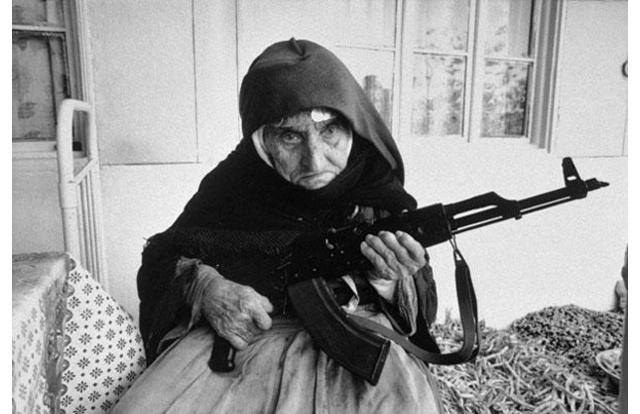
“That’s how I want to be 106 years old. I may not be so comely, but I wish I had the same attitude. This was an Armenian woman who guarded her home in 1990, at the age of 106 [the image is part of Frank’s mural on Facebook and was published by the same a few days before the conversation below]”
Humberto Rodrigues: Hi Comrade.
Frank Fitzmaurice: Hello Humberto.
Humberto Rodrigues: For a long time, I want to talk to you, we need to strengthen our bonds of friendship. Forgive me for my confused use of the English language.
Frank Fitzmaurice: Your English is fine. How are you? A lot better than my Portuguese, which is non-existent.
Humberto Rodrigues: No problem. What is your political origin?
Frank Fitzmaurice: I was in the WRP with Gerry [Downing, head of Socialist Fight]. After we expelled Healy, our group started talks with the LIT [International Workers League] and joined that organization in 1988 and became the English section, the ISL [International Socialist League, in Portuguese]. [After 2011] Some of us left after disagreements over the policy on Libya.
Humberto Rodrigues: Very progressive the rupture of you. It is truly a dialectical rupture. While the LIT followed a path, you went the opposite way.
Frank Fitzmaurice: It was more the way the debate was handled in our branch. Would have stayed in but could not debate properly
Humberto Rodrigues: Why?
Frank Fitzmaurice: Think the LIT has regressed really badly. Don’t think they got over the death of Moreno
Our branch was suffering because our leader, Bill Hunter was getting very old, in his nineties, and his faculties were declining, so differences came out.
Humberto Rodrigues: Libya, Syria, Ukraine, Brazil, … in all these countries, the LIT supported the policy of imperialism. In all the LIT supported the coup against the bourgeois ruler who was pro-BRICS.
Frank Fitzmaurice: they have fallen off a cliff.
Humberto Rodrigues: In my view, I believe that support for the “democratic counterrevolution” against the “Stalinist dictatorships” in the USSR and Eastern Europe had already pointed out the morenismo in favor of a pro-imperialist policy, but what happened after the crisis of 2008 was amazing. Stalinophobia of the 1980s and 1990s became “dictatorophobia” that followed the democratic public opinion of imperialism.
Frank Fitzmaurice: Yes, Bill [Hunter] wrote some good stuff against this view of “democratic revolutions”. We joined because we thought that their split with Unified Secretariat was based on principles and we liked Moreno’s anti- guerillaist platform. Above all, we agreed that we should join organizations in struggle and not be afraid to be in a minority.
Humberto Rodrigues: Undoubtedly, in the 1980s, Morenism was more progressive than Mandelism (and the USFI’s capitulations to foquismo, social democracy and, finally, Perestroika). But, from 1989 to 1991, Morenism evolved to increasingly pro-imperialist positions. Like supporting UN blue helmets in the Balkans.
Frank Fitzmaurice: Yes “an ultra-left pro-imperialist twist” sums them up. We gradually came to realise that the discussion had become one way. They sent some very good comrades over in the early days.
Humberto Rodrigues: Good. But, in any case, I consider it a non-materialistic stupidity to believe that the blame for any degeneration after Nahuel Moreno is to be attributed to NM and to his legacy. There was, without doubt, a leap in quality in the LIT program, particularly from Libya.
Frank Fitzmaurice: If Moreno had lived things may have turned out differently. We put into practice going into movements and we learned a lot and it certainly developed us.
Humberto Rodrigues: To assert that LIT’s current policy is NM’s fault is a spirited conception, of Allan Kardec and not of Karl Marx.
Frank Fitzmaurice: Yes there was a further degeneration, could not be blamed on Moreno
Will try to send some of Bill Hunters stuff to you, think you will like it.
Humberto Rodrigues: Okay … In Brazil, the PSTU lost more than half of its militants for supporting the coup against the PT.
Frank Fitzmaurice: That is a qualitative degeneration. The developement of the capitalist crisis, especially since the crash of 2008 has thrown all the left into turmoil. The LIT are by no means alone in giving in to the humanitarian interventionalism, in fact the majority have.
Humberto Rodrigues: Yes. I agree.
Frank Fitzmaurice: Off to bed now. Will write something for you tomorrow on that. Goodnight
We are sorry to announce the passing of Frank Fitzmaurice, a member of Socialist Fight and the LCFI, and formerly part of the originally pro-Moreno International Socialist League in Liverpool, a component of which fused with the old Socialist Fight in 2018. This grouping, of which Frank was a part, had its roots in the old Workers Revolutionary Party, and the grouping which Frank led was one of those that struggled out of that appallingly deformed organisation and attempted to re-found an authentic Trotskyist and Bolshevik tradition. We hope to publish more on Frank in due course but right now we express our condolences to all his family, friends and also all fellow comrades.
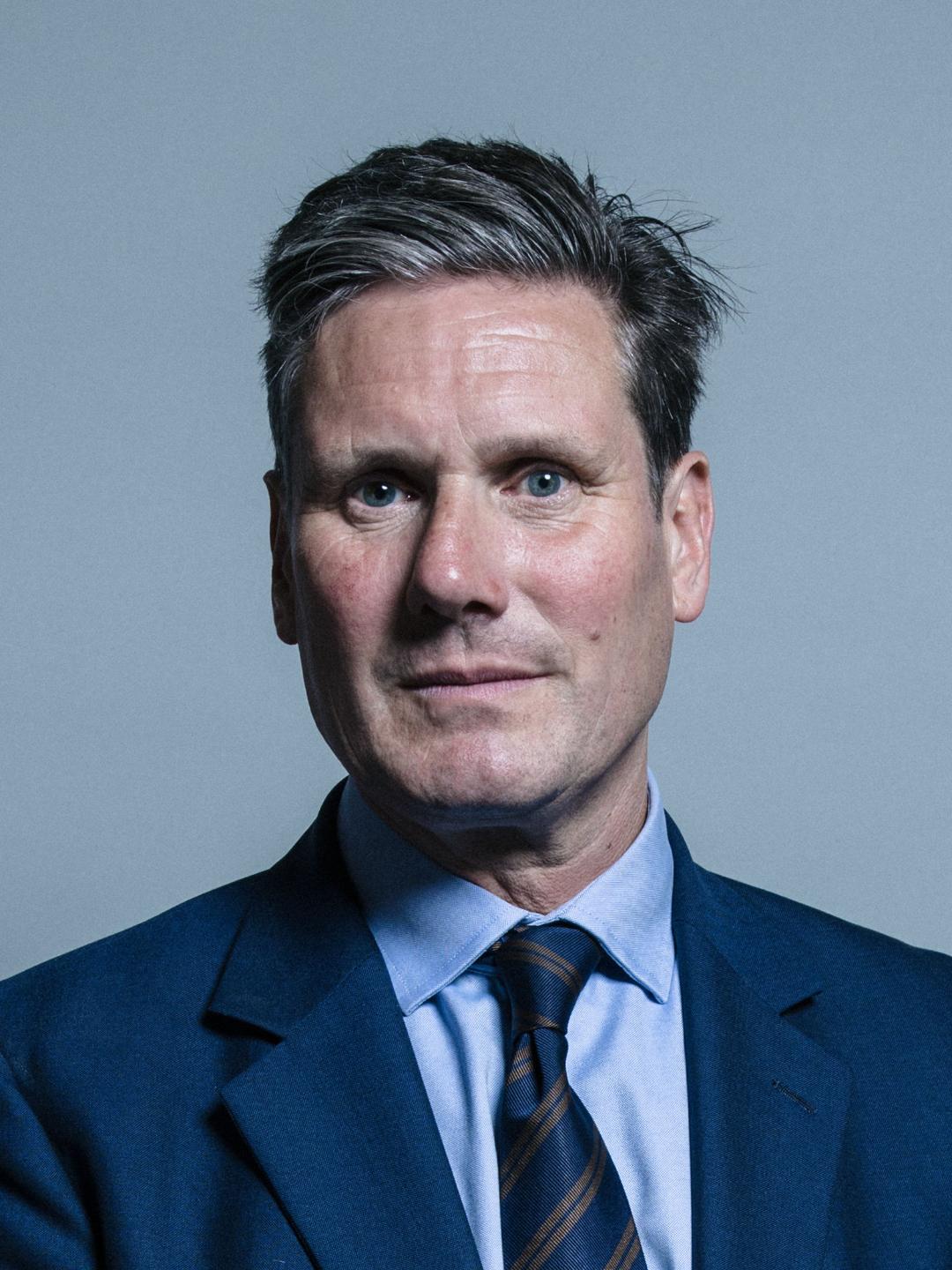
On 4th April the result of the Labour Party leadership election was announced and true to form and the prediction of the bourgeois press, Sir Keir Starmer was announced as the new leader of the opposition. Starmer, the establishment stooge, has hammered the final nail into the coffin of the Corbyn project.
Corbyn’s leadership success in 2015 paved the way for the Labour Party to be dragged, albeit kicking and screaming, from the Blairites and over to the left of the political spectrum. The Party attracted a membership of over 560,000, making it the largest political party in Western Europe. These members brought in both class consciousness and hope of reform of the bourgeois political system in the interests of ‘the many, not the few’, which at one point seemed to promise real change. The political landscape in Britain had and still has changed, despite those hopes within the Labour Party being snuffed out by the bureaucratic layer at the top and within the trade unions, protecting ruling class interests. This hope suffered terminal damage with the devastation of the general election defeat in December 2019.
Corbyn’s capitulation to the Zionist smears by constantly apologising and throwing principled anti-racist comrades under the bus on spurious accusations of ‘anti-Semitism’, the adoption of the IHRA, and the treachery of Lansman, Hodge et al, doomed the Corbyn project. It exposed him as unprincipled and weak and was a major factor (amongst others) in Labour’s disastrous general election result.
A Neoliberal Stooge
The general election defeat was a major blow to the left, and it has left many members and voters completely disillusioned and looking for a new political home. Many of these people are left in the wilderness and considering their Labour Party allegiance, as the natural establishment heir to the throne emerges to be crowned. Starmer, a Knight of the Realm, was involved in the 2016 ‘chicken coup’ attempt to oust Corbyn. His establishment credentials include being in the role of Director of Public Prosecutions during the period (2003-2009) when infiltration of environmental and leftist groups was being carried out by the state, and in 2011 when a trial of environmental activists collapsed due to the CPS (of which he was the Head of and was present in court) covering up vital evidence.
He has been responsible for overseeing the criminal activity of his imperialist paymasters, including in 2012, when he announced that MI5 and MI6 agents would not face charges of torture and extraordinary rendition during the Iraq war, concluding that there was insufficient evidence to prosecute. As an MP, he voted against an investigation into the Iraq war. He also fast tracked the extradition of Julian Assange, who as part of Wikileaks exposed imperialist crimes against the people of Iraq. He disregarded legal precedents by advising Swedish lawyers not to question Assange in the UK, and in so doing prolonged Assange’s legal purgatory, denied closure to his accusers in Sweden, and essentially ensured Assange would face the threat of extradition to a show trial in the US.
Starmer’s crowning is just a continuation of protecting the establishment under the pretext of being the leader of the ‘opposition’ in a ‘socialist’ party. His immediate olive branch to Johnson to work together in a ‘time of national crisis’ obfuscates his real purpose. Starmer immediately signed up to the Board of Deputies of British Jews’ 10 demands and declared his sympathy for Zionism. In February of this year he told the Jewish News that “I support Zionism without qualification.” He declared in his victory speech, “Anti-Semitism has been a stain on our party” vowing to “tear out this poison by its roots.”
This is code for a purge of the left, of anti-racist campaigners and pro-Palestinian activists and supporters, on the basis of the far-right, Goebellsian blood libel that to condemn the racism of Zionism and the Israeli state is in some way a racialised attack on Jews. In fact Labour is now dominated by anti-Arab, Zionist racism and under Starmer’s leadership and the dictatorship of the IHRA fake-definition, should be considered an anti-Arab, racist party.
Starmer grovels to racist Jewish-Zionist groups, promises to purge Palestine supporters. Labour is now an anti-Arab racist party
At all points of his career Starmer has put his ‘left credentials’ to use to ensure that the bourgeois state is protected at all costs, such as: altering legal guidelines so that those improperly claiming benefits could be charged under the Fraud Act, which carries a maximum sentence of 10 years; removing the financial threshold for such cases, allowing the government to waste endless resources arresting and incarcerating people who had claimed minimal amounts of money; drawing up rules that gave police officers more power to arrest demonstrators, including vague guidelines allowing scarfs to be classed as ‘masks’ and placards classed as ‘weapons’; being found by a Parliamentary Select Committee to have restricted the scope of the tabloid phone hacking investigation; and having abstained on the Tory Welfare Bill in 2015, which introduced a series of drastic cuts to social spending that disproportionately affected women, children and the disabled.
He replaced ‘leftists’ Barry Gardiner and Ian Lavery and brought the likes of Rachel Reeves into the Shadow Cabinet. The same Reeves, who in 2013 as Shadow Work and Pensions Secretary, claimed that “Labour will be tougher than the Tories on benefits” and earlier as a Blairite minister called for the eviction of the unemployed from council housing. Expecting these careerists to have any sympathy with the working class in the current economic crash would be like inviting a fox into a hen house and hoping it will behave itself.
Tactics and Strategy Toward the Labour left
For all the crowing of the right wing, the fact is that Keir Starmer has a much flimsier mandate as Labour leader than Corbyn had in 2015 and 2016. His supporters claim he has 56% of the vote, whereas in both earlier leadership contests, Corbyn received just shy of two thirds. Equally importantly, more Labour members did not vote at all in the 2020 leadership election than voted for Starmer. This has created a situation where a Scottish socialist, Sandy McBurney, who is often quite close to our comrades in terms of tactical understanding of the nuances of the Labour Party and its politics, projected:
“I think a future split of the Labour left is very much on the horizon. Sir Keir will be expelling many on the left and anyone who tries to organise against the expulsions. So we will have de facto an organisation that is mainly outside the Labour Party. Will our perspective just be to try to get back in? Or will it be trying to build a socialist current that stands for a mass socialist party and that calls a spade a spade i.e. that the Labour Party is led by an anti-socialist and the PLP is dominated by anti-working-class servants of capital. Look what has happened to social democracy in Europe? Should socialists be fighting to be in the French Italian, German or Spanish social democratic parties?
“Obviously not. Take the blinkers off. It is highly unlikely that the left will ever win over the Labour Party to socialism. Things are a lot later and have moved on from that. The Labour right and the capitalist class has shown it won’t accept even a mild left leadership of the LP. Are we not going to learn from that? A socialist takeover of the Labour Party is now ruled out. The right won’t make the same mistake again. But you can be sure that the Labour right is going to expel those socialists who won’t kowtow to their anti-working-class politics. They will try to integrate some as long as they keep their mouths shut but the right is out to purge the hard left with slanders about antisemitism etc.”
This has to be the tactical approach of Marxists to the radicalised and alienated, and quite massive Labour left, of maybe 200-250,000 militants or so. We need a lifeboat, an organising centre for the creation of a genuinely anti-capitalist, anti-Zionist mass workers party, and revolutionaries need to be sharpening up their programmatic approach to create a bridge between the alienated, but still to a very large degree left-reformist consciousness of this advanced layer, and the objective need for a revolutionary anti-capitalism, i.e. the programme of socialist revolution. This may involve blocs with principled left socialists of reformist or centrist consciousness, such as Chris Williamson and others, but our overall aim as revolutionaries must be to fight for a revolutionary programme among these vitally important vanguard layers of working class and allied militants.
The British road to socialism through the bourgeois parliamentary system is an illusion. The capitalist class will use all bureaucratic means necessary to frustrate, divert energy, and where necessary corrupt means with the support with their lackeys in the capitalist press to prevent any real change in the interests of workers. Crumbs will be given piecemeal here and there, some minor reforms, some concessions, but nothing substantial, to ensure that the working class are kept subdued and the protection of capital in the hands of the ruling class is kept in place.
The Labour Party has a track record of leading workers down a dead end and some of the most terrible of British imperialist crimes have happened during times of having a Labour government in power. However, the Tories response to the current COVID-19 pandemic has highlighted that the ruling class fear the class consciousness again developing within the masses. The majority now understand the importance of cleaners, nurses, delivery drivers, supermarket and factory workers and not the CEOs of large corporations that are now squealing to be bailed out.
The likes of Branson, the multi billionaire who evades taxes living on his own island, requesting government assistance while he lays off his workers is causing resentment amongst the masses, who now see the stinking hypocrisy very clearly. To placate the majority, financial promises and concessions have been made by Johnson and his Chancellor. The ruling class fear people on the streets as they have seen in France, the emergency powers rushed through Parliament, which were supported by Labour, show this.
If they believe that another round of austerity will solve the financial hole that they have now dug themselves into they are sorely mistaken. The genie will not go back into the bottle. The crisis has shown neoliberal economics has to be pulled out by its roots and the trunk and branches of capitalist system completely destroyed for humanity to have any chance of survival, and to realise its true potential to live in a more just and equal world; a world where capitalist class dictatorship is overcome and replaced with the class dictatorship of the working class and the oppressed, the great majority of humanity, as a bridge to a rational, sustainable and egalitarian world order, or world socialism to put it straightforwardly.
So Gerry Downing’s ‘change of heart’ on Zionism, leads to Tony Greenstein writing an ‘unsolicited’ letter of support for Gerry (see below) to the Palestine Solidarity Campaign executive, a melange of Abbas/Fatah supporters and treacherous Socialist Action bureaucrats who organise events featuring Zionist witchhunters such as Emily Thornberry (of Labour Friends of Israel), begging for Gerry’s PSC membership back. Any revolutionary militant worth their salt, any real anti-Zionist, would find this a source of shame, not of pride.
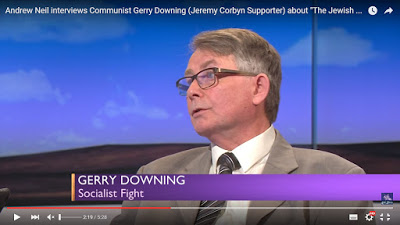
Gerry Downing defends Marxism against Zionism on Daily Politics, March 2016
It signifies that Gerry is now housebroken, and to be considered on the road to becoming an integral part of traitorous social democracy.
Its good that Tony clarifies the nonsense Gerry has been spouting about my supposed ‘move to the right’ in the recent factional conflict in SF. Tony entirely accurately writes:
“However there is no doubt in my mind that Gerry has had a sincere change of heart as a result of a heated debate inside his own organisation. I have written an article here for Weekly Worker and on my blog. Whilst I certainly have criticisms of Gerry, I have no doubt that he is sincere in making a political break from Ian Donovan who has not had a change of heart.”
And his ‘change of heart’, i.e. his capitulation to Zionism, now makes him fit for the company of those who parley with the regime of Abbas, who tortures and murders Palestinian militants on Israel’s behalf, and of those who work with Emily Thornberry, the Zionist who tried very hard to bully the movers of the successful resolution on Palestine at the 2018 LP Conference which condemned the Nakba, into withdrawing it. But failed!
It is not difficult to imagine what Lenin or Trotsky would have said about such grovelling to class enemies!
What is also revealing is what is unspoken but clearly visible in Tony’s letter. Tony considers himself to be part of a common movement with Ben Soffa and all the other traitors and Zionist capitulators in PSC, and is fully aware that they are organically linked to supporters of ethnic cleansing like Thornberry and Vichy-like collaborators like Abbas’ Palestinian authority (to cite the late Edward W. Said).
Tony sees himself as part of a common movement with those who collaborate with Israel against the Palestinian masses, and who work alongside those who defend the Nakba. His criticisms of them for these very things are really only platonic, as when push comes to shove he sides with them nevertheless. His ‘opposition’ to them is essentially fake, and an obstacle to a real, consistently anti-Zionist opposition to them emerging in the Palestine Solidarity Movement.
For him, to say that the many Jewish-Zionist bourgeois who concretely fight as a bourgeois faction/caste for Western support and endorsement of genocidal Israeli policies, are an independent factor and a social and economic formation that oppresses the Palestinians on ethnocentric lines, is a terrible crime, far worse than the Nakba, and fully entitles the pro-Zionist traitors at the top of PSC to exclude consistent anti-Zionists from their common movement.
He insists that:
“Until recently Gerry was of the view that there existed a trans-national Jewish/Zionist bourgeoisie and that what is termed the ‘over representation’ of Jews among America’s billionaires and ruling circles accounts for the US’s support for Israel. His group, Socialist Fight, did not accept that the USA supports Israel because it is in its interests to do so”
Thus he asserts that such things as the US support for the blockade and slow genocide in Gaza, the annexation of Jerusalem and Golan, are in the rational interests of the USA, and to project that they may not be is ‘anti-Semitic’. It is undoubtedly true that that the United States imperialist bourgeoisie regarded it as in US interests to have an alliance with imperialist France during its period of colonial war in Algeria, but that did not extend to US endorsement of the French claim that Algeria was itself merely a province of France! To deny that Jewish-Zionist ethnic politics plays any role in the US endorsement of Israeli annexations and openly genocidal actions is simply to deny reality, and is untenable. It is itself an apologia for Zionism.
Here we have proof that Greenstein’s ‘anti-Zionism’ is only skin deep, that for him, forbidding meaningful criticism of Jewish-Zionist bourgeois racism is far more important than any putative support for the Palestinians. Or to put it bluntly, for him also, despite his self-delusion otherwise, Jews are more important than Arabs.
The real social-imperialist nature of centrist gatekeepers like Greenstein is here revealed once again. They identify on communal lines with their ‘own’ bourgeoisie and ultimately regard themselves as part of a common movement with them. They police and ‘discipline’ the workers movement on behalf of the Jewish-Zionist bourgeois caste, and define which ‘crucial socioeconomic facts’ (to quote Norman Finkelstein) would be Marxists are allowed to incorporate into their analyses.
This makes them a political agency of part of the class enemy. The classic role of centrism, and now Gerry has obtained absolution from Greenstein, his centrist confessor, along with the Sven Golly’s of this world who again, when push comes to shove, show their real affinity. His obcurantist, incomprehensible writing about philosophy, Neitzsche, Arendt, and all the rest of the irrelevant gibberish he has gone around trying to pick fights with people about, is a smokescreen aimed at fooling others, and perhaps even deluding himself, that he is not capitulating to the bourgeoisie and becoming just another one of its tame servants.
That is is all just incoherent posturing and pretentious psuedo-intellectualism is shown by the following passage in his latest obscurantist article, “Tony Greenstein’s revenge”, when he notes, accurately enough, that the pre-war surrealist artist Salvador Dali was sympathetic to fascism. He writes:
“Salvador Dali’s art is repugnant to all class conscious socialists; his enthusiastic support for the fascist Francisco Franco in Spain and Adolf Hitler in Germany makes it an instrument of human oppression and the impressionist school justly expelled him in 1934 because theirs was a revolutionary movement under Andre Breton.”
Quite why the whole of Dali’s art, as distinct from the parts of it that glorify Hitler and fascism, should be ‘repugnant’ to class conscious socialists is not clear, as an examination of the art of Breton and Dali would reveal a great deal of similarity, which you would expect as they were from the same surrealist, Dadaist school. But as with his philosophical obscurantism, art is of no real interest to Gerry here, as the elementary error in the above passage shows. For Breton and Dali were not ‘impressionists’ at all; they were surrealists.
Impressionists are a completely different school from the late 19th Century, typified by Claude Monet and Paul Gauguin, that specialised in depictions of reality as it appeared, as different from the disturbed imaginings of surrealist art as black is from white. How anyone can pontificate about art and make such an elementary error is just staggering!
This is not a polemic about art, just as Gerry’s material about philosophy is not really about philosophy, whatever interest he may once have had in the latter. It is about erecting a smokescreen to cover his rightward retreat into the camp of ‘respectable’ psuedo-Marxism that is acceptable to those who formerly witchhunted him when he adhered to our politics.
In the same article Gerry claims that failing to agree with his refusal to condemn the 9/11 attacks, which attracted the attention of Cameron, means that I agree with the third campist CPGB, which took no side when imperialism bombed IS beginning in 2014.
Completely untrue, as he well knows. The very first leaflet I produced after I was forced out of the the Communist Platform of Left Unity, in September 2014, was distributed on the anti-war demo on 3 October 2014, with the headline “Imperialist Hands off Syria, Iran, Iraq and Islamic State”. It stated:
“…the basic contours of a genuinely communist, anti-imperialist policy need to be spelt out now. This means that, in the face of an imperialist drive to destroy the Islamic State movement and re-establish the status quo, communists stand for the defence of the Islamic State, notwithstanding their brutal nature, insofar as they are able to mobilise any serious section of the Sunni Arab masses in struggle against an imperialist re-subjugation of these areas. If they refrain from such mass mobilisation, nothing can ultimately help them.
Obviously this means no support for Al Qaeda-style actions like bombings and massacres such as those that all sides frequently perpetrate in Baghdad, or even similar acts in imperialist countries. It would involve communist solidarity with a serious war of resistance against re-occupation. Indeed, only such solidarity would have any hope of breaking down the impotent rage at oppression that makes such Islamic radicalism attractive to the youth. As opposed to more imperialist barbarism that can only feed more such desperately flawed ‘radicalism’.”
This is not remotely like the CPGB. But it does draw a clear distinction between support for an indigenous armed force among oppressed people resisting imperialism, and politically approving of atrocities carried out by such forces. It is simply wrong to support, or refuse to condemn, intentional atrocities against civilians even if the force that perpetrates them is also involved in a fight with imperialism. That was my position before I joined SF, and it is my position now, on all such actions no matter who carries them out. 9/11 was a deliberate attack on civilians as was the attack on the Stade De France by ISIS supporters in November 2015. I wrote the SF statement that condemned that attack specifically as a corrective to Gerry’s wrong position on 9/11 and he did not raise any objection.
Despite the headline “Imperialism’s Chicken’s come home to roost” which is an analytical point, the condemnation is clear:
“Socialist Fight condemns utterly the barbaric terrorist action carried out on Friday 13 November in Paris, which has left around 130 dead, and another 300 injured, 80 critically. These came only hours after other bloody actions targeting Shia Muslims in bombings in Beirut, where 41 died, and Baghdad, where 26 were killed.
“We condemn these actions as bloody crimes against the French, Middle Eastern and international working class, and indeed the civilian populations more generally. We extend our profound condolence, sympathy and solidarity to the families and friends to the murdered victims and the wounded.
“As Marxists we are totally opposed to methods of individual terrorism however ‘anti-imperialist’ the motivation of the perpetrators may be. The inevitable consequences of this is civilian casualties, intended or not. And the attack never weakens imperialism, it ALWAYS strengthens the repressive forces of the capitalist state against the working class and its aspiring revolutionary leadership. This attack in Paris is qualitatively worse than the Charlie Hebdo massacre because however misguided that was a least it was against targeted victims who they held to be in some manner, however distorted, responsible for the wars in the Middle East and North Africa. This attack was for openly reactionary motives specifically targeting defenceless civilians which can only result in increased Islamophobia and repression of the entire working class and further moves towards a police state.”
And a few month later in response to related events in Brussels, we wrote:
“Socialist Fight condemns the apparent suicide bombings at Brussels Zavateen Airport and the Maelbeeck metro station. These incidents are highly likely to be linked to the capture by the Belgian police of one of the chief suspects in the Paris massacre/shootings last November, where around 130 civilians were killed. It does appear from early reports that the death toll in both attacks is around 34, however it is quite likely that this could rise as more details emerge.
“Our attitude to these attacks is the same as for the Paris massacre…”
That again was my doing. And the Paris Massacre statement was before Gerry’s earlier refusal to condemn 9/11 became an issue in the Labour Party witchhunt. It is a principled Marxist position that has been held by me since around 1980 and never deviated from.
But it has nothing to do with third campism. You can support military struggles against imperialism and condemn atrocities against civilians: the two go hand-in-hand especially when the forces involved in such conflicts with imperialism, are bourgeois, whether Assad’s forces or those of IS. One presumes that support for Assad against imperialism does not mean support for the many crimes of his regime against civilians (I mean real ones, not fabrications like Ghouta). Obviously support is extended despite such crimes, not to the crimes themselves.
Gerry’s nonsense about how I supposedly agree with the CPGB about IS is just another petty falsification to obscure the fact that it is he who has had a ‘change of heart’ and it now being taken in hand by gatekeepers like Tony Greenstein and Zionists like ‘Sven Golly’. The fact is that I have had no change of heart at all, as Tony rightly points out. I am still as militantly anti-imperialist and anti-Zionist as I was when I put out that leaflet, and when I joined SF.
Gerry Downing’s Introduction to Tony Greenstein’s letter to PSC on his behalf
Tony Greenstein
Thanks to Tony Greenstein for this unsolicited letter in my support to Ben Sofa of the Palestinian Solidarity Campaign against my suspension. Despite political differences on other important issues it was vert big if him to do so.
I had missed the original letters from the PSC on my expulsion but I can appeal to the PSC AGM next January, which I will do.
Tony Greenstein letter to Ben Soffa on behalf of Gerry Downing
Dear Ben
I have been sent a copy of a letter from you to Gerry Downing regarding his suspension from PSC. Perhaps I can comment?
In your letter to him you express doubt that he is in a position to accept the stipulation in 4.1 of the Constitution viz. ‘The aims of the campaign include the requirement to be ‘in opposition to racism, including anti-Jewish prejudice’.
Until recently Gerry was of the view that there existed a trans-national Jewish/Zionist bourgeoisie and that what is termed the ‘over representation’ of Jews among America’s billionaires and ruling circles accounts for the US’s support for Israel. His group, Socialist Fight, did not accept that the USA supports Israel because it is in its interests to do so.
However there is no doubt in my mind that Gerry has had a sincere change of heart as a result of a heated debate inside his own organisation. I have written an article here for Weekly Worker and on my blog. Whilst I certainly have criticisms of Gerry, I have no doubt that he is sincere in making a political break from Ian Donovan who has not had a change of heart.
Gerry makes his own position clear here in a letter to WW of 29th February.
Gerry sent me a copy of your letter and although he did not make any request that I approach you I have nonetheless decided to do so. I do not believe that Gerry Downing holds anti-Semitic opinions any longer (I have never believed he was, on a personal level, antisemitic) and I am happy to recommend that the Executive reconsider the matter and lift his suspension.
The following letter was sent to the Weekly Worker in time for last week’s online edition, but was not published, in reply to Gerry Downing’s weak letter (see ‘Scurillous’ here) in the previous issue defending his comrade Gareth Martin against charges of racism. No doubt the editors did not consider concluding this exchange properly a political priority for them, which is comprehensible. However as a matter of political hygiene we consider that GD’s attempt to obsfuscate the truth about this should not go unanswered and so we are publishing it here.
Gerry Downing tries to deny that the abuse by Gareth Martin
of our Middle Eastern comrade, his grotesque allegation that he supported
imaginary murders of Jews in synagogues in London, was really directed at him
at all. He foolishly asks:
“Look at the line of argument here and the ridiculous, demented non-sequiturs; how in the hell is it ‘a direct criticism of one of our Middle Eastern comrades’? Ah, you see, Gareth mentions London and the comrade he is debating with lives in London (he doesn’t), so he must be referring to him!”
Well our comrade considers that he lives in London, even if
on the periphery and not inner London. And more to the point, it is clearly a
direct criticism since it is a Facebook comment in which our comrade is tagged,
and him alone. No one else is tagged. It is very clear that this comment was
directed at him personally. We have screenshots of this Facebook exchange which
we are quite prepared to produce before any reputable third party.
We also have screenshots of another Facebook exchange with
another defender of Downing’s politics racially abusing our comrade, one Rob
Lyons, apparently from North America, who lectured our comrade about a ‘worker’,
from the same Middle Eastern ethnic group that our comrade comes from, in an
even more obvious vein thus:
“If a [Middle Eastern] worker beats his spouse, then to his spouse he is a direct oppressor, but within the matrix of social relations globally, he is just another oppressed worker passing along his alienated state in the form of domestic violence.”
When our comrade protested that Lyons knew that he was from
the same ethnic group that Lyons was stereotyping, and that this was racist
innuendo, Lyons replied, tagging our comrade personally again:
“Get stuffed slimeball. I used an example I thought you could relate to given your experiences. Something real easy for you to understand. Obviously I over rated your intelligence. Truly sorry for that. But there is no colouring book to teach you how to draw inside the lines on this issue.”
The poisonous racial innuendo here is palpable. Yet when
both the target of this abuse, and myself, protested about this and pointed out
the obvious racist intent, we were both removed, and blocked, from the Socialist Fight Facebook group by the
admin, Gerry Downing, and our comments protesting the racial abuse deleted. We
have screenshots of Lyons’ comments which again are clearly tagged with the
same of our Middle Eastern comrade here.
This is where the racism that lurks behind Gerry’s capitulation
to Zionism becomes explicit. It is also borne out by his attempt to theorise
why Gareth Martin should not be challenged for this innuendo-laden attack:
“Previously Ian’s ‘proof’ of his racism was a ridiculous biological-determinist theory: he is white and was born in South Africa, so this made him a racist and a supporter of Zionism, regardless of his proud record of fighting apartheid in South Africa since he was a teenager and his direct participation in the Anti-Nazi League and the Socialist Workers Party for 10 years from the mid-1990s, all the while fighting against Zionism and Israel’s oppression of the Palestinians.”
Even in the minds of ‘biological’ racists, there is no
perceived difference between white settler types in Africa and the broader
white population around the world. Gerry has invented a strange new concept
here, even though he projects it onto me. My point is that Gareth’s attitudes
reflect backward attitudes that he has not overcome despite being in
essentially left-liberal, in practice reformist organisations like the
social-chauvinist Anti-Nazi League and the SWP that I rejected from the left at
the beginning of the 1980s. Presumably if that is his tradition then for Gerry
he cannot have failed to overcome backward, racist views that come from his
background at all. The fact that Gerry can make such an argument shows a degree
of political degeneration.
As does his whole argument about my ‘biological’ hostility
to Gareth’s racist backwardness. This is about backwardness from a cultural
background, and applies not only to Gareth but to the dictatorial leader of the
SWP, Alex Callinicos, who comes from a white settler aristocratic background in
colonial Zimbabwe. Callinicos denounced Norman Finkelstein as providing comfort
for Nazis in 1999, and now orders his SWP goons to bureaucratically harass
pro-Palestinian militants who object to the presence of open Zionists in the
SWP’s ‘Stand Up to Racism’ events. I would assert that this particular policy,
which was not the policy of the SWP under previous leaderships, is a product of
his personal regime in the SWP and Callinicos’s own politics and prejudices.
But I’m sure that Callinicos, like Martin, will profess opposition to Zionism
as well. It means nothing if his actions contradict that.
Gerry is in effect attacking me for ‘anti-white racism’,
racism against myself, with this polemic. This is itself a racist, far right
trope. ‘Self-hatred’ among groups that currently oppress others is always a far
right trope, and this has particular relevance where Zionists and those who are
soft on Zionism are involved. The campaign against Atzmon has much of the same
character, nothwithstanding his confusion about history, which is shared by an
enormous number of people in the Middle East who are faced with genocidal
oppression at the hands of ‘democratic’ imperialism and Zionist Jews.
There is an element of ‘my enemy’s enemy is my friend’ in the politics of the Middle East. This has produced the paradox today where it is perfectly possible for someone to doubt the truth of the Nazi holocaust, and yet for their underlying, real motive, be a confused hostility to the racism that Arabs and Muslims experience today. And conversely, it is perfectly possible for someone to be completely in tune with the long established truth of the Nazi genocide, and yet to be a genocidal racist who defends the mass murder of Arab civilians. I judge people by their real motive and drives, not their confusions. So actually, the ‘anti-white racism’ trope that Gerry implies has much in common with the denunciation of Atzmon the Jewish-Israeli as an ‘ Jewish anti-Semite’ and ‘self-hating Jew’. This is also a far right trope and it is no surprise that Gerry in defending the latter comes to advocate the former. It is indicate of an extreme contradiction in his politics that a left-wing militant of Trotskyist views should come to echo such tropes.
Gerry absurdly claims that to denounce Gareth for racially
abusing our comrade is anti-Semitic, and regrets that we are allowed to criticise
him. That is in tune with his behaviour in trying to silence our criticism on
every forum he controls. But when he tried to do that on an International forum
of the Liaison Committee for the Fourth International, this was countermanded
by International comrades. The contradiction Gerry has is that our ‘expulsion’
is not recognised internationally by our common International comrades, though
they are compelled to recognise that Gerry’s political retreat into pro-Zionist
chauvinism and bureaucratism have led to the creation of two groups, both of
whom are recognised as LFCI groups by the international comrades. That puts
Gerry in an extreme contradiction with not only workers democracy but also the
democracy of the LCFI when he denounces others for allowing us to argue our
views.
The Prime Minister of Britain, Boris Johnson, is tonight in
intensive care in St Thomas’s Hospital, London, apparently receiving oxygen on
a ventilator after spending around two weeks with worsening Covid-19. It is
possible he will not survive the viral pneumonia that has set in. This is
possibly the most shocking and prominent demonstration yet of the very
dangerous nature of the Coronavirus-Sars-2 virus which is responsible for this
pandemic. Johnson’s own ministers have started to emphasise that the virus does
not discriminate among its victims, and can infect or kill anyone. Even a
highly privileged, Eton-educated Tory Prime Minister can be struck down by it!
This just underlines the stupidity of the attitude that part
of the bourgeoisie, including Johnson himself, have adopted towards the
pandemic. This is particularly so of the right-wing populists of whom Johnson
is a prime example; not the worst or the most irrational, but pretty arrogant
and stupid nevertheless. US President Donald Trump is also a prime specimen of
this anti-scientific irrational idiocy, as is Jair Bolsonaro, the fascistic
right-populist Brazilian President.
You could quite literally say that Johnson may have signed
his own death warrant with his anti-scientific, callous stupidity. On the This Morning show of 5th
March, Johnson floated a strategy for dealing with the virus thus:
“Well it’s a very, very important question, and that’s where a lot of the debate has been and one of the theories is, that perhaps you could take it on the chin, take it all in one go and allow the disease, as it were, to move through the population, without taking as many draconian measures.” (https://fullfact.org/health/boris-johnson-coronavirus-this-morning/)
Johnson delayed for several weeks from crucial measures like
closing schools, or introducing social distancing measures, and equally
importantly, it has completely ignored the obvious need for the introduction of
widespread testing for the virus. The UK government has been forced into action
on some of these things from below, by such things as parents keeping their
children off school in defiance of the government. Such was the backlash when
it became clear that the result of this strategy would be 500,000 deaths, that
Johnson’s government has had to publicly abandon the ‘herd immunity’ concept, at least publicly. However
their failure to test the population for the disease reveals that the strategy
remains.
It’s an anti-scientific, genocidal strategy whose real
driving force has occasionally leaked out, such as when Dominic Cummings,
Johnson’s adviser and mentor, was quoted as saying in a meeting in February
that the government’s strategy was “herd immunity, protect the economy, and if
some pensioners die then too bad” (Sunday
Times, 22 March).
This is the logic of neo-liberalism, Social Darwinism, or
the survival of the fittest; the poor, the sick and the old can be allowed to
die off not least because of the potential savings that the wealthy can make
from social benefits and pensions. As one Daily Telegraph writer, Jeremy
Warner, wrote on 3 March:
“Not to put too fine a point on it, from an entirely disinterested economic perspective, the COVID-19 might even prove mildly beneficial in the long term by disproportionately culling elderly dependents. (https://metro.co.uk/2020/03/11/telegraph-journalist-says-coronavirus-cull-elderly-benefit-economy-1238390)
Johnson is the personification of the hubris of the
neoliberal populist right over this. His injunction to ‘take it on the chin’
could well be his epitaph. In tune with this, he boasted of visiting a hospital
and shaking hands “with everybody” including Covid-19 patients. He may well
have spread the disease from the infected to others by this act of sheer
stupidity alone. It appears he has also infected his pregnant partner, Carrie
Symonds, in the process.
He is not the only one of course. When Covid-19 first
emerged, Trump first declared that it was a ‘hoax’ put forward by his political
opponents to discredit him for the election, and has both tried to exploit the
virus’ apparent point of origin in Wuhan, China, calling it the ‘Chinese
Virus’, and then has like Johnson, declared that the priority is ‘the economy’
rather than preserving lives. He was forced into declaring a Federal Emergency
over the virus, at the same time he is continually trying to undermine it with
calls for easing it, for people to go back to work after Easter, etc. His
notorious tweets, such as that saying “”WE CANNOT LET THE CURE BE WORSE
THAN THE PROBLEM ITSELF” and hinting at easing the quarantine for the economy’s
sake, point one way. Yet Trump has also been forced to guarantee payment of
hospitals by the US government for the uninsured millions who are at risk of
huge hospital bills for treatment for the disease. Thus Trump has been forced,
temporarily, to institute a form of socialised medicine. Like in Britain, we
see the same outrageous contempt for life being forced to back down by the
certain knowledge that failing to do these elementary things will lead to a
social explosion.
The genocidal and anti-scientific ideology of the neoliberal
right over the pandemic is shown by the actions and words of Bolsonaro in
Brazil. According to the Brazilian President, the pandemic will end when 70%
are of the population are infected. He puts forward the outrageous view that
that social isolation is of no use and only hinders the economy.
But the retreat of the tide of infection in China is
concrete evidence that social isolation and distancing works. A country with
1.5 billion people had 83,000 cases, and yet the virus has stopped spreading.
The virus is not a living being, it depends on being finding suitable bodies to
multiply. If everyone is in social isolation the infected people create
antibodies or unfortunately end up dying. Thus the virus disappears. As the
contamination and reaction time of the organism is 3 to 4 weeks, if social
isolation lasts 2 to 3 months it is possible to stop the circulation of the
virus and have a small number of infected people, which is what is happening in
China today.
That is why they continue to quarantine everyone who comes
from outside, so that there is no new introduction of the virus and so no new
cycle of pandemic. For this cycle to be truly broken, it is essential that
government officials guarantee all support and continued income for the
population to remain in social isolation and apply tests to all. Testing for
everyone is crucial, so that those infected can actually be isolated and not be
the focus of new transmissions. Only after breaking the cycle and carrying out
this testing programme to a conclusion is it possible to relax the insulation.
But for Bolsonaro and
the elite he represents, their concern is not how to break the circulation of
the virus and save lives, but how to save corporate profits. And for that he
uses all possible lying arguments and the denial of scientific evidence, and
more blatantly and consistently than the likes of Johnson and Trump, gives
expression to the barbaric, genocidal Social-Darwinism that is at the core of
neoliberalism and the fascistic populism it has spawned.
The undersigned revolutionary working-class groups demand the protection of all workers and oppressed people from the dangers caused by the Covid-19 pandemic, which is a very dangerous threat to the health and lives of the oppressed. Particularly older workers, the retired, the disabled, those with underlying health conditions, to prisoners, the impoverished, those in nations such as Iran, occupied Palestine and Gaza, Cuba, Venezuela and North Korea who are targeted for starvation sanctions and barbaric deprivation of basic medical supplies and services by imperialism and its allies, and particularly also many oppressed people who live in impoverished semi-colonial nations in Africa, Asia, Latin America and Oceania.
This pandemic crisis has produced the most serious economic and political crisis for capitalism since the Second World War, or earlier crises that led to that war such as the 1929 Wall Street Crash and the Great Depression. The fundamental contradiction facing world capitalism is that the prolonged strategy of saving capitalist profitability over the last several decades has involved savage attacks on social benefits, including healthcare benefits, for workers and the poor around the world, both in the imperialist countries, going hand in hand with globalisation and the export of jobs to poor, low-wage countries, this putting pressure on the working class in the imperialist countries to accept a serious decline in living standards and benefits.
The imperialist drive to capitalist restoration in the former USSR and much of its sphere of influence was initially the driving force of these such attacks, but they have become a generalised phenomenon throughout the capitalist world, part of neo-liberalism, the dominant creed of capital today, which is seen by the ruling classes of the world as their saviour from the spectre of Communism and the Russian Revolution.
A similar, parallel thing has been done also in poorer, semi-colonial countries, where the rise of exported capital and the increase in jobs has led to the rise of free market economics and attacks on already meagre healthcare and social welfare systems there also, through such things as IMF ‘structural adjustment’ programmes to attract imperialist investment.
Now that neo-liberal capitalism is itself in terminal decay, we see the grotesque spectacle of the rise of right-wing populism with a stern, fascist tendency, put in power in part as a result of the disillusionment of backward sections of the working class in many countries, which has given rise to leaders such as Trump, Johnson , Bolsonaro and Modi, who make light of and mock a deadly pandemic that threatens to decimate the victims of capitalism, those who are considered surplus population by much of the ruling class.
At the same time we see that under mass pressure and fear of an eruption of the rage of the masses at the huge death toll that is threatened, and the obvious fact that healthcare has been deliberately undermined for decades as part of neo-liberal asset stripping and privatisation, many bourgeois regimes are attempting to stave off disaster by imposing a necessary measure of quarantine on the population.
We support the quarantine and demand effective measures of public health. We will also support agitation to force recalcitrant neoliberal regimes to carry out such measures where they a playing with obscenities like Johnson’s injunction to the British population to ‘take it on the chin’. While there is no vaccine or cure for this new disease the working class is in a defensive, backs-to-the-wall situation and needs to be extremely cautious about protecting its most vulnerable and frail components. We must seize on the weapon of quarantine to protect ourselves, and fight for the nationalisation of health provision and its supply chain, housing for the homeless, and protections for workers sacked because of the pandemic. We defend the international solidarity efforts of the workers’ states and peoples oppressed by imperialism against the pandemic, as Cuba has been doing.
But this situation is causing the capitalist system to totter economically, and we must demand of the bourgeois states every possible measure to negate the ruinous impact of capitalism and neo-liberalism on the masses. We demand the expropriation of private healthcare and the privileges of the rich to save as many working class people as possible from the pandemic. We demand the expropriation of failing industries in the economic crisis, and that all workers, in regular and ‘casual’ employment of all kinds, be paid in full for the duration of the pandemic. We demand economic planning to handle the economic needs of the masses under quarantine; the idea that market economics and neoliberalism can be any kind of solution to any of this is poisonous rubbish, too preposterous for words. Such is the international nature of this human crisis that this must be on a world scale if a terrible death toll is to be avoided in the poorest parts of the world.
At the same time we must be vigilant against attempts by far right and fascist forces to exploit the need for a quarantine to attack the democratic rights of the masses, to attack our freedom to criticise, to institute a dictatorship. An ominous example is the demand of Orban in Hungary for the right to rule by decree for the duration of the pandemic. There are similar dangers from Trump in the US, from Johnson in Britain, and in many other places. We must be on our guard.
Above all we demand and seek the world revolution, as the only way to save the working class, and the planet on which we live, which is being degraded and polluted, particularly through capitalist mode of production induced climate change, to the point where human extinction is on the horizon. Capitalism has caused a devastating Climate Change that in combination with systematic destruction of nature have caused unprecedented degradation of nature throughout the world. This allows deadly viruses such as the coronavirus to evolve, adapt, and jump from animals to humans. While we are facing such a deadly threat it may appear unrealistic to talk of world revolution, but the root causes of this calamity, and others to come, dictate political and economic tasks that only the world proletariat in power can solve. This particular disaster will end at some point and there must be a reckoning with its causes. We need worldwide economic planning, we need an end to the destruction of the ecosphere, we need the revolutionary overthrow of capitalism worldwide.
Signed:
Frente Comunista dos Trabalhadores (Brazil)
Tendencia Militante Bolchevique (Argentina)
Socialist Workers League (United States)
Socialist Fight (Britain)
Trotskyist Faction of Socialist Fight (Britain)
The above groups who endorse it are part of the Liaison Committee for the Fourth International.
Mohammad Basir Ul Haq Sinha, President, Inter Press Network, Dhaka – Bangladesh
Fernando Gustavo Armas, physician, militant of Socialismo Revolucionario – Argentina
Akhar Bandyopadhyay, non-partisan Political Activist — India
Ady Mutero, Revolutionary Internationalist League – Zimbabwe
Akash Mirza, chair, Bangladesh Revolutionary Socialist Union – BRSU
Nigel Singh, independent left militant, Oxford, UK
Curtis T, youth and socialist activist, Monrovia, Liberia
The above groups and militants also endorse the statement.
Privacy & Cookies: This site uses cookies. By continuing to use this website, you agree to their use.
To find out more, including how to control cookies, see here: Cookie PolicyClose & Accept
Manage consent
Privacy Overview
This website uses cookies to improve your experience while you navigate through the website. Out of these, the cookies that are categorized as necessary are stored on your browser as they are essential for the working of basic functionalities of the website. We also use third-party cookies that help us analyze and understand how you use this website. These cookies will be stored in your browser only with your consent. You also have the option to opt-out of these cookies. But opting out of some of these cookies may affect your browsing experience.
Necessary cookies are absolutely essential for the website to function properly. These cookies ensure basic functionalities and security features of the website, anonymously.
Functional cookies help to perform certain functionalities like sharing the content of the website on social media platforms, collect feedbacks, and other third-party features.
Performance cookies are used to understand and analyze the key performance indexes of the website which helps in delivering a better user experience for the visitors.
Analytical cookies are used to understand how visitors interact with the website. These cookies help provide information on metrics the number of visitors, bounce rate, traffic source, etc.
Advertisement cookies are used to provide visitors with relevant ads and marketing campaigns. These cookies track visitors across websites and collect information to provide customized ads.