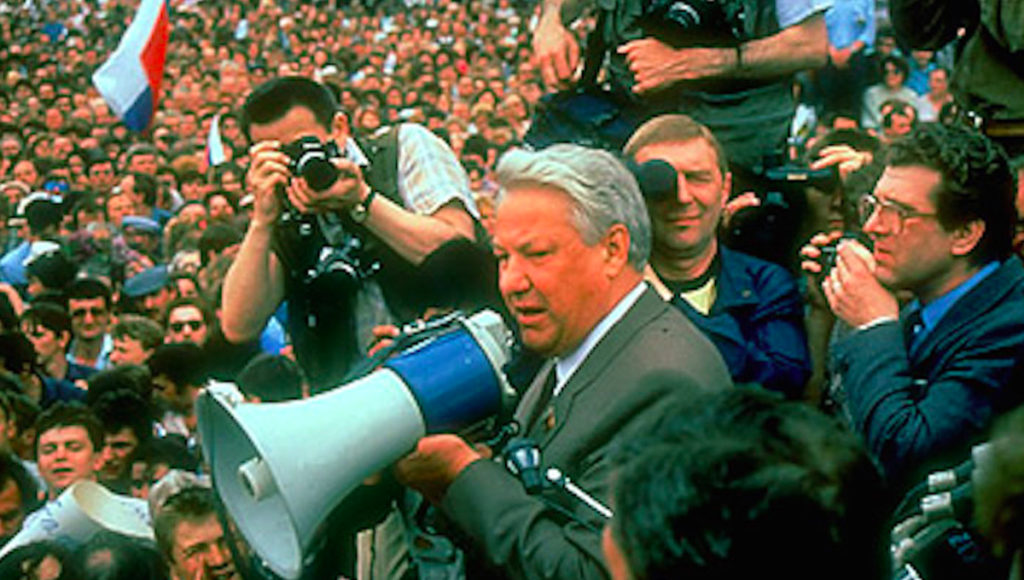
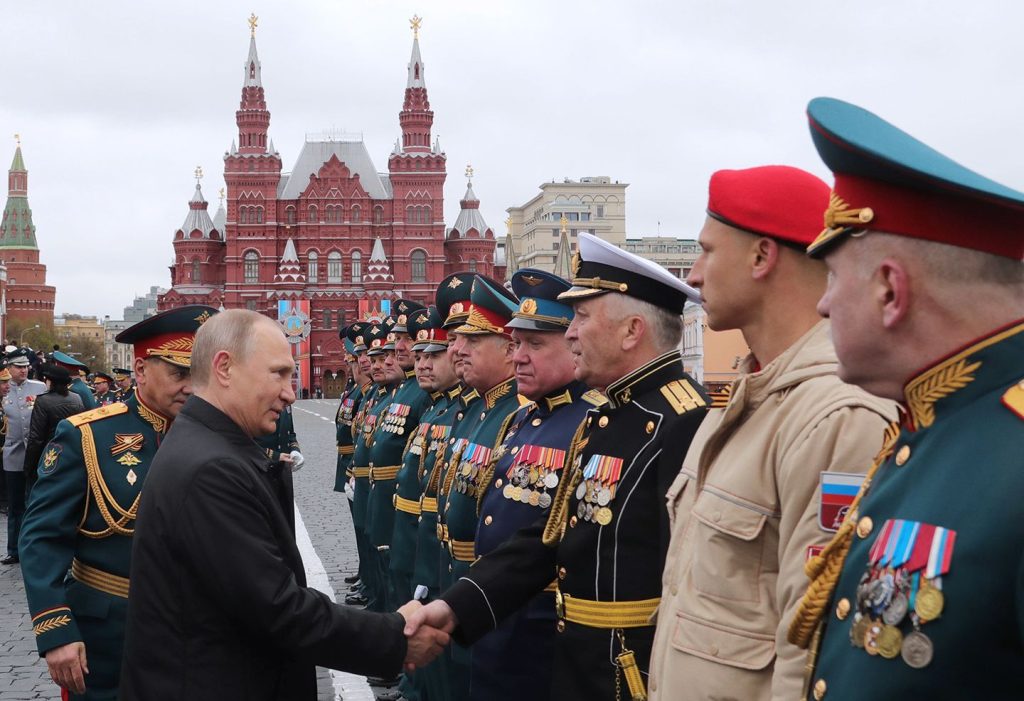
While Russia has not been a workers’ state since the collapse of the USSR in 1991, it is not imperialist and has no imperialist bourgeoisie. Its weak, oligarchic proto-bourgeoisie has no real tradition or stability except a sometime aspiration to be an imperialist client, and a parvenu gangster ethos and practise. The full-blooded neoliberal shock treatment that the counterrevolution of these lackey privateers imposed on Russia after 1991 caused massive suffering, starvation and countless despairing suicides. The fall in life expectancy of 5 years in the 1990s can only be explained by millions of early deaths. This fuelled a huge backlash from below, refracted through the productive and administrative apparatus left over from the workers state, which the counterrevolution was unable to rapidly destroy. That backlash elevated Putin, representing a remnant of the workers state that still had organic connections to the masses, to power, imposing a massive post-capitalist deformation on the weak capitalism that was all the counterrevolution was able to create. Although Putin is a representative of the old apparatus, this partial rollback of the counterrevolution does not define him and his faction as any longer ‘communist’. In formal ideological terms, Putin is a centre-right lesser-Russian nationalist, but sui generis, given his very contradictory social and political role.
The USSR prior to 1991 was a degenerated workers state. This was a correct designation because immediately after 1917 for several years under the revolutionary leadership personified by Lenin and Trotsky, the working class held direct political power, albeit in very difficult conditions. Only in the mid-1920s was workers democracy extinguished, by degrees, with the death of Lenin and the brutal factional war to defeat Trotsky and his supporters. The degenerated USSR was characterised by massive, qualitative deformations derived from the necessary imposition of bourgeois norms of distribution on its embryonic socialist construction. It struggled to create the beginning of a higher mode of production in conditions of involuntary national isolation and insufficient technological and material development and succumbed to the rule of a regime that resembled that of a labour bureaucracy, albeit one with state power. This bureaucratism eventually led the USSR, several decades later, to collapse. Post-Soviet Russia, under Putin today, is a deformed capitalist state, that is, a capitalist state with massive ‘socialist’ deformations, a dialectical complement of the bureaucratised workers state that was the USSR.
This is a unique form of combined and uneven development, with elements of the capitalist mode of production intertwined with embryonic elements of a higher, socialist mode. The Putinist deformation of the counterrevolution put the weak oligarchy in a subordinate position, including the West’s favourites, the likes of Khodorkovsky and Gusinsky, who were effectively socially and politically neutralised as part of (re)creating a much more statified, mixed economy heavily based on the state apparatus and industrial productive forces inherited from the workers’ state.
The principle of combined and uneven development is well known from Trotsky’s understanding of Permanent Revolution. It involves the interpenetration of capitalist development in backward countries with feudal and other pre-capitalist modes of production, to produce complex social forms where the working-class movement has to incorporate the demands of those whose oppression is rooted in earlier modes of production in its programme for power. But the (partially failed) counterrevolution in Russia, the central part of the USSR, has led to a new form of interpenetration of capitalism with an embryonic socialist mode of production, which ‘invades’ Russian capitalism, to paraphrase Engels’ concept of the ‘invading socialist society’ in Anti-Dühring.
The imperialist bourgeoisie understood that the accession of Yeltsin’s counterrevolution in 1991 did not mean the outright end of ‘socialism’ in Russia, which is why they began NATO Eastward expansion even under Yeltsin. Gradually with the rise of Putin, Cold War hysteria and anti-Russian warmongering re-emerged, despite the claim that the Cold War was over. In fact, it never ended. Only now it takes an uglier form – rather than old style anti-communism which could be conceived of as ethnically neutral, today’s racist demonisation of Russians, or Russophobia, resembles Hitler’s racist demonisation of Jews, who he considered organically ‘Bolshevik’. Today’s bourgeoisie considers Russians to be organically proto-communist and disobedient to neoliberalism and its ‘rules-based order’, noting the very high popularity of Putin in Russia. The reason for this high popularity is simply the popular memory of the horrors of Yeltsin’s counterrevolutionary economic shock, and how Putin’s change of course rolled much of it back. So, now we see open imperialist hatred of the Russian people themselves, which is why you get glaringly racist bans on references to or works by even long dead Russians like Gagarin, Dosteyevsky and Pushkin, from Western cultural events. And the supposedly liberal imperialist bourgeoisie, figures like Biden, Starmer and Macron, vehemently but covertly support outright Nazis in Ukraine, while at the same persecuting anyone who exposes this for supposedly peddling ‘disinformation’.
Russia’s intervention in Ukraine is thus a defensive one against an imperialist war drive that is aimed at breaking up Russia into several semi-colonies as the final act of destroying the entire legacy of the October Revolution. Socialists should defend Russia, and especially the peoples of the Donbass and Crimea, who are targets in a Western-inspired racist proxy war that blatantly uses outright Nazis, with genocidal aims. Not today against Jews, but against Russians, in the spirit of Hitler’s war on the Eastern Front, participated in eagerly by Ukrainian collaborators like Bandera and Shukhevych, where the Nazis exterminated 20 million Russians in that barbaric racist rampage. Somewhat unexpectedly for the imperialists, given their contempt for Russia, the Ukraine proxy war has gone badly for NATO and its Nazi dogs of war, and the post-capitalist elements of Russia’s productive apparatus are the main reason for that. Economic sanctions have backfired and considering the strain the country is under, Russia‘s economy has flourished during this difficult period, and it has moved ahead of the United States in some aspects of military technology, notably hypersonic missiles, which the West has no answer to. The dramatic use of Oreshnik to destroy a major covert NATO military installation at Dnipro, Ukraine, in November 2024 was a major manifestation of this. There are some resemblances and commonality between Russia’s technological advances and those of China, but also major differences between them.
China: A Deformed Workers’ State
China poses the question of Cold War and socialism even more sharply. Because China is still a deformed workers state. It was never ruled according to the basic norms of Soviet democracy, unlike early Soviet Russia/USSR. It was deformed from birth. Its Communist Party abandoned the proletariat in the cities after the defeated workers revolution of 1925-7 and transformed itself into a peasant-guerilla, petit-bourgeois formation. Its peasant-based armies defeated the Kuomintang and in part Japan. Despite its petit-bourgeois bureaucratic nature, formed up in the prolonged guerilla struggle including the famous Long March, it could develop no independent class basis separate from the main classes of capitalist society – the proletariat or the bourgeoisie. Simply to defend itself against imperialist attempts to destroy it, it was forced to adopt the property forms of the proletarian revolution, but crucially without Soviet democracy, after 1949. This was a flawed, but still historically progressive, social revolution. The Stalin-like bureaucratic regime of Mao Zedong made considerable progress in a primitive modernisation of the country but also engaged in dangerous and wrong-headed intra-bureaucratic feuds with the leadership of the USSR.
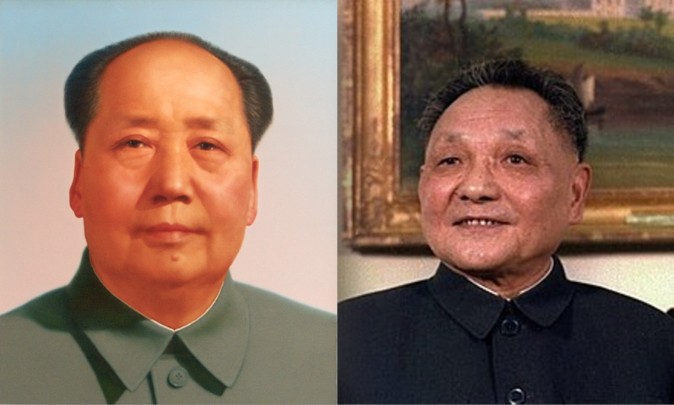
After Mao’s death in 1976 his followers were defeated by those of Deng Xiaoping and his programme of “socialism with Chinese characteristics”, a form of market ‘socialism’. Under both Mao and Deng China even allied with US imperialism against the USSR. That alliance helped the West to cause the collapse of the USSR through an enormous imperialist war drive and neoliberal political offensive. Since Deng’s rise, and up to today, China’s social and political regime resembles more the economic programme of Bukharin than that of Stalin. Despite the upheaval of Tien-An-Mien Square in 1989, when student demonstrations that evidenced pathetic faith in Western ‘democracy’ triggered off a naïve working-class upheaval (which was soon crushed), the central planning apparatus remained intact through all Deng’s market ‘reforms’.
A key part of the neoliberal ‘Thatcher/Reagan revolution’ in the West, which was continued under more ‘liberal’ administrations such as those of Clinton and Blair, eventually spreading also to the main EU countries, was the outsourcing of heavy industry to low wage countries such as those on the Indian subcontinent, Indonesia and the Far East … and China. China, as a workers’ state, slipped under the Western ‘radar’ in that period and managed to take advantage of this to massively expand its industrial productive forces. The result was a kind of mixed economy, still mainly statified, with industrialisation utilising a partially capitalist market, controlled by the bureaucracy of a deformed workers state. The outsourcing of heavy industry was a major, strategic change in the social structure of the imperialist countries, driven by the contradictions and decay of capitalism, and particularly the historical tendency of the rate of profit to fall. Falling profit rates were the root cause of the major economic crisis that manifested as ‘stagflation’ in the Western countries in the 1970s. As soon as the technological means came into existence – though widespread computer technology – to allow such outsourcing on a mass scale, the imperialists took advantage of this, deindustrialising their own economies in pursuit of higher profits among capable, but lower paid, workforces.
But this manoeuvre, driven by profit-hunger, backfired spectacularly as the Chinese deformed workers state, still intact, massively expanded its productive capacity. China is now a major non-imperialist world power because of this. Unlike Russia, where planning is somewhat limited in scope and a residue of a social system that has been overthrown, in China the economy is driven by a form of planning, with capital not in the driving seat. The Chinese Communist Party bureaucracy has permitted wide latitude to private capital – to the point that it had for a brief period in the 20-teens and early 2020s more billionaires in absolute terms than the United States. However, in terms of population, China is four times larger than the US, and its billionaires are much less wealthy than those in the US. They are also subordinate to the state – those who step out of line are likely to end up having wealth confiscated through massive fines, serving long prison sentences, or even being shot, for corruption and various related financial crimes that in the capitalist world might not even register.
In October 2024 the Asian news website Firstpost noted that:
“This year, the Hurun China Rich List counted 743 billionaires in US dollars, marking a 36 per cent drop from the 1,185 billionaires in 2021 — a peak year for China’s super-rich.” (https://www.firstpost.com/explainers/china-billionaires-declining-rich-list-13830670.html)
Over the past four decades, as China has risen to be a world power, 700 million people have been lifted out of extreme poverty. And now China’s economic advance means it has effectively caught up with the United States as the world’s leader in production of hi-tech, computer-related goods. The advent of Deepseek, its open-source flagship AI system, shows it pulling ahead of the US, particularly as the energy needed to run Deepseek is less than half of that consumed by the energy-guzzling US AI systems.
It ought to be clear that such a powerful capitalist force within a workers’ state is potentially a danger to the existence of that state, as a bourgeois class, driven by the imperative of capitalism, to realise surplus value and convert that into profit, will necessarily seek political conditions that maximise its ability to do that. This is what led Trotsky to conclude in the late 1920s that Bukharin’s programme of marketisation, which was mainly in the Russian countryside, allowing the Russian Kulaks (richer peasants) to “enrich themselves”, posed an immediate danger of counterrevolution. This he gave a degree of critical support, at least initially, to Stalin’s programme of collectivisation, before the brutal dimensions of that course became brutally apparent, when he denounced its irrationality. But in China, up to now, the bureaucracy has managed to avoid the danger of a counterrevolution.
It is possible now, with a considerable degree of hindsight, to say that one thing Trotsky was not able to fully anticipate with his analysis of the degeneration of the USSR, and such potential counterrevolutionary threats, is that post-capitalist relations of production could interpenetrate with capitalist relations for a extended period, and that two variants of such combined and uneven development are possible. One where a workers’ state continues to exist and defend proletarian property relations and the beginnings of the communist mode of production, dubbed ‘socialist’ in its less developed form, and at the same time considerable elements of capitalism continue to exist and even grow for a while. The other variant is where the workers state is overthrown, and an embryonic new bourgeois state attempts to impose a social counterrevolution, and yet proletarian property relations are sufficiently embedded in society and its production relations are already somewhat superior to capitalist relations, to the extent they are able to subvert the new bourgeois state and fundamentally deform it in a post-capitalist direction. It is arguable that these two variants of combined and uneven development are both unstable and ultimately fleeting phenomena and can exist side by side. China today is an example of the first variant; Russia is an example of the second.
Defend Russia and China against imperialism and ‘regime change’
Thanks to a strategic miscalculation by neoliberal imperialism, we now have a new, and unexpected international situation, as Russia and China are very different to the backward, impoverished countries that they were in 1917 and 1949. One of the preconditions for socialism is a development of the productive forces, and paradoxically the Western neoliberal outsourcing project has allowed a development of the productive forces in China to the point that China has become what Britain was in the 19th Century, but on a massively bigger scale: “the workshop of the world”. This has brought China to the brink of overturning the world hegemony of US imperialism, established after WWII. Russia, thanks to the partially defeated counterrevolution and its own targeting for attempted ‘regime change’ by US imperialism, has forged an alliance with China on an economic, diplomatic and partially military level that eluded the USSR Stalinist regime due to intra-Stalinist rivalry. The different social regimes in Russia and China seem to have eliminated that as a factor. But both Russia and China have elements of a higher mode of production within them that have made them natural allies in the present world situation. And the combined military and economic weights of Russia and China are clearly at least the equal of the Western powers in geopolitical terms. This is shown by Russia in its successful resistance to the imperialist proxy war in Ukraine; meanwhile the attempt of the West to foment a similar conflict with China over Taiwan looks less likely as China looks technologically and militarily too strong for this to be a viable proposition anymore.
Russia and China are not ‘imperialist rivals’ of the United States and the West, as various left capitulators to the ideological terror of imperialism say. They are natural allies of smaller non-imperialist countries that conflict with predatory imperialism. This includes smaller deformed workers states such as Cuba, North Korea and Vietnam, as well as semi-colonial countries struggling against imperialism such as Venezuela, Iran, Yemen and the insurgent countries of the Sahel such as Mali, Niger and Burkina Faso. The conflict between Russia/China and the West, in geopolitical terms, is not about who can get the most military bases, and who can send gunboats to repress the masses in their respective empires. Instead, they behave in a manner that focuses mainly on achieving diplomatic solutions to crises, not fighting to defeat imperialism through revolutionary struggle.
Russia and China: Unite and fight for World Socialism!
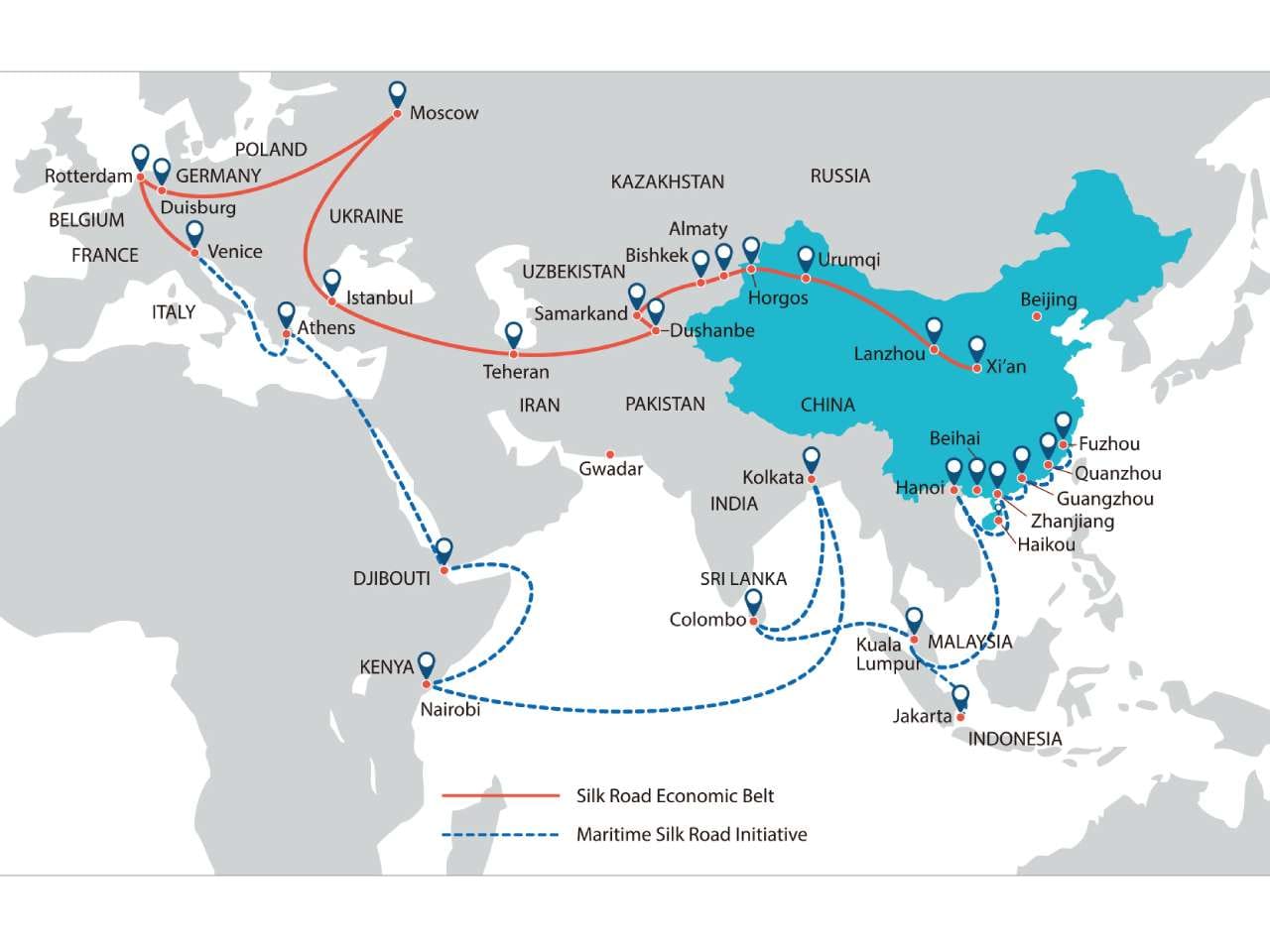
Thus, the Russia-China bloc behaves similarly to the way the USSR behaved in the Cold War, giving aid to those countries in conflict with imperialism, or who seek to find leverage to gain more independence from imperialism. They talk, which is to be expected given the bureaucratic, modified-Stalinoid and similar politics that dominates the bloc, of a ‘multipolar world’, which amounts to a modified version of the ‘peaceful coexistence’ with imperialism that drove the politics of the degenerated USSR. China’s most spectacular international initiative, the “One Belt, One Road” infrastructure-building project, is not a means of exploiting those countries involved, though China does derive economic benefits from it. It has a similar character to Russian and Chinese aid to Venezuela, Iran or Cuba – helping them to maintain independence against imperialist terrorism.
Thanks to the crisis of neoliberalism, we now have one giant workers state with advanced productive forces that are the equal of imperialism, which has another giant ally whose capitalism is marked by sufficient proto-socialist deformations to the point that it could relatively painlessly ‘revert’ to developing that higher mode of production. And yet these relatively far more advanced productive forces, and the proto-socialist elements that drive them, are still constrained by a labour bureaucracy in China, and an anomalous and contradictory formation in Russia, neither of which are remotely in tune with the demands of socialism. These productive forces, were they put consciously in the service of world revolution, of the fight to mobilise the world working class to take power in its own name, are enough to bury the capitalist system once and for all. To bring that about, we need the creation of a conscious international socialist/communist movement. Wherever it originates, it must spread around the world and create conditions allowing the existing administrations in Russia and China to be overcome by a rebirth of soviet democracy, as in early Soviet workers’ state under Lenin and Trotsky, to put these huge resources fully in the service of world socialism. That would bring about a rapid end to capitalism internationally.