By Mark Andresen
This summer’s plethora of industrial action across the UK has reminded us of the mainstream media’s historic disconnect between the priorities of the middle and working classes.
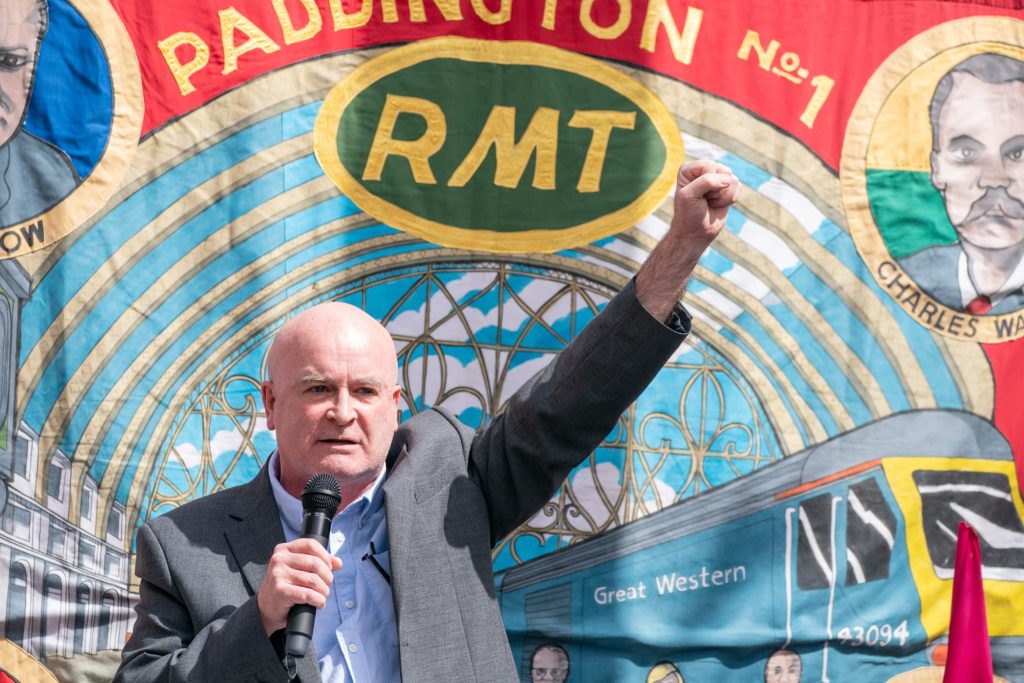
Sky reporter Kay Burley’s comedically out-of-touch questions to the RMT’s Mick Lynch in June was one of the more bizarre examples. ITV’s Richard Madeley’s baiting of Lynch was no more successful. Meanwhile, to Government ministers and MPs’, such an obvious question as, how do you justify prioritising additional billions of military expenditure in overseas wars over social policy back home? never passes either’s lips. Their woeful omissions of knowledge at least appeared genuinely incompetent; the BBC’s own omissions are long-observed editorial choices, which date from their founding as a private company one-hundred years ago.
Four years later, the General Strike represented the first test of allegiance for a national media outlet. From the outset, it fell in with the Establishment line. This was the result of a combination of factors: John Reith – the 6′ 6” tall, craggy son of a Scottish Presbyterian minister and first Director-General, respected and feared in equal measure – was a committed Unionist who saw his role as supporting, not challenging, the status quo. His refusal to broadcast a message with undertones mildly sympathetic to the Strike, from the Archbishop of Canterbury, has to be considered in the light of another, accusatory, against the strikers by the Archbishop of Canterbury. While this was a personal decision of Reith’s, the Company’s now compromised status ensured any such future executive decision would be partial. At the time, this could be construed as more structural than intentional.
Trevor Harris notes: ‘Reith’s main difficulty was that as Managing-Director of the British Broadcasting Company he was head of a private enterprise. Yet, as Chief Executive of a company, which was financed by a fee payable annually by each listener, a fee collected by the Government which, further, licenced all broadcasting, Reith was also head of a publicly controlled company.’
It is therefore ironic that the supposed ‘independence’ the company advertised as a positive selling point, in terms of accountability, is also that which has consistently compromised its raison d’etre.
Harris adds: ‘Throughout the brief Strike, Reith saw himself as guardian of the Company and the Company as the guardian of public order. Reith himself announced both the beginning and the end of the conflict, even inviting (Prime Minister) Baldwin – in order to avoid an inquisitve crowd at the BBC’s premises at Savoy Hill – into his own home to make a crucial broadcast . . . Reith’s (view) was that a Government-controlled broadcasting service could only support a viewpoint clearly opposed to the Government on that Government’s sufferance. And going against a proclaimed state of emergency could well have been treasonable.’
Tom Mills confirmed: ‘It was left officially “independent” on the understanding that it would continue to broadly serve the political objectives of the Government and the interests it represented.’
Scannel & Cardiff meanwhile argued that, with its reconstitution into a public corporation after the General Strike, the BBC “crossed the political threshold” by becoming a “governing institution” with aims and functions delegated to it by Parliament, committed to co-operation with Government, and sharing its assumptions about what constituted “the national interest.”
Therefore, despite its international growth as a Corporation, the only major structural change through subsequent decades (particularly since the founding of the BBC News channel twenty-five years ago) has been technical; i.e. the efficiency in making those same contacts via speed-dial. This has only served to further embed, broaden and make more casual the web of mutual co-operation.
Yet, an individual representative voice of the people, once given the chance, can still circumvent such expansion. Fast-forward to 2022 and the RMT’s Eddie Dempsey has shown himself as adept, succinct and influential on the mainstream media as Lynch. This two-pronged attacking defence of their position has proven key in the visual, dominant, rolling news media of today and produced (albeit briefly) an advantageous circumvention of state media beyond anything imaginable by the BBC’s first Director-General in 1926.
What remains is lip-service from the BBC hierarchy to the term ‘balance’; one rarely anticipating compromise from the middle-class boss, but too often from anticipated capitulation of the worker.
Harris stated: ‘the customary rejoinder to the horns of the dilemma on which the BBC seems caught, is to assert that since people on both sides of the political spectrum are grumbling, then the balance must be about right. But, for some, “balance” seems a disengaged, passive substitute for a more forensic approach. Applying “balance,” in the words of one observer, merely means that the BBC’s news coverage becomes “increasingly cautious and constipated.” Impartiality, in this reading, seems to have become equivalent to making only a series of negative choices . . .’
Such negative choices today as presenting authority figures from thinktanks, with no experience as workers in the current environment, as arbiters of fact. ‘Balance’ is, to some extent, achievable where politics isn’t the subject under discussion; where it is – when the Overton Window of ‘centrism’ has shifted so far to the Right – ‘balance’ favours those who oversee where it resides.
Earlier this year, both the BBC and ITV featured unintentionally amusing commercials highlighting their ‘independence’ and presenting their news with ‘absolutely no spin.’ If the definition of omission is “the action of excluding or leaving out,” then, in that, they certainly succeeded. A small development in recent years is how thinktank representatives have been introduced, as both ‘right-leaning’ and ‘left-leaning’; a differential that, at one level, may appear trivial, but may also be a result of viewer pressure rather than decided in isolation by a Tim Davie dictat. Such an incremental change is no solution in itself, yet as a regular inclusion in one of the most respected of mainstream media outlets may represent the first dent in its subjective presentation of ‘facts.’ Best case scenario, (if only unintentionally), this admission may be the first small foot-in-the-door of shifting the perception of the uncommitted viewer to self-question what they are being fed and from where it is being sourced.